
It’s week seven and your calendar looks like a crime scene: a lab report due Monday, a 2,000-word essay due Wednesday, a group presentation Thursday, and a reading response you forgot about until just now. If you’re trying to figure out how to manage multiple assignment deadlines without pulling three all-nighters in a row, you’re not alone, and the fix isn’t “just work harder.” It’s a handful of specific habits that most students are never taught.

Why Multiple Assignment Deadlines Feel So Much Worse Than One
One deadline is a task. Three or four overlapping deadlines is a logistics problem, and logistics problems need a system, not adrenaline. When students try to manage multiple assignment deadlines using only memory and good intentions, the brain treats every assignment as equally urgent the moment it becomes visible on the horizon. That’s why a paper due in twelve days can feel just as stressful as one due in two, right up until the two-day one swallows all your attention and the twelve-day one gets rushed anyway.
There’s also a hidden cost that professors rarely mention: switching between different types of academic work is expensive. Moving from statistics problem sets to a literature essay to a lab writeup means your brain has to reload three different sets of rules, formats, and expectations. Every switch costs you focus. Students who manage multiple assignment deadlines well aren’t smarter or faster typists — they’ve just reduced the number of times they have to switch cold.
Psychologists call the underlying trap the planning fallacy: almost everyone underestimates how long a task will take, even one they’ve done before. A five-page essay “always” takes an evening, until it collides with a lab report and suddenly needs two evenings you don’t have. That’s why a rough mental estimate isn’t enough once you’re juggling more than one assignment — you need something closer to an actual map of the weeks ahead.
Common Mistakes That Sabotage Even a Good Plan
Before the steps, it helps to name the traps that quietly wreck an attempt to manage multiple assignment deadlines. Most students don’t fail because they never made a plan — the plan had one of these cracks in it:
- Treating every deadline as equally urgent. A 5% quiz and a 40% research paper aren’t the same emergency, but panic makes them feel identical without a weighting system.
- Planning only the writing, not the thinking. Reading sources and forming an argument take real time on their own — skip that stage in the plan and the whole thing runs late.
- Assuming a perfect week. A bad night’s sleep or a slow internet day breaks a schedule with zero slack, and something always goes wrong eventually.
- Re-planning from scratch every time something shifts. One missed session shouldn’t mean abandoning the whole schedule — the goal is a plan flexible enough to absorb a bad day.
Once you can see these patterns, it’s much easier to build a plan to manage multiple assignment deadlines that survives contact with an actual, imperfect week.
Step 1: Get Every Deadline Onto One Surface
The single biggest reason students fail to manage multiple assignment deadlines is that the deadlines live in five different places: one course’s learning management system, a syllabus PDF you opened once in September, a group chat, an email from a TA, and your own memory. If it’s not in one place, it doesn’t exist as far as your planning brain is concerned.
- Open every syllabus you have right now and pull out every graded date — not just essays, but quizzes, labs, presentations, and peer reviews.
- Put all of them into a single calendar or planner app, even the small ones worth 2%. Small assignments still eat time and still need a slot.
- Color-code by course so you can see clustering at a glance — three assignments due the same week jumps out immediately in color, but not in a plain list.
- Add a recurring 10-minute Sunday review to catch anything a professor added mid-term.
This single step does more to help you manage multiple assignment deadlines than any productivity app, because it moves the problem out of your head and onto a surface you can actually look at.
Step 2: Work Backward From the Deadline, Not Forward From Today
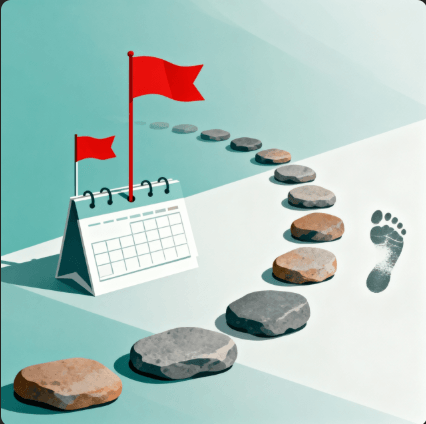
Most students plan forward: “I’ll start the essay when I finish the lab report.” That sounds reasonable until three things are due the same week and there’s no room left to start anything. The better approach, and the one that actually lets you manage multiple assignment deadlines instead of reacting to them, is to work backward from each due date.
For any assignment worth more than 10%, break it into three or four checkpoints and place each one on your calendar, working backward from the due date:
| Days Before Deadline | Checkpoint | What “Done” Looks Like |
|---|---|---|
| 10 days | Understand the question | You can explain the assignment in one sentence without looking at the prompt |
| 7 days | Research and outline | Sources gathered, rough structure or thesis on paper |
| 3 days | Full first draft | Complete draft, even a rough one, start to finish |
| 1 day | Edit and format | Proofread, citations checked, formatting matches requirements |
When you do this for every course at the start of the term, the checkpoints from different assignments naturally spread themselves across your weeks instead of colliding on the same three days. That’s the actual mechanism behind learning to manage multiple assignment deadlines: you’re not getting faster, you’re spreading the same amount of work more evenly.
Step 3: Triage Before You Start Anything
When four things are due in the same window, not all of them deserve equal time. Triage isn’t about being lazy about any single assignment — it’s about being honest about where your limited hours will do the most good. A useful way to manage multiple assignment deadlines under real time pressure is to sort everything into three categories:
- High weight, high difficulty — a dissertation chapter or a 30% essay. These need protected, uninterrupted blocks, ideally when you’re at your sharpest.
- High weight, low difficulty — a worth-a-lot but mechanically simple task, like a formatted bibliography. Do these early so they stop taking up mental space.
- Low weight, low difficulty — small quizzes or short response posts. Batch these into one sitting rather than letting them interrupt deeper work all week.
Sorting this way before you open a single document is what separates students who manage multiple assignment deadlines calmly from students who spend their first hour every day just deciding what to work on.
Step 4: Protect Focused Blocks Instead of Multitasking Between Courses
It’s tempting to bounce between three assignments in one evening, feeling productive because you touched all of them. In practice this is one of the worst ways to manage multiple assignment deadlines, because you pay a mental “restart cost” every time you switch subjects. A better pattern is a single focused block per assignment:
- Pick one assignment for the next 60-90 minutes. Close the tabs for the other courses.
- Work in that single subject’s mode: same sources, same formatting rules, same mental frame.
- Take a real break (10-15 minutes, away from the screen) before switching to the next assignment.
- Only after the break do you open the next course’s material.
Students who manage multiple assignment deadlines successfully tend to do fewer subject switches per day, not more work per hour. Depth beats motion.
Notifications are the other half of this problem. A phone buzzing during a focused block pulls your attention away, and it can take several minutes to fully re-engage afterward. Put the phone in another room during any block, or use a focus mode that silences everything except genuine emergencies — that removes the decision entirely instead of relying on willpower.
Step 5: Talk to Your Professor Before the Week You’re Drowning
If you can see a genuine pile-up coming — three major deadlines in the same 72 hours across unrelated courses — it is worth emailing the professor whose deadline is most flexible before the crunch, not during it. Most professors won’t move a hard deadline the night before it’s due, but many will consider a short extension requested a week in advance, especially if you show you’ve already made progress. Learning to manage multiple assignment deadlines includes knowing when the fix isn’t more hours, it’s renegotiating one date so the load fits into the time you actually have.
Keep the email short and specific: name the assignment, name the conflict, and propose a new date yourself rather than asking the professor to solve it for you. “Could I submit this by Friday at noon instead of Wednesday, since it overlaps with two other major submissions?” is easy to say yes to. A vague “I’m overwhelmed, can I get more time?” is much easier to decline.

Step 6: Build In Buffer Days, Not Just Work Days
Every plan to manage multiple assignment deadlines eventually meets reality: your laptop update takes two hours you didn’t plan for, a group member goes quiet, or you simply get sick for two days. A schedule with zero slack breaks the moment anything goes wrong, and something always goes wrong during a busy stretch of term.
Build a buffer day into your calendar every seven to ten days — a day with no new checkpoints scheduled, held in reserve. If nothing goes wrong that week, use it to get ahead on the next assignment. If something does go wrong, you already have room to absorb it without every other deadline sliding too. This single habit is what turns a fragile plan into one that can actually survive a real semester.
A Worked Example of Triage in Action
Imagine it’s Sunday night and you’re staring at three items due by Friday: a 30%-weighted essay, a 10%-weighted lab report, and a 3%-weighted reflection post. Using the triage categories from Step 3, the essay is high weight and high difficulty, so it claims your best morning block on Monday and Tuesday, when you’re least tired. The lab report is high weight but comparatively mechanical, so it gets one solid afternoon block on Wednesday. The reflection post is low weight and low difficulty, so it gets batched into fifteen minutes on Thursday alongside two other small tasks rather than nibbling at your attention all week.
Notice what didn’t happen: you didn’t give the reflection post equal billing just because it was also “due Friday.” That’s the actual skill behind learning to manage multiple assignment deadlines — not doing more, but refusing to let a small task steal time from a large one simply because both share a due date.
Group Assignments Make This Harder — Plan for That Specifically
Group projects add a layer solo assignments don’t have: you can manage multiple assignment deadlines perfectly on your own calendar and still get blindsided by a teammate who submits late. Three things reduce this risk:
- Set an internal deadline for group submissions 2-3 days before the real one, so there’s slack to fix problems.
- Assign one person to compile and format the final version — divided work with no single compiler often falls apart at the last minute.
- Put the internal deadline in writing (a shared doc or group chat message), not just a spoken agreement, so there’s a reference point if someone forgets.
Why This Hits International and First-Year Students Hardest
If you’re new to a Canadian or international university, learning to manage multiple assignment deadlines is harder for a few specific reasons. Grading structures can be unfamiliar, often weighting a handful of large assignments instead of many small ones, so any single deadline carries more stakes than in high school. If English isn’t your first language, reading and drafting simply take longer per page, so the checkpoint timelines from Step 2 may need extra days built in for that stage alone — not because you’re behind, but because the work genuinely takes longer to process. International students also often carry visa-related course-load requirements that make falling seriously behind a bigger problem than it would be otherwise, which raises the stakes on building a system early rather than adjusting after the fact. If you’re in your first term anywhere, treat the first month as a data-gathering exercise: notice which courses take longer than the syllabus implies, and adjust future checkpoints accordingly.
What a Realistic Week Actually Looks Like
Here’s a worked example. Say you have a 2,000-word essay due Wednesday, a lab report due Friday, and a reading quiz every Monday. Instead of treating Wednesday and Friday as two separate emergencies, a week built to manage multiple assignment deadlines might look like this: Monday morning, quiz (15 minutes, done before class). Monday evening, one 90-minute block finishing the essay’s first draft, since it’s due first. Tuesday, edit and format the essay in the morning, then a 90-minute block starting the lab report’s data section in the evening. Wednesday, submit the essay before your first class, then a focused block finishing the lab report’s discussion section. Thursday, full lab report draft finished, one read-through. Friday morning, final proofread and submission before the deadline, with the afternoon left open as buffer in case anything from next week has already started clustering.
Notice what’s missing: there’s no all-nighter in this week, and no single day carries more than two focused blocks. That’s the actual test of whether a system works — not whether it feels impressive, but whether an ordinary week following it stays survivable.
Tools That Help You Manage Multiple Assignment Deadlines Without Overcomplicating Things
You don’t need an elaborate system. A physical planner, your phone’s default calendar, or a free tool like Google Calendar or Todoist all work equally well, because the tool isn’t the hard part — the habit of using it consistently is. Pick whichever one you’ll actually open every day, and use these three rules inside it:
- Every graded item gets an entry the day the syllabus is released, not the week it’s due.
- Every entry worth more than 10% gets broken into the checkpoint structure from Step 2.
- You review the whole board once a week, on the same day, so nothing drifts unnoticed for more than seven days.
Students who manage multiple assignment deadlines successfully over a full degree, not just one busy week, are almost always the ones who made the review habit boring and automatic rather than something they only do during a crisis.
When to Ask for Help Instead of Pushing Through Alone
There’s a point where trying to manage multiple assignment deadlines through sheer scheduling stops being enough. If you consistently feel behind no matter how carefully you plan, or the workload seems disproportionate to what peers describe, that’s a signal to bring in outside support rather than tightening your calendar further. Campus writing centers handle questions about what an assignment is actually asking for, usually free. A tutor can shorten the distance between a rough first draft and a submission you’re confident in, by giving structured feedback on your own work — not by doing it for you. The goal is the same as everything else here: making the hours you spend more effective.
Frequently Asked Questions
What’s the single best way to manage multiple assignment deadlines when I’m already behind?
Stop trying to do all of it. Triage using the high-weight/low-weight method from Step 3, protect one focused block for the highest-priority item today, and email the professor for the next most urgent one if a short extension is realistic. Trying to touch everything at once when you’re already behind almost always makes the delay worse.
How far in advance should I start planning to manage multiple assignment deadlines?
Ideally at the start of the term, using every syllabus at once. If that ship has sailed, the next best time is right now — pull every current deadline into one calendar today, even mid-semester.
Is it better to finish one assignment completely before starting the next?
Not necessarily. For assignments with more than a week of runway, working in checkpoints across multiple courses in parallel — rather than finishing one entirely before touching the next — is usually what lets you manage multiple assignment deadlines without a pileup at the end.
What if my professor won’t grant any extension?
Then triage becomes essential. Protect the highest-weight assignment’s remaining time, and accept a lower but honest effort on the lowest-weight one rather than losing sleep trying to do all of them at full quality.
Do study apps actually help with this, or is it just the habit that matters?
The habit matters far more than the app. A simple paper planner used every single day will help you manage multiple assignment deadlines better than an elaborate app opened once a week.
How do I stop feeling anxious even after I’ve made a plan?
Some anxiety is normal with a heavy course load, but a written plan usually reduces it because the deadlines are no longer only living in your head. If the anxiety stays high despite a solid plan, it’s worth talking to your school’s academic advising or counselling office — that’s a different problem than scheduling, and it deserves real support.

The Bottom Line
Learning to manage multiple assignment deadlines isn’t about becoming a different kind of person who never feels busy. It’s a small set of concrete habits: one calendar for everything, checkpoints built backward from each due date, honest triage when things pile up, protected focused blocks instead of scattered multitasking, early conversations with professors when a genuine conflict is visible, and buffer days that absorb the inevitable surprise. None of these require extra hours in the day — they just use the hours you already have more deliberately.
If you want a second set of eyes on how you’re structuring an assignment once you’ve carved out the time for it, AssignPro Solution offers tutoring and feedback support that helps students plan, structure, and refine their own work rather than outsourcing it — the kind of guidance that makes the hours you do spend actually count. Whether it’s a single overwhelming week or a whole term that feels like it’s closing in, the goal is always the same: a plan you can actually follow, not just one that looks good on paper.
For more structured, university-verified guidance on building a workable schedule, see Dartmouth’s Academic Skills Center time management resources. And if you’re working on the assignments themselves once your schedule is under control, these guides can help: study tips for university students, why assignments get low grades, and how to structure a university assignment properly.
Related reading you may find useful: