

How to Justify Research Methodology Without Getting Rejected
Your dissertation topic is locked in. Your research questions are written. You’ve even started collecting data. Then the feedback comes back: “Your methodology justification isn’t convincing enough.”
That one comment can cost you weeks. Many students struggle to justify research methodology in a way that satisfies examiners You can inspect an approved model of philosophical and methodological justification in our annotated dissertation methodology proposal.
Most students describe their research approach — they list what they did and why it’s generally acceptable. But describing and justifying are two completely different things. Examiners don’t want to know that qualitative research is useful. They want to know why qualitative research was the right call for your specific research problem, your objectives, and your context.
Learning how to justify research methodology properly is what separates a dissertation that passes from one that goes back for major corrections.
This guide breaks it down without the academic waffle — nine practical steps, real examples of weak vs. strong justification, and a self-check list you can use before you submit. If you’ve already started your methodology chapter, keep this open alongside it.
Prefer to talk it through? WhatsApp our dissertation experts now — most students get clarity in under 15 minutes.
Describing vs. Justifying: What Examiners Actually Look For
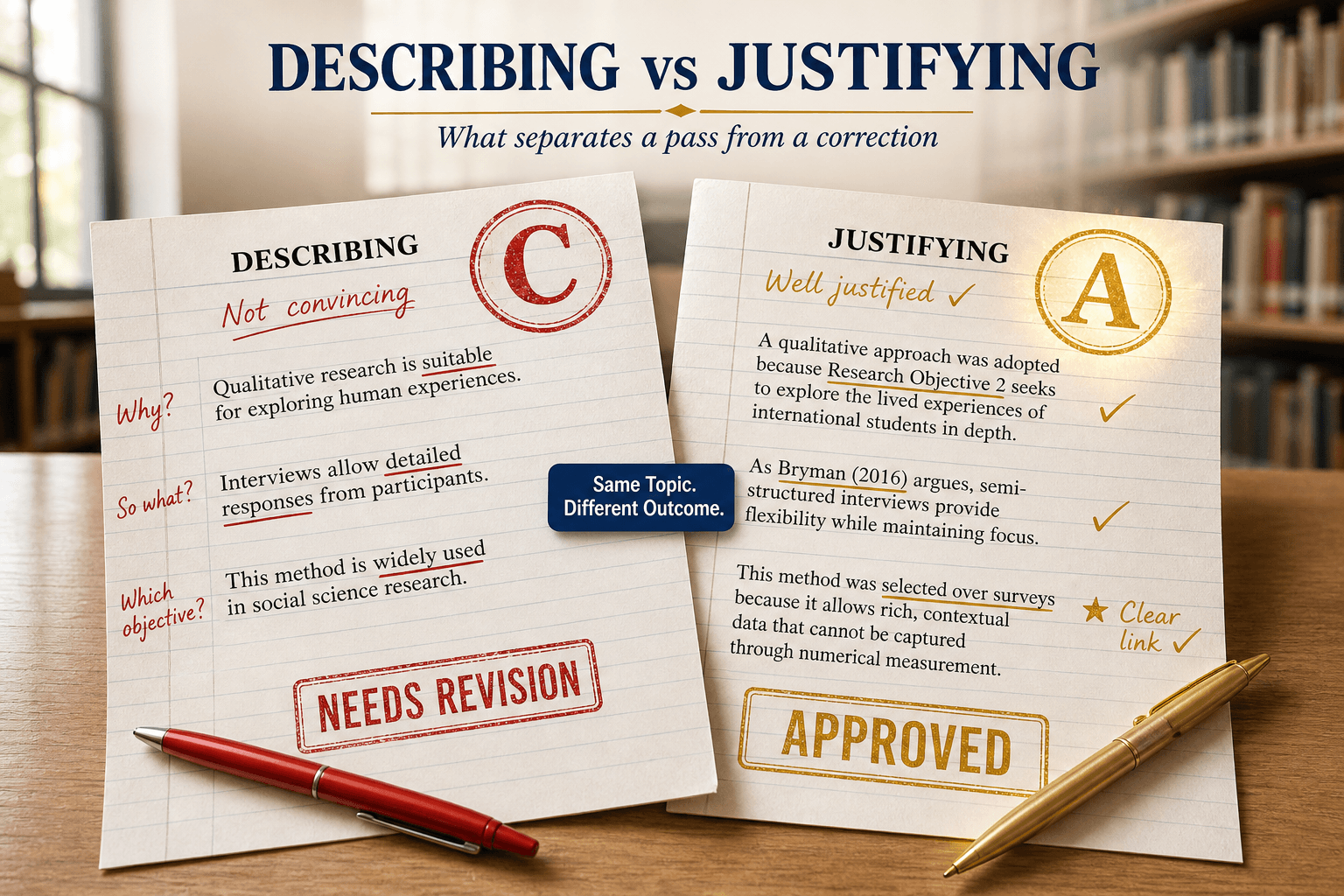
There’s a mistake almost every student makes in the methodology chapter — and most don’t catch it until the feedback lands.
They describe. They don’t justify.
Here’s the difference. Describing your methodology means explaining what it is. Justifying it means explaining why it was the right choice for your research — your questions, your context, your constraints. One tells the examiner what you did. The other convinces them you knew what you were doing.
| Describing | Justifying |
| “Interviews are a qualitative data collection method.” | “Semi-structured interviews were selected to explore participant experiences in depth, which aligns directly with Research Objective 2.” |
| “Surveys allow data collection from large samples.” | “An online survey was used to quantify patterns across 200+ respondents, supporting the positivist stance taken in this study.” |
| “Thematic analysis is used to identify patterns.” | “Thematic analysis was chosen over content analysis because the study prioritises meaning over frequency of occurrence.” |
The examiner already knows what interviews are. What they’re looking for is whether you understood why interviews — and not focus groups, not surveys, not observation — were the correct tool for the job you were doing.
Stop writing: “Qualitative research is suitable for exploring human experiences.”
Start writing: “A qualitative approach was adopted because this study seeks to understand the lived experiences of international students, which cannot be adequately captured through numerical measurement alone.”
Notice the second version ties the method directly to the study’s purpose. That’s the standard examiners hold you to — and it’s the standard this guide will help you meet.
If you’re unsure whether your current chapter is describing or justifying, the gap is usually visible within the first two paragraphs. You can also check our breakdown of common dissertation mistakes students make at this exact stage.
Top 3 Reasons Students Get Their Methodology Sent Back
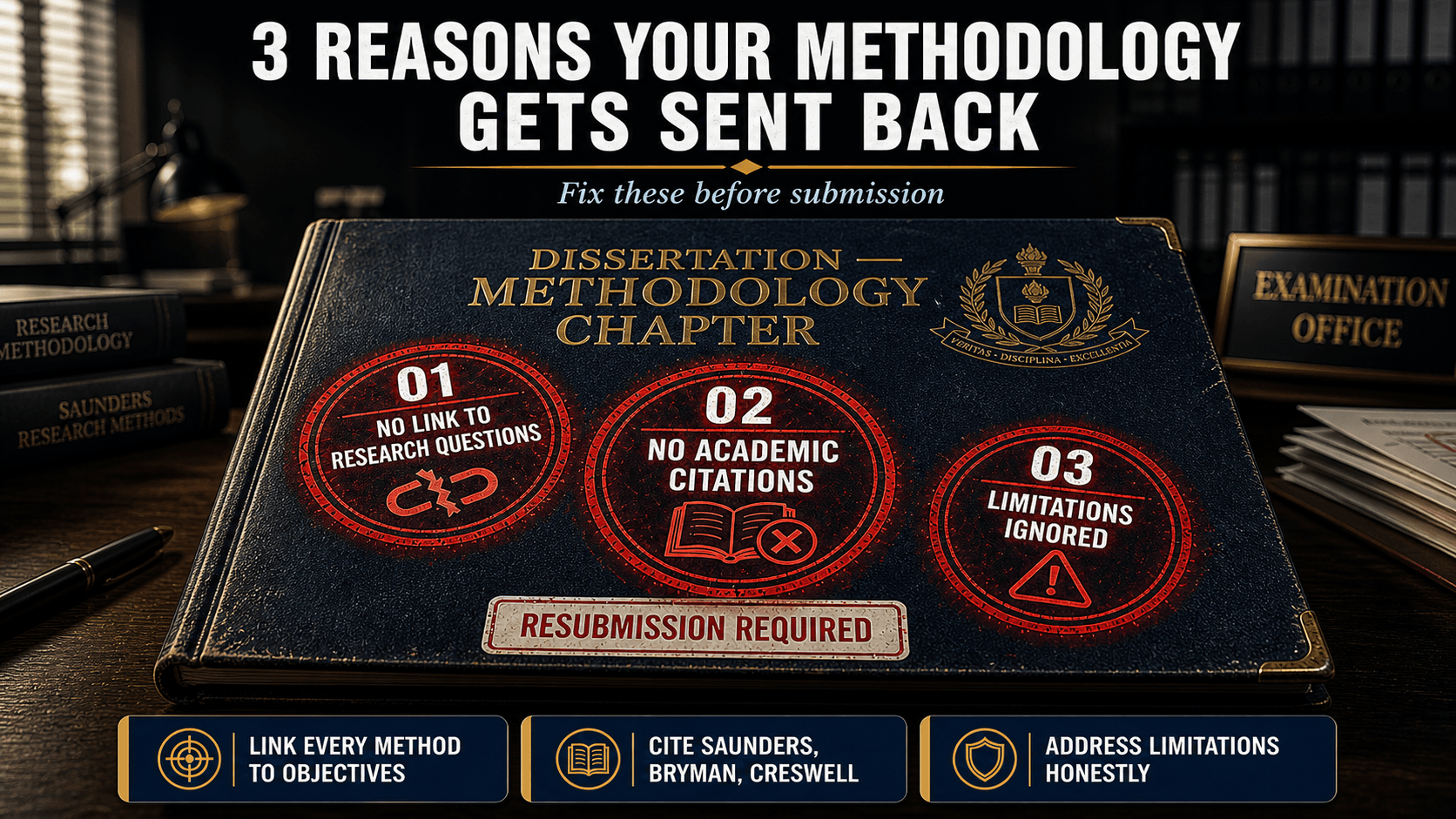
One of the biggest mistakes is failing to justify research methodology with academic backing. Getting examiner feedback on your methodology is more common than most students admit. The chapter looks complete — references are there, the approach is explained — but it still comes back marked insufficient. Usually, it’s one of three reasons.
- No clear link to the research questions
This is the most common one. Students pick a method, explain it in general terms, then move on. The examiner reads it and can’t see why that method serves those specific research questions. The connection has to be explicit — not implied, not obvious to you, but written out clearly on the page. If your methodology section could be copy-pasted into someone else’s dissertation without changing a word, it’s not justified, it’s described.
- No academic backing
Your method choice needs to be grounded in methodology literature. Creswell, Saunders, Bryman, Cohen — these aren’t just names to drop. Citing them shows the examiner that your approach has a theoretical basis, not just a practical convenience. A student who writes “interviews were chosen because they allow detailed responses” and a student who writes “semi-structured interviews were selected in line with Bryman’s (2016) argument that they allow flexibility while maintaining focus” are submitting very different quality chapters. If your methodology has zero citations to methodology authors, that’s a red flag examiners notice immediately. Our guide on dissertation methodology writing covers exactly which sources to reference and how.
- Limitations are completely ignored
Every method has weaknesses. Ignoring them doesn’t make your dissertation stronger — it makes it look naive. Examiners know that interviews have small sample sizes. They know surveys can’t capture depth. What they want to see is that you know this, and that you’ve thought about how your findings should be interpreted in light of those limitations. Acknowledging limitations isn’t a weakness in your dissertation. Pretending they don’t exist is. Examiners expect you to confidently justify research methodology, not just describe it.
If your methodology chapter has any of these three problems, it’s worth fixing before submission rather than after. A rejected methodology chapter means resubmission, which means more time, more stress, and in some cases, a delayed graduation. The dissertation methodology rejection page covers what happens when it goes wrong and what you can do about it.
Qualitative, Quantitative, or Mixed? Choosing the Right Defense

This is where most students make a decision they can’t properly defend later. They pick an approach because it feels right, or because their supervisor mentioned it once, or because the previous literature used it. Then when the examiner asks why — in the viva or through written feedback — there’s no solid answer.
The choice between qualitative, quantitative, and mixed methods isn’t just a research preference. It’s a philosophical position. And if you can’t explain the philosophy behind your choice, the justification will always feel thin.
Qualitative Research
Qualitative research is built for questions that ask how and why. It works when your study is trying to understand meaning, experience, perception, or process — things that numbers alone can’t capture.
The philosophical grounding here is interpretivism. Interpretivism holds that reality is subjective and socially constructed, meaning different people experience the same situation differently, and those differences matter. If your research is exploring how students experience academic pressure, or how managers interpret organisational change, a qualitative approach fits because you’re trying to understand the world from the participant’s perspective.
Methods that sit under qualitative research include semi-structured interviews, focus groups, ethnography, and document analysis. The justification isn’t just “interviews give detailed responses.” It’s that your ontological position — your belief about the nature of reality — calls for a method that captures depth and context rather than statistical frequency.
Where students go wrong here is treating qualitative as the easier option. Examiners are more critical of qualitative justifications precisely because they require a clear philosophical argument. If you haven’t addressed your research philosophy, your qualitative justification is incomplete regardless of how well-written the rest of the chapter is.
Quantitative Research
Quantitative research suits questions that ask how many, how much, or to what extent. It’s designed to measure, test, and generalise — to find patterns across large datasets that can be expressed numerically.
The philosophical grounding is positivism. Positivism treats reality as objective and measurable, independent of the researcher. It assumes that if you design your study correctly, collect your data systematically, and apply the right statistical tests, you can draw conclusions that apply beyond your sample.
Surveys, structured observations, and experiments are the typical methods here. The key to justifying a quantitative approach is showing that your research questions are genuinely asking for measurement. If your aim is to examine the relationship between study hours and academic performance across 300 undergraduate students, quantitative methods are the appropriate fit — and you can justify that by connecting it to your positivist stance and your need for generalisable findings.
One thing many students miss: quantitative doesn’t automatically mean more rigorous. It means differently rigorous. Validity and reliability in quantitative research come from your instrument design, your sampling strategy, and your statistical approach — all of which need their own justification within the methodology chapter.
Mixed Methods Research
Mixed methods is the most complex choice to justify, and also the most frequently misused. Students sometimes choose it thinking it covers all bases. In practice, it requires you to justify two methodological approaches instead of one — and explain why using both was necessary rather than just convenient.
The legitimate reason to use mixed methods is triangulation. Triangulation means using more than one method to cross-check findings — if your qualitative interviews reveal patterns that your quantitative survey then confirms at scale, the combined evidence is stronger than either method alone. Creswell and Plano Clark (2017) describe this as a way of compensating for the inherent weaknesses of each individual method by combining their strengths.
There are different mixed methods designs — sequential exploratory, sequential explanatory, and concurrent triangulation being the most common in dissertation research. The choice between them depends on whether your qualitative phase informs your quantitative phase, the other way around, or both run simultaneously. Each design requires its own justification, and each has a different implication for how you analyse and present your findings.
If you’re unsure which approach fits your research aim, this is genuinely worth getting right before you write the full chapter. A mismatch between your research questions and your methodological approach is one of the harder problems to fix late in the process. You can read more about this in our detailed comparison of qualitative vs quantitative dissertation approaches which walks through the decision with real dissertation examples. To justify research methodology, you must connect your chosen approach to your research philosophy
The Research Onion: A Framework Worth Knowing
Saunders, Lewis, and Thornhill introduced the research onion as a way of thinking about methodology from the outside in — starting with philosophy, moving through approach, strategy, and method, before reaching data collection and analysis. Most UK and Australian universities expect dissertation students to engage with this framework, even if only briefly.
Working through the research onion forces you to be consistent. If you claim an interpretivist philosophy but then use a structured survey with closed-ended questions, there’s a contradiction in your methodology that an examiner will spot. The onion doesn’t tell you which choice to make — it forces you to make sure your choices align with each other. That internal consistency is what a strong justification is built on.
9 Steps to Write a Bulletproof Methodology Justification

Knowing which approach to pick is one thing. Writing a justification that actually holds up under examiner scrutiny is another. These nine steps cover everything from the first sentence of your methodology chapter to the final reflection — in the order you should address them.
- Open With Your Research Philosophy
Before you justify anything, you need to establish your philosophical position. Are you working from a positivist standpoint, an interpretivist one, or somewhere in between — pragmatism, critical realism? This isn’t box-ticking. Your philosophy determines every choice that follows, and examiners read the methodology chapter knowing this. If your philosophy section is vague or missing entirely, the justification for your methods has no foundation.
A weak opening looks like: “This study uses a qualitative approach to explore the topic.”
A stronger opening looks like: “This study is grounded in an interpretivist philosophy, which holds that social reality is subjective and context-dependent. This position informed the decision to adopt a qualitative approach, as the aim of this research is to understand participant experiences rather than measure them.”
That’s the difference between describing and justifying — and it starts in the very first paragraph.
- Connect Every Method Directly to a Research Objective
This is the single most actionable fix you can make to a weak methodology chapter. Go through each methodological choice — your approach, your strategy, your data collection method — and draw an explicit line to the research objective it serves.
Don’t write: “Semi-structured interviews were used to collect primary data.”
Write: “Semi-structured interviews were selected to address Research Objective 2, which seeks to explore how final-year students experience academic pressure during dissertation writing. This method allows participants to expand on their responses, producing the depth of insight that a structured questionnaire could not provide.”
Every method needs a reason. Every reason needs to connect back to what you’re actually trying to find out. If you can’t make that connection clearly, it’s worth revisiting whether the method is the right one.
- Ground Your Choice in Methodology Literature
Your justification needs academic support — not just your own reasoning. Methodology texts exist precisely so that researchers can cite established frameworks when explaining their choices. Saunders, Lewis, and Thornhill’s Research Methods for Business Students is the most widely cited in UK business and management dissertations. Bryman’s Social Research Methods is standard across social sciences. Creswell covers qualitative, quantitative, and mixed methods across disciplines.
Citing these authors doesn’t just tick a reference box. It signals to the examiner that your choices are theoretically informed, not arbitrary. A methodology chapter with zero citations to methodology literature is one of the clearest signs that the justification hasn’t been properly developed. This step helps you clearly justify research methodology in a structured way.
- Justify Your Sampling Strategy
Sample size and sampling method are two of the most scrutinised parts of any methodology chapter — and two of the least justified in most student dissertations. Choosing purposive sampling because it was convenient is not a justification. Choosing it because your research requires participants with specific characteristics that random sampling cannot guarantee — that is.
For qualitative studies, the justification for a smaller sample size should reference data saturation — the point at which additional interviews stop producing new themes. Guest, Bunce, and Johnson (2006) found that saturation commonly occurs between 12 and 16 interviews in homogeneous samples, which gives you a citable basis for a sample size that might otherwise look small to an examiner.
For quantitative studies, sample size justification is more technical — it typically involves a power analysis that calculates the minimum sample needed to detect a statistically significant effect. If your dissertation doesn’t include this, and your sample size isn’t otherwise justified, that’s a gap worth closing. Our dedicated guide on sample size justification in dissertations goes into this in detail with worked examples.
- Explain Your Data Collection Method and Its Limitations
Choosing interviews, surveys, observations, or secondary data — each comes with trade-offs that need to be acknowledged, not hidden. An examiner reading a methodology chapter that presents only the advantages of a chosen method will immediately question whether the student fully understands what they’re doing.
For interviews: acknowledge that findings may not be generalisable beyond the sample, and that social desirability bias can affect participant responses.
For surveys: acknowledge that closed-ended questions limit the depth of data, and that low response rates can affect validity.
For secondary data: acknowledge that the data was collected for a different purpose, which may introduce limitations in how directly it applies to your research questions.
Acknowledging limitations isn’t weakness — it’s methodological maturity. Universities like Coventry, Greenwich, and Hertfordshire all emphasise critical reflection in their dissertation assessment criteria, and the methodology chapter is where that reflection is most directly evaluated.
Stuck on whether your data collection method is properly justified? WhatsApp our dissertation experts and get a straight answer.
- Address Your Data Analysis Approach
Students frequently justify their data collection method in detail and then write one sentence about how they analysed the data. That’s a problem. The analysis method needs its own justification, not just a name-drop.
If you’re using thematic analysis, explain why — and cite Braun and Clarke (2006), who established the framework most UK universities recognise. If you’re using content analysis, regression, or structural equation modelling, the same principle applies: name it, cite the methodological source, and explain why it suits your data and your research questions.
The analysis method should feel like a natural extension of everything that came before it in the chapter. If your philosophy is interpretivist, your approach is qualitative, and your data is interview transcripts — thematic analysis fits that chain of logic. Regression analysis does not. That consistency is what examiners are checking for.
- Cover Ethics
Ethics in a dissertation methodology is not just a formality. It’s a demonstration that you understood your responsibilities as a researcher. Cover informed consent, the right to withdraw, data anonymisation, and how you stored participant data in line with GDPR requirements if your study involved UK or EU participants.
If your university required ethical approval before data collection, reference that approval in the chapter. If your study was low-risk and exempt from full ethical review, explain why — don’t just skip the ethics section entirely. Leaving it out entirely raises questions an examiner shouldn’t have to ask. You need to justify research methodology by linking each method to specific objectives.
- Turn Your Limitations Into Methodological Honesty
Every study has limitations. The question isn’t whether yours does — it’s whether you’ve thought carefully enough about what they are and what they mean for your findings.
A limitation isn’t an apology. It’s a boundary marker. It tells the reader: here is where this study’s conclusions apply, and here is where they don’t. That kind of intellectual honesty is exactly what distinguishes a strong dissertation from a superficial one.
Don’t write: “A limitation of this study is the small sample size.”
Write: “The sample size of 14 participants limits the generalisability of findings beyond the specific context studied. However, as the aim of this research is to generate rich, contextual insight rather than statistical generalisation, this limitation does not undermine the study’s capacity to address its research objectives.”
See the difference? The second version acknowledges the limitation and immediately explains why it doesn’t invalidate the study. That’s the standard to aim for.
- Close With Critical Reflection
The final part of a strong methodology justification is a brief critical reflection — a paragraph or two where you step back and assess the overall approach. Would a different philosophical stance have produced more useful findings? Were there methods you considered and rejected, and why? What would you do differently with more time or resources?
This isn’t filler. Critical reflection shows the examiner that you’re not just reporting what you did — you understand the choices you made well enough to evaluate them. It’s the section that separates students who followed a methodology template from students who actually engaged with the research process. For more on how supervisor feedback intersects with this stage of your dissertation, the supervisor feedback guide covers what examiners typically flag and how to address it before submission.
Real Examples: Weak vs. Strong Methodology Justification
Reading about what good justification looks like is useful. Seeing it side by side with a weak version is more useful. These examples cover the most common methodology choices students make — use them as a reference point when reviewing your own chapter.
Example 1: Justifying a Qualitative Approach
Weak: “A qualitative approach was used because it is suitable for exploring human experiences and provides rich data.”
Strong: “A qualitative approach was adopted in this study because the central research question seeks to understand how first-generation university students construct their sense of academic belonging — a phenomenon that is inherently subjective and context-dependent. As Bryman (2016) argues, qualitative methods are appropriate when the aim is to access the meanings individuals attach to their experiences rather than to measure those experiences numerically. A quantitative approach was considered but rejected on the basis that closed-ended instruments cannot capture the nuance and complexity that this research question demands.”
The strong version does three things the weak version doesn’t: it ties the method to the specific research question, it cites a methodology author, and it explains why an alternative approach was rejected.
Example 2: Justifying a Survey
Weak: “Surveys were used because they are popular and allow data to be collected from many people quickly.”
Strong: “An online self-completion survey was selected as the primary data collection instrument to quantify the relationship between social media usage and self-reported academic performance across a geographically dispersed sample of undergraduate students. This approach aligns with the positivist philosophical stance adopted in this study and supports the deductive research approach, as the survey instrument was designed to test the hypotheses derived from the existing literature. Saunders et al. (2019) identify surveys as particularly appropriate for descriptive and explanatory research where standardised data is needed from a large sample — both conditions that apply to this study.”
Example 3: Justifying Semi-Structured Interviews
Weak: “Semi-structured interviews were chosen because they allow follow-up questions.”
Strong: “Semi-structured interviews were selected to address Research Objectives 1 and 3, both of which require an in-depth exploration of participant perspectives on workplace inclusion. This format was preferred over fully structured interviews because it allows the researcher to probe unexpected responses while maintaining enough consistency across interviews to enable systematic comparison — a balance that Bryman (2016) identifies as a key advantage of semi-structured designs in qualitative research. Focus groups were considered but rejected due to the sensitive nature of the topic, where individual interview settings were more likely to encourage honest and detailed disclosure.”
Example 4: Justifying Mixed Methods
Weak: “A mixed methods approach was used to get both qualitative and quantitative data.”
Strong: “A sequential explanatory mixed methods design was adopted, in which quantitative survey data was collected and analysed first, with qualitative interviews conducted in the second phase to explain and contextualise the statistical findings. This design was chosen because the survey results alone could not account for the variation observed in student engagement scores across different subject areas. The qualitative phase was therefore designed to provide explanatory depth that the quantitative data could not offer independently. This approach is consistent with Creswell and Plano Clark’s (2017) framework for sequential explanatory designs, in which qualitative data is used to interpret quantitative outcomes rather than simply supplement them.”
Example 5: Justifying Secondary Data
Weak: “Secondary data was used because it was easier to access than primary data.”
Strong: “Secondary data from the Higher Education Statistics Agency (HESA) was used as the primary data source for this study on graduate employment outcomes. Primary data collection was considered but rejected on practical and ethical grounds — the population of interest spans multiple institutions and graduation cohorts, making primary data collection within the scope of a single dissertation study neither feasible nor representative. HESA data was selected specifically because it covers the full UK graduate population across a ten-year period, providing the breadth and longitudinal depth that this research requires. The limitation of using secondary data — namely that it was collected for administrative rather than research purposes — is acknowledged and addressed in the limitations section.”
The pattern across all five examples is the same. Strong justification names the method, connects it explicitly to the research question or objective, cites a methodology author, and addresses at least one alternative that was considered and rejected. If your current methodology chapter does all four of those things, it’s in good shape. If it’s missing any of them, that’s where the examiner’s feedback will land. These examples show how to properly justify research methodology in real dissertations.
For students who are at the stage of starting their dissertation and haven’t written the methodology chapter yet, building this structure in from the beginning is significantly easier than retrofitting it after the chapter is written.
Do You Have These Errors? (Self-Check Before You Submit)
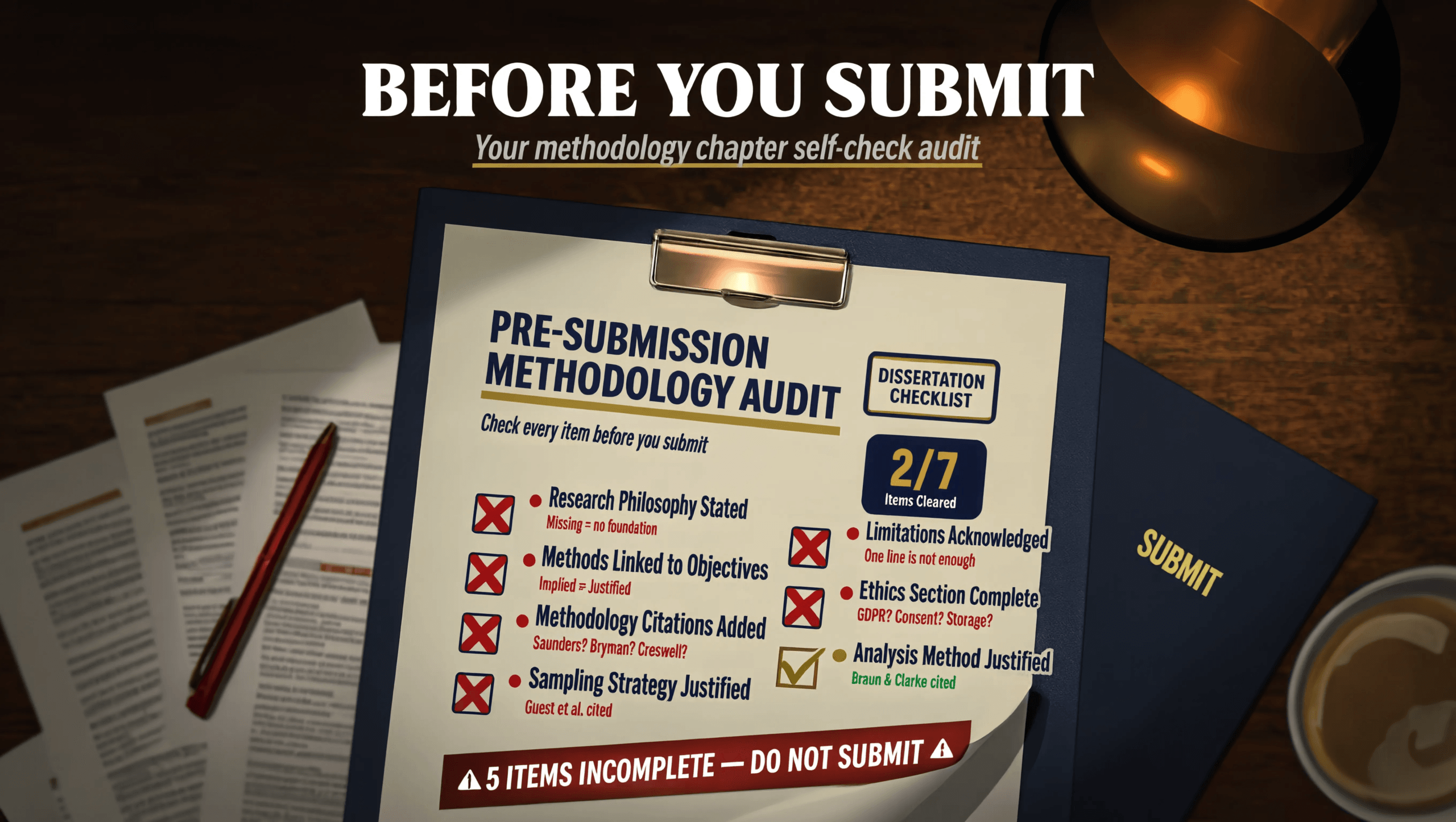
Run through this before you submit your methodology chapter. These are the errors that come up most often in examiner feedback — and most of them are fixable in a day if you catch them early.
No research philosophy stated
If your methodology chapter doesn’t mention positivism, interpretivism, pragmatism, or critical realism anywhere, that’s a gap. Your philosophical position is the foundation everything else sits on. Without it, your method choices look arbitrary.
Methods chosen without linking to research questions
Go back through your chapter and check: does every method you used connect explicitly to at least one research question or objective? If you can’t draw that line clearly, neither can your examiner.
No methodology citations
Saunders, Bryman, Creswell, Cohen — if none of these names appear in your methodology chapter, you’re missing the academic backing that examiners expect. General references to your topic area don’t count here. You need citations specifically defending your methodological choices.
Sample size left unjustified
“15 participants were selected for this study” is not a justification. Why 15? Why those 15? What sampling strategy did you use and why was it appropriate for your research design? If you can’t answer those questions in writing, your sampling section needs work.
Limitations section is missing or one line long
A single sentence acknowledging that your sample was small is not a limitations section. Each major methodological choice should have its limitations acknowledged and contextualised — not apologised for, but explained in terms of what they mean for how your findings should be read.
Ethics covered in one paragraph with no detail
Informed consent, right to withdraw, data storage, anonymisation, GDPR compliance where applicable — if any of these are missing, your ethics section isn’t complete. Universities take this seriously, and so do examiners.
Analysis method named but not justified
Thematic analysis, regression, content analysis — whatever you used, it needs more than a name. One or two sentences explaining why that analysis method suits your data type and your research questions is the minimum standard.
No critical reflection at the end
If your methodology chapter ends after the data analysis section without any reflective commentary on the overall approach, it’s missing the final layer examiners look for. A short paragraph acknowledging what you would do differently, or what the approach’s broader limitations mean for the field, is enough — but it needs to be there. If you can’t justify research methodology, your chapter will likely be sent back for revisions.
If you ticked yes to three or more of these, your methodology chapter needs attention before submission. The dissertation methodology help page covers how our team works through exactly these issues with students — if you’d rather have an expert look at it directly, that’s the fastest route to knowing where you stand.
From Rejection to Approval: A Real Case Study
Priya was a Master’s student at a UK university, six weeks out from her final submission deadline. Her supervisor had returned her methodology chapter twice. The feedback both times was the same: justification insufficient, philosophical grounding unclear, sampling rationale missing.
She wasn’t failing because she didn’t understand her topic. She understood it well. The problem was that her methodology chapter read like a textbook summary — accurate, but disconnected from her actual study. She had described what qualitative research is. She hadn’t explained why her study, with her research questions, in her specific context, required it.
By the time she came to AssignProSolution, she had already rewritten the chapter once on her own. The rewrite was better, but it still had the same core problem. The methods were listed and explained. The link to her research objectives was implied, not stated. The sampling section said “purposive sampling was used” without explaining what made her sample purposive or why that mattered for her study.
The fix wasn’t a complete rewrite. It was targeted. Three things changed.
First, a two-paragraph philosophy section was added at the opening of the chapter — one that established her interpretivist stance and connected it directly to her aim of understanding lived experience. That single addition gave the rest of the chapter a foundation it had been missing.
Second, every method in the chapter was given an explicit link to a numbered research objective. The word “because” appeared far more often. Not “interviews were used” but “interviews were used because Research Objective 2 requires depth of insight that a survey instrument cannot generate.”
Third, the sampling section was expanded to include a justification for the sample size — referencing Guest, Bunce, and Johnson’s (2006) work on data saturation — and an explanation of why purposive sampling was appropriate given that her participants needed to meet specific criteria relevant to her research context.
Her chapter went back to her supervisor. No further revisions were requested on the methodology.
That turnaround took less than 48 hours. Not because the original work was poor — it wasn’t — but because the gaps were specific and fixable once someone with experience looked at the chapter with fresh eyes.
If you’re sitting with supervisor feedback that says your justification isn’t strong enough, and you’re not sure exactly what’s missing, that’s a solvable problem. You don’t need to start over. You need to know where the gaps are. The dissertation deadline guide is worth reading if time is already becoming a factor — it covers how to prioritise fixes when you’re working against a submission date.
Protect Yourself Before Submission
Methodology rejections don’t always come as a surprise. Most of the time, the signs were there — vague justifications, missing citations, a limitations section that was clearly written in a hurry. Students see them and hope the examiner won’t. The examiner always does.
The smarter move is to treat your methodology chapter the way you’d treat any high-stakes document before it goes out. You check it. You get someone else to check it. You fix what needs fixing before it becomes feedback.
Here’s what that looks like in practice.
Read your methodology chapter as if you’re the examiner
Print it out or open it on a separate screen. Go through it with one question in mind: does every method choice have a clear, cited reason that connects back to my research questions? Not a general reason. Not a reason that applies to any study using this method. A reason specific to this study, these questions, this context. Where the answer is no, that’s where you work.
Get supervisor feedback before the final submission
If your supervisor has capacity for one more read, use it. Most students hold back because they’re worried the chapter isn’t ready. That’s exactly the wrong calculation. A supervisor’s pre-submission comments are free feedback that saves you from post-submission corrections. Even a short email asking for their impression of the methodology section is worth sending.
Use a second pair of eyes with methodology experience
Supervisors aren’t always available, and sometimes the feedback they give is too general to act on. “Strengthen the justification” tells you there’s a problem — it doesn’t tell you where or how. Someone who has read and written methodology chapters across multiple disciplines can usually identify the specific gaps within a read-through, which is why a targeted methodology review tends to be more actionable than general supervisor comments.
Don’t submit and hope
This one sounds obvious. It isn’t. A significant number of students submit knowing their methodology chapter has gaps, banking on the examiner being lenient or not noticing. Examiners notice. Methodology is one of the most technically evaluated chapters in a dissertation, and experienced examiners read it looking specifically for the things this guide has covered — philosophy, linkage to research questions, sampling rationale, limitations, ethics. The gaps stand out.
If your submission is coming up and you want your methodology chapter reviewed before it goes in, our team at AssignProSolution works with students at exactly this stage. A review catches what you’ve missed. A resubmission costs you time you may not have. If you’re already feeling the pressure of a close deadline, the dissertation deadline guide is worth reading before you decide your next move.
Frequently Asked Questions
How long should the methodology justification be?
There’s no universal word count, but in most UK, Australian, and Canadian universities, the methodology chapter sits between 1,500 and 3,000 words for a Master’s dissertation and 800 to 1,500 for an undergraduate dissertation. The justification itself — the reasoning behind your choices — should run through the entire chapter rather than appearing as one isolated section. If your methodology chapter is under 1,000 words at Master’s level, it’s almost certainly underdeveloped.
Can I change my methodology after I’ve already started collecting data?
Technically yes, but it’s complicated. If you’ve already collected data using a particular method, switching methodology mid-study creates consistency problems that are difficult to resolve without starting the data collection again. The more realistic fix at that stage is to strengthen the justification for what you’ve already done rather than change the approach entirely. If the method itself is fundamentally wrong for your research questions, that’s a conversation to have with your supervisor immediately — not something to paper over in the write-up.
Is qualitative research harder to justify than quantitative?
In practice, yes — and for a specific reason. Quantitative justification leans heavily on established statistical logic: sample size, reliability, generalisability. These are measurable standards with accepted benchmarks. Qualitative justification requires a philosophical argument about why subjective, contextual data is appropriate for your research questions. That argument is harder to make convincingly, which is why qualitative methodology chapters get more examiner scrutiny. It doesn’t mean qualitative is the wrong choice — it means the justification needs to be more carefully constructed.
What’s the difference between research methodology and research methods?
Research methods are the specific tools you use to collect and analyse data — interviews, surveys, thematic analysis, regression. Research methodology is the broader framework that explains and justifies why those tools were chosen — your philosophy, your approach, your strategy, and how they all connect. Most students write about methods. Examiners assess methodology. The distinction matters because a chapter that lists methods without addressing methodology will always feel incomplete, regardless of how well the individual methods are described.
How do I justify research methodology in a viva?
The viva question on methodology usually comes in one of two forms: “Why did you choose this approach?” or “What would you do differently?” Both require the same preparation — knowing your philosophical position, being able to explain the link between your methods and your research questions, and having thought through your limitations honestly. If you can answer those three things clearly and without hesitation, the methodology section of your viva is manageable. If you’re not sure you can, it’s worth revisiting the chapter before the viva rather than hoping the question doesn’t come up.
How does AssignProSolution help with methodology chapters?
We work with students at different stages — some come to us before they’ve written anything and want a structure and framework built out, others come with a complete chapter that’s been sent back by their supervisor. In both cases, the starting point is the same: understanding your research questions, your subject area, and what your university’s methodology requirements actually are. From there, the support is targeted to what’s missing. We don’t rewrite for the sake of it — we fix what needs fixing and make sure the justification holds up. If you want to know what that looks like for your specific chapter, the fastest way is to get in touch directly.
Ready to Submit With Confidence?
A weak methodology justification is one of the most common reasons dissertations come back for corrections. It’s also one of the most preventable. Everything this guide has covered — the philosophy, the linkage to research questions, the sampling rationale, the limitations, the critical reflection — is fixable before your submission date if you know what to look for.
The students who struggle most aren’t the ones who chose the wrong method. They’re the ones who chose a perfectly reasonable method and then couldn’t explain why on paper. That gap between knowing and justifying is exactly what costs marks.
If you’ve read this far and you’re still not confident your methodology chapter holds up, that’s worth acting on now rather than after submission. Before submission, make sure you can clearly justify research methodology at every stage.
Three ways to move forward depending on where you are:
You want to fix it yourself — go back through your chapter using the nine-step framework in this guide. Cross-reference every method choice against your research objectives. Add citations from Saunders, Bryman, or Creswell wherever your reasoning is currently unsupported. Expand your sampling rationale and your limitations section. Run through the self-check in Section 6 before you close the document.
You want a second opinion — send your methodology chapter to our team for a review. We’ll tell you specifically what’s missing and what needs strengthening. No vague feedback. No generic suggestions. Just a clear read on where your justification stands and what to do about it.
You want the chapter written or rewritten properly — if time is short or the chapter needs more than targeted fixes, our dissertation writers work across all subject areas and all university levels. The output is referenced, justified, and written to the standard your examiner is looking for.
Whichever route fits your situation, the worst option is submitting a methodology chapter you’re not confident in and hoping it passes. It rarely does — and a resubmission costs you far more time than fixing it now. The ability to justify research methodology is what separates average dissertations from high-scoring ones.
WhatsApp our team now and tell us where you’re at. We’ll give you an honest assessment of what your chapter needs — no obligation, no sales pitch, just a straight answer.
Related reading you may find useful: