
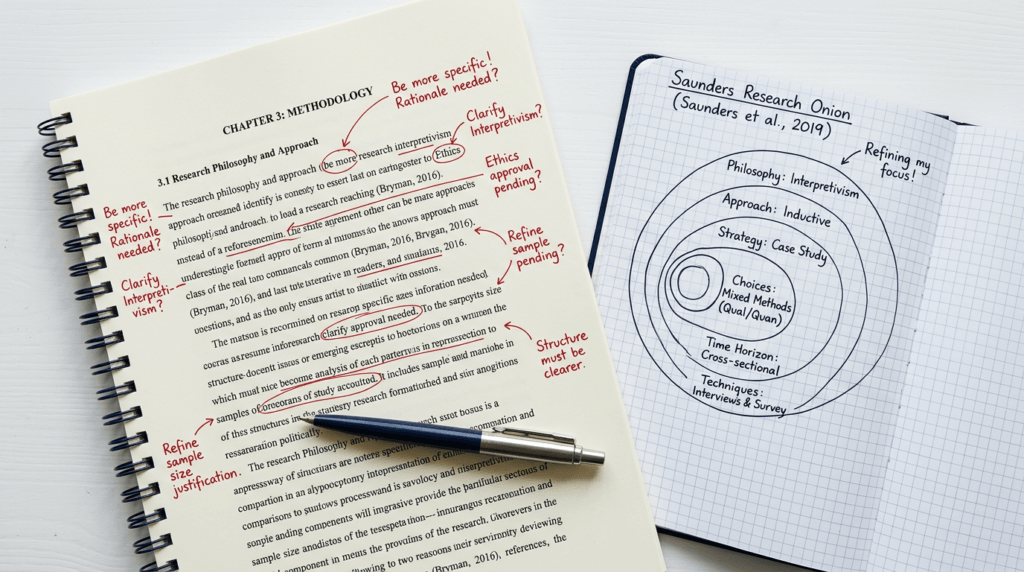
You opened your supervisor’s email expecting one word: Approved.
Instead, you got: “Methodology needs major revisions.”
That sinking feeling — every dissertation student knows it. And the worst part is not even the rejection itself. It is the feedback. Vague, generic, impossible to act on. “Lacks rigour.” “Weak justification.” “Rethink your approach.” You read it ten times and still cannot tell what they actually want you to change.
Having your dissertation methodology rejected does not just bruise your confidence. It is one of the most common reasons students fall behind their submission timeline — and one of the most fixable, once you understand why dissertation methodology gets rejected in the first place. It pushes your entire submission timeline back by weeks. Sometimes months. And while you are stuck rewriting the same chapter, your deadline keeps moving closer.
Here is what most students do not realise: methodology rejections are not random. They happen for the same reasons, across the same types of universities, in the same parts of the chapter — every single semester. Once you understand those reasons clearly, fixing them becomes far more manageable than that feedback email makes it feel.
This guide gives you 7 proven fixes for a rejected dissertation methodology, a real before-and-after example, and a clear action plan you can use before your next submission. Whether you are studying in the UK, Australia, Canada, or UAE — the logic applies.
If you have already read your feedback three times and still cannot see the problem, our academic support team can review your chapter and tell you exactly what needs to change.
How to Fix a Rejected Dissertation Methodology in 5 Steps Before You Read Any Further
Before we go deep into each fix, here is what you can do right now — even if you only have an hour. These 5 steps resolve the majority of dissertation methodology rejections. Most students skip at least two of them. Do not.
Step 1: Re-read the feedback line by line — not as a whole
- Problem: Students skim feedback emotionally and miss the actual issue buried in the comments.
- Fix: Print it out. Highlight every comment. Sort each one into a category — Design issue, Justification issue, Ethics issue, or Sampling issue.
- Why it works: Supervisors reject methodology chapters for specific, repeatable reasons — and understanding which category your rejection falls into is the first step to fixing a rejected dissertation methodology fast. If you fix the wrong thing, you get rejected again.
Step 2: Justify every choice with “because” logic
- Problem: You wrote what you did — not why you did it.
- Fix: For every methodological decision (qualitative approach, sample size, data tool), write one sentence: “Chosen because…” backed by a citation.
- Why it works: Examiners are not looking for description. They are looking for reasoning. One without the other gets sent back.
Step 3: Place your research question and your method side by side
- Problem: Your method does not actually answer your research question — and your supervisor spotted it immediately.
- Fix: Open a blank document. Write your RQ at the top. Write your chosen method underneath. Ask yourself honestly: does this method produce data that answers this question?
- Why it works: Misalignment between the RQ and method is the single most common reason methodology chapters get rejected.
Step 4: Add a research philosophy paragraph
- Problem: Your chapter jumps straight into data collection with no mention of positivism, interpretivism, or pragmatism.
- Fix: Add 150–200 words covering your philosophical positioning and whether your approach is inductive or deductive.
- Why it works: Universities across the UK, Australia, and Canada treat this as non-negotiable. Missing it signals that your research foundation is weak — regardless of how good the rest of the chapter is.
Step 5: Rewrite your ethics section as specific risk management — not a formality
- Problem: Ethics sections that say “ethical approval was obtained” and nothing else get flagged instantly.
- Fix: Write specifically about informed consent, anonymity, data storage under GDPR, right to withdrawal, and any sensitive topic handling.
- Why it works: A vague ethics paragraph tells your supervisor you treated it as a checkbox. A specific one tells them you understood the actual responsibilities involved.
If you have already done all five of these and still received a rejection — the issue goes deeper than structure. Keep reading.
Why Your Dissertation Methodology Gets Rejected — Real Reasons Students Miss Every Time
Most students assume methodology rejection happens because of poor writing. It does not.
It happens because of logic gaps — and these gaps are the core reason why dissertation methodology gets rejected at every level, from undergraduate final-year projects to Masters submissions. Places where your supervisor cannot trace a clear line from your research question to your method, or from your method to your data. Once that gap is visible, the entire chapter loses credibility — regardless of how well the individual sentences are written.
Universities like Coventry University and University of Westminster publish postgraduate research expectations that make one thing very clear: methodology is not just a chapter. It is the academic argument for why your research can be trusted. If that argument has holes, approval will not come — no matter how many times you resubmit.
Here are the real reasons your dissertation methodology gets rejected — the ones supervisors rarely spell out in their feedback.
Your method does not match your research question
This is the most common reason dissertation methodology gets rejected — and the least obvious one to spot yourself because the misalignment is rarely visible from inside the chapter.
You chose qualitative interviews — but your research question is asking for measurable trends across a population. Or you designed a survey — but your topic requires deep exploration of lived experience. Either way, your supervisor sees the mismatch in the first two minutes of reading.
The fix is not to change your research question. It is to reverse-engineer your method from the data your question actually needs.
Justification is missing or too thin
“I chose a qualitative approach because it suits my study.”
That sentence appears in thousands of rejected methodology chapters every year. It is not justification — it is a placeholder pretending to be one.
Your supervisor wants to know why qualitative beats quantitative for your specific topic, supported by methodology authors. Creswell, Saunders, Bryman — these names need to appear in your reasoning. Without them, your choices look like personal preference rather than academic decision-making.
No research philosophy or paradigm
This is a non-negotiable expectation at most UK, Irish, and Australian universities — and one of the most commonly missing elements in rejected drafts.
If your methodology chapter goes straight from the introduction into data collection methods without addressing positivism, interpretivism, or pragmatism, it reads like an undergraduate report rather than a postgraduate dissertation. Supervisors trained in research methods notice this absence immediately.
The Saunders Research Onion is the standard structural framework. Your philosophy, approach, strategy, and time horizon all need to be addressed — in that order.
Sampling section lacks academic grounding
Saying “I will interview 10 people” without explaining who those people are, why 10 is an appropriate number, how you will access them, and which sampling technique you are using is an instant rejection trigger.
Purposive, snowball, stratified, convenience — whichever technique you used, it needs to be named, justified with literature, and explained in terms of access and inclusion criteria. Every element of your sample needs a reason behind it.
Ethics treated as a single line
The phrase “ethical approval was obtained from the university” is not an ethics section. It is one sentence about process.
Your supervisor wants evidence that you understood the actual ethical implications of your research — participant consent, anonymity, data storage, GDPR compliance, right to withdrawal, and handling of any sensitive topics. Particularly if you are studying in the UK or EU, GDPR-specific language is expected. University of Greenwich’s postgraduate research guidelines reflect exactly this level of detail in their ethics requirements.
Vague ethics paragraphs get flagged every time. Specific ones get approved.
Data analysis plan is too vague to be credible
“I will analyse the data using thematic analysis.”
Which thematic analysis? Braun and Clarke’s six-phase framework? How will you code — manually or through NVivo? What is your approach to theme generation?
Naming the method is not enough. Your supervisor needs to see that you understand how the analysis actually works — step by step, author-cited, tool-named.
No limitations or reliability discussion
A methodology chapter that presents itself as perfect raises immediate suspicion. Every research method has limitations. Pretending otherwise signals that you do not fully understand what you are doing.
Reliability, validity, generalisability for quantitative work — credibility, transferability, dependability for qualitative — these concepts need to appear in your chapter. Alongside them, two or three honest limitations with a clear explanation of how you mitigated each.
Fixing all seven of these issues while managing lectures, other deadlines, and supervisor response times can take three to six weeks. If you are already on your second rejection, that timeline is a problem. Our dissertation support team works with students at exactly this stage — turning rejected drafts into approval-ready chapters without adding another revision cycle to your calendar.
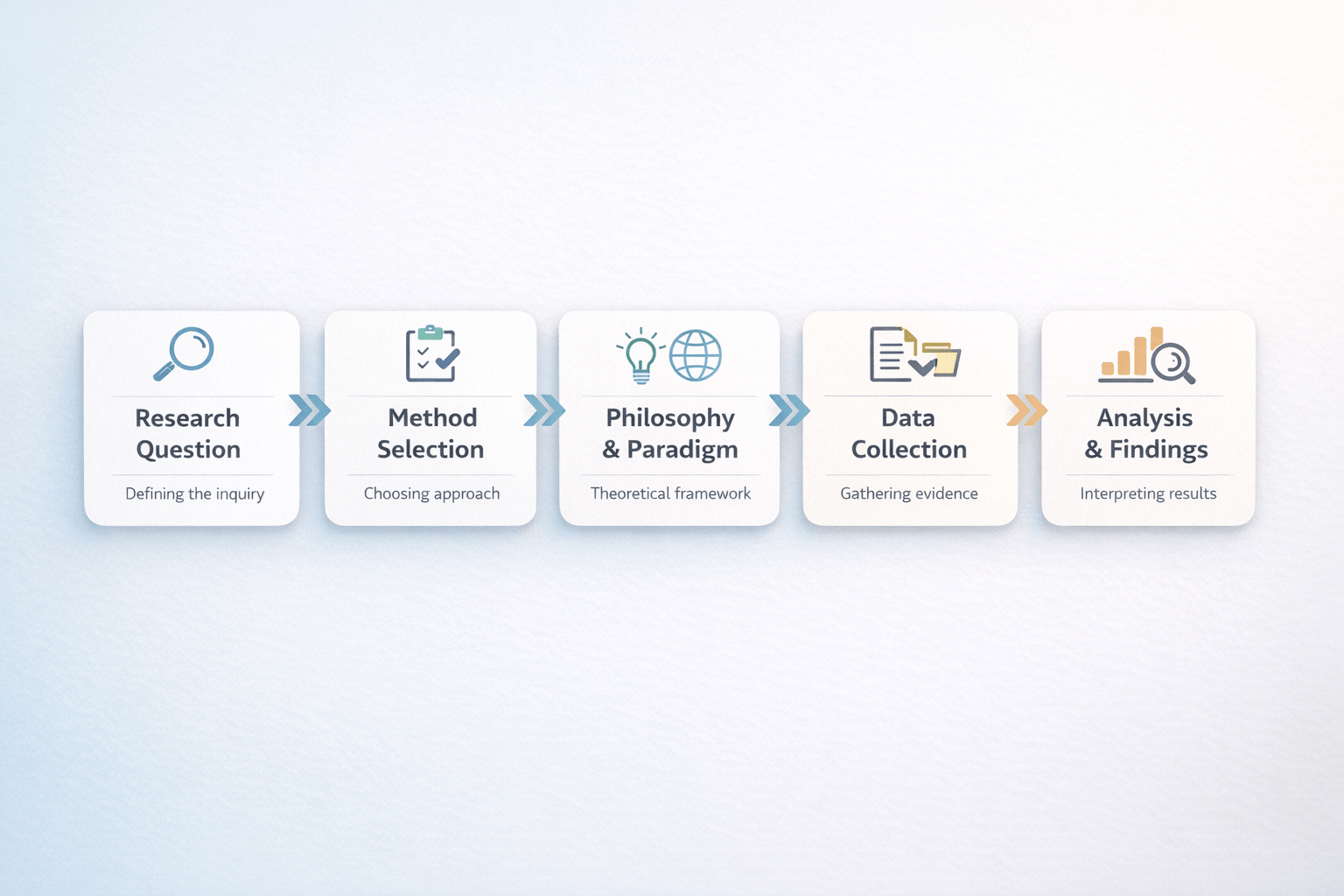
How to Fix a Rejected Dissertation Methodology — 7 Proven Fixes
You now know why it got rejected. Let us fix it.
These seven fixes are built around the most common supervisor feedback patterns across UK, Australian, Canadian, and UAE universities. Work through them in order. These are the exact fixes that turn a dissertation methodology rejected draft into an approval-ready submission. Do not patch individual paragraphs — if your methodology was rejected, it needs a clean rebuild, not cosmetic edits.
[Image: Methodology chapter structure flowchart | Alt text: how to fix dissertation methodology rejected by supervisor]
Fix 1: Rebuild Your Methodology Around the Research Question
Do not start by fixing sentences. Start by fixing alignment.
Open a blank document. Write your research question at the top. Underneath it, write your chosen method. Now ask yourself one honest question: does this method produce data that directly answers this research question?
If the answer is “mostly” or “I think so” — that is your rejection reason right there.
The approach that works: reverse-engineer the entire chapter. Start from the data your research question needs. Identify which method produces that data. Then build your methodology chapter around that logic — not the other way around.
This single fix resolves more dissertation methodology rejected cases than any other change you can make — because alignment is what supervisors check first.
Fix 2: Add the Research Philosophy Layer
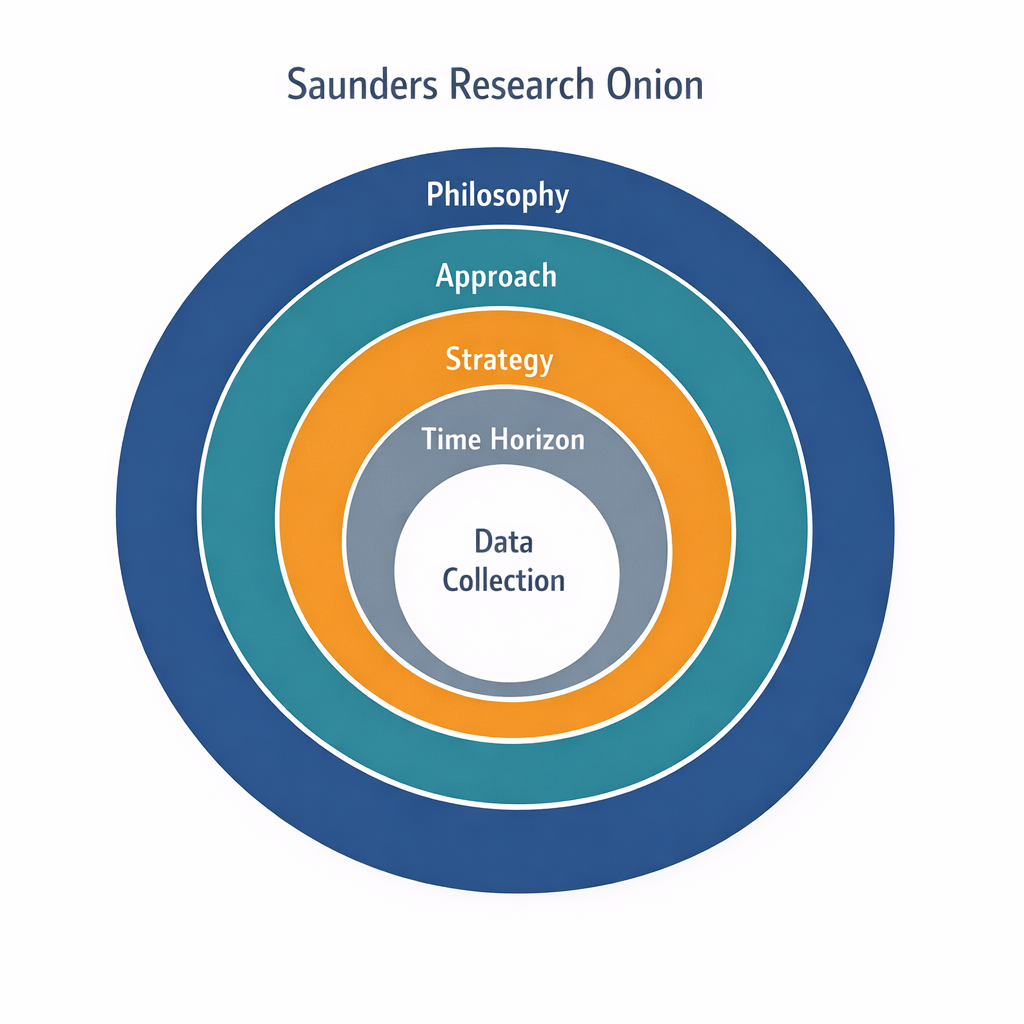
This is the most commonly missing section in a rejected dissertation methodology — and the one supervisors notice first.
Your methodology chapter needs a structured section that covers four things in this order:
Research philosophy — positivism, interpretivism, or pragmatism, with a clear justification for your choice based on your research aims.
Research approach — deductive if you are testing an existing theory, inductive if you are building new understanding from your data.
Research strategy — survey, case study, ethnography, grounded theory, action research — whichever applies, named and justified.
Time horizon — cross-sectional if your data collection happened at one point in time, longitudinal if it spans a period.
Use Saunders’ Research Onion as your structural skeleton. UK examiners expect this framework by name. If it is not in your chapter, its absence is noticed.
Fix 3: Fix 3: Justify Every Choice — The Core of How to Fix Rejected Dissertation Methodology
This is the fix that transforms a descriptive methodology into an academic one.
Every methodological decision in your chapter needs to follow this formula:
“I chose [X] because [specific reason linked to your research question], as supported by [Author, Year].”
For example: “A qualitative approach was selected because this study explores the subjective experiences of employees managing remote work burnout, which cannot be adequately captured through numerical measurement (Creswell, 2018). Quantitative methods, while effective for identifying trends across large populations, do not provide the depth of insight required to address the research question (Saunders et al., 2019).”
Apply this formula to every choice — philosophy, approach, strategy, sampling, data collection tool, and analysis method. Every single one. No choice should appear in your chapter without a “because” attached to it.
Fix 4: Rebuild Your Sampling Section From Scratch
Weak sampling is present in the majority of rejected methodology chapters. Here is the structure that supervisors actually want to see:
Population — who are you studying overall, and why is this the relevant population for your research question?
Sample size — how many participants or responses, and why is this number academically justified? Cite literature that supports your chosen size for your method type.
Sampling technique — purposive, random, stratified, snowball, convenience — name it, define it briefly, and explain why it is appropriate for your study.
Access strategy — how will you actually reach your participants? Supervisors want to know this is realistic, not aspirational.
Inclusion and exclusion criteria — who qualifies for your study and who does not, and why?
If even one of these five elements is missing from your current draft, your sampling section is incomplete. That is enough to trigger a rejection on its own.
Fix 5: Rewrite Your Ethics Section as Risk Management
Generic ethics paragraphs get rejected. Specific ones get approved. The difference is not length — it is precision.
Your ethics section needs to address each of the following with specificity:
Informed consent — how participants were informed about the study, what they agreed to, and how that consent was documented.
Anonymity and confidentiality — how participant identities are protected in your data, your analysis, and your final submission.
Data storage — where data is stored, who has access, what encryption is used, and when the data will be deleted. GDPR compliance language is mandatory for UK and EU-based research.
Right to withdrawal — when participants could withdraw, how they could do so, and what happened to their data if they did.
Sensitive topics — if your research touches on mental health, trauma, financial difficulty, or any vulnerable population, explain specifically how you managed participant wellbeing.
This section can be the difference between a rejection and an approval. Supervisors read it carefully precisely because most students write it carelessly.
Fix 6: Explain Your Data Analysis Method Step by Step
Naming your analysis method is not enough. Your supervisor needs to see that you understand how it works.
For qualitative research, a credible analysis section looks like this:
“Data will be analysed using Braun and Clarke’s (2006) six-phase thematic analysis framework. The phases followed are: familiarisation with the data, generating initial codes, searching for themes, reviewing themes, defining and naming themes, and producing the final report. NVivo 14 will be used to manage and organise the coding process.”
For quantitative research:
“Data will be analysed using SPSS version 28. Descriptive statistics will be used to summarise participant demographics, while multiple regression analysis will examine the relationship between X and Y variables.”
Named. Cited. Step-by-step. That is the standard your supervisor is measuring against.
Fix 7: Add Reliability, Validity, and Honest Limitations
A methodology that has no weaknesses is not rigorous — it is naive. Supervisors know this, and they look for whether you know it too.
For quantitative work, address internal and external validity, reliability, and the limits of your generalisability.
For qualitative work, use Lincoln and Guba’s four criteria — credibility, transferability, dependability, and confirmability — and explain how your research design addresses each.
Then state two or three real limitations honestly. Small sample size, geographic scope, self-reporting bias, time constraints — whatever genuinely applies to your study. For each limitation, explain the mitigation step you took.
This section converts a methodology that looks rushed into one that looks academically mature. It is one of the fastest ways to shift a supervisor’s reading from sceptical to satisfied.
Patching a rejected methodology paragraph by paragraph almost never works. Supervisors read chapters holistically — inconsistency between a rewritten section and the original surrounding text stands out immediately. A clean, full rewrite reads with confidence. Patched edits read like exactly what they are. If your deadline is within four weeks, get your rejected chapter reviewed by our dissertation team before attempting another solo rewrite.
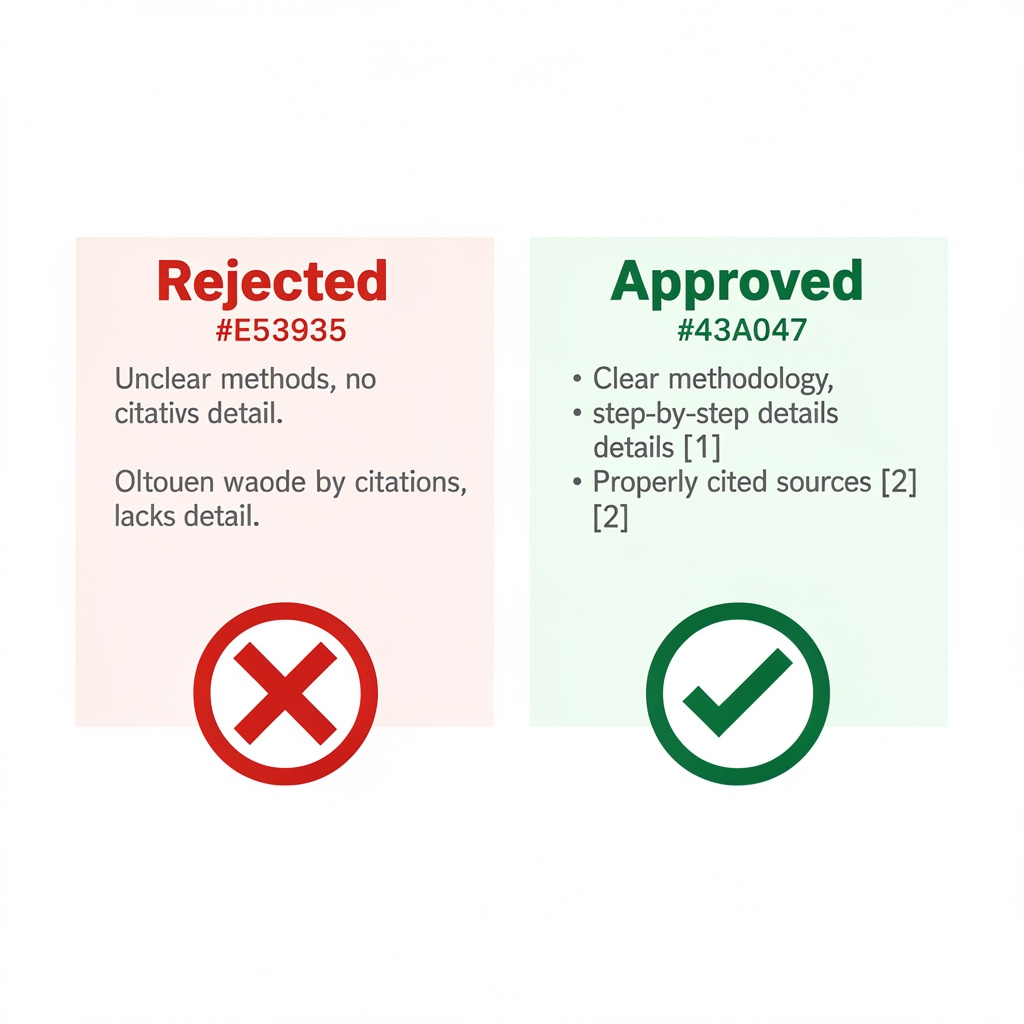
Dissertation Methodology Rejected Example — Before vs After
Theory is useful. But let us look at what this actually means on the page.
Most dissertation methodology rejected cases share one thing in common: they describe what the student did without ever explaining why the student did it. Supervisors do not want a research diary. They want an academic argument. The difference between a rejected draft and an approved one usually comes down to that single distinction.
Here is a real example of the kind of writing that gets sent back — and exactly how to fix it.
[Image: Before and after dissertation methodology paragraph comparison | Alt text: dissertation methodology rejected example before and after fix]
The Rejected Version
“I chose a qualitative methodology for my research because I want to understand how employees feel about remote work. I will interview 10 people from different companies. This is the best method because it gives deep insights rather than just numbers.”
Supervisor feedback received:
“Too descriptive. No academic justification for the choice of qualitative over quantitative. Sample size not justified. No reference to methodology literature. Rewrite.”
Why this gets rejected:
There are no citations. There is no link to the research question. The phrase “I want to understand” is personal preference — not academic reasoning. The claim that qualitative “gives deep insights” is an opinion stated as fact. The sample of 10 is dropped in with no explanation of why 10, who these people are, or how they will be accessed.
Every sentence in this paragraph describes. None of them justify. That is the entire problem.
The Approved Version
“This study adopts a qualitative research design to investigate the subjective experiences of employees managing burnout in remote working environments. Qualitative methods are particularly suited to research questions that seek to explore complex human behaviours and lived experiences that cannot be adequately represented through numerical data (Creswell, 2018). Since the primary research question examines why remote employees experience burnout — rather than how frequently it occurs across a population — a qualitative approach provides the depth of contextual insight that quantitative surveys are structurally unable to generate (Saunders et al., 2019).
Ten participants were selected through purposive sampling, a technique used when the researcher requires participants with specific lived experience relevant to the research focus (Bryman, 2016). This sample size is consistent with established guidance for semi-structured interview-based qualitative studies, where depth of data takes precedence over volume (Guest et al., 2006).”
Why this gets approved:
The research design is named clearly in the opening line. The justification links directly to the specific research question — not to qualitative research in general. Two methodology authors are cited with their reasoning for why this method fits. The sample size is explained and supported with a citation. The sampling technique is named and defined. Every sentence earns its place.
What the Difference Actually Shows
The approved version is not longer for the sake of length. It is longer because every additional sentence carries a specific function — justification, citation, or logical connection to the research question.
This is the standard your supervisor is reading against — and it is what separates an approved methodology from a dissertation methodology rejected for the third time. Not perfection. Not sophisticated vocabulary. Just clear academic reasoning, properly supported.
Now apply this same logic across every section of your methodology chapter — philosophy, approach, sampling, ethics, analysis, limitations. That is a full methodology rewrite. For most students, that is three to four weeks of work, done alongside everything else on their plate.
If your deadline does not give you three to four weeks, or if you have already attempted one rewrite and received the same feedback again, contact our dissertation team directly via WhatsApp — we rebuild rejected methodology chapters to approval standard, aligned to your specific university’s expectations.
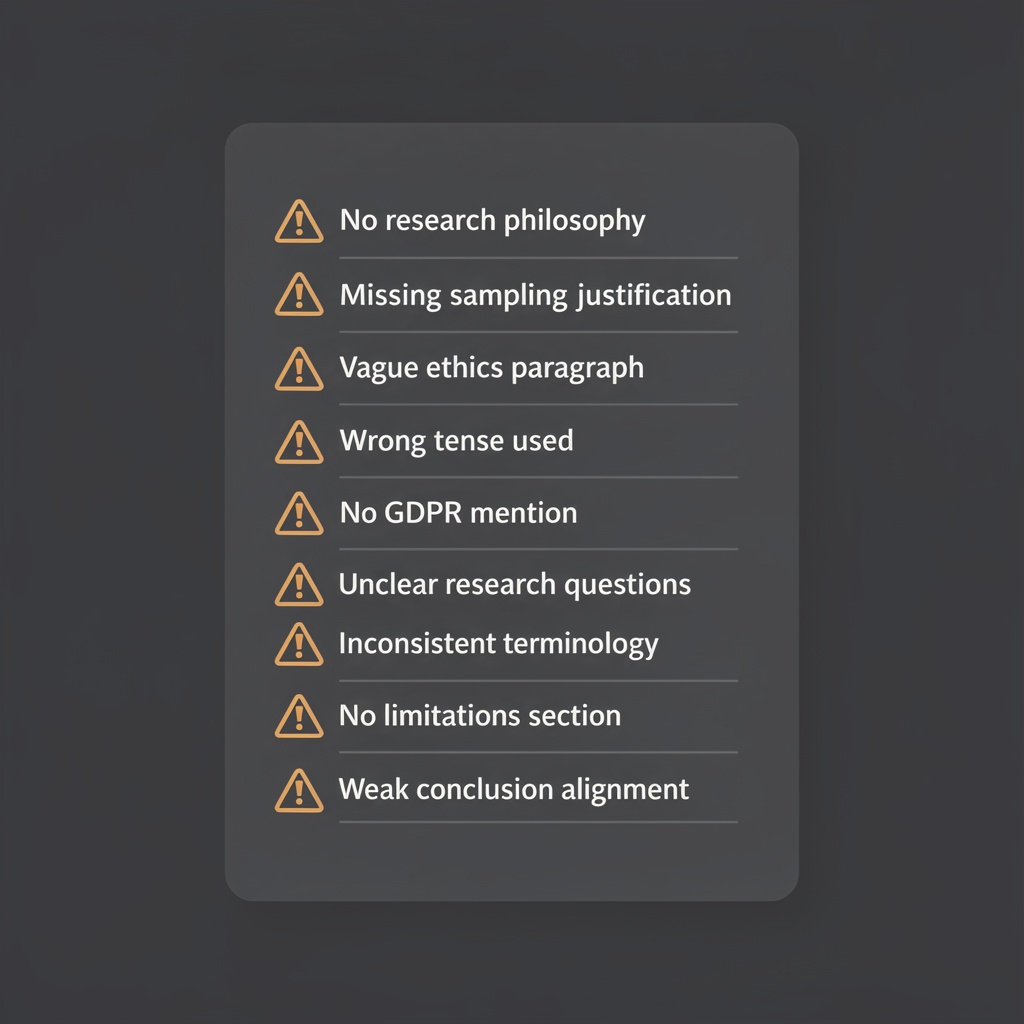
Common Dissertation Methodology Mistakes That Keep Getting You Rejected
Even after reading the feedback carefully and attempting a rewrite, students keep landing in the same traps. The mistakes below are not rare edge cases — they appear consistently across dissertations at every level, from undergraduate final-year projects to Masters submissions at universities like Coventry, Westminster, and Greenwich.
Knowing what these mistakes look like is half the fix.
[Image: Checklist of common dissertation methodology mistakes | Alt text: common dissertation methodology mistakes and solutions students must avoid]
Mistake 1: Copying the structure from another dissertation
You found a methodology chapter online or borrowed one from a senior student. You changed the topic-specific words and kept the rest. It felt like a shortcut that made sense.
Supervisors read hundreds of dissertations per year. They recognise recycled structure, borrowed phrasing, and methodology logic that does not match the research question sitting above it. Even if the plagiarism checker does not flag it, the mismatch between method and topic gives it away within the first paragraph.
Use samples for structural inspiration only. Every justification in your chapter must be written specifically for your research question — not borrowed from someone else’s.
Mistake 2: Confusing methodology with methods
This is the most widespread confusion in rejected dissertations and the one most students do not realise they are making.
Methodology is the philosophical and theoretical reasoning behind your entire research approach — why this design, why this paradigm, why these choices make sense for this specific inquiry.
Methods are the tools — interviews, surveys, SPSS, NVivo, observation.
If your methodology chapter lists tools without explaining the reasoning behind them, it is a methods list — not a methodology chapter. This is one of the most common dissertation methodology mistakes that leads directly to a rejected dissertation methodology, you have written a methods section, not a methodology chapter. Supervisors flag this distinction every time because it signals a fundamental misunderstanding of what the chapter is supposed to achieve.
Mistake 3: Wrong tense throughout the chapter
If you have already collected your data, your entire methodology chapter must be written in past tense.
“I will interview 15 participants” — rejected.
“Fifteen participants were interviewed” — correct.
Tense inconsistency makes your chapter look unfinished. It is a small detail that creates a large impression. Supervisors read it as careless, and careless methodology chapters do not get approved.
Mistake 4: No mention of a pilot study
If you conducted interviews or distributed surveys without running a pilot first — and your methodology makes no mention of this — it raises a credibility question about your research design.
Even a minimal pilot — two test interviews, five trial survey responses — demonstrates that your data collection instruments were tested before full deployment. Mentioning it, and briefly explaining what adjustments you made as a result, adds a layer of rigour that supervisors notice.
Mistake 5: Unrealistic sample size claims
“I will survey 500 employees across eight countries.”
If you are a solo Masters student with a three-month data collection window, that claim is not ambitious — it is implausible. Supervisors reject unrealistic sampling plans because they signal poor research planning, not thoroughness.
A well-justified sample of 12 purposively selected participants is academically stronger than an unjustified claim of 500. Size is not the measure of rigour. Justification is.
Mistake 6: Hiding limitations instead of addressing them
Students hide limitations because they assume acknowledging weakness makes the research look bad. The opposite is true.
A methodology chapter that presents zero limitations signals to your supervisor that you either do not understand your method well enough to identify its constraints, or that you are being intellectually dishonest. Neither reading helps you.
State two or three genuine limitations. Explain what you did to mitigate each. That combination — honesty plus mitigation — is what academic maturity looks like on the page. It is one of the clearest signals to a supervisor that the student understands their own research.
Mistake 7: No GDPR or data protection language for UK and EU research
If you are studying at a UK university — whether that is Coventry, University of Greenwich, Birmingham City, or any institution operating under UK GDPR — and your methodology makes no mention of data protection compliance, you have a compliance gap — and a dissertation methodology rejected on ethics grounds is one of the hardest rejections to recover from quickly.
Your ethics section needs to state clearly: where participant data is stored, who has access to it, what encryption or password protection is in place, and when the data will be permanently deleted. One focused paragraph. Specific and factual. Not a generic statement about following university guidelines.
Mistake 8: Methodology that does not connect to the literature review
Your methodology chapter should not appear from nowhere. It needs to flow logically from the gaps and tensions your literature review identified.
A single transition sentence at the opening of your methodology chapter solves this entirely:
“Building on the gaps identified in Chapter 2 — particularly the limited qualitative investigation into X within the UK context — this chapter outlines the methodological approach designed to address those gaps directly.”
One sentence. It connects two chapters, demonstrates structural awareness, and signals to your supervisor that you understand how a dissertation functions as a cohesive argument rather than a collection of separate sections.
Mistake 9: Missing or poorly presented research design diagram
A cluttered or absent research design diagram tells your supervisor you have not thought your methodology through visually — or that you assembled it section by section without a clear overall picture.
Include a clean visual representation of your research process. A Saunders Research Onion adapted to your study works well. So does a simple flowchart showing the sequence from philosophy through to analysis. Visuals make complex methodological logic easier to follow — and examiners who can follow your logic easily are examiners who approve faster.
Most rejected methodology chapters contain at least four of these mistakes simultaneously. If that describes your current draft, patching each mistake individually will create inconsistency across the chapter. A full, clean rewrite — applying all fixes in one pass — is the approach that actually works. If you want that done to your specific university’s standard before your next submission window, explore our dissertation support services here.
When to Stop Doing It Yourself — Signs You Need Expert Help
There is no shame in struggling with methodology. But if your dissertation methodology keeps getting rejected, the problem is rarely effort — it is almost always a knowledge gap about what your specific university expects. It is the hardest chapter in the dissertation. But there is a point where attempting the same fixes repeatedly stops being persistence and starts costing you your deadline.
Here are the clear signals that DIY is no longer the right move.
You have been rejected more than once
One rejection is normal. Two means something specific is still being missed — and you may not be able to see it yourself because you are too close to the work. Each revision cycle costs two to three weeks. Do the maths against your submission date.
The feedback feels contradictory
First rejection: “Add more detail.” Second rejection: “Too descriptive.” If the comments feel like they are moving the goalposts, you are not failing — you are missing the unwritten academic standard that experienced writers understand instinctively.
Your deadline is within four weeks
Methodology is not a chapter you can rush. If you are still rewriting the same section with less than a month to submission, the timeline no longer supports another solo attempt.
You do not know what “ontology” or “epistemology” means — and your supervisor keeps hinting at it
If your feedback mentions “philosophical positioning” or “paradigm alignment” and you are Googling those terms at midnight, you are playing catch-up against a knowledge gap that takes weeks to close alone.
The hard reality
Can you graduate with a failed dissertation? No. You need to pass every chapter, including methodology. Most universities allow one or two resubmissions before academic probation or a programme extension kicks in. A late approval almost always means a rushed final submission — and rushed work rarely scores above passing.
If you are nodding at two or more of these signs, reach out via WhatsApp or contact our team directly. A rejected methodology chapter can be rebuilt to approval standard in three to five days — aligned to your specific university’s expectations, not a generic template.
Why University Standards Differ — and Why Generic Fixes Fail
Not all dissertation methodology rejected cases are the same. A chapter that passes at one university can fail at another — same topic, same method, different examiner expectations.
This is the part most DIY guides miss entirely.
UK universities such as Coventry, Westminster, and Greenwich expect explicit philosophical positioning using Saunders’ Research Onion, clear inductive or deductive reasoning, and Harvard referencing applied consistently throughout. Missing any one of these is enough to trigger a revision request.
Australian universities place heavy emphasis on ethical frameworks, indigenous research considerations where applicable, and strict APA alignment. A methodology that skips detailed ethics coverage will not pass peer review at Melbourne or Monash regardless of how strong the design is.
Canadian and Irish institutions want clear mixed-methods justification and rigorous reliability and validity discussions — more so than most UK programmes.
UAE and German universities follow European Quality Assurance standards closely, with particular attention to data protection language and structural precision.
Generic fixes pulled from a random blog do not account for any of this. Context is everything.
Our academic specialists hold postgraduate qualifications from these institutions. When a UK examiner writes “weak justification,” they mean a missing Saunders citation. When an Australian supervisor flags “ethical concerns,” they want GDPR-specific storage protocols — not a consent form template. We know the difference because we have been on both sides of that feedback.
If your dissertation methodology was rejected and you want it rebuilt to the exact standard your university expects, explore our full academic support services.
Frequently Asked Questions — Dissertation Methodology Rejected
Why does my dissertation methodology keep getting rejected?
Almost always one of three reasons: your method does not align with your research question, your justification is descriptive rather than academic, or your philosophy layer is missing entirely. Supervisors reject when they cannot follow your logic chain. Fix the logic, fix the rejection.
What actually happens when your dissertation methodology is rejected?
You enter revise and resubmit. You typically get two to four weeks to address the feedback. One rejection is normal. Two is a warning sign. Three often triggers a formal academic review or programme extension. Time moves fast at this stage — each cycle costs weeks you may not have.
Can you graduate with a failed dissertation?
No. A failed dissertation means no degree. Depending on your university, you may receive a lesser qualification — a Postgraduate Certificate or Diploma instead of a Masters — or one chance to resubmit. The methodology chapter must pass for the dissertation to pass.
My methodology was rejected — what should I do first?
Stop writing and start categorising. Sort every piece of feedback into one of four buckets: design issue, justification issue, sampling issue, or ethics issue. Fix the category with the most comments first. Then rewrite the chapter clean — patching individual paragraphs almost never works.
What are the most common dissertation methodology mistakes that cause rejection?
The biggest ones are: no research philosophy, weak or missing justification, sampling section with no academic grounding, vague ethics paragraphs, and a method that does not match the research question. Most rejected methodology chapters contain at least three of these simultaneously. Fix them together in one rewrite — not one at a time.
How do I justify my methodology properly?
Use the because and citation formula for every decision: “I chose [X] because [specific reason linked to your RQ], as supported by [Author, Year].” Apply it to your philosophy, approach, sampling, data collection method, and analysis framework. No choice should appear in your chapter without a reason and a citation behind it.
Is it normal for a PhD dissertation methodology to be rejected?
Yes — PhD methodology commonly goes through three to five revisions over several months. If you are a Masters student facing the same level of scrutiny, the difference is that you do not have months. You have weeks. That is when external support shifts from optional to necessary.
Conclusion — Fix the Methodology, Get the Approval, Graduate on Time
Getting your dissertation methodology rejected feels like hitting a wall at full speed. But it is a logic problem — not an intelligence problem. And logic problems have solutions.
You now have everything you need. Align your method to your research question. Add the philosophy layer. Justify every choice with because logic and a citation. Fix your sampling section properly. Write ethics as specific risk management, not a formality. Detail your analysis framework step by step. Own your limitations honestly.
Apply these fixes in one clean rewrite — that is how to fix rejected dissertation methodology properly, rather than patching a draft that supervisors have already read and flagged — not as patchy edits across a draft that was already rejected.
If your deadline is still comfortable and you have one clear rejection with specific feedback, you can work through this yourself using everything in this guide.
But if you are on your second rejection, your submission is within three to four weeks, or your supervisor’s feedback still does not make sense after reading it multiple times — the smartest move is not another solo attempt. It is getting someone who knows your university’s exact standard to rebuild the chapter with you.
You have come too far to let one chapter delay your degree.
Struggling to get your dissertation methodology approved? Get expert help with methodology restructuring, justification writing, and full chapter rewrites — aligned to UK, Australian, Canadian, and UAE university standards.
Talk to our team on WhatsApp — View our dissertation services — Contact us directly
Related reading you may find useful: