

You opened the email expecting a green light. Instead, you got three pages of comments, tracked changes everywhere, and phrases like “requires significant revision” staring back at you.
You read it twice. Still confused. You are not sure if your dissertation is close to done or nowhere near it.
This is exactly where most students get stuck — not because their work is bad, but because supervisor feedback on dissertation documents is rarely written to be understood at first glance. Supervisors are academics. They write feedback in academic language. And unless someone decodes it for you, you will spend weeks fixing the wrong things.
This guide breaks down the 9 most common hidden meanings behind supervisor feedback on dissertation documents — what they actually mean, and exactly how to fix them. If you have received feedback that feels confusing, harsh, or impossible to act on, you are in the right place.
And if you would rather have an expert look at your feedback and tell you precisely what needs doing — message us on WhatsApp right now and we will get back to you within the hour.
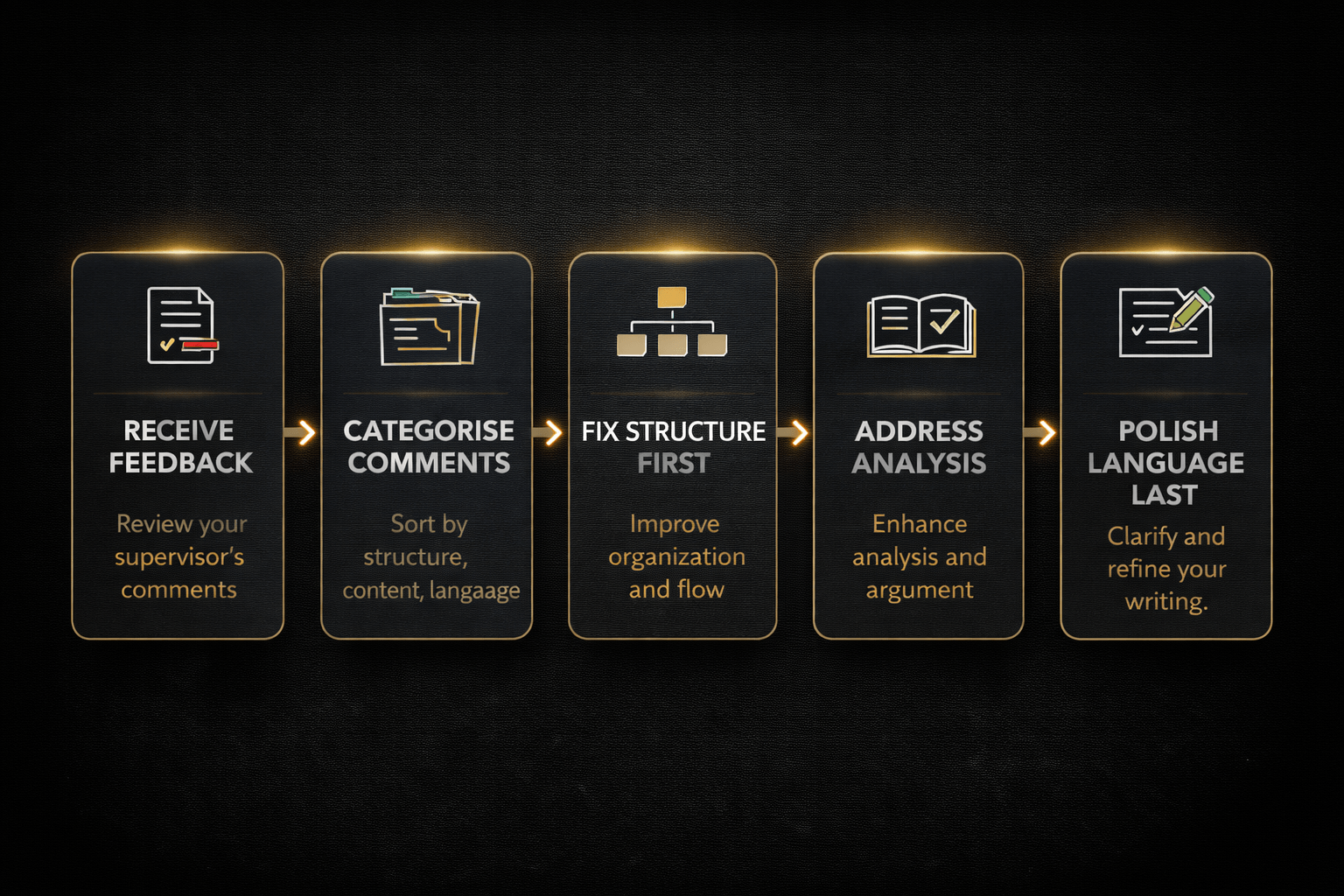
Decode This in 5 Steps
Before we get into the 9 hidden meanings, here is a quick framework. Every time you receive supervisor feedback on dissertation work, run it through these five steps first.
| Problem | Fix | Why It Works |
| Feedback feels vague or unclear | Read it once without reacting, then highlight only the action words — “develop”, “revise”, “clarify” | Removes emotional noise so you can see what is actually being asked |
| You do not know where to start | Fix structural comments first, content second, language last | Structure affects everything below it — fixing language on a broken argument wastes time |
| Same comment appears more than once | Treat it as a pattern, not a one-off — your supervisor is flagging a recurring weakness | Repeated comments mean the issue is systemic, not isolated |
| You disagree with the feedback | Write your counter-argument down, then sit on it for 24 hours before responding | Most disagreements dissolve once emotion settles — and if they do not, you now have a reasoned case |
| You have too many corrections to handle | Categorise them: structural, analytical, technical, language — then tackle one category at a time | Breaking it down makes the volume manageable and stops you from going in circles |
Why Supervisor Feedback Leaves You More Confused Than Before
Most students assume they are confused because their dissertation is bad. That is rarely the reason.
The real problem is the gap between how supervisors write supervisor feedback on dissertation documents and how students are trained to read them. Supervisors write feedback for other academics. You are not one yet — and that is completely fine, but it explains everything.
Academic feedback is designed to be evaluative, not instructional. Your supervisor is trained to identify what is wrong. They are not always trained to explain how to fix it in plain language. So you get “the argument lacks coherence” instead of “move paragraph three to the introduction and connect it to your research question.”
There is also a professional distance built into the process. Supervisors at universities like Coventry, Westminster, and Greenwich are working across multiple students, research projects, and marking criteria simultaneously. The supervisor feedback on dissertation you receive is often written under time pressure, which means it is compressed, coded, and stripped of the context you actually need.
Then there is the emotional layer. When you have spent six months on a dissertation, reading “this requires significant revision” does not feel like academic guidance. It feels like failure. And once that feeling kicks in, your brain stops processing the feedback as information and starts processing it as a verdict.
That is why so many students either over-correct — rewriting everything when only one section needed work — or under-correct — changing surface-level wording when the supervisor wanted structural changes.
Neither response actually addresses what the supervisor feedback on dissertation documents is asking for. And both cost you time you likely do not have.
Understanding why this confusion happens is the first step. The second step is knowing what your supervisor feedback on dissertation actually means when you read it.
That is what the next section covers — all nine of them.
Struggling to make sense of your supervisor’s comments? Our team works with Masters and PhD students every day — reading feedback, identifying exactly what needs fixing, and helping you act on it without second-guessing yourself.
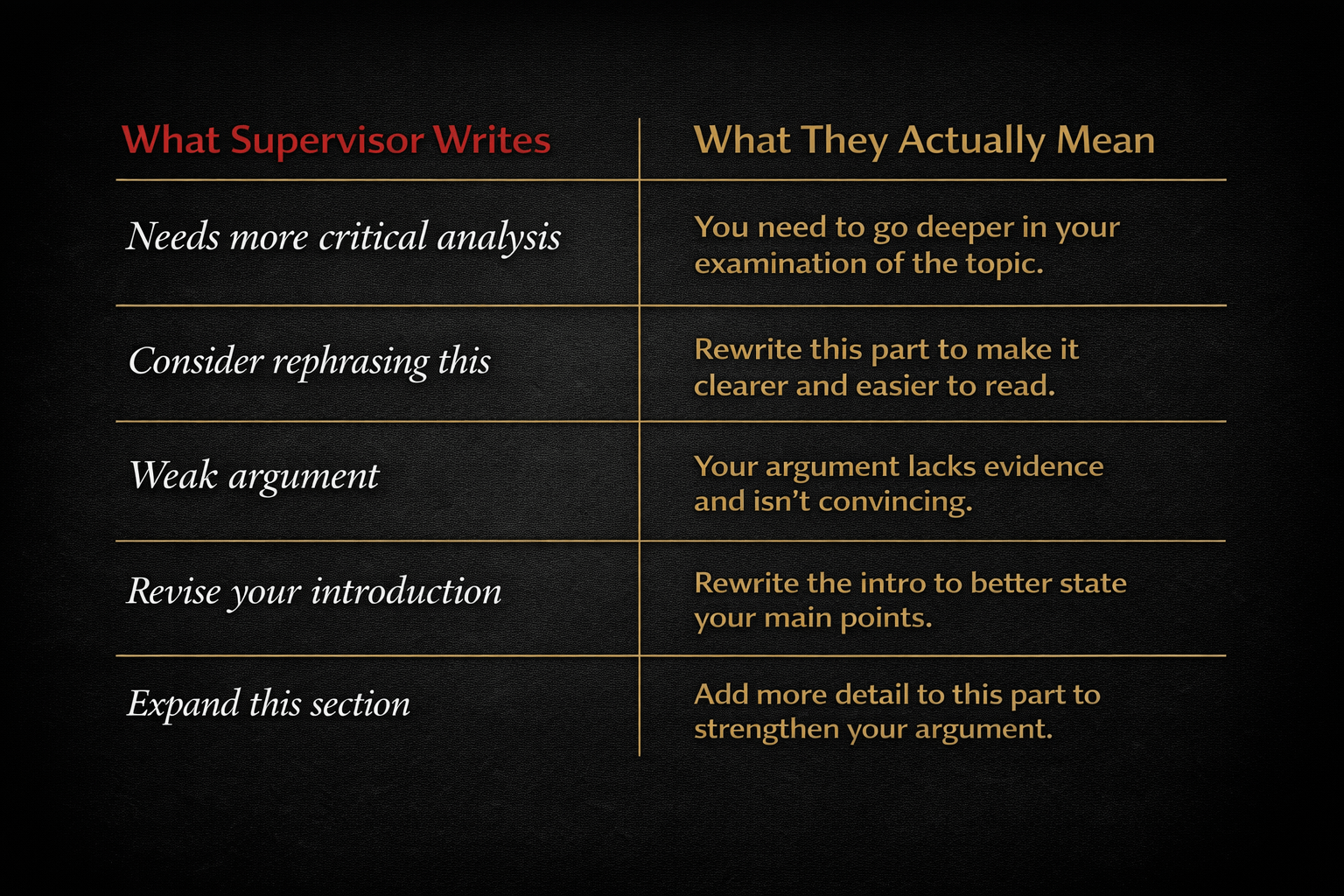
9 Hidden Meanings Behind Supervisor Feedback on Dissertation
“The theoretical framework needs substantial development”
What your supervisor wrote: “The theoretical framework needs substantial development before this can progress.”
What they actually mean: You have listed theories but not used them. Your supervisor’s feedback on dissertation chapter two shows you named three theorists and never connected them to your research question or findings. The framework exists on paper but does not do any work in the dissertation.
How to fix it: Go back to each theory you cited and write one paragraph per theory that explicitly connects it to your research question. Then check your findings chapter — every major finding should trace back to at least one theoretical lens. If it does not, your framework is decorative, not functional.
“Your argument lacks coherence throughout”
What your supervisor wrote: “Your argument lacks coherence throughout the dissertation.”
What they actually mean: Your chapters are not talking to each other. The literature review is making one case, the methodology is doing something else, and the conclusion is arriving at a point that neither of them set up. Your supervisor is not saying your individual points are wrong — they are saying the thread connecting them is missing.
How to fix it: Write a one-sentence summary of what each chapter argues. Then read those sentences in order. If they do not build on each other logically, your structure needs reworking before anything else. This is one of the most common supervisor feedback on dissertation patterns — students fix sentences instead of fixing the spine of the argument.
“The methodology chapter requires significant revision”
What your supervisor wrote: “The methodology chapter requires significant revision.”
What they actually mean: You have described what you did but not justified why you did it. There is a difference between explaining your method and defending your methodological choices. Your supervisor wants to see that you understood why your approach was the right one for your research question — not just that you followed a process.
How to fix it: When supervisor feedback on dissertation flags methodology, go through every decision — research design, data collection, sampling, analysis — and add a justification sentence that starts with “this was chosen because.” Then add a sentence acknowledging the limitation of that choice. That combination of justification plus limitation awareness is what examiners and supervisors at institutions like the University of Westminster expect at Masters and PhD level.
“This reads more like a literature review than an analysis”
What your supervisor wrote: “Chapter four reads more like a literature review than an analysis.”
What they actually mean: You are summarising sources instead of analysing data. Your findings chapter is full of “according to Smith (2019)” and “Jones (2021) argues that” — but your own voice, your own data, and your own interpretations are barely present. You have written a very long summary of what other people think instead of telling your supervisor what your research found.
How to fix it: Go through your findings chapter and highlight every sentence that references an external source. Then ask yourself — is this source supporting my finding, or is it replacing it? Every paragraph in your findings chapter should lead with what your data showed, and sources should appear only to support or contextualise that finding. If your data is leading, you are analysing. If sources are leading, you are summarising.
“You have not engaged critically with the literature”
What your supervisor wrote: “You have not engaged critically with the literature.”
What they actually mean: You are treating every source as equally valid and equally relevant. You have cited studies without questioning their methodology, their sample size, their context, or their relevance to your specific research. Critical engagement does not mean being negative — it means showing that you can evaluate a source, not just report it.
How to fix it: Pick five of your most frequently cited sources and add one critical sentence after each citation. Something like — “however, this study was conducted in a North American context and may not translate directly to the UK higher education environment.” That one sentence demonstrates critical thinking. Do that consistently and your literature review transforms from a summary into an argument.
“The scope of your study is unclear”
What your supervisor wrote: “The scope of your study remains unclear.”
What they actually mean: Your dissertation is trying to do too much, or it is not clear enough about what it is and is not covering. Your supervisor cannot tell where your study begins and ends. This usually happens when the research question is broad and the boundaries of the study were never explicitly stated.
How to fix it: Add a dedicated scope section in your introduction — three to four sentences that explicitly state what your study covers, what it does not cover, and why those boundaries were chosen. This is not a weakness. Defining scope is a sign of academic maturity and it is something supervisors across universities like Coventry and Greenwich expect to see clearly articulated.
“Your conclusions do not follow from your findings”
What your supervisor wrote: “Your conclusions do not follow logically from your findings.”
What they actually mean: You have arrived at a conclusion that your data does not actually support. This often happens when a student decides what they want to conclude early in the writing process and then writes toward it — rather than letting the findings lead. Your supervisor is telling you that the leap from what you found to what you concluded is too large and unsupported.
How to fix it: Go to your conclusions chapter and highlight every claim you make. Then go back to your findings chapter and check whether each claim is directly supported by your data. If a conclusion cannot be traced back to a specific finding, either remove it or reframe it as a recommendation for future research rather than a conclusion of this study.
“There is insufficient evidence to support your claims”
What your supervisor wrote: “There is insufficient evidence to support several of your central claims.”
What they actually mean: Your arguments are running ahead of your data. You are making strong statements — sometimes in your introduction or literature review — that your actual research does not have the evidence to back up. This is particularly common in dissertations where the student is passionate about their topic and writes with more confidence than their data warrants.
How to fix it: Audit your language. Go through your dissertation and find every instance of absolute language — “proves”, “demonstrates conclusively”, “clearly shows.” Replace each one with appropriately hedged academic language — “suggests”, “indicates”, “provides evidence that.” This is not about weakening your argument. It is about calibrating your claims to what your evidence can actually hold.
“The structure needs rethinking”
What your supervisor wrote: “The overall structure of the dissertation needs rethinking.”
What they actually mean: This is the hardest one to receive because it feels like a complete restart. But it rarely is. What your supervisor is usually saying is that the order of your argument is wrong — not that the content itself is unsalvageable. Information is appearing in the wrong chapters, sections are in the wrong sequence, and the reader cannot follow the logic of how you built your case.
How to fix it: Print your chapter headings and sub-headings on a single page and read them as a document outline. Does the story of your research make sense from that outline alone? If not, restructure at the heading level first before touching any content. Moving sections around is far less work than rewriting them — and in most cases, the content just needs to be in the right place. If you are unsure whether restructuring alone will be enough after receiving supervisor feedback on dissertation, a dissertation revision help service can save you weeks of guesswork.
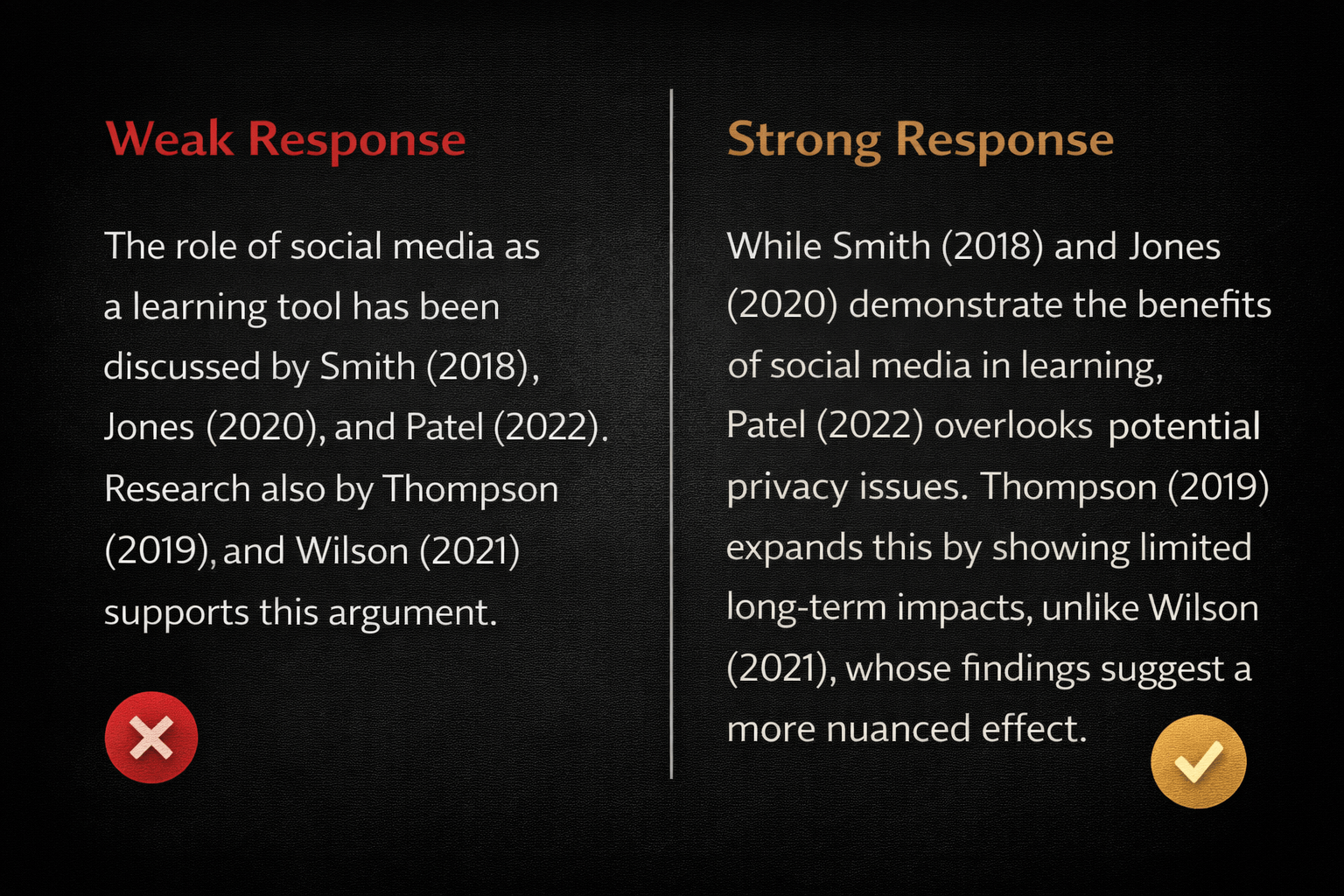
Before vs After: How Students Actually Respond to Supervisor Feedback
Most students know their response was weak only after they resubmit and get the same comments back. Here is what the difference looks like in practice.
Feedback received: “You have not engaged critically with the literature.”
| Response | |
| Weak response | Student goes back and adds more citations. Literature review gets longer. More sources, more summaries. Resubmits thinking volume equals critical engagement. |
| Strong response | Student identifies five key sources and adds evaluative commentary to each — questioning methodology, sample size, geographical relevance. Literature review stays the same length but every citation now does analytical work. |
Why the weak response fails: Adding sources without changing how you engage with them does not fix the problem. Your supervisor will send back the exact same comment because the issue was never about quantity.
Feedback received: “Your conclusions do not follow from your findings.”
| Response | |
| Weak response | Student rewrites the conclusion chapter in different words. Same claims, smoother sentences. Resubmits thinking the problem was how it was written. |
| Strong response | Student traces every conclusion back to a specific finding. Removes two conclusions that had no data support. Reframes one as a recommendation for future research instead. Conclusion chapter is now shorter but watertight. |
Why the weak response fails: Rewriting is not the same as restructuring. If the logic was broken, better sentences do not fix it — they just dress it up.
Feedback received: “The scope of your study is unclear.”
| Response | |
| Weak response | Student adds a line in the abstract mentioning the topic area. Assumes that counts as defining scope. |
| Strong response | Student adds a dedicated scope paragraph in the introduction explicitly stating what the study covers, what it excludes, and why those boundaries were set. Three sentences. Done. |
Why the weak response fails: Scope needs its own space. Burying it in the abstract or mentioning it in passing does not give your supervisor or examiner what they need to evaluate your research boundaries.
The pattern across all three is the same. Weak responses fix the surface. Strong responses fix the logic. Knowing how to respond to supervisor feedback on dissertation work is not about writing more — it is about understanding what your supervisor feedback on dissertation was actually asking for.
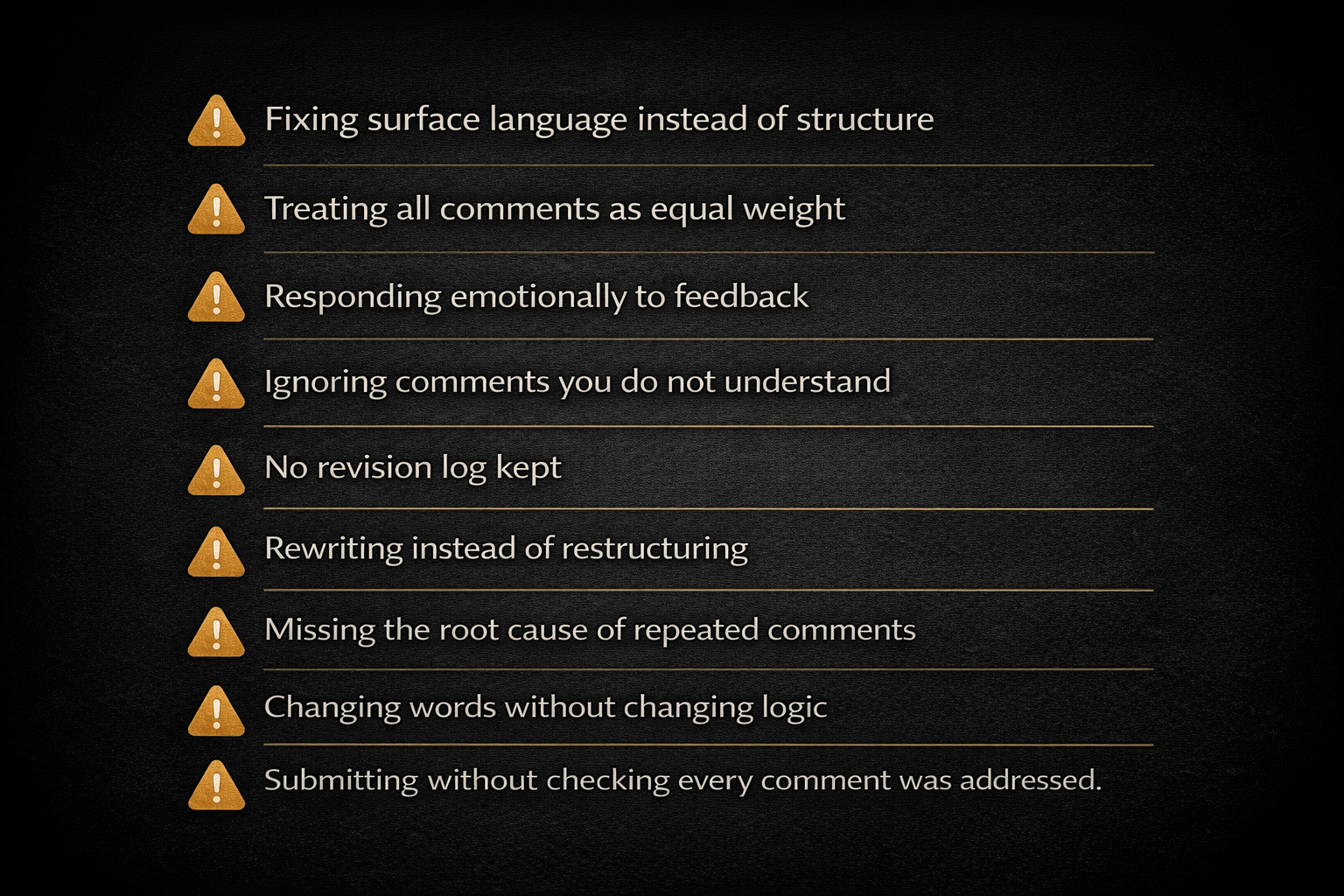
Common Mistakes Students Make When Responding to Supervisor Feedback
Receiving the feedback is only half the problem. What most students do next is where things go wrong.
Fixing everything at once
The moment the feedback lands, most students open their dissertation and start editing from page one. No plan, no categorisation, no priority order. Three hours later they have changed 40 sentences, broken two arguments that were working fine, and still have not touched the actual problem their supervisor flagged.
Fix the structure first. Then the argument. Then the language. Always in that order.
Treating every comment as equal weight
Not all supervisor comments carry the same consequence. “The theoretical framework needs substantial development” is a structural issue that affects your entire dissertation. “Check referencing consistency in chapter three” is a formatting task that takes an afternoon.
Students who treat both as equally urgent end up spending a week on references while the core argument remains broken. Read through all the feedback first, categorise by impact, then prioritise accordingly.
Responding emotionally in writing
Some students write back to their supervisor disagreeing with the feedback before they have sat with it long enough to understand it. This is almost always a mistake.
If you genuinely disagree with a comment, write your counter-argument privately first. Sleep on it. If it still holds after 24 hours, raise it professionally and specifically — not defensively. Supervisors respond well to reasoned academic pushback. They do not respond well to emotional reactions dressed up as academic argument.
Making surface changes and calling it done
This is the most expensive mistake because it costs you a resubmission cycle. A student receives supervisor feedback on dissertation saying “your argument lacks coherence” and spends three days on sentence flow and adding transition phrases. The argument is still incoherent — it just reads more smoothly now.
Coherence is a structural problem. Transitions are a language problem. Fixing the wrong layer wastes time you cannot get back, especially when deadlines are close.
Not keeping a revision log
When you resubmit, your supervisor will check whether their comments were addressed. If you cannot show — clearly and specifically — where and how each comment was acted on, you are making their job harder and your case weaker.
Keep a simple document: supervisor comment in one column, what you changed and where in the other. This takes twenty minutes to set up and saves hours of confusion during resubmission. It also shows academic professionalism, which matters more than most students realise.
Ignoring the comments they do not understand
This one is common and completely understandable — but it is also the one that gets students failed or sent back for major corrections. If a comment does not make sense, the instinct is to move past it and fix the ones that do. But the comments you do not understand are often the most important ones.
If the supervisor feedback on dissertation is genuinely unclear, contact your supervisor directly for clarification. If you cannot reach them, or if the deadline does not allow for back and forth, get a second set of expert eyes on it. Dissertation feedback help exists precisely for this situation — when the comments are real but the path forward is not.
When to Stop Doing It Yourself
There is a point where pushing through alone stops being resilience and starts being a risk to your grade. Most students cross that line without realising it.
Here is how to know you are there.
Your supervisor has flagged the same issues twice
If your second round of supervisor feedback on dissertation contains the same comments as your first round, that is not bad luck. It means your fix did not address the root problem. You changed what you thought they meant, not what they actually meant. At this point, doing it a third time the same way will produce the same result.
Your deadline is under three weeks away
Three weeks sounds like enough time. It is not — not if you have structural corrections, analytical gaps, and language issues all sitting in the same document. Dissertation revision help at this stage is not an admission of failure. It is time management with your degree on the line.
You have rewritten the same section more than twice
When you keep returning to the same section and it still does not feel right, it is usually because you are too close to it. You cannot see what is missing because you wrote it. An outside expert can identify the gap in twenty minutes that you have been circling for two weeks.
The feedback used words like “major corrections” or “not yet at the required standard”
These are not soft phrases. “Major corrections” at PhD level means your examiner found fundamental problems — not surface errors. “Not yet at the required standard” means the bar has been defined and your work is currently below it. BBoth require a clear-headed response to supervisor feedback on dissertation that is very difficult to produce when you are the one who wrote it and you are the one who just got rejected.
You are doubting whether the entire dissertation is salvageable
This feeling is almost never accurate — but it is completely paralysing. Most dissertations that feel unsalvageable to the student are actually one or two structural fixes away from being in good shape. The problem is that panic makes it impossible to see which two fixes those are.
If you are at this point — feedback in hand, deadline close, and no clear path forward — do not sit on it.
Message us on WhatsApp and tell us what feedback you received. We will tell you exactly what it means and what needs fixing. Or if you prefer, reach out through our contact page and we will get back to you with a plan.
What UK Universities Actually Expect From a Dissertation
A lot of the confusion around supervisor feedback on dissertation work comes from students not knowing the benchmark their work is being measured against.
It is not just about word count or referencing style. Universities like Coventry, Westminster, and Greenwich have specific expectations around research quality, critical thinking, and academic rigour — and supervisors write feedback with those expectations in mind, even when they do not spell them out explicitly.
At Masters level, the expectation is that you are not just reviewing existing knowledge — you are contributing something to it. Your dissertation needs to demonstrate that you can identify a gap in the literature, design a study to address it, analyse your findings with academic rigour, and draw conclusions that are supported by evidence. Every piece of supervisor feedback on dissertation around “critical engagement” or “analytical depth” is rooted in this expectation.
At PhD level, the bar is higher. Your research needs to make an original contribution to your field. Supervisors at this level are not just checking whether you followed a process — they are evaluating whether your work can withstand scrutiny from external examiners who will read it without the benefit of knowing you or your journey.
This is why dissertation feedback confusing students is so common. The feedback is written for the standard, not for the student. Your supervisor assumes you know what “theoretical coherence” means at this level. Often, you do not — and that gap is nobody’s fault, but it is your problem to solve.
Universities like Coventry run dedicated research centres precisely because academic research at this level has specific methodological and ethical standards. When supervisor feedback on dissertation flags your methodology, they are holding you to those same standards — the same ones that govern published research in your field.
The University of Greenwich similarly maintains clear research ethics and quality frameworks that feed directly into how dissertations are supervised and assessed. When feedback touches on research design or ethical considerations, it is coming from this institutional framework — not from a personal opinion about your work.
Knowing this does not make the feedback easier to receive. But it does make it easier to act on — because you can stop taking it personally and start treating it as a technical problem with a technical solution.
And technical problems, with the right help, are always fixable.
Frequently Asked Questions
What does supervisor feedback on dissertation actually mean when it says “major revisions required”?
“Major revisions required” means your dissertation has fundamental issues that go beyond language or formatting — usually structural, analytical, or methodological problems. It does not mean your dissertation is unsalvageable. It means specific sections need to be reworked at a deeper level before it meets the required standard. The first step is categorising exactly which sections were flagged and why, rather than attempting to fix everything at once.
How do I respond to supervisor feedback on dissertation work without making the same mistakes again?
Start by reading all the feedback before touching the document. Categorise comments by type — structural, analytical, language, referencing. Fix in that order. Keep a revision log so you can show your supervisor exactly where and how each comment was addressed. The most common reason students receive the same feedback twice is that they fixed the symptom instead of the cause.
How long does it take to improve a dissertation after supervisor feedback?
It depends entirely on the type of corrections. Language and referencing issues can be resolved in a few days. Structural or analytical corrections — where whole sections need reworking — can take two to four weeks if done properly. If your deadline is under three weeks away and you have more than surface-level corrections, dissertation revision help is worth considering seriously.
Can I get professional dissertation feedback help without having my work rewritten?
Yes. A good dissertation correction service will read your supervisor’s comments, explain what they mean in plain language, identify exactly what needs changing and where, and guide you through the fixes — without replacing your work with someone else’s. The goal is to make your dissertation stronger, not to replace your voice in it.
What should I do if I find supervisor feedback confusing or unclear?
First, try to identify the action word in each comment — “develop”, “revise”, “clarify”, “expand.” That tells you what type of fix is being asked for even if the reasoning is not clear. If the comment is still unclear after that, contact your supervisor for clarification. If time does not allow for that, or if you have multiple unclear comments across the dissertation, getting expert dissertation feedback help is the most efficient way to move forward without guessing.
You Have the Feedback. Now Use It.
Receiving supervisor feedback on dissertation work is not the end of the process — it is the part where the real work begins. And the students who come out of it with a stronger dissertation are not the ones who panicked and rewrote everything. They are the ones who understood what was being asked, fixed the right things in the right order, and asked for help when they needed it.
If this guide has helped you decode what your supervisor actually meant, that is a start. But understanding the problem and knowing how to fix it are two different things — especially when the deadline is close and the corrections are significant.
You do not have to figure it out alone.
If you are looking at feedback right now and still not sure where to begin — message us directly on WhatsApp and tell us what your supervisor said. We work with Masters and PhD students across the UK, Australia, Canada, and UAE every day. We will read your feedback, tell you exactly what it means, and give you a clear path forward.
If you want to know more about how we help students at every stage of the dissertation process — from improving dissertation after supervisor feedback to full dissertation editing service UK students rely on — visit our services page and see what fits your situation.
Or if you would rather talk it through first — get in touch via our contact page and we will respond within the hour.
Your dissertation is not broken. It just needs the right fix.
Related reading you may find useful: