You opened the email expecting a green light. Instead, you got three pages of comments, tracked changes everywhere, and phrases like “requires significant revision” staring back at you. You read it twice. Still confused. You are not sure if your dissertation is close to done or nowhere near it. This is exactly where most students get stuck — not because their work is bad, but because supervisor feedback on dissertation documents is rarely written to be understood at first glance. Supervisors are academics. They write feedback in academic language. And unless someone decodes it for you, you will spend weeks fixing the wrong things. This guide breaks down the 9 most common hidden meanings behind supervisor feedback on dissertation documents — what they actually mean, and exactly how to fix them. If you have received feedback that feels confusing, harsh, or impossible to act on, you are in the right place. And if you would rather have an expert look at your feedback and tell you precisely what needs doing — message us on WhatsApp right now and we will get back to you within the hour. Decode This in 5 Steps Before we get into the 9 hidden meanings, here is a quick framework. Every time you receive supervisor feedback on dissertation work, run it through these five steps first. Problem Fix Why It Works Feedback feels vague or unclear Read it once without reacting, then highlight only the action words — “develop”, “revise”, “clarify” Removes emotional noise so you can see what is actually being asked You do not know where to start Fix structural comments first, content second, language last Structure affects everything below it — fixing language on a broken argument wastes time Same comment appears more than once Treat it as a pattern, not a one-off — your supervisor is flagging a recurring weakness Repeated comments mean the issue is systemic, not isolated You disagree with the feedback Write your counter-argument down, then sit on it for 24 hours before responding Most disagreements dissolve once emotion settles — and if they do not, you now have a reasoned case You have too many corrections to handle Categorise them: structural, analytical, technical, language — then tackle one category at a time Breaking it down makes the volume manageable and stops you from going in circles Why Supervisor Feedback Leaves You More Confused Than Before Most students assume they are confused because their dissertation is bad. That is rarely the reason. The real problem is the gap between how supervisors write supervisor feedback on dissertation documents and how students are trained to read them. Supervisors write feedback for other academics. You are not one yet — and that is completely fine, but it explains everything. Academic feedback is designed to be evaluative, not instructional. Your supervisor is trained to identify what is wrong. They are not always trained to explain how to fix it in plain language. So you get “the argument lacks coherence” instead of “move paragraph three to the introduction and connect it to your research question.” There is also a professional distance built into the process. Supervisors at universities like Coventry, Westminster, and Greenwich are working across multiple students, research projects, and marking criteria simultaneously. The supervisor feedback on dissertation you receive is often written under time pressure, which means it is compressed, coded, and stripped of the context you actually need. Then there is the emotional layer. When you have spent six months on a dissertation, reading “this requires significant revision” does not feel like academic guidance. It feels like failure. And once that feeling kicks in, your brain stops processing the feedback as information and starts processing it as a verdict. That is why so many students either over-correct — rewriting everything when only one section needed work — or under-correct — changing surface-level wording when the supervisor wanted structural changes. Neither response actually addresses what the supervisor feedback on dissertation documents is asking for. And both cost you time you likely do not have. Understanding why this confusion happens is the first step. The second step is knowing what your supervisor feedback on dissertation actually means when you read it. That is what the next section covers — all nine of them. Struggling to make sense of your supervisor’s comments? Our team works with Masters and PhD students every day — reading feedback, identifying exactly what needs fixing, and helping you act on it without second-guessing yourself. See how we can help you → 9 Hidden Meanings Behind Supervisor Feedback on Dissertation “The theoretical framework needs substantial development” What your supervisor wrote: “The theoretical framework needs substantial development before this can progress.” What they actually mean: You have listed theories but not used them. Your supervisor’s feedback on dissertation chapter two shows you named three theorists and never connected them to your research question or findings. The framework exists on paper but does not do any work in the dissertation. How to fix it: Go back to each theory you cited and write one paragraph per theory that explicitly connects it to your research question. Then check your findings chapter — every major finding should trace back to at least one theoretical lens. If it does not, your framework is decorative, not functional. “Your argument lacks coherence throughout” What your supervisor wrote: “Your argument lacks coherence throughout the dissertation.” What they actually mean: Your chapters are not talking to each other. The literature review is making one case, the methodology is doing something else, and the conclusion is arriving at a point that neither of them set up. Your supervisor is not saying your individual points are wrong — they are saying the thread connecting them is missing. How to fix it: Write a one-sentence summary of what each chapter argues. Then read those sentences in order. If they do not build on each other logically, your structure needs reworking before anything else. This is one of the most
Dissertation Methodology Rejected? 7 Proven Fixes to Get Approval Fast
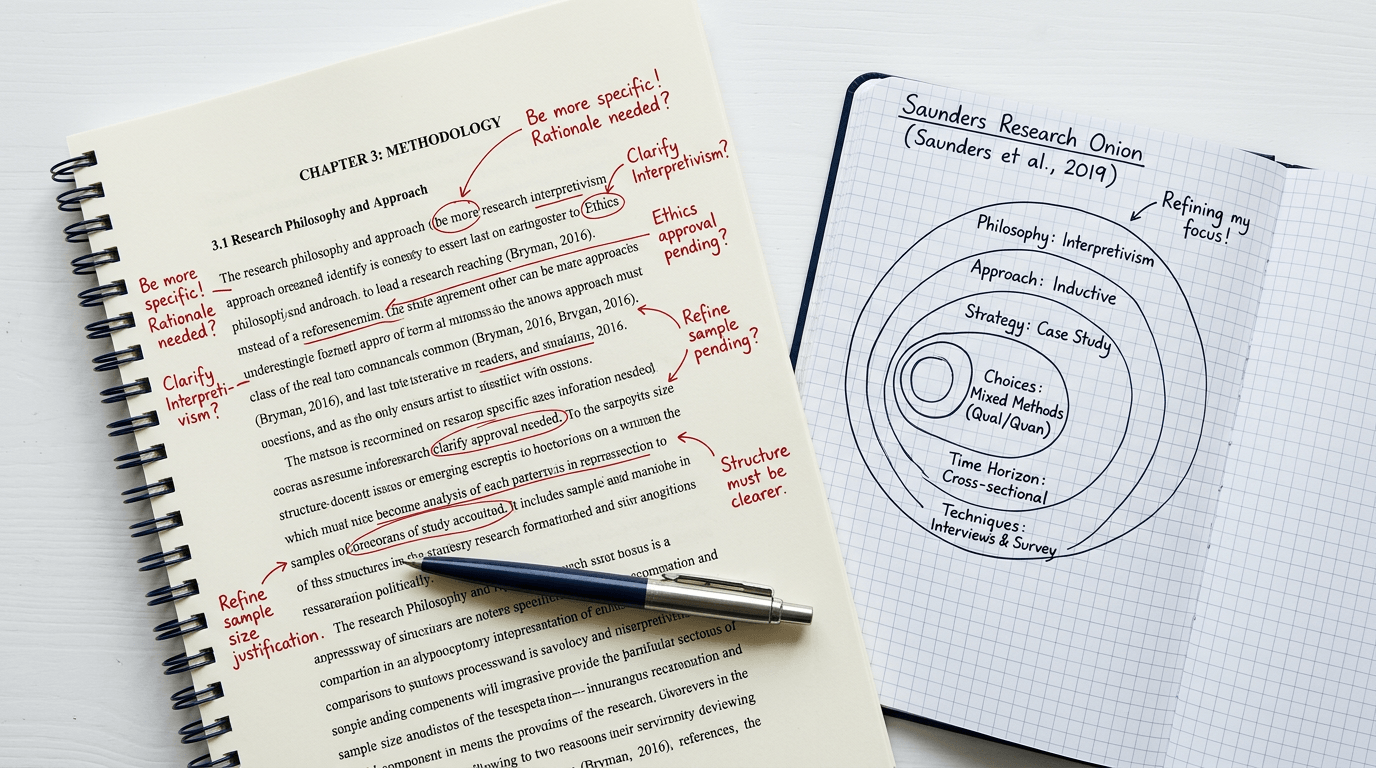
You opened your supervisor’s email expecting one word: Approved. Instead, you got: “Methodology needs major revisions.” That sinking feeling — every dissertation student knows it. And the worst part is not even the rejection itself. It is the feedback. Vague, generic, impossible to act on. “Lacks rigour.” “Weak justification.” “Rethink your approach.” You read it ten times and still cannot tell what they actually want you to change. Having your dissertation methodology rejected does not just bruise your confidence. It is one of the most common reasons students fall behind their submission timeline — and one of the most fixable, once you understand why dissertation methodology gets rejected in the first place. It pushes your entire submission timeline back by weeks. Sometimes months. And while you are stuck rewriting the same chapter, your deadline keeps moving closer. Here is what most students do not realise: methodology rejections are not random. They happen for the same reasons, across the same types of universities, in the same parts of the chapter — every single semester. Once you understand those reasons clearly, fixing them becomes far more manageable than that feedback email makes it feel. This guide gives you 7 proven fixes for a rejected dissertation methodology, a real before-and-after example, and a clear action plan you can use before your next submission. Whether you are studying in the UK, Australia, Canada, or UAE — the logic applies. If you have already read your feedback three times and still cannot see the problem, our academic support team can review your chapter and tell you exactly what needs to change. How to Fix a Rejected Dissertation Methodology in 5 Steps Before You Read Any Further Before we go deep into each fix, here is what you can do right now — even if you only have an hour. These 5 steps resolve the majority of dissertation methodology rejections. Most students skip at least two of them. Do not. Step 1: Re-read the feedback line by line — not as a whole Problem: Students skim feedback emotionally and miss the actual issue buried in the comments. Fix: Print it out. Highlight every comment. Sort each one into a category — Design issue, Justification issue, Ethics issue, or Sampling issue. Why it works: Supervisors reject methodology chapters for specific, repeatable reasons — and understanding which category your rejection falls into is the first step to fixing a rejected dissertation methodology fast. If you fix the wrong thing, you get rejected again. Step 2: Justify every choice with “because” logic Problem: You wrote what you did — not why you did it. Fix: For every methodological decision (qualitative approach, sample size, data tool), write one sentence: “Chosen because…” backed by a citation. Why it works: Examiners are not looking for description. They are looking for reasoning. One without the other gets sent back. Step 3: Place your research question and your method side by side Problem: Your method does not actually answer your research question — and your supervisor spotted it immediately. Fix: Open a blank document. Write your RQ at the top. Write your chosen method underneath. Ask yourself honestly: does this method produce data that answers this question? Why it works: Misalignment between the RQ and method is the single most common reason methodology chapters get rejected. Step 4: Add a research philosophy paragraph Problem: Your chapter jumps straight into data collection with no mention of positivism, interpretivism, or pragmatism. Fix: Add 150–200 words covering your philosophical positioning and whether your approach is inductive or deductive. Why it works: Universities across the UK, Australia, and Canada treat this as non-negotiable. Missing it signals that your research foundation is weak — regardless of how good the rest of the chapter is. Step 5: Rewrite your ethics section as specific risk management — not a formality Problem: Ethics sections that say “ethical approval was obtained” and nothing else get flagged instantly. Fix: Write specifically about informed consent, anonymity, data storage under GDPR, right to withdrawal, and any sensitive topic handling. Why it works: A vague ethics paragraph tells your supervisor you treated it as a checkbox. A specific one tells them you understood the actual responsibilities involved. If you have already done all five of these and still received a rejection — the issue goes deeper than structure. Keep reading. Why Your Dissertation Methodology Gets Rejected — Real Reasons Students Miss Every Time Most students assume methodology rejection happens because of poor writing. It does not. It happens because of logic gaps — and these gaps are the core reason why dissertation methodology gets rejected at every level, from undergraduate final-year projects to Masters submissions. Places where your supervisor cannot trace a clear line from your research question to your method, or from your method to your data. Once that gap is visible, the entire chapter loses credibility — regardless of how well the individual sentences are written. Universities like Coventry University and University of Westminster publish postgraduate research expectations that make one thing very clear: methodology is not just a chapter. It is the academic argument for why your research can be trusted. If that argument has holes, approval will not come — no matter how many times you resubmit. Here are the real reasons your dissertation methodology gets rejected — the ones supervisors rarely spell out in their feedback. Your method does not match your research question This is the most common reason dissertation methodology gets rejected — and the least obvious one to spot yourself because the misalignment is rarely visible from inside the chapter. You chose qualitative interviews — but your research question is asking for measurable trends across a population. Or you designed a survey — but your topic requires deep exploration of lived experience. Either way, your supervisor sees the mismatch in the first two minutes of reading. The fix is not to change your research question. It is to reverse-engineer your method from the data your question actually needs.
Mastering Dissertation Methodology UK: A Practical Guide for Students to Get It Right
Of all the chapters in a dissertation, the methodology is the one UK students most consistently underestimate — and most frequently get wrong. It is not the longest chapter. It is not the most research-intensive. But it is the chapter examiners scrutinise most carefully — because a flawed methodology does not only damage one section. It casts doubt over your entire study. Your findings become questionable. Your conclusions lose weight. And months of research begin to feel less credible than they should. The reason most students struggle with dissertation methodology UK universities expect is not a lack of effort. It is a lack of clarity — about what the chapter needs to demonstrate, how each decision connects to the next, and why justification matters more than description alone. Supervisor rejection at the methodology stage is more common than most programmes openly acknowledge. Students describe what they did without explaining why. They choose research designs that sound appropriate without aligning them to their research questions. And they discover the problem only when feedback arrives — often when time is already short. This guide changes that. Whether you are writing a Masters, MBA, or undergraduate dissertation, this practical breakdown covers every component of the methodology chapter — with clear structure, real examples, and guidance built around what UK universities actually expect. If you have not already read our guides on common dissertation mistakes and MBA dissertation help, those are worth reviewing alongside this one. What Is a Dissertation Methodology Chapter? The methodology chapter is the section of your dissertation where you explain how you conducted your research — and more importantly, why you made those specific choices. It is not a log of actions taken. It is a justified, academically grounded argument for why your research approach is the most appropriate one for the questions you are investigating. Definition of Methodology in Dissertation In simple terms, methodology refers to the overall framework that governs your research process. It covers your philosophical stance, your approach to reasoning, your research design, how you collected data, how you analysed it, and how you handled ethical responsibilities throughout. Every element must connect logically to the one before it. Purpose of the Methodology Section The purpose of this chapter is twofold — to demonstrate that your research was conducted rigorously, and to give your examiner enough detail to evaluate and, in principle, replicate your study. A methodology chapter that only describes what you did without justifying why leaves examiners with unanswered questions. Those unanswered questions become lost marks. Why Methodology Is Important in UK Universities UK universities place significant weight on the methodology chapter because it directly determines the credibility of your findings. A well-justified methodology signals academic maturity. A weak one — regardless of how strong your analysis is — raises doubts about the validity of everything built on top of it. Methodology vs Methods — Common Confusion These two terms are frequently used interchangeably, but they are not the same. Methodology is the broader framework — the reasoning behind your approach. Methods are the specific tools and techniques used within that framework, such as surveys, interviews, or statistical analysis. Confusing the two is a common mistake that weakens the academic rigour of the chapter Why Mastering Methodology Matters for UK Students Methodology is not just another chapter to complete and move past. For UK university examiners, it is one of the clearest indicators of whether a student genuinely understands their own research — or simply went through the motions of producing one. Methodology Weightage in UK Marking Criteria Across most UK universities, the methodology chapter carries between 20 and 25 percent of the total dissertation mark. That alone makes it one of the highest-weighted individual sections in the entire submission. More significantly, a weak methodology has a multiplier effect — it actively reduces confidence in your findings and analysis chapters too, even when those chapters are well written. Supervisor Expectations in UK Universities UK supervisors expect you to demonstrate independent academic thinking in your methodology — not a textbook recitation of research definitions. They want to see that you understood your options, evaluated them against your specific research questions, and made deliberate, justified choices. Vague or generic methodology chapters are among the most common reasons supervisors request revisions before approving a dissertation for submission. How Weak Methodology Leads to Low Grades The damage caused by a weak methodology chapter rarely stays contained within that chapter alone. If your research design is unjustified, your data collection method becomes questionable. If your sampling strategy is weak, your findings lack credibility. Examiners follow this chain — and they will flag every point where the logic breaks down. Common Feedback Students Receive The most frequently repeated supervisor feedback on methodology chapters across UK universities includes the following — no clear justification for the chosen research philosophy, insufficient explanation of why qualitative or quantitative design was selected, missing or inadequate ethics section, no acknowledgement of research limitations, and sample size decisions presented without academic reasoning. If any of these sound familiar, the sections ahead address each one directly. For a broader picture of where dissertation students typically go wrong, our guide on common dissertation mistakes covers the full pattern in detail. Standard Dissertation Methodology Structure (UK Format) Before diving into individual components, it helps to see the full picture. A well-structured dissertation methodology chapter in UK format follows a consistent logical sequence — each section building on the one before it. Jumping straight into data collection methods without first establishing your research philosophy is one of the most common structural errors UK students make. Here is the standard structure your methodology chapter should follow. Research Philosophy Your research philosophy establishes the foundational assumptions that underpin your entire study — specifically, how you believe knowledge is created and what counts as valid evidence. This is where your chapter begins because every decision that follows flows from this position. Research Approach Your research approach determines the direction of your reasoning —

MBA Dissertation Help: Topics, Structure & Expert Support
An MBA dissertation is one of the most demanding academic milestones a postgraduate student will face. Whether you are enrolled at a university in the United Kingdom, Australia, Canada, Germany, Ireland, or the UAE, the expectations remain consistently high — original research, rigorous methodology, and a compelling argument that demonstrates genuine business acumen. Yet for most MBA students, the challenge is not intelligence. It is time, direction, and the pressure of balancing coursework, professional commitments, and an independent research project simultaneously. This guide walks you through everything you need to know — from understanding what an MBA dissertation actually entails, to selecting a strong topic, building a solid structure, and knowing when expert MBA dissertation help can make the difference between a pass and a distinction. If you are already certain you need professional support, explore our MBA Dissertation Writing Services and get started today. H2 1 — What Is an MBA Dissertation? What Is an MBA Dissertation? An MBA dissertation is a substantial, independent research project completed as part of a Master of Business Administration programme. Unlike standard coursework assignments, a dissertation requires you to identify a real-world business problem, review existing academic literature, design a research methodology, collect and analyse data, and present findings that contribute meaningfully to your field of study. Most universities require MBA students to produce a dissertation of between 12,000 and 20,000 words, depending on the institution and programme structure. It is typically completed in the final year of study and carries significant weight towards your overall degree classification. The dissertation tests not only your subject knowledge but your ability to think independently, manage a long-term project, and communicate complex ideas with clarity and precision — skills that are equally valued in the boardroom. MBA Dissertation vs MBA Thesis — What Is the Difference? The terms dissertation and thesis are frequently used interchangeably, but there is a meaningful distinction worth understanding. An MBA dissertation is primarily applied in nature. It focuses on investigating a real business problem using existing theories and frameworks — your contribution lies in the analysis, interpretation, and recommendations you produce. An MBA thesis, by contrast, is more theoretical and aims to generate new knowledge or challenge existing academic thinking. It is more common in research-focused programmes and PhD pathways. For most MBA students at universities in the UK, Australia, and Canada, the requirement is a dissertation — though some institutions use the term thesis to mean the same thing. Always confirm with your programme handbook. How Long Is an MBA Dissertation? Programme Type Typical Word Count Full-time MBA (UK/Australia) 15,000 – 20,000 words Part-time or Executive MBA 12,000 – 15,000 words MBA Top-Up Dissertation Only 8,000 – 12,000 words MBA Dissertation Proposal 1,500 – 3,000 words These are general benchmarks. Your university’s programme handbook is always the definitive source — word count requirements vary significantly between institutions. H2 2 — Why MBA Students Struggle With Their Dissertation Why MBA Students Struggle With Their Dissertation The MBA dissertation is not simply a longer version of an assignment. It is a sustained, independent research project that demands a different level of academic rigour, self-discipline, and subject expertise. Understanding where most students struggle is the first step towards avoiding the same pitfalls. Time Constraints and Academic Pressure Most MBA students are not studying in isolation. Many are working professionals managing full-time roles, family responsibilities, and multiple coursework deadlines simultaneously. The dissertation sits on top of all of that — requiring weeks of focused reading, data collection, writing, and revision. Procrastination at the early stages is the single most common reason students find themselves in crisis closer to submission. By the time the pressure becomes acute, the timeline for quality work has already collapsed. Choosing the Right Research Methodology Methodology is where a significant number of MBA dissertations lose marks — not because students lack intelligence, but because the choice of research design is made without a clear understanding of what each approach demands. Selecting a quantitative methodology without access to sufficient data, or choosing qualitative interviews without a clear sampling strategy, leads to structural weaknesses that are difficult to correct at the writing stage. Your methodology must align with your research questions from the outset — not be retrofitted afterwards. Narrowing Down Your Research Topic A topic that is too broad produces a dissertation that is shallow and unfocused. A topic that is too narrow produces one with insufficient literature to support a meaningful literature review. Finding the right scope — a specific, researchable question within a clearly defined industry, geography, or business function — is genuinely difficult without prior research experience. Most students either overestimate what is achievable within the word count or underestimate how much depth a strong dissertation requires. If you are finding it difficult to identify a focused, viable topic, our team can help you narrow your research scope effectively. Explore our MBA Dissertation Writing Services to get started. H2 3 — MBA Dissertation Structure: A Complete Chapter Breakdown MBA Dissertation Structure — A Complete Chapter Breakdown A well-structured dissertation is not merely a formatting requirement — it is the backbone of your argument. Each chapter serves a distinct purpose, and the strength of your dissertation depends on how logically and cohesively these chapters connect with one another. Below is a standard MBA dissertation structure followed by universities across the UK, Australia, Canada, and most international institutions. Chapter 1 — Introduction and Research Objectives The introduction establishes the foundation of your entire dissertation. It should clearly articulate the research problem, explain why it is worth investigating, and outline the specific objectives or research questions your dissertation will address. A strong introduction also provides a brief overview of the industry or business context, justifies your chosen scope, and concludes with a signposting paragraph that guides the reader through the remaining chapters. Key components: Background and context of the research problem Research aim, objectives, and questions Significance and rationale of the study Brief outline of dissertation structure Chapter 2 —
10 Common Dissertation Mistakes That Make Students Fail (And How to Avoid Them)
Common Dissertation Mistakes That Cause Students to Fail Imagine spending six months researching, writing, and revising your dissertation — only to open your results and see a failing grade. It happens more than you think. Studies show that nearly 19.5% of university students in the UK fail their dissertation — not because they lacked intelligence, but because they fell into the same traps that hundreds of students before them did. Small, avoidable common dissertation mistakes that snowball into serious academic consequences. From choosing the wrong research topic to ignoring referencing guidelines, these dissertation mistakes are rarely taught in classrooms — which is exactly why so many students get blindsided. Whether you are an undergraduate writing your first major paper or a postgraduate chasing distinction, this guide is for you. Here, we cover the 10 most critical dissertation mistakes that cause students to fail, why they happen, and — most importantly — exactly what you can do to avoid them before it is too late. What Makes a Dissertation Fail? A dissertation does not fail because of one catastrophic error. It fails because of several small, overlooked mistakes that quietly pile up over months of work — and by the time most students realise what went wrong, it is already too late to fix them. University examiners assess your dissertation from multiple angles simultaneously. They look at the quality of your research, the strength of your central argument, the accuracy of your referencing, and whether your conclusions actually answer the research questions you set out at the beginning. Falling short on even two or three of these fronts can bring your entire grade down significantly — even if the rest of your work is strong. Poor Research Design The foundation of any successful dissertation is its research design. If your methodology is weak or poorly justified, examiners will question the validity of your entire study — not just the methodology chapter. Many students pick a research method simply because it seems the easiest option, not because it genuinely suits their research questions. This is one of the most damaging common dissertation mistakes a student can make, and it almost always shows in the results and analysis chapters. Weak Thesis Statement Your thesis statement tells your examiner exactly what your dissertation is arguing, exploring, or proving. A vague, generic, or descriptive thesis statement sets the wrong tone for the entire paper — and experienced examiners will flag it within the first few pages. Every chapter of your dissertation should connect directly back to your thesis. If your thesis is weak, your entire structure suffers as a result. Ignoring University Guidelines Every university provides a dissertation handbook outlining word count limits, formatting requirements, referencing styles, and submission deadlines. Most students skim it once at the start and never look at it again. This is a costly mistake. These guidelines are non-negotiable — ignoring even one of them can result in direct mark deductions or outright failure, regardless of how strong your actual research and writing are. 10 Common Dissertation Mistakes Students Make Understanding what makes a dissertation fail is one thing — but knowing the specific mistakes to watch out for is what actually protects your grade. Below are the 10 most common dissertation mistakes that cause students across the UK, Australia, and Canada to fall short of the mark they worked so hard for. 1. Choosing a Topic That Is Too Broad or Too Narrow One of the earliest and most damaging dissertation mistakes happens before a student even opens a Word document — choosing the wrong topic. A topic that is too broad means your research will lack focus and depth. You will end up scratching the surface of multiple areas instead of exploring one properly, leaving your examiner with the impression that your work is shallow and unfocused. On the other hand, a topic that is too narrow leaves you with very little existing research to engage with, making it nearly impossible to write a strong literature review or build a well-supported argument. The ideal dissertation topic sits in the middle — specific enough to be manageable within your word count, and broad enough to have sufficient academic literature and research surrounding it. How to Choose the Right Dissertation Topic Start by identifying a genuine gap in existing research within your subject area. Run a quick literature search before committing to your topic — if you cannot find at least five credible, relevant academic sources within 20 minutes of searching, your topic is likely too narrow. Speak to your supervisor early in the process and get their input before finalising your decision. A topic your supervisor is familiar with will also mean better guidance throughout your dissertation journey. 2. Weak or Missing Thesis Statement Your thesis statement is the backbone of your entire dissertation. It tells your examiner exactly what you are arguing, exploring, or proving — and every single chapter that follows should connect directly back to it. Without a strong thesis statement, your dissertation has no clear direction, and your examiner will feel that lack of focus in every chapter they read. A weak thesis statement is vague, overly broad, or simply descriptive. It does not take a clear position or outline the specific direction of your research. This is one of the most common dissertation mistakes because many students genuinely confuse a thesis statement with a topic sentence — they describe what they are writing about rather than what they are actually arguing. A missing thesis statement is even more damaging. Some students bury their research purpose so deep within their introduction that examiners struggle to identify it at all. This immediately signals poor academic writing and a lack of structural clarity. What a Strong Thesis Statement Looks Like A strong thesis statement is specific, debatable, and directly researchable. Compare these two examples: Weak: “This dissertation explores the relationship between social media and mental health among university students.” Strong: “This dissertation argues that excessive social
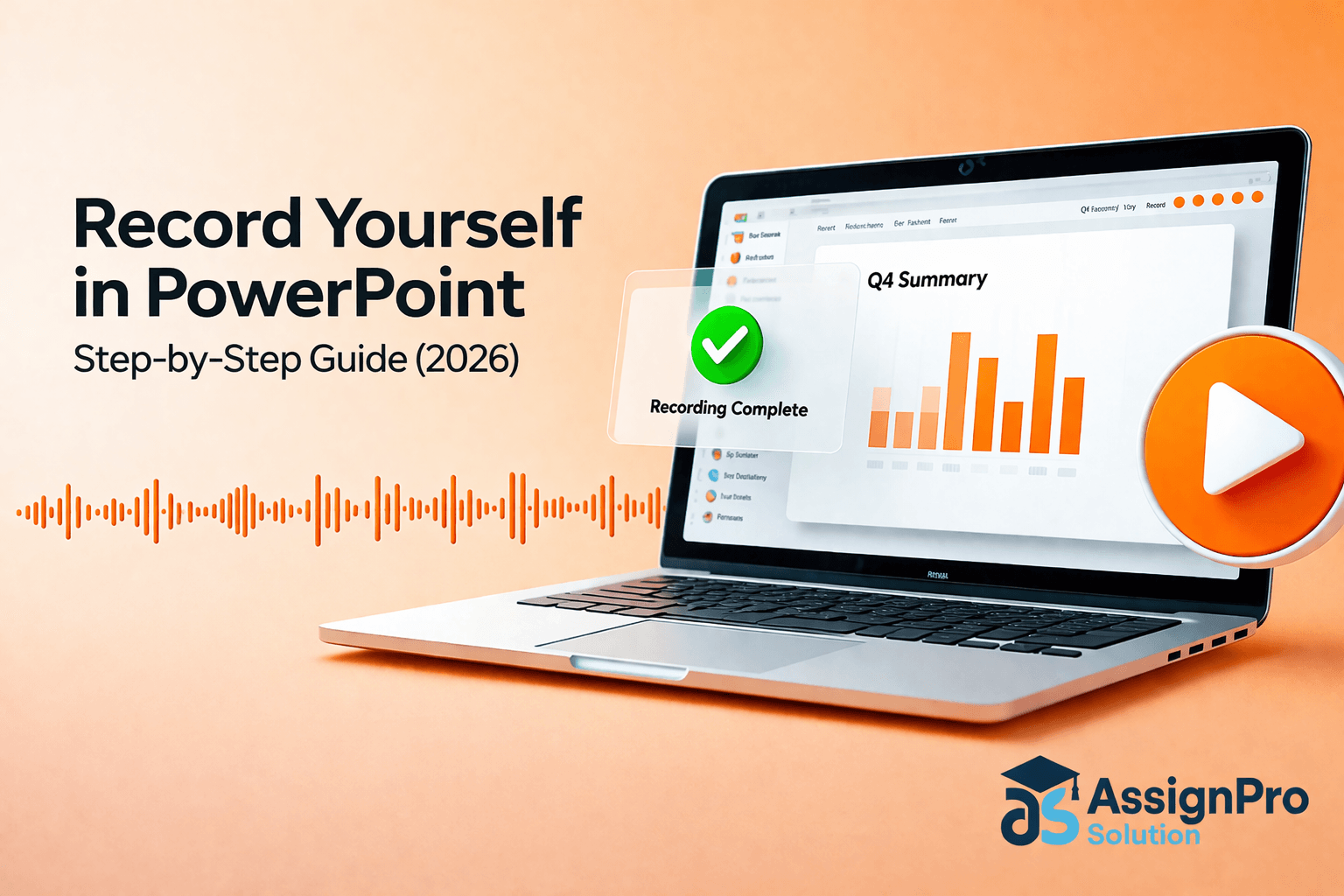
How to Record Yourself in PowerPoint: 7 Easy Steps (2026)
Introduction Picture this: Your professor just assigned a video presentation due in 48 hours. You’ve got your slides ready. But now you’re staring at your screen wondering how to record yourself in PowerPoint without looking like a complete amateur. Sound familiar? Whether you’re studying in the UK, Australia, Canada, Germany, or anywhere else, video presentations have become a standard university requirement. From recorded lectures to assessed presentations, knowing how to record yourself in PowerPoint is no longer optional — it’s essential. The good news? PowerPoint has a built-in recording feature that captures your face, voice, and slides simultaneously. No expensive software needed. No complicated editing required. This 2026 guide walks you through exactlyhow to record yourself in PowerPoint— from setup to submission. You’ll learn the step-by-step process for Windows 11 and Mac, discover how to troubleshoot common errors, and pick up professional tips that make your recordings stand out. By the end, you’ll record video presentations with confidence. Let’s get started. Definition Box: Recording yourself in PowerPoint means capturing your webcam video and audio while presenting your slides — all within PowerPoint’s built-in Record feature. This creates a professional video presentation without needing any external software. Table of Contents Why University Students Struggle to Record Themselves in PowerPoint What You Need Before You Start How to Record Yourself in PowerPoint — Step by Step (Windows 11) How to Record Yourself in PowerPoint on Mac How to Record PowerPoint With Webcam and Slide at Same Time Common Errors When Recording in PowerPoint — And How to Fix Them How to Export and Submit Your PowerPoint Recording Tips to Look and Sound Professional on Camera Frequently Asked Questions Why University Students Struggle to Record Themselves in PowerPoint Most students don’t struggle because recording is hard. They struggle because nobody taught them the basics. Here’s what typically goes wrong: They can’t find the Record tab — Many students use outdated PowerPoint versions or don’t know where Microsoft hid the recording feature. Their webcam doesn’t appear — Privacy settings, driver issues, or simple toggle mistakes block the camera feed. Audio sounds terrible or doesn’t record at all — Microphone permissions and input settings trip up even tech-savvy students. They don’t know how to add themselves to PowerPoint presentation — The webcam overlay feature isn’t obvious without guidance. File sizes explode — Students record high-resolution videos that exceed university submission limits. These problems waste hours. Students who structure their university assignments properly often neglect presentation planning entirely. The solution? Follow a proven process. That’s exactly what this guide provides. What You Need Before You Start Before you learn how to record yourself in PowerPoint, gather these essentials. Missing even one item creates problems mid-recording. Hardware Requirements Webcam — Built-in laptop cameras work fine. External USB webcams offer better quality. Microphone — Your laptop’s built-in mic works for basic recordings. USB microphones or headset mics dramatically improve audio clarity. Stable surface — Shaky cameras look unprofessional. Use a laptop stand or steady desk setup. Software Requirements Microsoft PowerPoint 2016 or later — The Record feature requires PowerPoint 2016, 2019, 2021, or Microsoft 365. Older versions lack webcam integration. Windows 10/11 or macOS — Both operating systems support PowerPoint recording with webcam. Updated drivers — Ensure your webcam and microphone drivers are current. Pre-Recording Checklist Close unnecessary programs (they slow your computer) Plug in your laptop (recording drains battery fast) Check internet connection (OneDrive auto-save needs it) Test webcam in another app first Verify microphone input levels How to Record Yourself in PowerPoint — Step by Step (Windows 11) This section teaches you exactly how to record yourself in PowerPoint on Windows 11. Follow each numbered step precisely for best results. These instructions work for PowerPoint 2021 and Microsoft 365. Minor interface differences exist in older versions. Step 1: Open Microsoft PowerPoint Launch PowerPoint from your Start menu or desktop shortcut. Wait for the application to fully load before proceeding. If PowerPoint opens slowly, close other programs consuming memory. Step 2: Create or Open Your Presentation Click “Open” to load an existing presentation, or select “New” to create fresh slides. For university presentations, your slides should already be complete before recording. Don’t build slides and record simultaneously. Ensure your presentation is saved before recording begins. Step 3: Click the Record Tab Look at the top ribbon menu. Click the “Record” tab. This tab contains all tools needed to record yourself in PowerPoint with webcam and audio. Warning: If you don’t see the Record tab, your PowerPoint version may be outdated. Check our troubleshooting section below. Step 4: Click the Record Button Inside the Record tab, you’ll see a large “Record” button (or “Record Slide Show” in some versions). Click it. PowerPoint opens the recording interface. This full-screen mode shows your slides with recording controls. Step 5: Check Your Webcam Preview Look for the webcam preview window. It typically appears in the bottom-right corner of your screen. You should see yourself on camera. If your face appears, the webcam is working correctly. If no preview appears, your camera may be disabled. Click the camera icon to toggle it on. Step 6: Test Your Microphone Before recording, verify your microphone works. Click the microphone icon in the recording toolbar. Some versions show audio level meters — speak normally and watch for movement. If levels don’t move, your mic input isn’t detected. Check your system sound settings. Warning: Recording without testing audio first is the #1 mistake students make. Always test before important recordings. Step 7: Toggle Camera and Microphone ON Ensure both camera and microphone icons show as enabled (not crossed out). The webcam icon controls your video feed. The microphone icon controls audio recording. Both must be active to record yourself in PowerPoint with webcam and audio simultaneously. Step 8: Position Your Recording Window Drag the webcam preview to your preferred corner. Most presenters place it bottom-right. Resize the preview window if needed. Make it large enough to see clearly but small enough to avoid blocking important

Does Turnitin Detect AI Writing? 7 Shocking Answers Every UK Student Desperately Needs
Does Turnitin detect AI writing? Yes — but not in the way most UK students expect. It doesn’t just catch copy-pasted ChatGPT responses. It analyses your writing patterns, sentence rhythm, and word predictability to generate an AI score. And that score is now sitting in front of your lecturer before you even know it’s there. Since Turnitin launched its AI detection feature in 2023, UK universities have been switching it on quietly. Some students have been flagged for work they genuinely wrote themselves. Others submitted AI-heavy essays and heard nothing back. That inconsistency is exactly what makes this so stressful. This guide gives you 7 real answers — covering how the detector actually works, its accuracy rate in 2025, what triggers a red flag, and what UK universities are doing with those scores right now. If you’ve used AI in any form — even just for research or grammar — read this before your next submission. According to Turnitin’s official AI detection page, the tool was specifically built to identify content generated by large language models including ChatGPT and GPT-4. Already worried about how universities treat AI use beyond Turnitin? Read our detailed guide on AI in UK Academia: What Universities Allow vs What They Penalise. Table of Contents What Is Turnitin’s AI Detection Tool and How Does It Work? How Accurate Is Turnitin AI Detection in 2025? Can Turnitin Detect ChatGPT and Other AI Tools? What Percentage Score Should UK Students Worry About? Can Universities Detect ChatGPT Essays Beyond Turnitin? Is Using AI for Essays Cheating? UK Rules Explained What Should UK Students Do If Their Work Gets Flagged? 1. What Is Turnitin’s AI Detection Tool and How Does It Actually Work? Turnitin didn’t build its AI detector overnight. The company spent years training it on millions of human-written and AI-generated texts before launching it in April 2023. Since then, it has been updated multiple times. And UK universities have been quietly switching it on — often without telling students directly. But most students still don’t know what it’s actually looking for. How Does Turnitin Detect AI Writing — The Technology Behind It Turnitin’s AI detector doesn’t search the internet for matching text. That’s the plagiarism checker’s job. This is something different entirely. It analyses the probability patterns inside your writing. AI language models like ChatGPT generate text by predicting the most likely next word, every single time. That creates a very specific rhythm — sentences that feel smooth, consistent, and almost too clean. Turnitin’s tool is trained to spot exactly that pattern. It looks at three things specifically: Sentence predictability — how expected each word choice is statistically Stylistic consistency — human writing has natural variation, AI writing doesn’t Perplexity and burstiness — how surprising and uneven the text feels overall The output is a single percentage score showing what portion of your submitted text appears AI-generated. Does Turnitin detect AI writing? It analyses sentence predictability, word choice patterns, and stylistic consistency to identify text likely generated by tools like ChatGPT or GPT-4 — producing a percentage score visible to your lecturer. Is Turnitin AI Detection Different From Its Plagiarism Checker? Yes — and this confusion catches students off guard more than anything else. The plagiarism checker compares your text against a database of existing sources — websites, academic journals, previously submitted papers. It is looking for matching text. The AI detector doesn’t compare against anything external. It analyses the writing itself — the structure, the rhythm, the pattern. Two completely separate systems running simultaneously on the same submission. This means your work can be: 0% plagiarism but 80% AI-generated Fully original in sources — and still flagged They are not the same tool. They don’t measure the same thing. Treating them as one is a costly mistake. Want to understand how UK universities are responding to AI submissions beyond Turnitin? Read our full breakdown of AI in UK Academia: What Universities Allow vs What They Penalise. 2. How Accurate Is Turnitin AI Detection in 2025? This is the section most blogs skip. They tell you Turnitin detects AI — but nobody talks about how often it gets it wrong. The honest answer? It’s not perfect. Not even close. What Do the Numbers Actually Say About Turnitin AI Detector Accuracy? Turnitin claims its AI detection tool has a 98% accuracy rate for identifying AI-generated text. That sounds reassuring — until you read the small print. That figure applies to fully AI-written content. Meaning someone opened ChatGPT, typed a prompt, copied the output word for word, and submitted it unchanged. Real student work doesn’t look like that. Most students mix AI with their own writing. They use it for research, for restructuring paragraphs, for fixing grammar. That’s where Turnitin’s accuracy drops — and drops significantly. Independent researchers have found error rates climbing when content is: Partially AI-written or heavily edited after generation Written by non-native English speakers Formal and structured in academic style How accurate is Turnitin AI detection? Turnitin claims 98% accuracy on fully AI-generated text, but accuracy drops considerably on mixed or edited content — raising serious concerns about false positives for international and non-native English speaking students. Turnitin AI Detection False Positives — Can It Flag Innocent Students? Yes. This is documented, not speculation. Turnitin itself admits its tool can produce false positives. Their own guidelines state that a high AI score alone should never be used as proof of academic misconduct. Students who write in a structured, formal academic style have reported being flagged incorrectly. Non-native English speakers are at higher risk because their writing patterns can unintentionally mirror AI output. If your work gets flagged, it doesn’t automatically mean you’re guilty. UK universities are required to investigate further before taking any action. This is exactly why sample-based academic help is safer than AI-generated content — human-written work simply doesn’t carry this risk. 3. Can Turnitin Detect ChatGPT and Other AI Tools? This is the question students search most. The answer is yes —
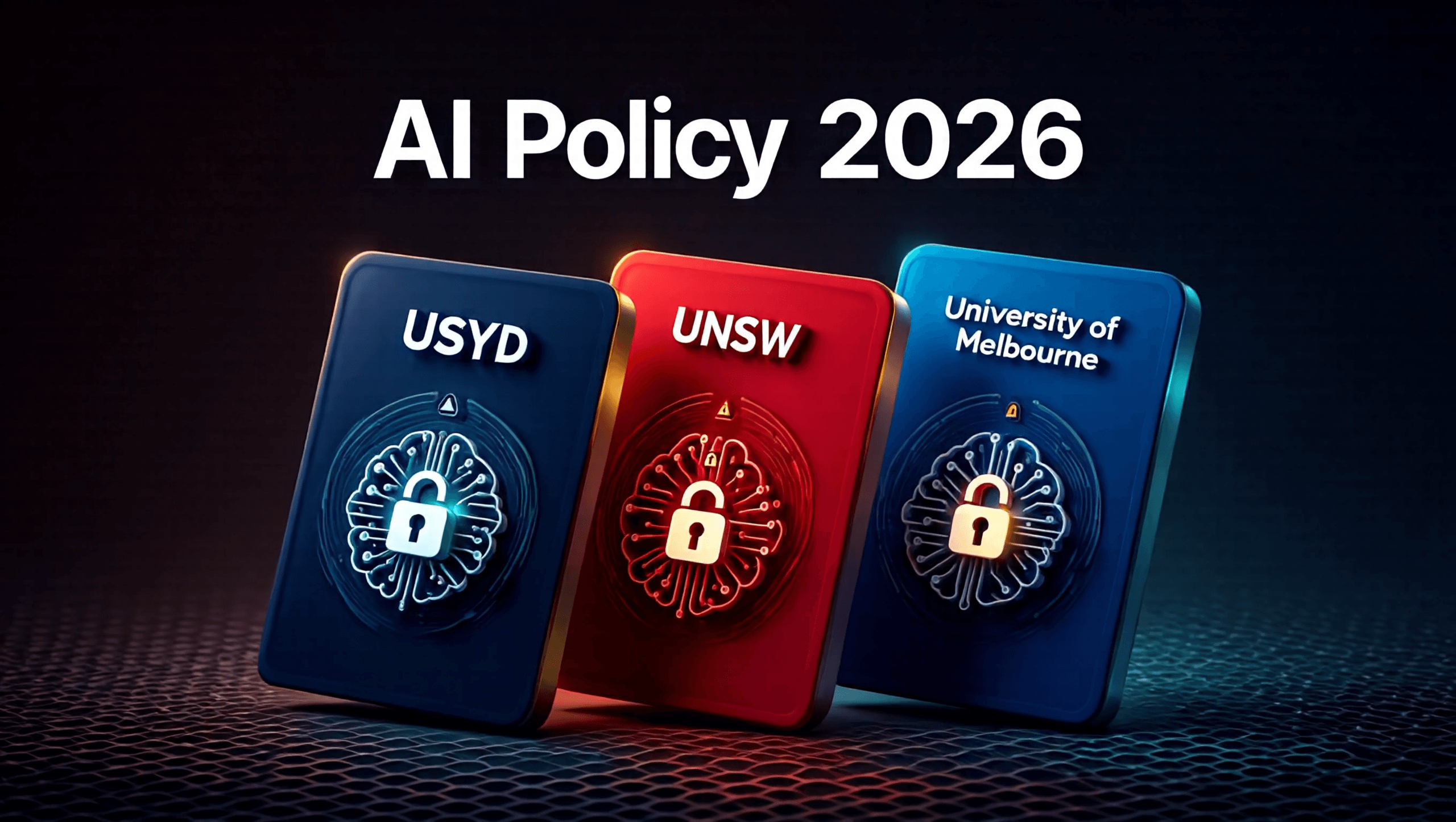
AI Policy Australian Universities 2026: USYD, UNSW & Melbourne Brutally Compared
AI policy Australian universities enforce in 2026 has become one of the most consequential issues facing students today. Three years ago, most institutions had no formal position on generative AI. By 2026, that gap has been filled with structured frameworks, disclosure requirements, and active misconduct enforcement carrying real academic consequences. The shift happened fast. When ChatGPT crossed a hundred million users in early 2023, Australian universities faced an immediate problem with no ready answer. Students were already using generative AI for assignments. Policies either didn’t exist or were buried in outdated academic integrity documents written long before large language models became part of everyday student life. The result is three major institutions that have each built a distinctly different approach. The AI policy Australian universities like USYD, UNSW, and the University of Melbourne have developed reflects genuinely different educational philosophies — not just different rule sets. This guide breaks down what each university’s policy actually says, how strictly it’s enforced, and what it means for students on a day-to-day basis. For students navigating similar questions elsewhere, our breakdown of AI in UK academia covers how British universities are handling the same challenge. Why AI Policy at Australian Universities Changed Everything in 2025 The 2023 ChatGPT Panic That Forced Universities to Act The speed at which generative AI entered Australian classrooms caught administrators off guard. ChatGPT reached a hundred million users faster than any consumer application in history — and within weeks, academics were reporting submissions that argued too cleanly and cited sources that didn’t exist. The immediate response was predictable: default to prohibition. Course guides were updated with one-line additions. Turnitin’s AI detection rolled out. The AI policy Australian universities scrambled to build in 2023 was reactive, inconsistent, and largely unenforceable. Detection tools flagged statistically likely AI-generated text, but false positive rates were high enough that no institution could rely on scores as standalone evidence. Non-native English speakers were disproportionately affected. Several universities quietly walked back their dependence on detection scores entirely. By 2024, blanket bans weren’t sustainable. Formal frameworks emerged. And by 2025, the AI policy Australian universities had built carried real structure — and real consequences. What “Academic Integrity” Actually Means in the AI Era AI doesn’t copy existing text — it produces new text on demand, tailored to any topic. That’s a fundamentally different challenge from plagiarism detection. The debate shifted from “did this student copy?” to “what level of AI involvement is academically acceptable?” USYD, UNSW, and Melbourne each answered that question differently. Understanding those differences is the starting point for navigating AI policy at Australian universities in 2026. Students who struggle with source acknowledgment alongside these AI rules can refer to our guide on common referencing mistakes for practical guidance. How We Evaluated AI Policy Strictness (Our Methodology) Calling any university policy “strict” without a clear basis is just opinion. To make this comparison of AI policy at Australian universities meaningful, each institution was evaluated against six specific criteria applied consistently across all three. 6 Criteria Used to Rank Each University 1. AI permitted in general coursework Does the default position allow generative AI in take-home assignments and essays — or does the AI policy Australian universities set start from restriction? 2. AI permitted in formal exams Are students allowed AI tools in supervised, invigilated settings? 3. Disclosure requirements Is acknowledging AI use mandatory — and how specific must that acknowledgment be? 4. Enforcement mechanisms How does each university investigate suspected AI misuse — detection software, verbal examination, human review, or a combination? 5. Penalty severity What are the documented consequences for confirmed misuse, from first offence through to repeat violations? 6. Instructor control How much authority do individual coordinators have over AI rules — and does that create consistency or confusion? The stricter the default position, the heavier the enforcement, and the more severe the penalties — the higher the strictness ranking. The ranking reflects the overall policy environment a student actually encounters, not just what the formal document says on paper. Understanding how to submit work correctly within these frameworks is equally important — covered in our guide on how to structure a university assignment properly. University of Sydney (USYD) AI Policy Explained Of the three universities compared here, USYD has built the most structurally transparent approach to AI policy. Rather than leaving permissions ambiguous, USYD introduced a formal two-lane system that applies across the institution. The official USYD AI policy is documented at sydney.edu.au. The Two-Lane Assessment System USYD divides all assessments into two categories, and AI rules follow directly from which category an assessment falls into. Lane one covers “secure assessments” — in-person exams, supervised tests, invigilated tasks. Generative AI is prohibited unless a coordinator has explicitly stated otherwise in writing. Lane two covers “open assessments” — take-home essays, research projects, unsupervised tasks. In open assessments, generative AI is permitted — with full, documented disclosure attached. The two-lane structure matches the rule to the actual risk level of the assessment type. Among the AI policy Australian universities have developed, USYD’s is the most honest acknowledgment that AI exists and students will use it. USYD AI Disclosure Rules: What Students Must Do Disclosure at USYD is documentation, not a checkbox. Students must identify the tool and version used, name the publisher, provide the URL, describe how it was used, and in some cases provide actual prompt logs. Hiding AI use in an open assessment constitutes academic misconduct — the same category as plagiarism. Our guide on common referencing mistakes covers acknowledgment obligations that apply alongside these AI rules. USYD AI Policy for Exams vs Assignments In formal exams: AI banned, no exceptions unless coordinator specifies in writing. In open assignments: AI permitted with full disclosure. USYD’s publicly stated position is that graduates enter a workforce where AI is standard — the goal is AI literacy, not prohibition. Penalties for AI Misuse at USYD Undisclosed AI use in open assessments, or any AI use in secure assessments, goes through USYD’s standard academic

Australia 485 Visa Fee Hike 2026: Shocking New Costs & Student Survival Guide
If you are an international student in Australia, you have probably already heard the news — the cost of applying for a Subclass 485 visa has doubled. As of March 1, 2026, the base application fee jumped from AUD 2,300 to AUD 4,600, and honestly, for most graduates, this came as a gut punch. You are already dealing with expensive rent, unpredictable work hours, and a pile of assignment deadlines. The last thing you needed was a AUD 2,300 hole in your budget — but here we are. The good news is that knowing exactly what you are dealing with puts you ahead of most students who are still scrambling for answers. This guide covers everything you actually need to know about the australia 485 visa fee hike 2026 — the real fee numbers broken down by applicant type, the hidden costs that catch people off guard, who gets hit the hardest, and most importantly, what you should be doing right now to stay on top of both your visa and your studies. Australia 485 visa fee hike 2026 has changed the financial reality for thousands of international graduates overnight. Whether you are applying next month or planning ahead for later this year, walking into this process without the right information is a risk you cannot afford to take. Let us get into it. Table of Contents Understanding the Australia 485 Visa Fee Hike 2026 New Fee Breakdown: Old vs. New Costs Who Is Affected by the Graduate Visa Fee Increase in Australia? Hidden Costs Beyond the Visa Application Charge How to Manage Study Stress During the Visa Crisis Action Steps: What You Must Do Right Now FAQ: Common Questions About Subclass 485 Fee 2026 Conclusion New Fee Breakdown: Old vs. New Costs This is probably the section you came here for — the actual numbers behind the australia 485 visa fee hike 2026. So let us get straight to it. The australia 485 visa fee hike 2026 affects not just the primary applicant but also anyone applying alongside them. If you are planning to include your partner or children in your application, the total cost climbs very quickly. Applicant Type Old Fee New Fee 2026 Increase Primary Applicant AUD 2,300 AUD 4,600 +AUD 2,300 Partner / Secondary (18+) AUD 1,150 AUD 2,400 +AUD 1,250 Child (Under 18) AUD 575 AUD 1,150 +AUD 575 To put this into perspective — a student applying with their partner is now looking at a combined bill of over AUD 7,000 before a single additional expense is counted. For students from India, Nepal, or the Philippines, that figure feels even heavier once you convert it to your home currency. Something worth noting here is that the duration of the visa has not changed as part of the australia 485 visa fee hike 2026. You are paying double the price for the same visa you could have gotten last year for half the cost. That is the part that stings the most for most graduates. The subclass 485 fee 2026 applies regardless of which stream you are applying under — whether that is the Post-Higher Education stream or the Post-Vocational Education stream. There are no discounts or concessions available based on your qualification type. This is the reality of the Australia 485 visa fee hike 2026 that every graduate must factor into their financial plan before doing anything else. Who Is Affected by the Graduate Visa Fee Increase in Australia? Not every international student is in the same position when it comes to the australia 485 visa fee hike 2026. Some graduates are feeling the pressure more than others, and it is worth understanding exactly where you stand before you start planning your next move. The Core Eligibility Group The Subclass 485 visa is built for recent graduates who studied at a registered Australian institution. To even be in the running for this visa, you generally need to meet the following conditions: You completed your degree at a registered Australian institution You held a valid student visa at some point during your studies You are under 50 years of age, and under 36 for certain streams You meet the English language requirements set by the Department of Home Affairs You apply within a specific timeframe after receiving your final results If you tick these boxes, the graduate visa fee increase australia applies to you directly and the new fee structure is something you need to plan around immediately. Post-Higher Education Stream This stream is for graduates who completed at least a bachelor’s degree at an Australian university. Depending on your qualification level, this stream can grant you between two and four years of stay in Australia. It is the most commonly used stream and the one most international students are aiming for. The australia 485 visa fee hike 2026 applies in full to this stream with no exceptions. Post-Vocational Education Stream This stream covers graduates from trade and vocational qualifications. The stay period is typically around 18 months. Students who completed their studies through a TAFE or registered training organisation fall into this category. Like the higher education stream, this group is fully subject to the new fee structure under the australia 485 visa fee hike 2026. Who Feels It the Most Students from India consistently make up one of the largest groups of international graduates in Australia. The same is true for students from Nepal, Sri Lanka, Bangladesh, and the Philippines. When you convert AUD 4,600 into rupees or Nepali currency, the number becomes genuinely difficult to absorb — especially when you factor in that most graduates are not yet working full time in their field. The graduate visa fee increase australia hits this demographic particularly hard because of the currency exchange reality. A fee that already feels significant in Australian dollars becomes an even heavier burden when converted to home currencies. If the financial pressure of all this is starting to spill over into your studies, it is worth knowing that you

6 Common Referencing Mistakes That Cost Students Marks
Many college students lose marks in assignments not because their ideas are weak, but because their referencing is incorrect. Even well-researched assignments with strong arguments can drop an entire grade band due to citation errors. It is common for students to receive feedback such as “poor referencing,” “incorrect citations,” or “inconsistent reference list formatting,” without fully understanding what went wrong. Referencing is one of the most underestimated parts of academic writing, and common referencing mistakes are a major reason students lose easy marks. Students often focus heavily on research and content while assuming citations and references are minor details. In reality, lecturers treat referencing as a core academic skill. Poor referencing signals weak academic discipline and raises concerns about academic integrity. As a result, small referencing mistakes can reduce marks across multiple marking criteria, including structure, research quality, and presentation. A typical scenario seen in universities involves a student submitting a well-written essay that deserves around 65–70%. However, inconsistent Harvard referencing, missing citations, and formatting errors can reduce the final mark to 55–60%. This kind of mark reduction happens frequently because referencing is assessed as part of academic standards, not just presentation. Many students struggle with referencing because university expectations are stricter than school-level writing. Citation styles such as Harvard, APA, or MLA have precise formatting rules involving punctuation, italics, author order, and publication details. Students can review official style explanations in the Harvard referencing guidance provided by the University of Leeds Missing even small elements such as page numbers or publication years can cost marks. Confusion increases when students use automatic citation generators that produce incorrect or inconsistent references. Another common challenge is the fear of plagiarism. Students often worry about accidental plagiarism but still make referencing errors because they do not fully understand how citations and reference lists connect. For example, a source might appear in the reference list but not be cited in the text, or a citation might appear in the essay but be missing from the reference list. Both situations lead to mark deductions. Lecturers expect referencing to be accurate, consistent, and complete. When these expectations are not met, assignments are marked as careless or academically weak, regardless of the quality of ideas. This is one of the major reasons students struggle to improve assignment grades, even when they spend significant time researching and writing. This article explains the most common referencing mistakes that cost students marks and shows exactly how to avoid them. You will learn what lecturers expect, how referencing is marked, and how to use correct Harvard referencing with practical examples. The guide also includes academic templates, comparison tables, and a practical checklist that can be used before assignment submission. What Are Referencing Mistakes in Academic Assignments? Referencing mistakes are errors in the way sources are cited within the text and listed at the end of an academic assignment. These errors include incorrect in-text citations, missing references, inconsistent formatting, and incomplete source details. Common referencing mistakes reduce academic credibility and commonly lead to mark deductions in university assignments. In academic writing, referencing serves two essential purposes. First, it shows where ideas and evidence come from. Second, it allows lecturers to verify the quality and reliability of sources. Proper referencing demonstrates that a student understands academic research standards and respects intellectual property. Referencing involves two connected parts: In-text citations – These appear inside the assignment and show which source supports a statement or idea. Reference list – This appears at the end of the assignment and contains full publication details of all cited sources. Both parts must match perfectly. If an in-text citation does not appear in the reference list, or a reference list entry is not cited in the text, marks are usually deducted. Lecturer Expectations Lecturers expect referencing to meet clear academic standards. Referencing is not judged only on effort but on precision and consistency. Typical lecturer expectations include: Correct citation style (Harvard, APA, MLA, or university-specific style) Accurate author names and publication years Correct punctuation and formatting Complete reference details Matching in-text citations and reference entries Consistent formatting throughout the assignment From a lecturer’s perspective, common referencing mistakes indicate poor academic discipline. Even small mistakes suggest that the student has not carefully reviewed the assignment before submission. For example, a lecturer marking a business management essay expects references such as: Correct Example (Harvard Style): Kotler, P. and Keller, K. (2016) Marketing Management. 15th edn. Harlow: Pearson. Problematic Example: Kotler Marketing Management Pearson The second example lacks the year, edition, location, and formatting. Although the source exists, incomplete referencing makes it difficult to verify and reduces academic credibility. Why Referencing Directly Affects Marks Referencing affects marks because it is included in multiple grading criteria rather than a single category. Most university rubrics assess referencing under areas such as: Research quality Academic writing Structure and presentation Use of evidence Academic integrity This means referencing mistakes can reduce marks across several sections simultaneously. For instance: Missing citations reduce marks for research use. Incorrect formatting reduces presentation marks. Weak sources reduce research credibility marks. As a result, referencing errors often create a larger mark reduction than students expect. How Referencing Is Marked In many university marking rubrics, referencing accounts for approximately 5–15% of the total grade, but its indirect impact is often much larger. Markers typically check: Whether sources are properly cited Whether Harvard or required style is followed correctly Whether references are complete Whether sources are credible Whether citations support arguments Assignments with accurate referencing appear more professional and trustworthy. Assignments with referencing errors appear careless, even when the content is strong. Because of this, referencing problems are one of the most common academic issues linked to assignment marking mistakes, especially among first- and second-year students. Common Referencing Mistakes That Cost Students Marks Many common referencing mistakes are predictable. Lecturers see the same problems repeatedly, and these mistakes often lead to avoidable mark deductions. Understanding these common errors helps students prevent unnecessary grade loss. Incorrect In-Text Citations In-text citations show where information