

Facing a situation where your dissertation rejected after submission can feel overwhelming, but what you do next matters more than the rejection itself.
But here is what most students don’t realise in that moment: a rejected dissertation is not the end of your degree. It is, more often than not, a fixable problem.
Universities across the UK, Australia, Canada, Ireland, Germany, UAE, and Romania have formal resubmission processes in place precisely because examiners understand that a dissertation can fall short without the student being academically unfit. The system expects some students to resubmit — and many of them go on to graduate successfully.
If your dissertation got rejected after submission, you’re not alone — but ignoring it or panicking will only make things worse. The right response at this stage decides whether you recover quickly or lose more time.
The difference between students who recover and students who don’t usually comes down to one thing: how they respond in the first 72 hours after receiving feedback.
A dissertation rejected after submission often feels like a dead end, but in most cases, it’s a recoverable situation if handled correctly.
This guide walks you through exactly what happens after a dissertation rejection, why it happens, and the seven steps that give you the strongest possible chance of passing on resubmission. If you’ve already read about common dissertation mistakes and you’re now past that point — this is where you need to be.
If you’re overwhelmed and need immediate support, you can speak to a dissertation expert on WhatsApp right now.
What Happens When Your Dissertation Is Rejected?
When your dissertation is rejected, your university will issue a formal decision letter outlining the outcome and your available options. This letter is not just bad news — it is your roadmap. Read it carefully before you do anything else.
A dissertation rejected after submission triggers a formal evaluation process that clearly outlines your next steps.
Most universities classify dissertation outcomes into categories. A full fail with no resubmission option is rare. In the majority of cases, students receive one of the following:
- Resubmit with major corrections — significant structural, methodological, or analytical issues need to be addressed
- Resubmit with minor corrections — smaller issues around clarity, referencing, or formatting
- Referred — the dissertation is sent back without a pass, but resubmission is permitted within a set timeframe
The exact terminology varies by institution and country. A “referral” in a UK university may be called a “resubmission with revisions” in an Australian one. The meaning is largely the same — you have another chance, but it comes with conditions and a deadline.
Your examiner’s report will accompany this decision. That report is arguably more important than the outcome letter itself. It tells you precisely where your dissertation failed to meet the required standard — and that is exactly where your recovery begins.
One thing worth knowing: receiving a rejection does not automatically mean your supervisor failed you. As covered in our guide on how to handle supervisor feedback on your dissertation, the examining panel operates independently. Their standards may differ from what your supervisor communicated during the writing process.
Understanding why your dissertation rejected after submission is critical before making any changes.
Can You Still Graduate If You Fail Your Dissertation?
The short answer is: it depends on your university’s regulations and the type of rejection you received.
In most universities across the UK, Australia, Canada, Ireland, and Germany, a failed dissertation does not automatically mean you lose your degree. What it means is that your graduation is delayed until the resubmission is assessed and passed.
Here is how it typically plays out:
If you receive a resubmit decision, you are given a fixed window — usually three to twelve months depending on the institution — to address the examiner’s feedback and resubmit. During this period, you remain an enrolled student in most cases, though your status may shift to “completing” or “under examination.”
If your dissertation is failed outright with no resubmission option, which is uncommon but does happen, your university may offer an exit award. In the UK, for example, a postgraduate student who fails their dissertation but has passed all taught modules may be awarded a Postgraduate Diploma instead of a full Master’s degree.
Undergraduate students in most institutions have slightly more flexibility — dissertation weight in the overall degree classification varies, and in some cases a failed dissertation can be compensated by strong performance elsewhere, subject to regulations.
The critical mistake students make here is assuming the worst without reading their regulations. Every institution publishes its assessment and progression rules. Check yours before concluding anything.
If your deadline is already close and you’re unsure how to proceed, our guide on what to do when your dissertation deadline is close covers the immediate steps clearly.
Why Do Dissertations Get Rejected? (Real Reasons)
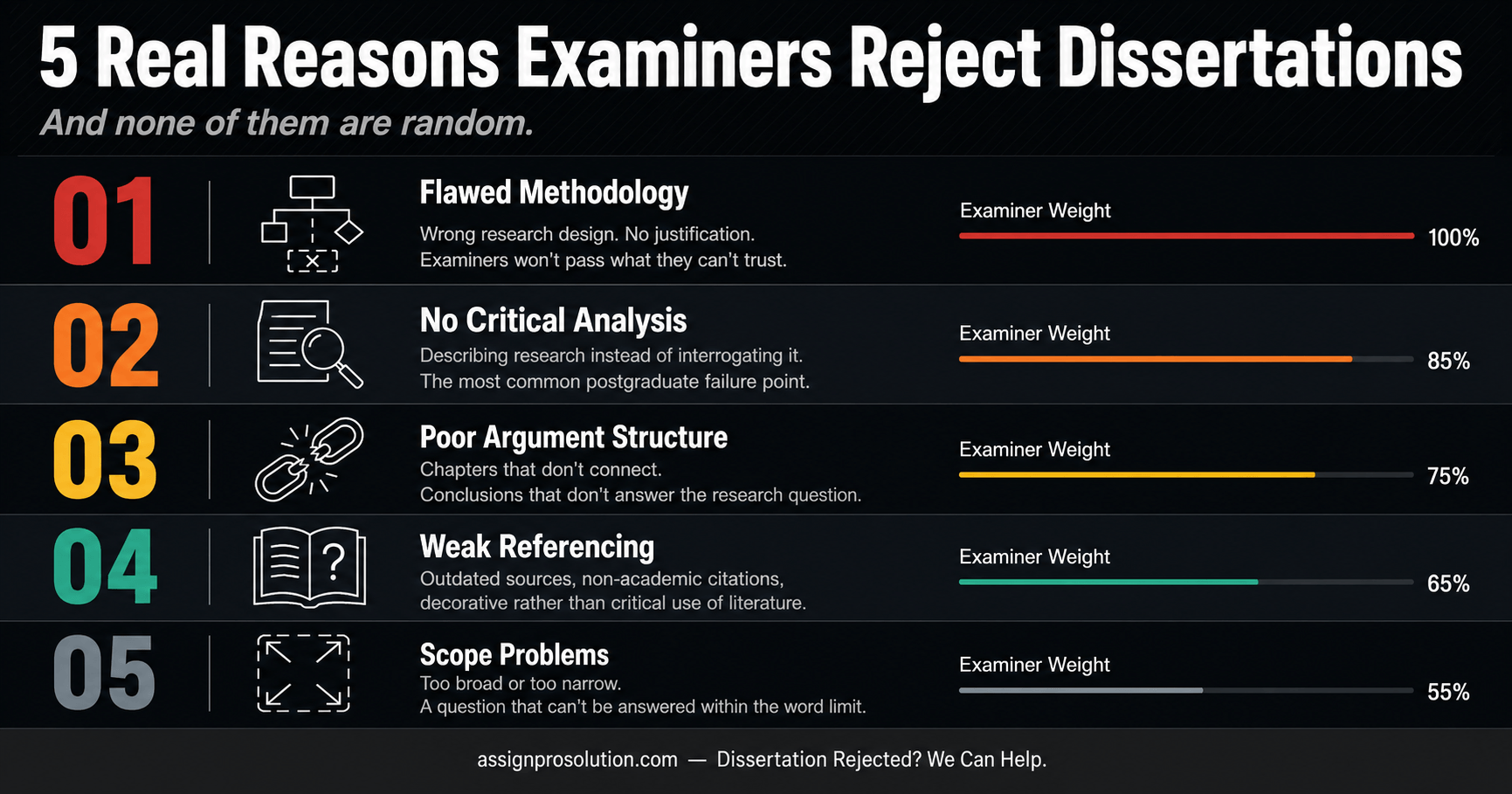
Examiners do not reject dissertations arbitrarily. There are consistent, recurring reasons why dissertations fall short — and most of them are avoidable in hindsight.
Understanding why yours was rejected is not about assigning blame. It is about knowing exactly what you are fixing before you touch a single word of your resubmission.
Weak or flawed methodology is the single most common reason for rejection at postgraduate level. If your research design does not align with your research questions, or if you cannot justify your chosen approach, examiners will flag it regardless of how well-written everything else is. This is non-negotiable at Master’s and PhD level. Our detailed breakdown of why dissertation methodology gets rejected explains the specific triggers examiners look for.
Insufficient critical analysis is another major failure point. Descriptive writing — summarising what other researchers said without interrogating it — is one of the clearest signs that a dissertation has not reached the required academic standard. Universities in the UK, Australia, and Germany are particularly strict on this at postgraduate level.
Poor structure and argument coherence matters more than most students expect. A dissertation where chapters do not logically build on each other, or where the conclusion does not connect back to the research questions, will struggle even if individual sections are competently written.
Referencing and academic integrity issues account for a significant portion of rejections that students do not anticipate. Inconsistent citation styles, over-reliance on non-academic sources, or insufficient engagement with recent literature all raise red flags during examination.
Scope problems — either too broad or too narrow — are common among first-time dissertation writers. A research question that cannot be meaningfully answered within the word limit, or one so narrow it produces no useful findings, both create fundamental problems that editing alone cannot fix.
Knowing which of these applies to your dissertation determines everything about how you approach your resubmission.
7 Smart Steps to Recover From Dissertation Rejection
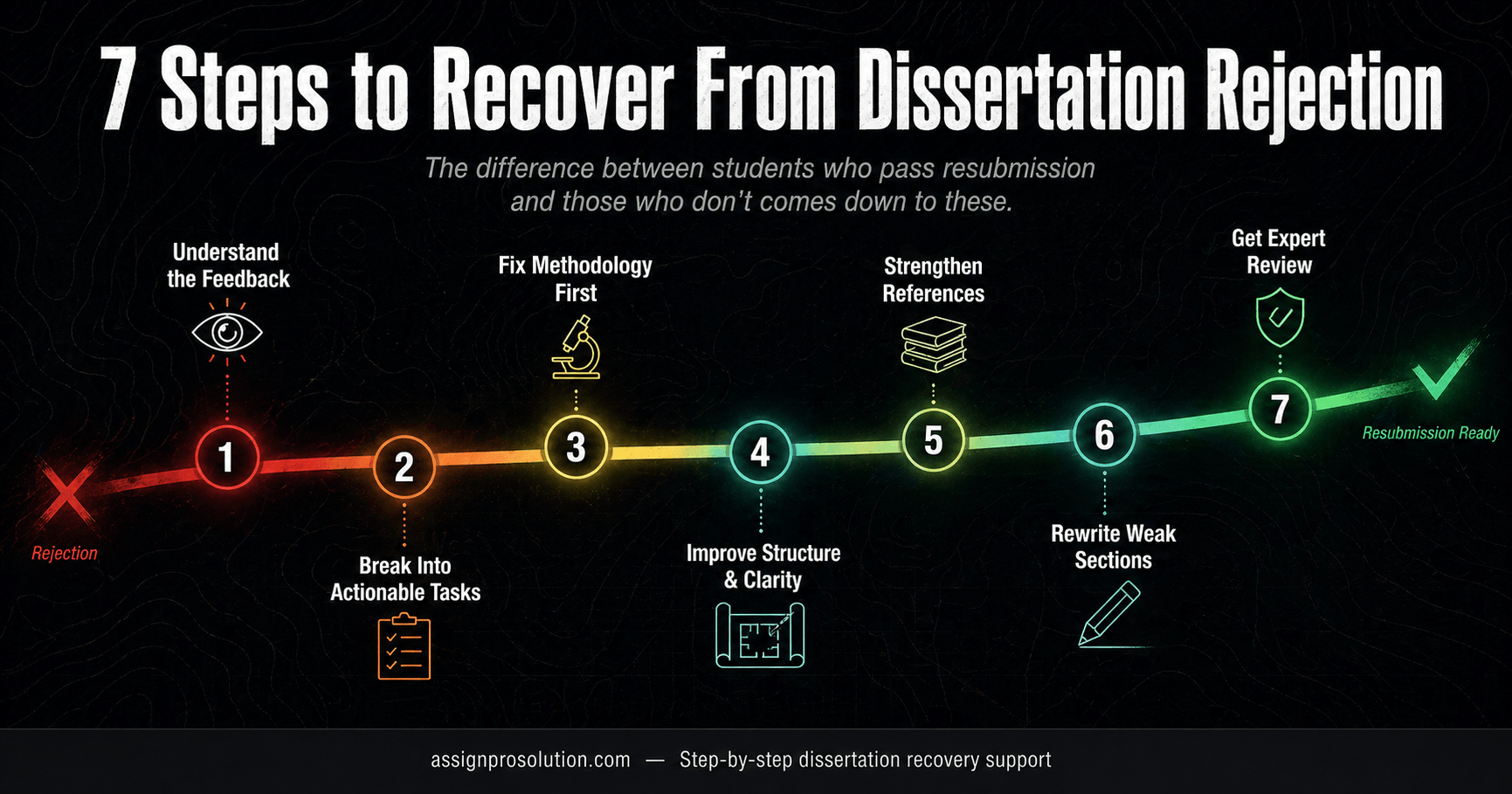
If your dissertation rejected after submission, these steps will help you recover without wasting time on the wrong fixes.
Step 1: Understand the Feedback Properly
Most students read their examiner’s report once, feel the emotional weight of it, and either shut down or immediately start making changes. Both reactions are mistakes.
Your examiner’s report is a technical document. It needs to be read slowly, multiple times, and with a specific goal — to extract exactly what failed and why, not to process how it makes you feel.
Start by reading the full report without annotating anything. Let it settle. Then read it again with a highlighter or annotation tool, marking every specific criticism the examiner raises. Separate the comments that identify a problem from those that suggest a fix — examiners do not always make this distinction clearly, and conflating the two leads to surface-level changes that miss the actual issue.
Pay close attention to language. Words like “insufficient”, “unclear”, “lacks justification”, and “not demonstrated” are examiner shorthand for specific academic failures. “Insufficient critical analysis” does not mean write more — it means your engagement with existing literature needs to move from descriptive to evaluative. “Lacks justification” in a methodology context means your rationale for choosing your research design was either absent or unconvincing.
If any part of the feedback is genuinely unclear, you are entitled to request a meeting with your supervisor or the examining panel to seek clarification. Most universities in the UK, Australia, Canada, Ireland, and Germany have formal processes for this. Use them.
Do not start rewriting until you are certain you understand what is actually being asked of you. Rewriting based on a misread of the feedback is one of the most common — and most costly — mistakes students make after rejection.
Step 2: Break Feedback Into Actionable Tasks
Once you have read and understood the examiner’s report properly, the next step is to turn it into a working plan. Vague intentions like “fix the methodology” or “improve the literature review” will not get you through resubmission. Specific tasks will.
Go through every point in the examiner’s report and convert it into a discrete, actionable item. If the examiner said your methodology lacks justification, the task is not “rewrite methodology” — it is “add a clearly argued rationale for choosing qualitative over quantitative design in Section 3.2, with reference to at least two methodological sources.” That is a task you can actually complete and check off.
Group your tasks into three categories:
Structural changes — sections that need to be reorganised, merged, split, or removed entirely. These affect the skeleton of your dissertation and should be addressed before anything else.
Content changes — arguments that need to be strengthened, analysis that needs to go deeper, literature that needs to be added or replaced. These sit inside your existing structure once it is fixed.
Technical changes — referencing inconsistencies, formatting errors, word count issues, citation gaps. These are addressed last, after structural and content changes are locked in.
Working in this order matters. Students who fix referencing before sorting out structural problems often find they have to redo the technical corrections anyway after moving sections around.
Set a realistic timeline against each task group. Factor in your resubmission deadline and work backwards. If your window is three months, your structural changes should be done within the first four weeks — not the last.
This is the stage where a clear head and a structured approach separate students who pass resubmission from those who don’t.
Step 3: Fix Your Methodology First
If your examiner flagged methodology issues — and in the majority of rejections, they do — this is where your resubmission will be won or lost. Everything else you fix becomes significantly less effective if the foundation of your research design is still flawed.
Methodology is not just a chapter. It is the justification for every claim your dissertation makes. When examiners reject a dissertation on methodological grounds, they are essentially saying the research cannot be trusted — not because the findings are wrong, but because the process used to arrive at them has not been sufficiently defended. A dissertation rejected after submission is often linked to weak or poorly justified methodology.
The most common methodology failures that lead to rejection fall into a few clear patterns. Choosing a research approach without explaining why — why qualitative over quantitative, why a case study over a survey, why thematic analysis over content analysis — leaves examiners with no basis to evaluate whether your method was appropriate for your research question. Justification is not optional at postgraduate level.
Sampling decisions are another consistent weak point. If you cannot explain why your sample size was appropriate, how participants were selected, and what the limitations of that selection are, your methodology will not hold up under examination. Our guide on sample size justification in dissertations covers this in detail and is worth reading before you rewrite this section.
When rewriting your methodology, do not just add sentences to what is already there. In many cases, the existing structure needs to be rebuilt. Each methodological choice needs its own clear rationale, supported by academic sources on research design — not just sources from your subject area.
If you are unsure whether your revised methodology meets the required standard, getting it reviewed before resubmission is significantly less costly than finding out it still falls short after.
Step 4: Improve Structure and Clarity
A dissertation can contain genuinely strong research and still fail because the examiner cannot follow the argument. Structure is not a cosmetic concern — it is how your thinking becomes legible to someone reading your work for the first time.
When examiners flag structure and clarity issues, they are usually pointing to one of three problems: chapters that do not connect logically, arguments that drift without resolution, or a conclusion that does not tie back to the original research questions. Any one of these is enough to undermine an otherwise competent piece of work.
Start by reading your dissertation as if you are the examiner — someone who has not been inside your head for the past year. Does each chapter have a clear purpose that is established at the start and delivered by the end? Does the argument in Chapter 3 build on what was established in Chapter 2, or does it start fresh as if the previous chapter did not exist? Does your conclusion actually answer the research questions you set out in your introduction, or does it introduce new ideas at the last moment?
These are structural questions, and they need structural answers. Moving paragraphs around or tightening sentences will not fix a dissertation where the chapter architecture itself is broken.
Clarity at the sentence level matters too, but it is secondary to structural coherence. Academic writing does not need to be complex to be credible. Short, precise sentences that say exactly what they mean are more effective than dense, convoluted ones that obscure your argument behind formal language.
If you are finding it difficult to see the structural problems in your own work — which is common, because familiarity with your own writing makes it harder to spot gaps — reading our guide on how to start writing a dissertation can help you reframe how you approach the architecture of your argument before you rewrite.
Step 5: Strengthen Academic References
Weak referencing is one of those rejection reasons that students consistently underestimate — not because they were careless, but because they did not fully understand what “strong academic referencing” actually requires at examination level.
It is not just about citation formatting. Examiners assess whether your sources are appropriate, current, and engaged with critically rather than used decoratively.
The first thing to audit is recency. In most disciplines, sources older than ten years carry significantly less weight unless they are foundational texts in your field. If your literature review is built primarily on sources from the early 2000s, examiners will question whether you have engaged with current academic debate. Go through every source and ask whether it is still relevant to the conversation your dissertation is entering.
The second issue is source quality. Textbooks, websites, and newspaper articles do not carry the same weight as peer-reviewed journal articles and academic publications. If your dissertation leans heavily on non-academic sources to support core arguments, that needs to change before resubmission. Databases like JSTOR, Google Scholar, and your university library’s journal access are where your replacement sources should come from.
The third — and most commonly overlooked — issue is how sources are used. Citing a source to show you have read it is not the same as engaging with it. Examiners expect you to compare perspectives, identify tensions between authors, and use sources to build your own argument rather than simply report what others have said. This is the difference between descriptive and critical literature engagement, and it is one of the clearest markers of postgraduate-level work.
Go through your literature review and methodology sections with this lens. Anywhere you have cited a single source to make a point, ask whether that point would be stronger with a contrasting perspective alongside it.
Step 6: Rewrite Weak Sections (Don’t Just Edit)
This is the step most students resist — and it is exactly why many resubmissions still fall short.
Editing feels productive. You are moving through pages, tightening sentences, adding a reference here, adjusting a paragraph there. But editing a fundamentally weak section produces a tidier version of the same weak section. It does not fix the underlying problem the examiner identified. Many students facing a dissertation rejected after submission try editing instead of rewriting — which leads to repeated failure.
If your examiner said a section lacks critical analysis, editing the existing sentences will not introduce critical analysis — it will just make the descriptive writing cleaner. If your argument in a chapter does not hold together logically, smoothing out the prose will not repair the logic. The only way to fix a section that has failed at a structural or analytical level is to rewrite it from the ground up.
The way to approach this is to start with a blank document for the sections flagged as weak. Do not look at what you wrote before — not yet. Write the section the way it should have been written, based on your understanding of the examiner’s feedback and what the section needs to achieve. Only after you have a new draft should you go back to the original and check whether anything from it is worth incorporating.
This approach feels slower. It is also significantly more effective.
Be honest with yourself about which sections genuinely need this treatment. Students often convince themselves that a section only needs light editing when the examiner’s language clearly signals something more fundamental. Phrases like “this section does not demonstrate sufficient understanding” or “the argument is not developed” are not editing notes. They are rewrite signals.
The discomfort of rewriting from scratch is temporary. Failing resubmission because you only edited when you should have rewritten is a much more expensive outcome.
Step 7: Get Expert Review Before Resubmission
You have worked through the feedback, restructured weak sections, rebuilt your methodology, and strengthened your references. At this point, most students make one final mistake — they submit without having anyone qualified review the revised work.
The problem is not effort. By this stage you have put significant work into the resubmission. The problem is proximity. When you have been inside a document for weeks, you lose the ability to see it the way an examiner will. Gaps in argument that are obvious to a fresh reader become invisible to the person who wrote them. This is not a personal failing — it is how familiarity with your own work operates.
Your supervisor is the first person to approach. Share your revised draft and ask for specific feedback on the sections the examiner flagged. Be direct about what the examiner said and ask whether your revisions adequately address those points. Do not ask for general impressions — ask targeted questions that correspond to the specific criticisms in your report.
If your supervisor’s availability is limited, or if the relationship has become strained after the rejection — which does happen — an independent academic review is worth considering. A subject-matter expert who has not been involved in your dissertation can assess it with the same fresh perspective an examiner will bring.
This is where professional dissertation support becomes genuinely useful rather than a shortcut. Getting your revised dissertation reviewed by someone with examining experience before you resubmit is not a workaround — it is a risk management decision. The cost of an expert review is considerably lower than the cost of a second rejection.
If you are approaching your resubmission deadline and need a qualified review of your revised work, our dissertation experts are available on WhatsApp and can assess your dissertation and give you an honest picture of where it stands before you submit.
Real Example: Rejected Dissertation vs Improved Version
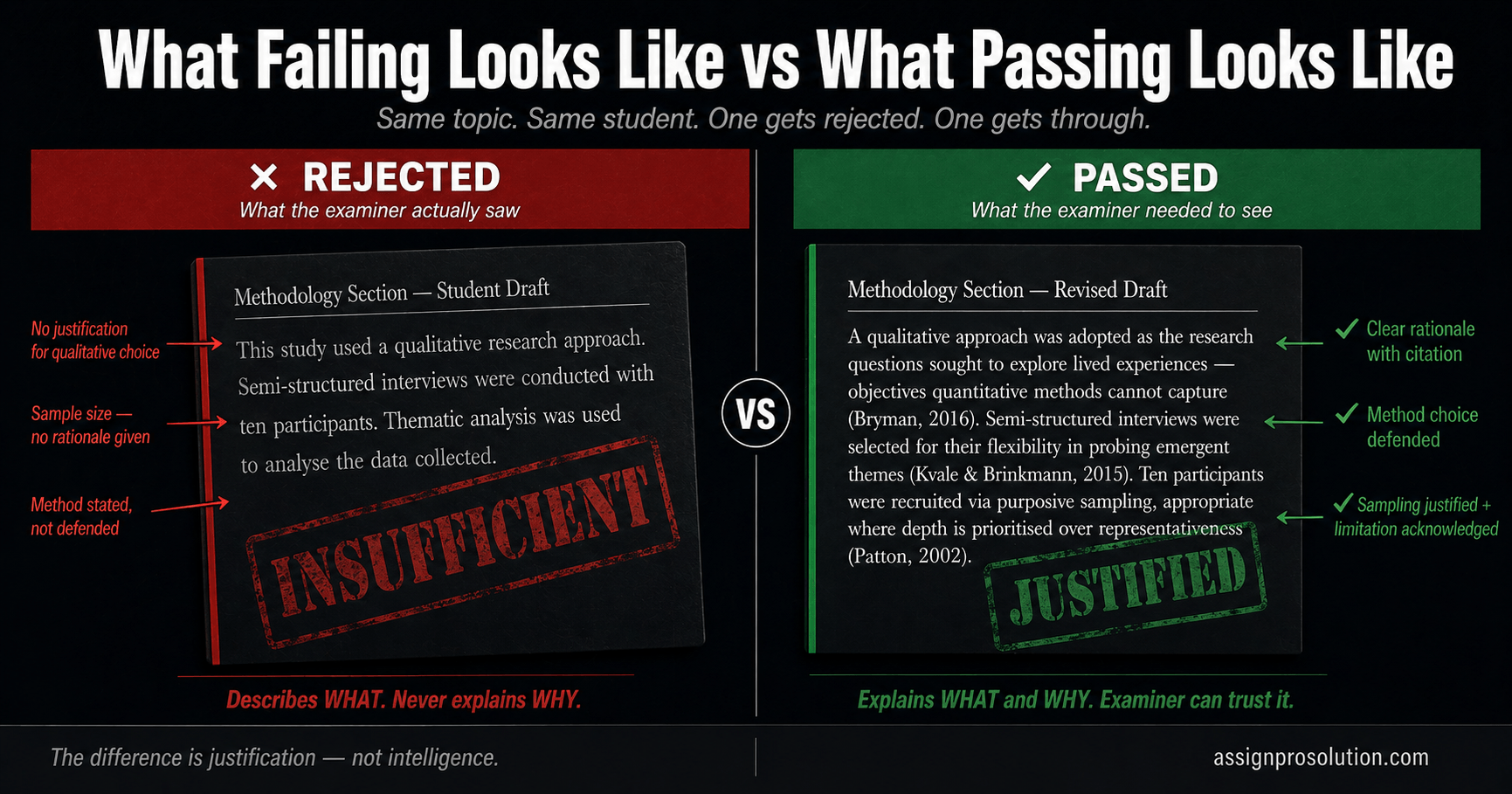
Abstract comparisons only go so far. Sometimes the clearest way to understand what examiners actually want is to see the difference between what failed and what passed — side by side.
The following example is based on a common rejection scenario at Master’s level: a methodology section flagged for lacking justification.
Rejected Version
“This study used a qualitative research approach. Semi-structured interviews were conducted with ten participants. Thematic analysis was used to analyse the data collected.”
This version states what was done. It does not explain why. There is no rationale for choosing qualitative over quantitative, no justification for semi-structured interviews over other qualitative methods, no explanation of why ten participants were considered appropriate, and no reference to any methodological literature. An examiner reading this has no basis to evaluate whether the research design was fit for purpose.
Improved Version
“A qualitative research approach was adopted for this study, as the research questions sought to explore participants’ lived experiences and subjective perceptions — objectives that quantitative methods are not designed to capture (Bryman, 2016). Semi-structured interviews were selected over other qualitative instruments because they allow for structured data collection while preserving the flexibility to probe emergent themes (Kvale & Brinkmann, 2015). Ten participants were recruited using purposive sampling, a strategy appropriate for studies where depth of insight is prioritised over statistical representativeness (Patton, 2002). The limitations of this sample size, including its restricted generalisability, are acknowledged and discussed in Section 5.4.”
The difference is not length — it is justification. Every methodological choice in the improved version is explained, referenced, and honest about its limitations. That is what passing looks like at postgraduate level.
This pattern applies across every section of your dissertation. If you find yourself describing what you did without explaining why, you are writing at the wrong level for examination.
Common Mistakes Students Make After Rejection
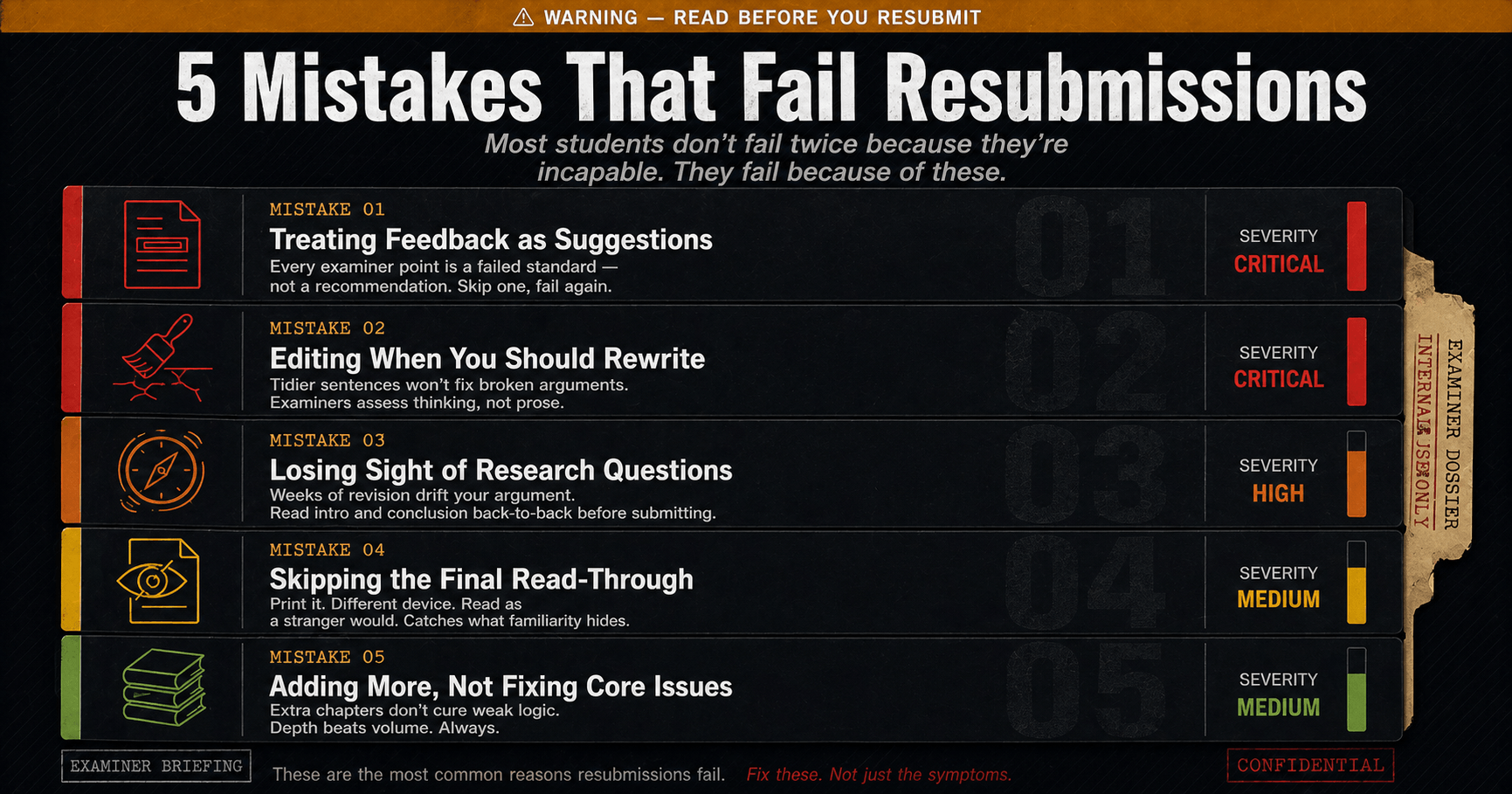
Recovery is possible for most students — but a significant number make the same errors in the resubmission process that cost them their second attempt. Knowing what these are before you start is worth more than any revision tip. After a dissertation rejected after submission, repeating the same mistakes in resubmission is the biggest risk.
Treating feedback as suggestions rather than requirements
Examiner feedback is not a wishlist. Every point raised in your report represents a standard your dissertation did not meet. Students who approach feedback selectively — addressing the comments they agree with and quietly ignoring the ones they find unfair or confusing — almost always produce a resubmission that still falls short. If you disagree with a point of feedback, the correct move is to seek clarification, not to skip it.
Making surface changes to sections that need structural fixes
This has been covered in Step 6, but it is worth naming again because it is the most common resubmission failure pattern. A dissertation that failed because its argument lacked coherence will not pass because the sentences are now better written. Examiners are assessing the quality of your thinking, not the polish of your prose.
Losing sight of the research questions
After weeks of revisions, it is easy to drift. Students add new literature, restructure chapters, and rework arguments — and somewhere in that process, the connection between the work and the original research questions quietly breaks down. Before you submit, read your introduction and your conclusion back to back. If they do not speak to each other clearly, something has gone wrong during revision.
Submitting without a final read-through as an examiner would
Print your dissertation or use a different device to read it. Change the context. Read it slowly, from the beginning, as someone who has never seen it before. This single step catches more problems than most students expect — and it costs nothing except time.
Isolating yourself through the process
Rejection carries a social weight that makes many students pull back from their supervisors, peers, and support networks. This is understandable and counterproductive in equal measure. The students who recover fastest are almost always the ones who stayed connected — to their supervisors, to academic support services, and where needed, to external expertise.
How to Handle Supervisor Feedback Properly
Your supervisor occupies an unusual position after a dissertation rejection. They guided you through the writing process, yet the examining panel — which may or may not have included them — found the work insufficient. That dynamic can make post-rejection conversations with your supervisor feel awkward, even adversarial. Handled well, though, your supervisor remains one of your most valuable resources during resubmission.
The first thing to understand is that supervisor feedback and examiner feedback are not the same thing, and they do not always align. Your supervisor was advising you on a work in progress. The examiner assessed a finished submission against a fixed academic standard. If there is a gap between what your supervisor said was acceptable and what the examiner flagged as insufficient, that gap is real — and worth discussing openly rather than letting it create resentment on either side.
When you approach your supervisor after rejection, come prepared. Bring the examiner’s report, your annotated notes from reading it, and a draft revision plan. Do not arrive asking “what should I do?” — arrive asking specific questions. “The examiner said my methodology lacks justification for the sampling approach — does my revised rationale in Section 3.3 address that adequately?” is a question your supervisor can answer usefully. A general request for reassurance is not.
Be honest about what you do not understand in the feedback. Supervisors can often translate examiner language into practical guidance — but only if you tell them where you are stuck.
Also be realistic about what your supervisor can and cannot do. They can guide, advise, and review. They cannot rewrite sections for you, and in most institutions they are not permitted to provide line-by-line corrections on a resubmission. Understanding this boundary early prevents frustration later.
For a more detailed breakdown of how to navigate supervisor feedback at every stage — not just after rejection — our guide on handling supervisor feedback on your dissertation is worth reading before your next meeting.
How Long Does Dissertation Resubmission Take?
The timeline for dissertation resubmission varies by institution, degree level, and the nature of the corrections required. There is no single universal answer — but there are clear patterns worth knowing before you plan your recovery.
University-set resubmission windows typically range from three to twelve months for postgraduate dissertations. In the UK, most universities allow between three and six months for major corrections. Australian institutions tend to operate on similar timelines, though some research degrees allow up to twelve months. In Germany and Ireland, resubmission periods are often defined at faculty level rather than institution level, so checking your specific faculty regulations is essential.
The window you are given is not a suggestion. Missing a resubmission deadline without an approved extension typically results in a fail with no further opportunity — so your first action after receiving your rejection outcome should be to confirm the exact deadline in writing with your department.
How long revision actually takes depends almost entirely on the scope of changes required. A dissertation with minor corrections — referencing gaps, clarity issues, isolated weak sections — can realistically be revised in four to eight weeks if you work consistently. A dissertation with major corrections — methodology flaws, structural problems, insufficient critical analysis across multiple chapters — should be treated as a substantial rewrite, and six to ten weeks of focused work is a more honest estimate.
The mistake most students make is losing the first two to three weeks to shock, avoidance, or unfocused effort. That lost time compresses the revision window significantly and increases the pressure on every subsequent week.
Build your timeline from the deadline backwards. Assign fixed weeks to each task category — structural changes, content revisions, technical corrections, final review — and treat those assignments as non-negotiable. Buffer time at the end for a proper final read-through before submission.
If you are already partway through your resubmission window and feel behind, the priority is not to panic — it is to triage. Identify which examiner criticisms carry the most weight and address those first.
What If You Fail Again?
This is the question most students are too afraid to ask — which is exactly why it needs a direct answer.
A second rejection is rare. Most students who approach resubmission seriously, address the examiner’s feedback systematically, and get their revised work reviewed before submission do not fail again. But it does happen, and knowing what your options are in advance is more useful than discovering them under pressure.
What universities typically offer after a second failure
In most UK, Australian, and Canadian institutions, a second failed dissertation results in one of the following outcomes: an exit award at a lower qualification level, a permanent fail with no further resubmission opportunity, or in exceptional circumstances, an appeal. The specific outcome depends on your institution’s regulations, your degree level, and the grounds on which the second failure was determined.
Exit awards are more common than students realise. A student who fails a Master’s dissertation but has passed all taught modules will often be awarded a Postgraduate Diploma — a recognised qualification, though not the degree they were working towards. In some professional fields, a PG Diploma carries genuine weight. It is not the outcome you wanted, but it is not nothing.
Grounds for appeal
If you believe your second rejection was the result of procedural irregularities, inadequate supervision, or extenuating circumstances that were not properly considered, most institutions have a formal appeals process. Appeals on the grounds of academic disagreement — essentially arguing that the examiner got it wrong — are rarely successful. Appeals based on process failures or documented personal circumstances have a stronger basis.
The honest assessment
If you are facing the possibility of a second failure, the most important thing you can do is get an independent expert to review your resubmission before it goes in. A second attempt that still falls short of the required standard is an avoidable outcome in most cases — but only if someone with examining experience tells you where it still falls short before the examiner does.
Dissertation Resubmission: DIY vs Expert Help
This is a decision every student facing resubmission has to make — and most make it based on pride or cost rather than an honest assessment of their situation. Neither is a good basis for a decision that affects your degree.
The DIY route works when the examiner’s feedback is specific and limited in scope, you have a clear understanding of what needs to change and how to change it, your supervisor is available and willing to review your revised work, and your resubmission window gives you enough time to work through corrections properly. If all four of those conditions are true, a self-managed resubmission is entirely viable.
The calculation changes when any of those conditions breaks down.
If the feedback is broad or touches your methodology at a fundamental level, self-managing without subject-matter expertise is a significant risk. If your supervisor’s availability is limited — which is common during examination periods — you may be working without any qualified feedback loop until the examiner sees your resubmission. If your window is short, the margin for error shrinks considerably.
Expert help in this context does not mean having someone write your dissertation for you. It means getting your revised work assessed by someone with academic examining experience who can tell you, before you submit, whether your revisions actually address the examiner’s concerns — or whether you have fixed the surface and left the underlying problem untouched.
The students who benefit most from expert support are those who have done the revision work themselves but are not confident the changes are sufficient. That is a legitimate concern, not an admission of failure.
If you are weighing this decision and want an honest assessment of where your resubmission currently stands, speak to one of our dissertation specialists on WhatsApp. No commitment required — just a clearer picture of your options before you decide.
Many students dealing with a dissertation rejected after submission have similar questions — here are the answers that actually matter.
FAQ: Dissertation Rejected After Submission
Can a rejected dissertation be resubmitted?
Yes, in the vast majority of cases. Most universities across the UK, Australia, Canada, Ireland, Germany, UAE, and Romania have formal resubmission processes for dissertations that do not meet the required standard on first submission. The outcome letter you receive after rejection will specify whether resubmission is permitted, the conditions attached, and the deadline you are working to. A full fail with no resubmission option is the exception, not the rule.
How long do I have to resubmit my dissertation?
This varies by institution and degree level. In the UK, most universities allow between three and six months for major corrections. Australian institutions operate on similar timelines, with some research degrees allowing up to twelve months. The safest approach is to confirm your exact deadline in writing with your department immediately after receiving your rejection outcome — do not rely on general guidance from peers or online forums.
Will a dissertation rejection show on my academic record?
This depends on your institution’s policies. In many universities, the final transcript reflects only the outcome of your last submission — meaning a pass on resubmission is what appears, not the initial rejection. However, some institutions do record the resubmission status. Check your university’s academic records policy directly, as this varies significantly between institutions and countries.
Should I contact my supervisor after my dissertation is rejected?
Yes — and sooner rather than later. Your supervisor can help you interpret the examiner’s feedback, identify which corrections carry the most weight, and review your revised work before resubmission. Come to that conversation prepared: bring the examiner’s report, your initial reading of it, and specific questions. A general request for reassurance is less useful than targeted questions about the sections the examiner flagged.
What is the difference between minor and major corrections?
Minor corrections typically involve referencing inconsistencies, formatting issues, clarity problems at the sentence level, and isolated gaps in argument. They are usually expected to be completed within a shorter window — often four to twelve weeks. Major corrections indicate more fundamental problems: methodology flaws, structural issues, insufficient critical analysis, or inadequate engagement with literature. These require a more substantial revision effort and are given a longer resubmission window accordingly.
Can I appeal a dissertation rejection?
Yes, but the grounds for a successful appeal are narrow. Appeals based on academic disagreement — arguing that the examiner’s assessment was wrong — are rarely upheld. Appeals based on procedural irregularities, inadequate supervision, or documented extenuating circumstances that were not properly considered during examination have a stronger basis. Check your institution’s appeals process carefully and act within the stated timeframe, as appeal windows are typically short.
Still Stuck After Rejection? Here’s What to Do Next
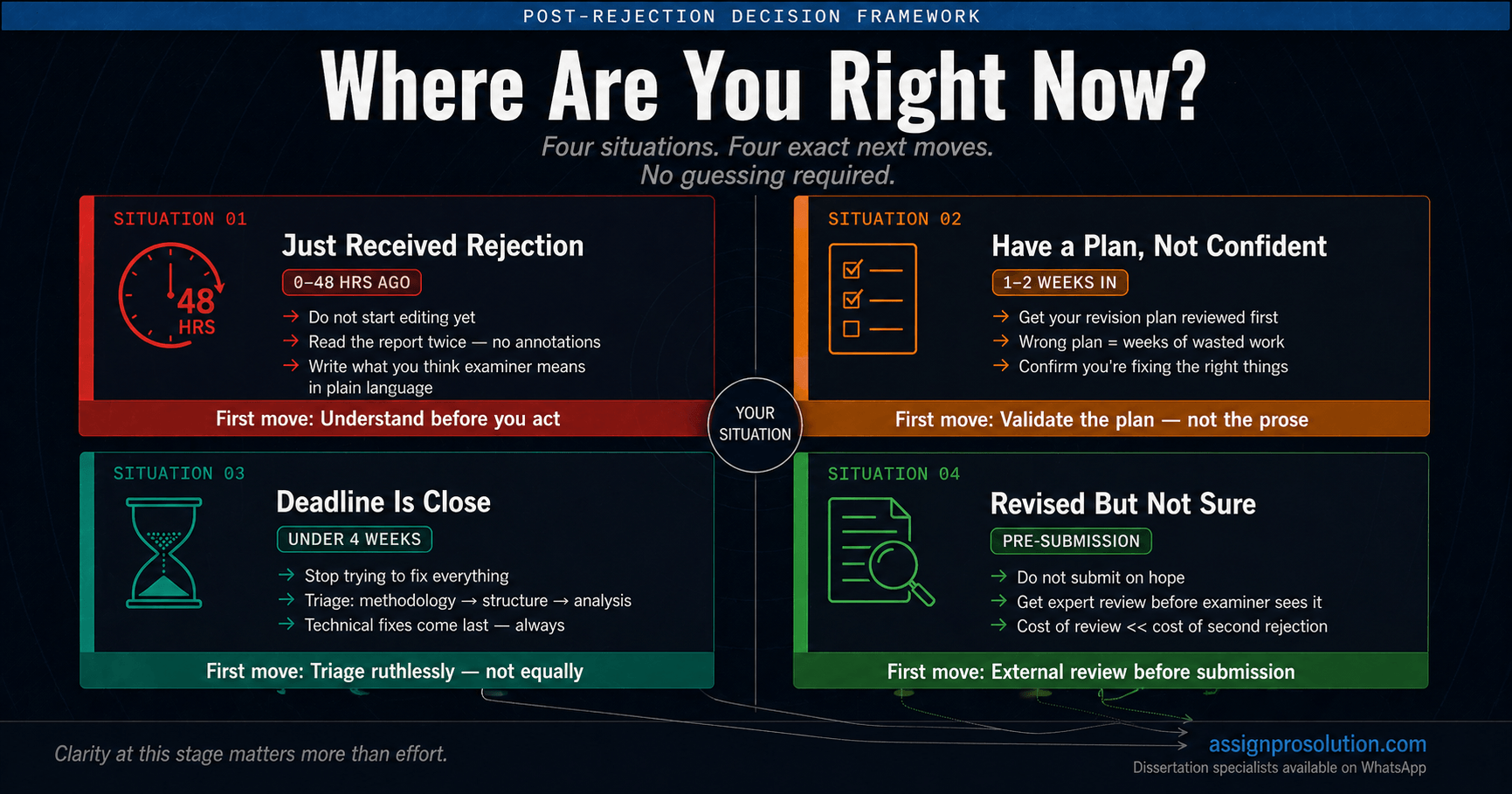
If your dissertation rejected after submission and you’re unsure what to fix first, clarity at this stage matters more than effort.
Reading through seven steps, a real example, a FAQ, and everything in between is useful — but it does not automatically translate into knowing what your next move is when you close this tab and go back to your examiner’s report.
So here is the practical version.
If you received your rejection in the last 48 hours, do not start editing yet. Read the report twice, let the initial reaction settle, and then write down — in plain language, not academic language — what you think the examiner is actually saying about each flagged section. That exercise alone will tell you whether you have understood the feedback or whether you are still processing it emotionally.
If you are a week or two in and have a revision plan but are not confident it addresses the right things, the priority is getting that plan reviewed before you invest weeks of work into the wrong fixes. A plan that misreads the examiner’s concerns will produce a resubmission that misses the mark — regardless of how much effort went into it.
If you are close to your resubmission deadline and still have significant sections to address, triage immediately. Identify the two or three criticisms in your examiner’s report that carry the most weight — methodology failures, structural problems, insufficient critical analysis — and ensure those are fully resolved before you spend time on anything else. Polished referencing in a dissertation that still has a broken argument will not save the resubmission.
If you have revised your dissertation and are not sure whether it is ready, get it reviewed by someone with academic examining experience before you submit. The cost of finding out it still falls short after submission is significantly higher than the cost of finding out before.
Whatever stage you are at, you do not have to work through this alone. Our dissertation specialists are available on WhatsApp and can give you an honest assessment of where your resubmission stands — whether you need a full expert review or just a second opinion on your revision plan.
Still Stuck After Rejection? Here’s What to Do Next
Reading through seven steps, a real example, a FAQ, and everything in between is useful — but it does not automatically translate into knowing what your next move is when you close this tab and go back to your examiner’s report.
So here is the practical version.
If you received your rejection in the last 48 hours, do not start editing yet. Read the report twice, let the initial reaction settle, and then write down — in plain language, not academic language — what you think the examiner is actually saying about each flagged section. That exercise alone will tell you whether you have understood the feedback or whether you are still processing it emotionally.
If you are a week or two in and have a revision plan but are not confident it addresses the right things, the priority is getting that plan reviewed before you invest weeks of work into the wrong fixes. A plan that misreads the examiner’s concerns will produce a resubmission that misses the mark — regardless of how much effort went into it.
If you are close to your resubmission deadline and still have significant sections to address, triage immediately. Identify the two or three criticisms in your examiner’s report that carry the most weight — methodology failures, structural problems, insufficient critical analysis — and ensure those are fully resolved before you spend time on anything else. Polished referencing in a dissertation that still has a broken argument will not save the resubmission.
If you have revised your dissertation and are not sure whether it is ready, get it reviewed by someone with academic examining experience before you submit. The cost of finding out it still falls short after submission is significantly higher than the cost of finding out before.
Whatever stage you are at, you do not have to work through this alone. Our dissertation specialists are available on WhatsApp and can give you an honest assessment of where your resubmission stands — whether you need a full expert review or just a second opinion on your revision plan.
Related reading you may find useful: