
Sample size justification dissertation sections are often treated as a small part of the methodology, but they end up creating the biggest problems later. You might have a clear research topic and decent data, but if your sample size is not explained properly, your entire work can be questioned.
This is where most students struggle. They understand what sample size means, but when it comes to writing the sample size justification dissertation section, they either guess a number or copy a generic explanation that does not actually fit their research.
The problem is not the number itself. It is the reasoning behind it. Examiners are not looking for a “perfect” sample size, they are looking for a clear explanation of why your chosen number makes sense based on your research method.
Academic guidelines from sources like Coventry University academic writing support and University of Greenwich academic skills guidance also emphasise that research decisions must be justified, not assumed.
In this guide, you will learn how to handle sample size justification dissertation requirements step by step. You will see practical methods, real examples, and clear explanations that you can actually use in your own dissertation.
If you are already stuck or dealing with deadline pressure, getting professional dissertation help and consultation can help you avoid repeated feedback and save time.
Let’s start by understanding what sample size justification dissertation actually means and why it matters in research.
What is Sample Size Justification Dissertation and Why It Matters
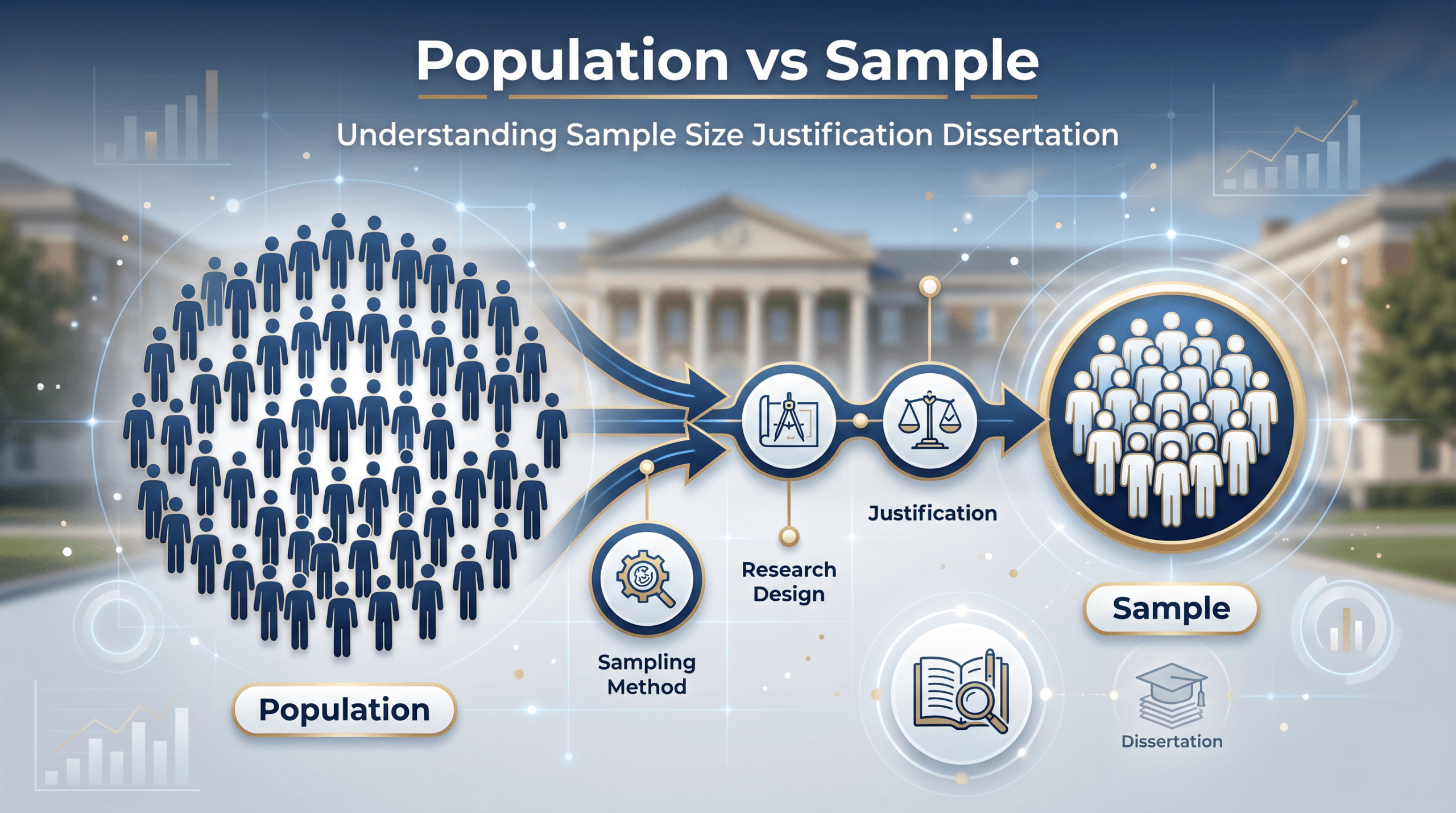
Sample size justification dissertation simply means explaining why you have chosen a specific number of participants for your research. It is not enough to just mention the number. You need to show that your decision is logical, relevant, and aligned with your research method.
In simple terms, you are answering one question: Why is this sample size appropriate for this study?
This section is a key part of your research methodology. It connects your research design, data collection, and analysis. Whether you are conducting surveys, interviews, or case studiesFor a complete demonstration of empirical data justification in a postgraduate thesis, consult this dissertation methodology and sample analysis PDF. , your sample size must fit the way your research is structured.
Many students treat sample size as just a number, but examiners look at it as a decision. According to guidance from University of Hertfordshire academic skills support, research choices must be clearly explained and supported rather than assumed.
A strong sample size justification dissertation section usually includes:
- The type of research (qualitative, quantitative, or mixed)
- The sampling method used
- The reasoning behind the chosen number
- Support from existing studies or accepted methods
If this explanation is weak, it affects the credibility of your entire dissertation. This is one of the most common reasons students receive critical feedback on their methodology.
If you want to understand how this fits into your full methodology structure, you can review this UK dissertation methodology guide for a clearer breakdown.
Why Sample Size Justification Dissertation Matters in Research
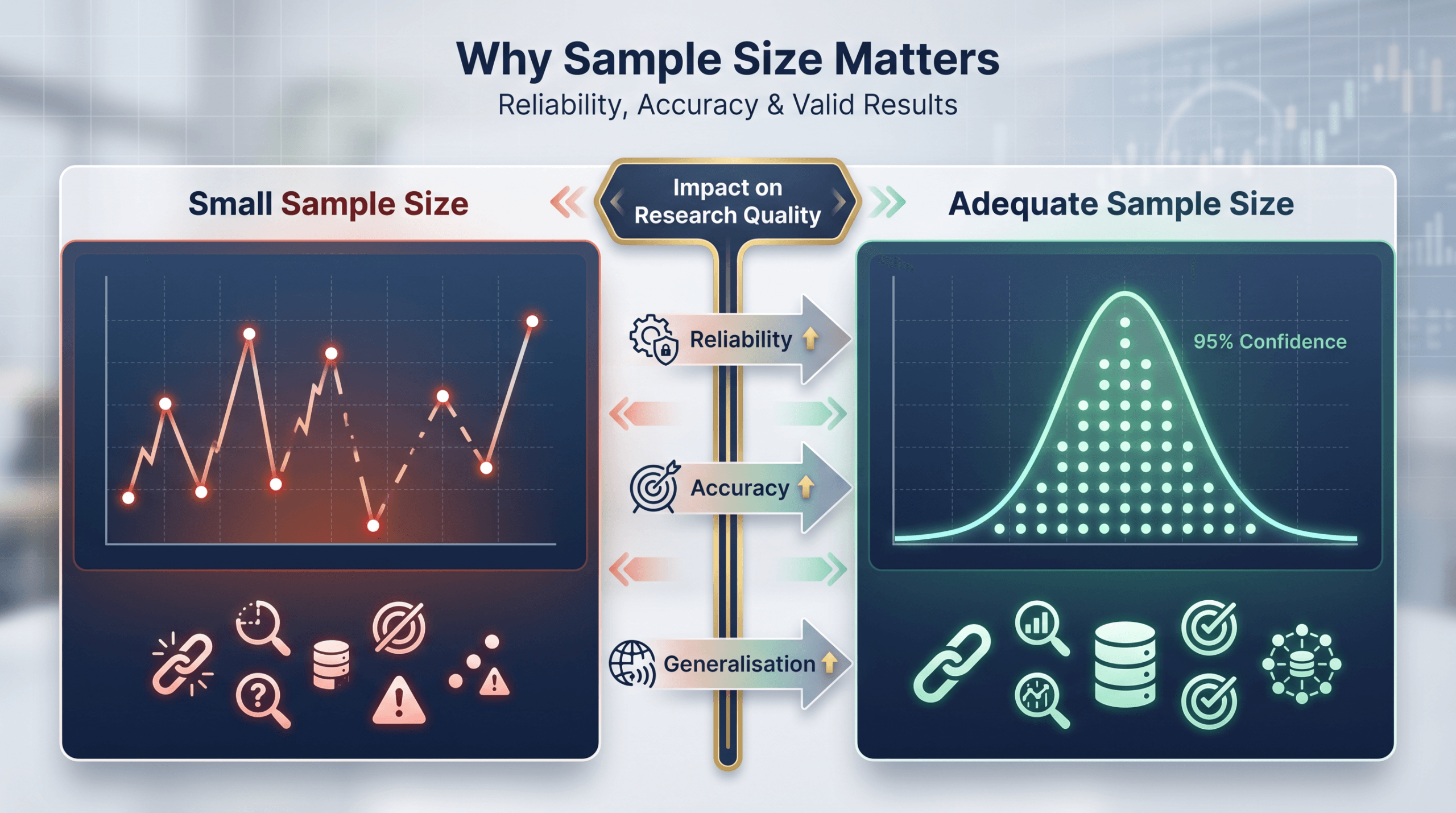
Sample size justification dissertation is not just an academic requirement. It directly impacts how your research is judged.
First, it affects the validity of your research. If your sample size is not appropriate, your findings may not represent the population accurately.
Second, it influences reliability. A poorly justified sample size makes your results harder to trust or repeat, which raises concerns during evaluation.
Third, it determines how well your research can be generalised. For example, using a very small sample in a study meant to represent a larger population can weaken your conclusions.
Academic expectations from institutions like University of Greenwich academic skills guidance highlight that every research decision, including sample size, must be clearly justified to support the overall quality of the study.
Another important factor is supervisor feedback. Many students lose marks not because their research is wrong, but because they cannot explain their decisions properly. If you have already faced this issue, you can go through this supervisor feedback on dissertation guide to understand what examiners usually look for.
At the end of the day, your sample size is not just a number. It shows how well you understand your research methodology. A clear and well-justified sample size strengthens your dissertation, while a weak explanation can create doubts about your entire work.
If you are unsure whether your justification is strong enough, getting expert dissertation help and consultation can help you fix issues before submission.
In the next section, we will break down proven methods for sample size justification dissertation with practical explanations.
6 Proven Methods for Sample Size Justification Dissertation
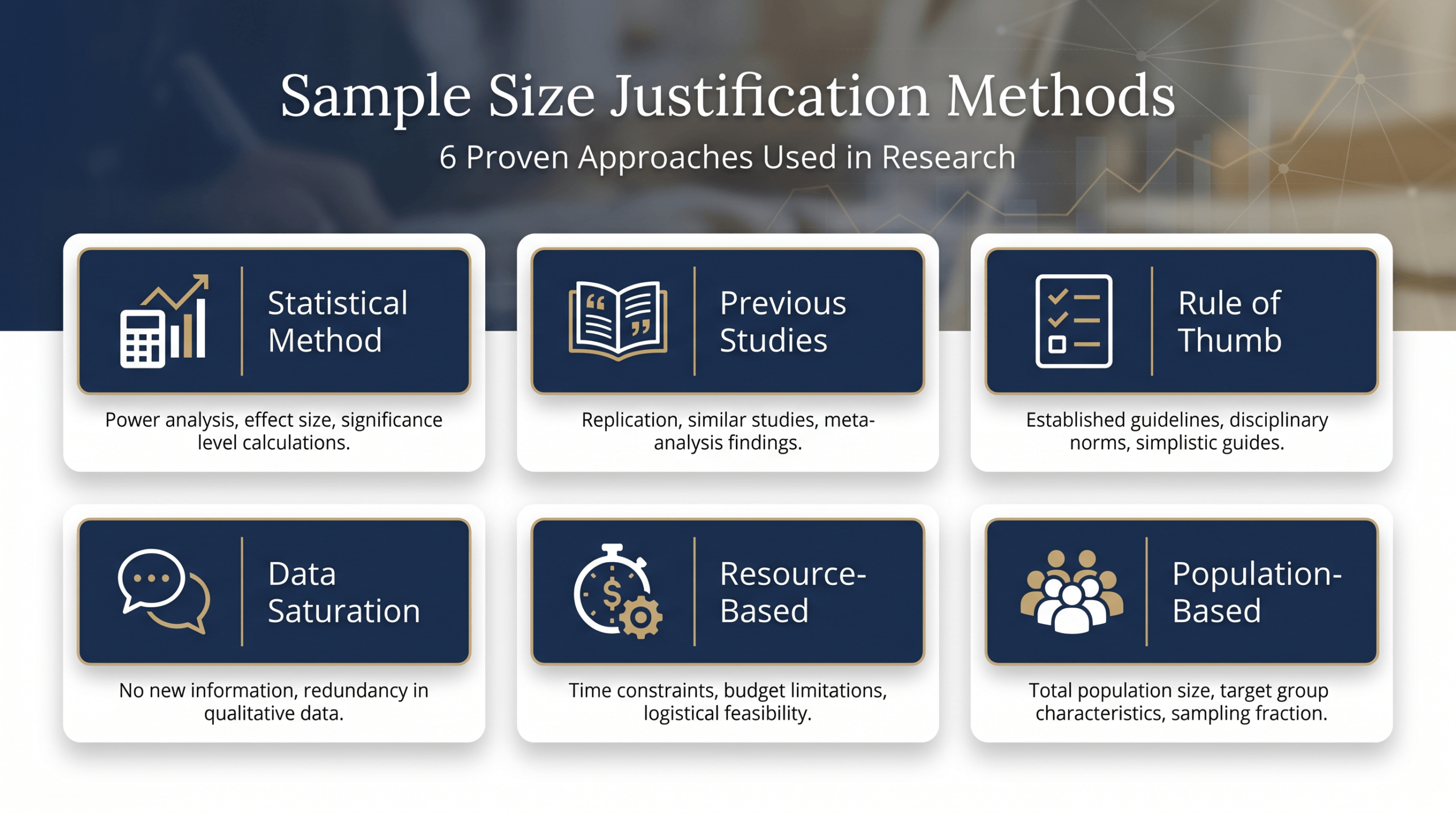
One of the most common issues in dissertation writing is not choosing a sample size, but explaining it properly. A strong sample size justification dissertation section is not built on guesswork. It is built on a clear methodological decision that aligns with your research design.
Below are six widely accepted approaches you can use, depending on the type of research you are conducting.
1. Statistical Method (Quantitative Research)
If your research involves numerical data, surveys, or hypothesis testing, your sample size is usually expected to be justified using a statistical approach.
Instead of selecting a number arbitrarily, you calculate it using factors such as confidence level, margin of error, and population size. Tools like power analysis are also commonly used to determine the minimum number of participants required to detect meaningful results.
The reason this method is preferred in quantitative research is because it:
- Ensures your findings are statistically valid
- Reduces the risk of biased or unreliable results
- Provides a clear, defensible explanation to examiners
For example, stating that your sample size was calculated at a 95% confidence level with a 5% margin of error immediately shows that your decision is grounded in statistical reasoning rather than assumption.
2. Previous Studies Method
Another practical way to approach sample size justification dissertation is by referring to existing studies within your research area.
Instead of working in isolation, you look at how similar research has been conducted and use that as a benchmark. If multiple studies in your field have used a similar sample size, you can justify your choice by aligning with those established patterns.
This method works well because it:
- Demonstrates awareness of academic literature
- Shows that your research is consistent with existing work
- Adds credibility without overcomplicating the explanation
However, this approach should not be used blindly. You still need to explain why those studies are relevant to your specific research context.
3. Rule of Thumb Method
At undergraduate and even some postgraduate levels, general sample size guidelines are often considered acceptable when used carefully.
For instance:
- Around 30 participants for basic quantitative analysis
- 100 or more for survey-based studies
- 8–20 participants for qualitative interviews
These ranges are not strict rules, but they provide a starting point. The key is not the number itself, but how you justify it.
A common mistake is relying only on these numbers without explanation. A stronger approach is to combine this method with either previous studies or practical reasoning to support your choice.
4. Data Saturation Method (Qualitative Research)
In qualitative research, sample size is not fixed in advance in the same way as quantitative studies. Instead, it is guided by the concept of data saturation.
Data saturation is reached when additional data no longer provides new insights or themes. At this point, continuing data collection does not significantly improve the quality of your findings.
This approach is particularly relevant for:
- Interviews
- Focus groups
- Case studies
A strong sample size justification dissertation for qualitative research will explain:
- How data was collected and analysed simultaneously
- At what point themes began to repeat
- Why further data collection was not necessary
This shows that your decision was based on the richness of the data rather than a predefined number.
5. Resource-Based Justification
In real-world research, practical constraints often influence sample size. These may include limited time, restricted access to participants, or budget limitations.
While this is a valid factor, it needs to be handled carefully in your justification.
Simply stating that your sample size was limited due to time constraints is not enough. Instead, you should:
- Acknowledge the limitation
- Explain why it occurred
- Show how you still maintained research quality
For example, you might explain that access to a specific participant group was limited, but those selected were highly relevant to the research topic.
If you are working under tight deadlines, reviewing resources like this dissertation deadline close support guide can help you better manage these constraints.
6. Population-Based Sampling Method
This method focuses on the relationship between your target population and your selected sample.
Rather than choosing a number randomly, you define your population clearly and then select a sample that represents it. This is particularly important in studies where generalisation is a key objective.
For example, if your research focuses on university students in a specific region, your sample should reflect that group in a meaningful way. This may involve using sampling techniques such as random sampling or stratified sampling.
A strong sample size justification dissertation using this method will explain:
- Who the target population is
- How the sample was selected
- Why the sample is representative of that population
Each of these methods offers a valid way to approach sample size justification dissertation. The important thing is not which method you choose, but how clearly you explain it and how well it fits your research design.
If you are unsure which approach is most suitable for your study or how to present it properly, getting professional dissertation help and consultation can help you avoid common mistakes that often lead to revisions.
In the next section, we will look at ready-to-use sample size justification dissertation templates that you can adapt directly for your own work.
Sample Size Justification Dissertation Templates (Ready to Use)
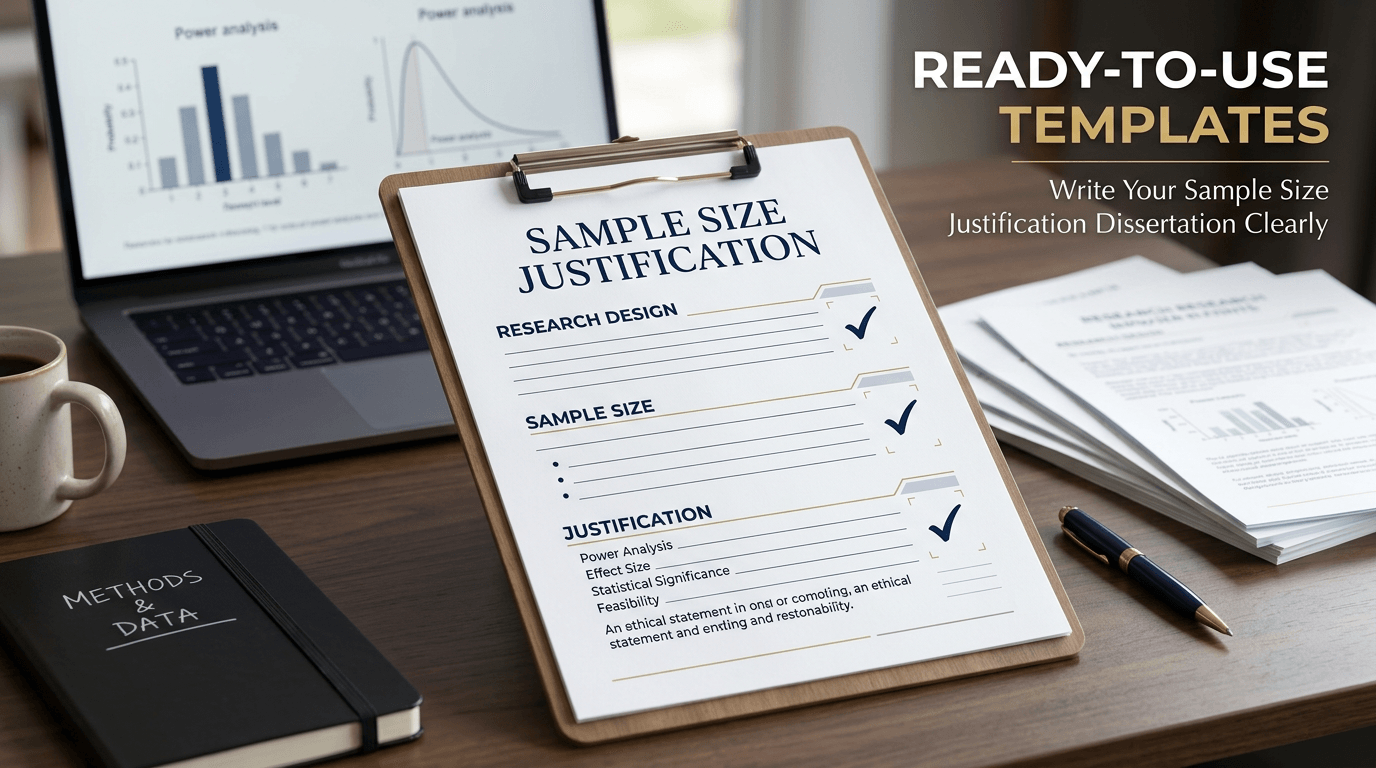
Reading about methods is useful, but most students still get stuck when they actually sit down to write their methodology. The gap is not understanding the concept, it is translating that understanding into clear academic writing.
The templates below are written in a way that reflects how a sample size justification dissertation section is typically presented at Masters or MBA level. You should adapt the details based on your topic, population, and research design.
Qualitative Sample Size Justification Template
“This study adopts a qualitative research design, and the sample size was determined using the principle of theoretical saturation. Semi-structured interviews were conducted with twelve participants, selected through purposive sampling based on their direct experience with [research topic].
Data collection and analysis were carried out simultaneously. After a certain point, no significantly new themes were emerging from additional interviews, indicating that data saturation had been reached. This confirmed that the sample size was sufficient for the purpose of this study.
The final sample size is consistent with qualitative research practices, where studies at this level typically involve a smaller number of participants to allow for deeper exploration of the topic. The focus of this research is on understanding experiences and perspectives rather than achieving statistical generalisation.”
Quantitative Sample Size Justification Template
“The sample size for this study was determined using a statistical approach to ensure the reliability and validity of the findings. Based on a 95% confidence level and a 5% margin of error, the minimum required sample size was calculated using an established formula.
A total of [X] valid responses were collected, which meets and exceeds the required threshold. This ensures that the data is sufficient for the statistical analysis conducted in this study.
Participants were selected from [target population] using [sampling method], ensuring that the sample represents the key characteristics relevant to the research objectives. This approach strengthens the overall credibility of the sample size justification dissertation.”
Mixed Methods Sample Size Justification Template
“This study uses a mixed methods research design, combining both quantitative and qualitative approaches. The sample size was determined separately for each component to reflect their different methodological requirements.
For the quantitative phase, a sufficient number of survey responses were collected to support statistical analysis, based on standard sample size calculation principles. For the qualitative phase, participants were selected using purposive sampling, and interviews were conducted until data saturation was achieved.
This approach ensures that both the breadth and depth of the research are addressed. The sample size justification dissertation reflects a balance between statistical reliability and meaningful qualitative insight, aligned with the overall research objectives.”
Important Note Before You Use These Templates
Do not copy these templates exactly as they are.
Examiners can easily recognise generic writing. What you should do instead is:
- Adjust the numbers based on your study
- Mention your actual research topic
- Add references if required
- Align it clearly with your methodology
If your dissertation has already been returned with feedback, the issue is usually not the sample size itself, but the lack of a clear explanation. You can review this what happens when dissertation methodology gets rejected guide to understand where most students go wrong.
If you are still unsure how to structure your own sample size justification dissertation section, getting professional dissertation help and consultation can help you avoid repeated corrections and confusion.
In the next section, we will look at the most common mistakes that lead to sample size justification getting rejected.
Common Mistakes in Sample Size Justification Dissertation (And Why Students Lose Marks)
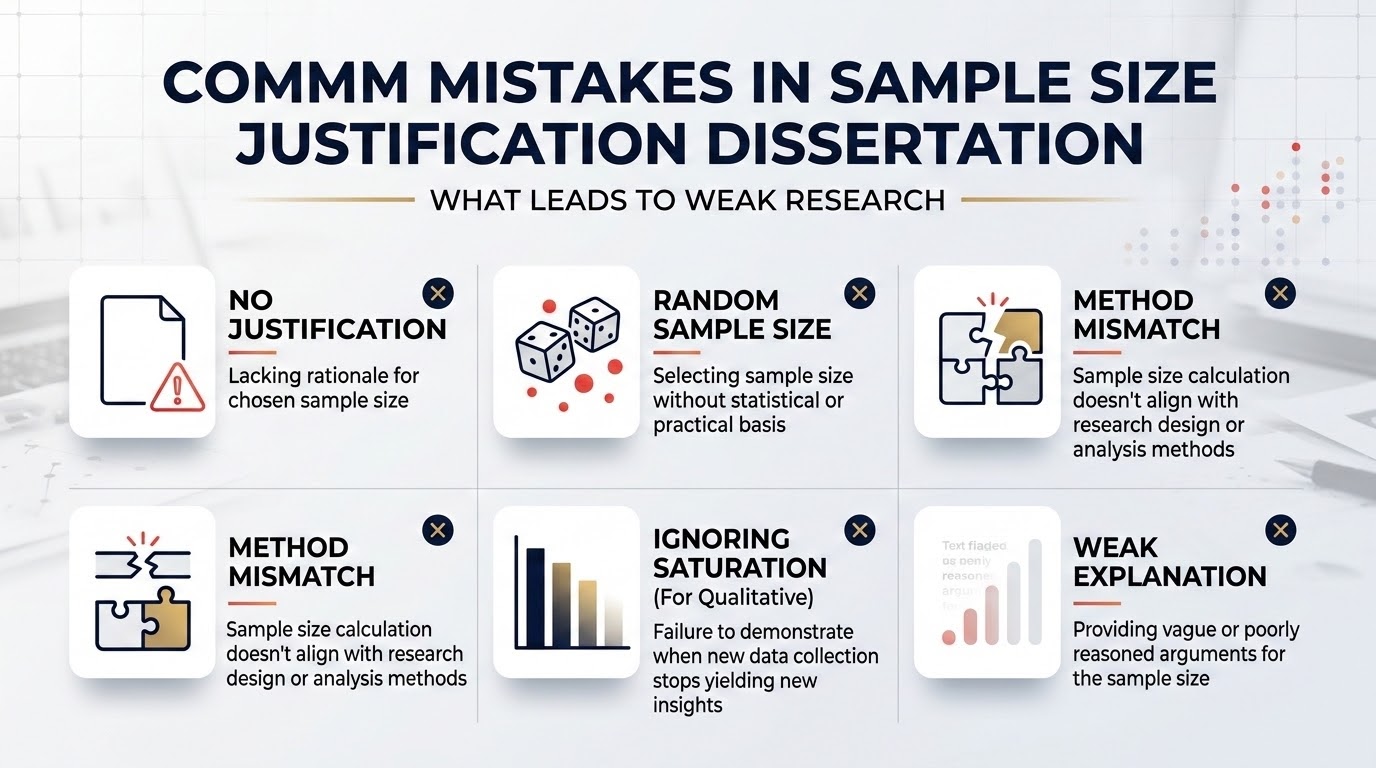
Most students do not struggle with choosing a sample size. They struggle with explaining it. And that is exactly where marks are lost.
If your sample size justification dissertation section feels unclear or weak, chances are you are making one of the mistakes below.
1. Stating the Number Without Explaining It
A very common line you will see in dissertations:
“The sample size for this study is 50 participants.”
This does not explain anything. It just states a number.
What examiners expect is simple:
- Why 50?
- How did you decide it?
- What makes it suitable for your research?
Without that, your justification is incomplete.
2. Choosing a Number Without Any Basis
Some students pick a number because:
- It looks “reasonable”
- They saw it in another dissertation
- It feels manageable
The problem is, none of these are academic reasons.
If your sample size justification dissertation is based on assumption rather than method, it becomes difficult to defend.
3. Not Matching Sample Size with Research Type
This is where many students lose easy marks.
Examples:
- Using a very small sample but claiming statistical accuracy
- Using a large fixed number in qualitative research without mentioning saturation
Your sample size must match your methodology. If it does not, your whole research starts to look inconsistent.
4. Ignoring Data Saturation in Qualitative Research
In qualitative studies, the focus is not on numbers, but on insight.
If you say “I interviewed 10 people” but do not explain why you stopped at 10, it raises questions.
You need to show:
- When themes started repeating
- Why further interviews were not needed
Without this, your justification feels incomplete.
5. No Support from Research or Methods
A strong sample size justification dissertation usually refers to:
- Established methods (like statistical calculation)
- Previous studies
- Research guidelines
If your explanation has no support, it feels like a personal decision rather than an academic one.
Guidance from sources like Coventry University academic writing support also highlights that research decisions should always be supported, not assumed.
6. Weak or Missing Sampling Explanation
Sample size and sampling method go together.
If you mention the number but do not explain:
- How participants were selected
- Why they were chosen
then your justification is incomplete.
7. Ignoring Limitations Completely
No dissertation is perfect, and examiners know that.
If your sample size is smaller due to time, access, or other constraints, it is better to:
- Acknowledge it
- Explain it
- Show how you handled it
Ignoring limitations makes your research look careless, not strong.
Why These Mistakes Matter
Examiners are not just reading your results. They are judging how well you understand your research decisions.
A weak sample size justification dissertation creates doubt about:
- Your methodology
- Your findings
- Your overall understanding
If you have already received feedback and are unsure what went wrong, going through this supervisor feedback on dissertation guide can help you see what examiners actually expect.
If you want to avoid these mistakes and strengthen your methodology before submission, getting expert dissertation help and consultation can help you fix issues early instead of dealing with revisions later.
In the next section, we will break down the difference between qualitative and quantitative sample size so you can clearly understand what applies to your research.
Qualitative vs Quantitative Sample Size Justification Dissertation
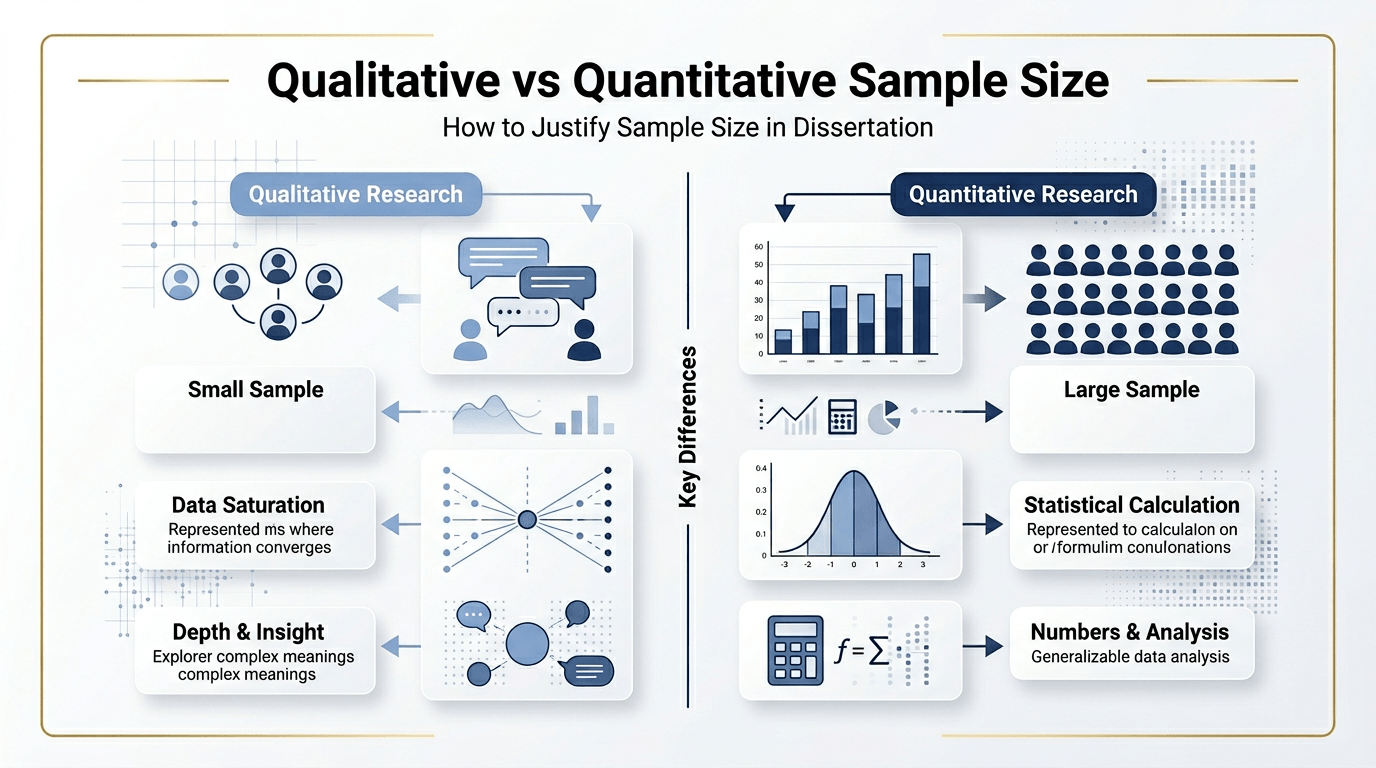
One of the biggest reasons students struggle with sample size justification dissertation is confusion between qualitative and quantitative research. Both follow completely different logic when it comes to deciding how many participants you need.
If you do not understand this difference clearly, your justification will almost always feel weak or inconsistent.
Key Difference You Need to Understand
In simple terms:
- Quantitative research is about numbers, measurement, and statistical testing
- Qualitative research is about understanding experiences, opinions, and deeper insights
Because of this, the way you justify sample size in each case is completely different.
Quick Comparison
| Factor | Qualitative Research | Quantitative Research |
|---|---|---|
| Focus | Depth and meaning | Measurement and testing |
| Sample Size | Small (usually 8–20) | Larger (50–400+) |
| Basis | Data saturation | Statistical calculation |
| Flexibility | Flexible during research | Fixed before data collection |
| Goal | Explore ideas and themes | Test hypotheses |
How This Affects Your Justification
If you are working on qualitative research, your sample size justification dissertation should focus on:
- How participants were selected
- When data saturation was reached
- Why additional data was not needed
If you are working on quantitative research, your justification should explain:
- How the sample size was calculated
- Why it is statistically sufficient
- How it represents your target population
Where Most Students Get Confused
A common mistake is mixing both approaches without explaining it properly.
For example:
- Using a small sample but claiming strong statistical conclusions
- Using a large number in qualitative research without explaining saturation
This creates confusion and weakens your methodology.
If you are still unsure how both approaches work in a full dissertation context, you can go through this detailed qualitative vs quantitative dissertation guide for a clearer understanding.
A Simple Way to Remember
- Qualitative → Explain when and why you stopped collecting data
- Quantitative → Explain how you calculated your sample size and why it is enough
If you are still confused about which approach your research follows or how to justify your sample size properly, getting professional dissertation help and consultation can help you avoid mistakes that often lead to weak methodology sections.
In the next section, we will look at what to do if your sample size is too small and how to justify it without losing marks.
What If Your Sample Size Is Too Small in a Dissertation?
If you are worried that your sample size is too small, you are not alone. This is one of the most common concerns students have while writing their sample size justification dissertation section.
And honestly, the fear makes sense. It feels like a small sample automatically means weak research. But that is not how examiners look at it.
A small sample size is not the problem. Not explaining it properly is.
When a Small Sample Size Is Actually Fine
There are many situations where a smaller sample is completely acceptable.
For example:
- You are doing interviews or qualitative research
- Your participants are very specific or hard to access
- Your study focuses on depth rather than numbers
- You reached a point where new responses stopped adding value
In these cases, a smaller sample can actually make your research stronger, not weaker.
What You Should Do Instead of Hiding It
A mistake a lot of students make is trying to ignore the issue or hoping the examiner will not notice.
They will.
A better approach is to be honest and explain your situation clearly.
Instead of writing something vague like:
“The sample size was limited due to time constraints.”
You can say something like:
“The sample size was limited due to restricted access to participants within the available timeframe. However, the selected participants were directly relevant to the research topic, and data collection continued until no new insights were emerging.”
This shows that you are aware of the limitation and have still handled your research properly.
Turn It Into a Strength
This is where most students miss the opportunity.
A smaller sample size does not have to weaken your sample size justification dissertation. If explained properly, it can actually show:
- You understand your research
- You made informed decisions
- You focused on quality over quantity
Examiners usually respect this more than forced or poorly collected large samples.
What Examiners Actually Care About
They are not counting your participants and deciding your marks.
They are asking:
- Does this student understand their research method?
- Can they explain their decisions clearly?
- Is the reasoning logical?
If the answer is yes, your sample size is rarely a problem.
If you have already received feedback about this, going through something like this dissertation deadline close support guide can help you understand how to handle limitations and improve your work under pressure.
If you still feel unsure about how to justify your sample size or present it properly, getting professional dissertation help and consultation can help you fix things before submission instead of after feedback.
In the next section, we will answer some of the most common questions students have about sample size justification dissertation.
Frequently Asked Questions (FAQs)
How do I write sample size justification dissertation properly?
Start by being clear about your research type. If your study is quantitative, explain how you calculated the sample size or why it is statistically enough. If it is qualitative, focus on how you reached data saturation.
The main thing is simple: do not just mention the number. Explain how you decided it and why it fits your research.
What is the minimum sample size for a dissertation?
There is no fixed number that works for everyone.
In qualitative research, students often work with 8–20 participants depending on when meaningful insights stop emerging. In quantitative research, the number is usually higher and depends on your data analysis method.
Instead of chasing a “minimum number,” focus on what actually makes sense for your study.
Can my dissertation be rejected because of sample size?
Yes, but not in the way most students think.
It is usually not about the number being too small or too big. The problem is when the sample size justification dissertation is weak or does not match the research method.
If your explanation is clear and logical, your sample size is rarely the issue.
What if my sample size is too small?
A smaller sample size is acceptable if you can justify it properly.
For example, in qualitative research, a smaller sample is normal if you reached data saturation. Even in other cases, you can explain limitations like time, access, or a specific target group.
The important thing is to explain it, not ignore it.
How many participants do I need for a Masters dissertation?
It depends on your research approach.
For interviews or qualitative work, around 10–20 participants is usually acceptable. For surveys or quantitative research, the number is generally higher.
There is no perfect number. What matters is whether your sample size fits your method and is properly justified.
What is sample size justification dissertation in research?
It is simply the explanation of why you chose a particular number of participants or data points.
You are showing that your decision is not random, but based on your research design, data collection method, and academic reasoning.
If you are still confused about your sample size or not sure how to explain it clearly, getting professional dissertation help and consultation can save you from last-minute stress and repeated revisions.
In the final section, we will quickly wrap everything up and what you should do next.
Conclusion: Getting Your Sample Size Justification Dissertation Right
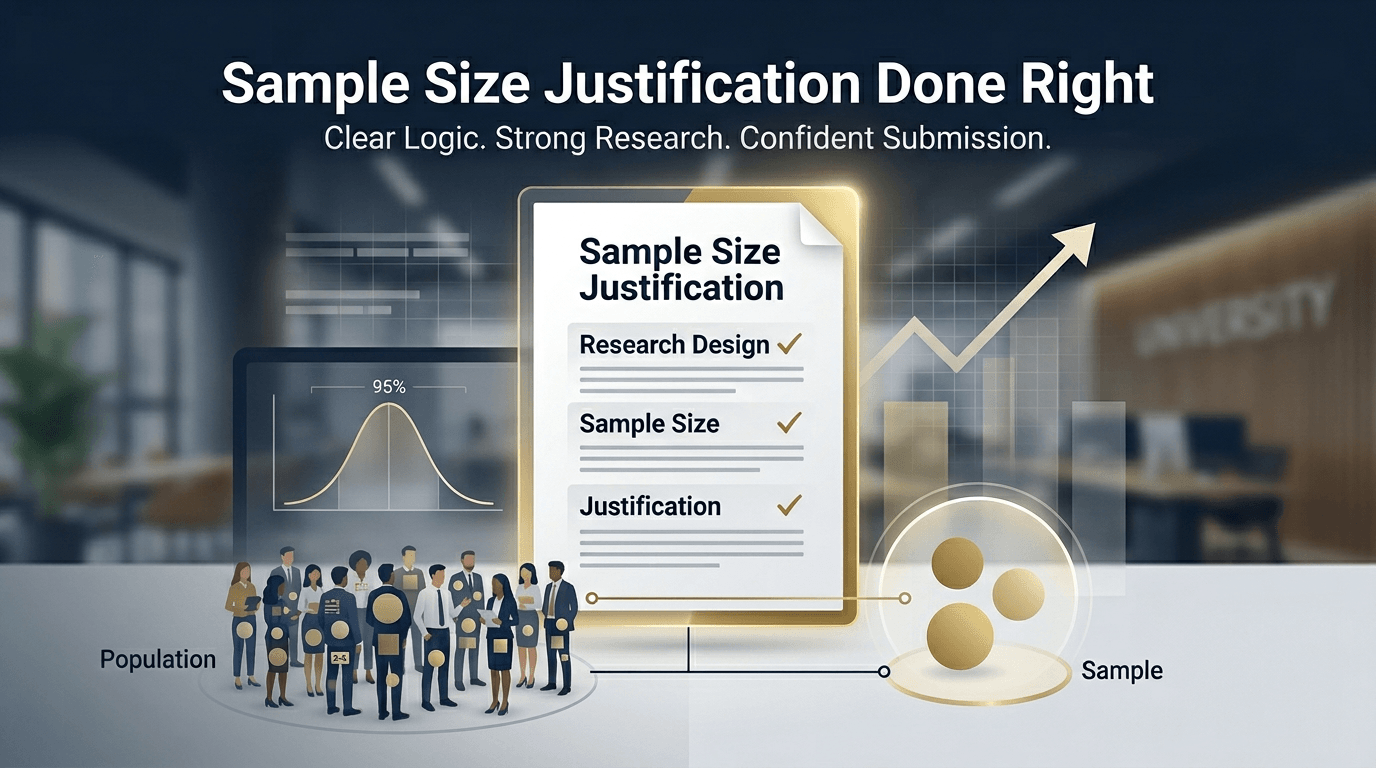
By now, one thing should be clear — sample size justification dissertation is not about picking a number that “looks okay.” It is about showing that your choice makes sense.
If your explanation is clear, connected to your research method, and backed by some form of reasoning or reference, your sample size will rarely be questioned. Most issues happen when students treat this section as a formality instead of an important part of their methodology.
You have now seen:
- What sample size justification dissertation actually means
- Different ways to justify your sample size
- Practical examples you can follow
- Common mistakes that lead to lost marks
At this point, the real question is not what to write, but whether you can explain your decisions with confidence.
Take a moment and think about your own work.
Does your sample size justification actually explain your choice, or does it just mention a number?
That small difference is often what separates a well-written dissertation from one that needs revision.
If you feel unsure about your methodology or want to avoid last-minute feedback issues, getting professional dissertation help and consultation can help you structure everything properly before submission.
Fix it once, and you do not have to keep fixing it later.
Related reading you may find useful: