
Every year, hundreds of dissertation submissions get delayed — not because the research was bad, but because the student picked the wrong methodology.
Qualitative when the supervisor wanted quantitative. Quantitative when the topic clearly needed depth over data. One wrong decision, made early, can cost you months of rework — or worse, your entire submission window.
And the frightening part? Most students don’t find out until it’s too late.
If you’re currently staring at your dissertation brief trying to figure out whether you need interviews or surveys, themes or statistics, words or numbers — this guide was written for you.
We’ve helped hundreds of students across the UK, Australia, and Canada navigate exactly this decision. Some came to us early. Others came to us after their methodology had already been rejected. The ones who came early had a significantly smoother ride.
This blog breaks down the 7 real differences between a qualitative and quantitative dissertation, tells you which one gets approved more easily, and gives you a decision framework so you stop second-guessing and start writing with confidence.
Still unsure where to begin? Message us on WhatsApp — our dissertation specialists reply within minutes.
Quick Answer Box
Qualitative vs Quantitative Dissertation: What’s the Difference?
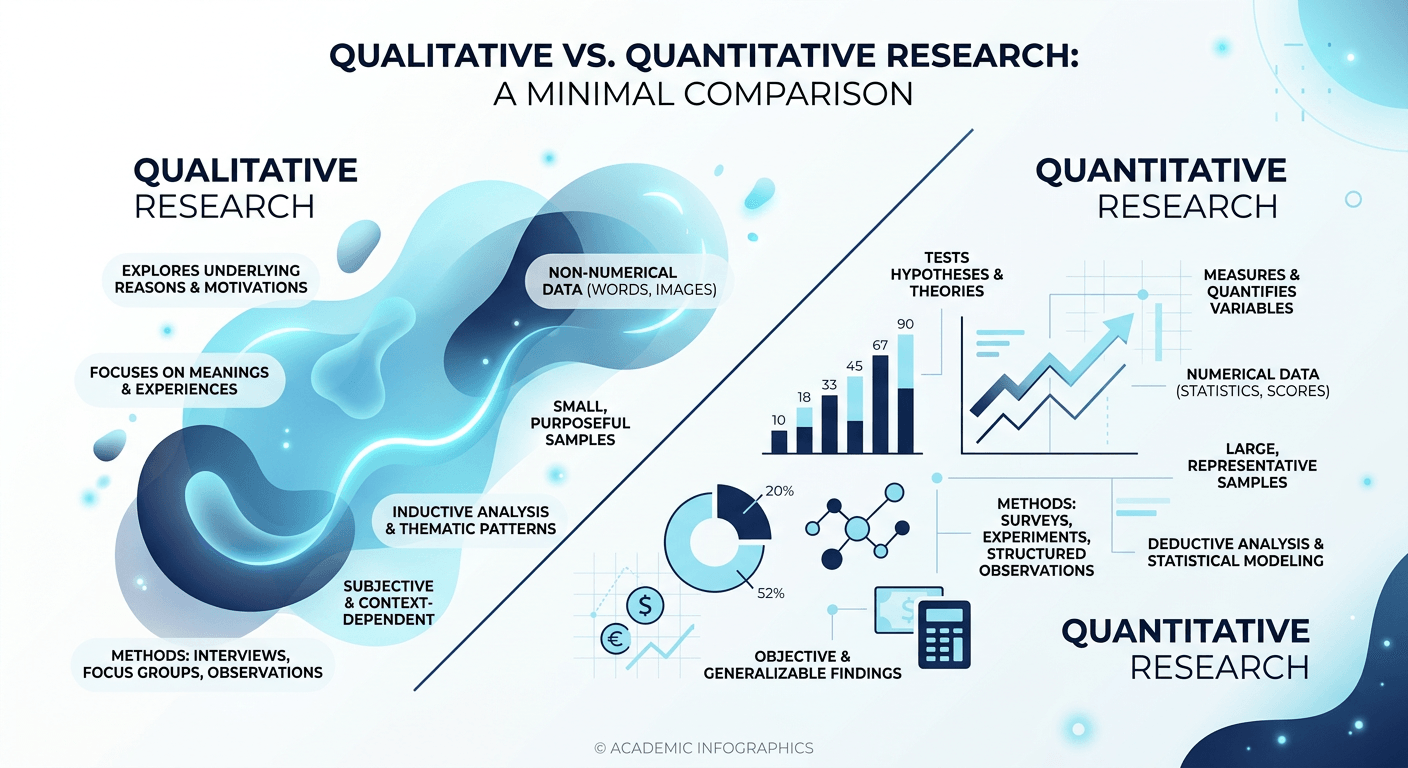
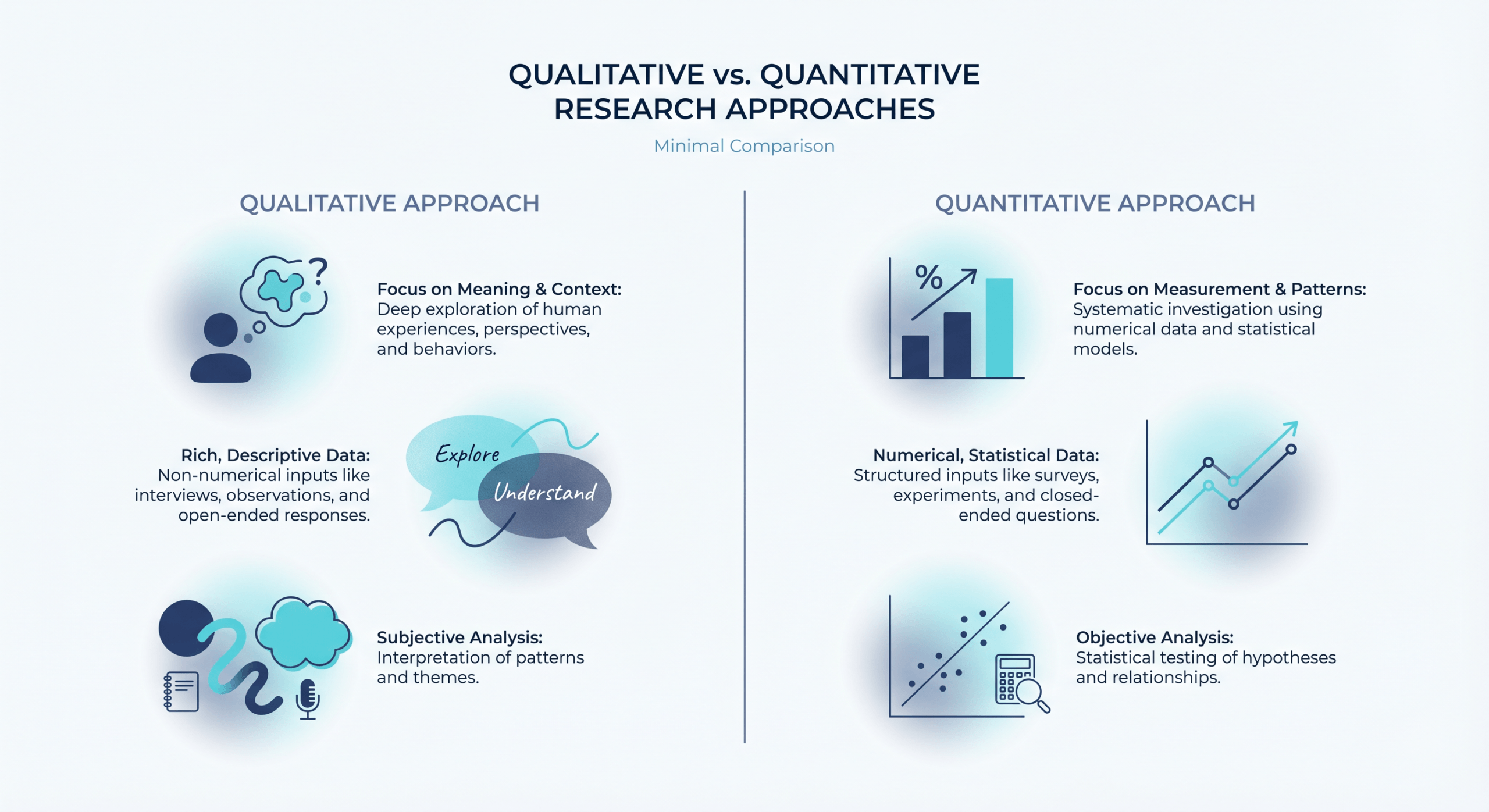
A qualitative dissertation explores ideas, experiences, and meanings through interviews, observations, or case studies. A quantitative dissertation measures and analyses numerical data using surveys or experiments.
Neither is universally easier to get approved — the one that matches your research question and topic gets approved faster. Choosing the wrong one is the most common reason supervisors reject a methodology chapter.
Table of Contents
- What is a Qualitative Dissertation?
- What is a Quantitative Dissertation?
- Qualitative vs Quantitative Dissertation: 7 Key Differences
- Which One Gets Approved More Easily?
- How to Choose in 60 Seconds: Decision Framework
- Common Mistakes Students Make
- Mini Case Studies: Real Student Scenarios
- Expert Tips to Get Your Dissertation Approved Faster
- Conclusion
- FAQs
What is a Qualitative Dissertation?
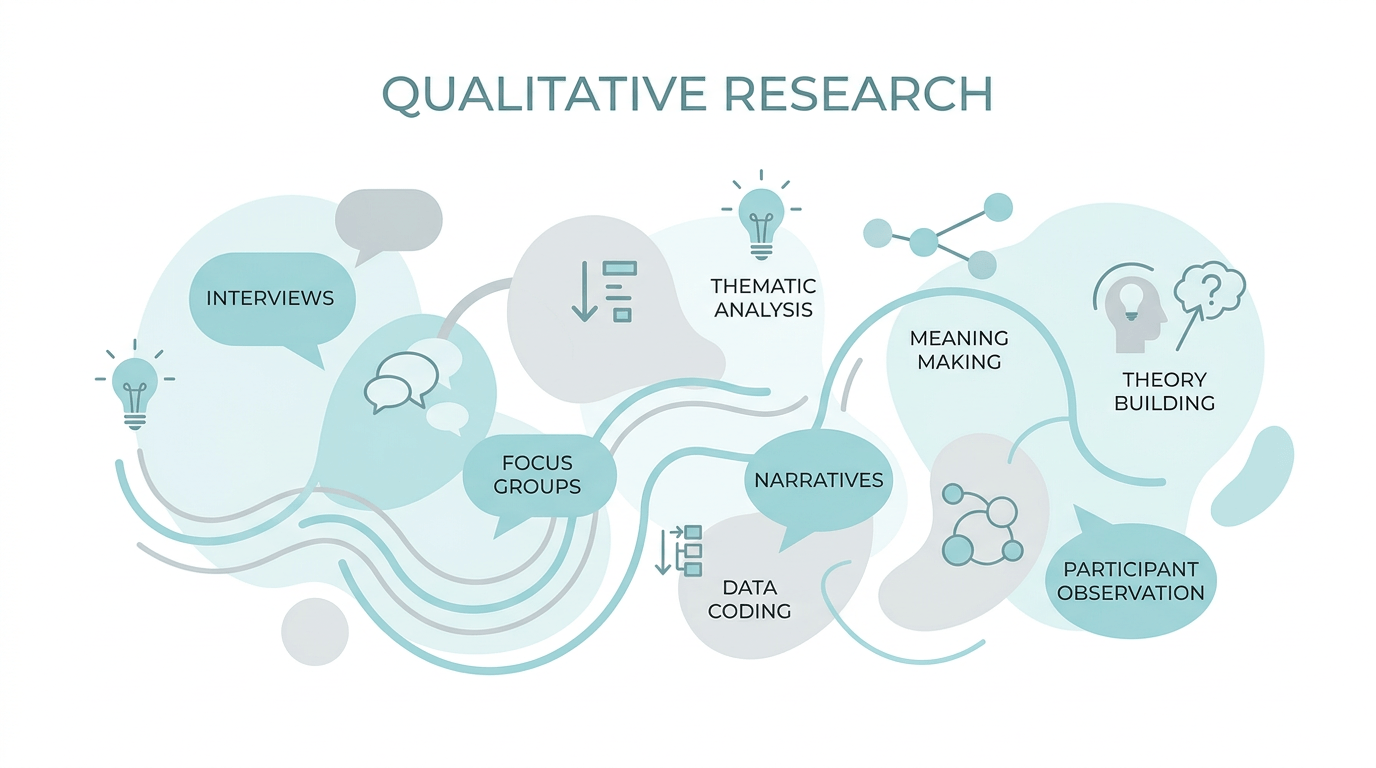
A qualitative dissertation is built around understanding — not measuring.
Instead of collecting numbers, you’re collecting experiences, opinions, perspectives, and meanings. You’re trying to answer the “why” and “how” behind human behaviour, not the “how many” or “how much.”
The data comes from interviews, focus groups, observations, or case studies. The analysis involves identifying patterns and themes in what people say or do — a process called thematic analysis or content analysis.
It’s the methodology you use when the answer to your research question can’t be captured in a spreadsheet.
A Real Example
Imagine you’re a Psychology student researching how university students cope with academic pressure post-COVID. You can’t measure “coping” with a number. You need to sit with people, ask open-ended questions, and understand their lived experience.
That’s a qualitative dissertation.
Another example — an Education student exploring why first-generation university students in the UK feel academically excluded. The story is in the experience, not the statistics.
When Supervisors Prefer It
Your supervisor will lean towards qualitative research when:
- Your topic is exploratory — there isn’t enough existing research to form a hypothesis
- The subject involves human emotions, culture, identity, or social behaviour
- Your discipline is Psychology, Sociology, Education, Social Work, or Humanities
- You’re doing a case study or ethnographic research
- The research question starts with “how” or “why”
One thing students often miss — qualitative doesn’t mean easier. The interpretation stage is intellectually demanding. If your thematic coding is weak or your theoretical framework is unclear, supervisors will send it back. If you’re worried your methodology chapter isn’t strong enough, our dissertation specialists can review it for you.
What is a Quantitative Dissertation?
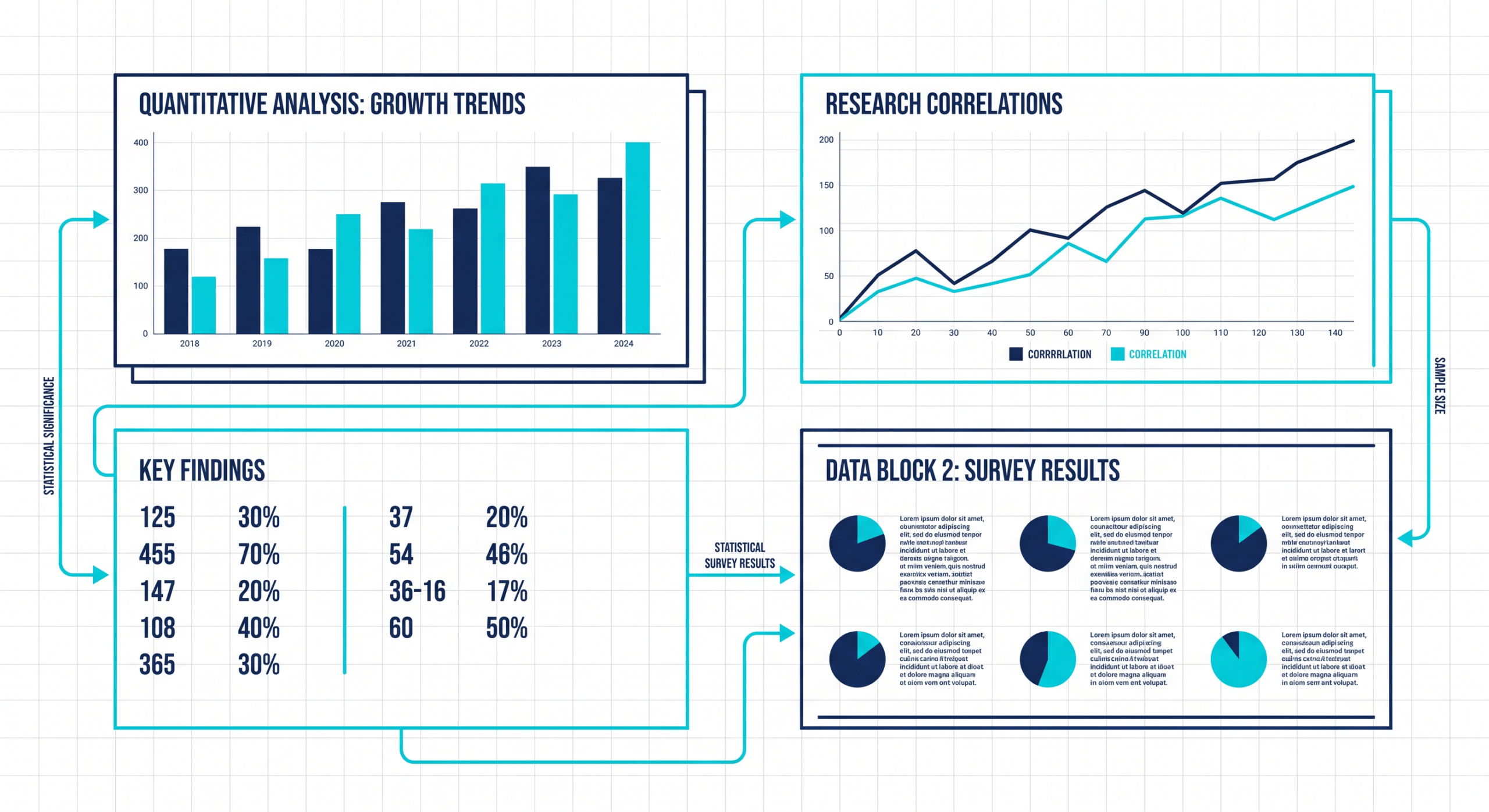
A quantitative dissertation is built around measuring — not interpreting.
Instead of exploring experiences, you’re collecting numbers, running statistical tests, and proving or disproving a hypothesis. You’re answering “how many,” “how much,” or “to what extent” — not “why” or “how.”
The data comes from surveys, experiments, structured observations, or existing datasets. The analysis involves statistical tools like SPSS, Excel, or R — looking for patterns, correlations, and causations in numbers.
It’s the methodology you use when you need evidence that can be generalised across a larger population.
A Real Example
Imagine you’re a Business student researching whether social media advertising directly influences the purchase behaviour of university students aged 18–25. You design a structured survey, collect responses from 200 participants, run a regression analysis, and present findings backed by statistics.
That’s a quantitative dissertation.
Another example — a Health Sciences student measuring the impact of sleep deprivation on academic performance across 150 undergraduate students using standardised test scores and a sleep tracking questionnaire.
When Supervisors Prefer It
Your supervisor will steer you towards quantitative research when:
- Your research question involves measuring a relationship, pattern, or trend
- Your discipline is Business, Economics, Health Sciences, Finance, or Engineering
- You already have access to a dataset or can distribute a survey at scale
- Your topic requires findings that can be statistically generalised
- The research question starts with “what is the effect of” or “to what extent does”
A common mistake here — students assume quantitative is more credible because it uses statistics. That’s not true. A poorly designed survey, a sample size of 40, or the wrong statistical test will get your methodology rejected just as fast. If you’re unsure whether your quantitative approach is structured correctly, get it checked before you submit.
Qualitative vs Quantitative Dissertation: 7 Key Differences
If you’ve read the sections above, you already understand what each methodology does. Now let’s put them side by side so you can see exactly where they differ — and what that means for your dissertation.
| # | Criteria | Qualitative | Quantitative |
| 1 | Data Type | Words, themes, narratives | Numbers, statistics |
| 2 | Research Goal | Explore & understand | Measure & prove |
| 3 | Sample Size | Small (10–30 participants) | Large (100+ participants) |
| 4 | Data Collection | Interviews, focus groups, observations | Surveys, experiments, datasets |
| 5 | Analysis Method | Thematic, content, discourse analysis | SPSS, regression, correlation |
| 6 | Time to Complete | Longer (interpretation is time-heavy) | Faster once data is collected |
| 7 | Approval Risk | High if coding framework is weak | High if statistical test is wrong |
What This Means for You
Most students look at this table and immediately ask — “okay but which one is better?” That’s the wrong question.
Here’s what actually matters:
- If your research question asks “why” or “how” — qualitative fits. If it asks “how much” or “to what extent” — quantitative fits.
- A small sample in qualitative is not a weakness. It’s by design. But a small sample in quantitative is a serious methodological flaw that supervisors will flag immediately.
- Both carry approval risk — just in different places. Qualitative gets rejected for weak interpretation. Quantitative gets rejected for poor survey design or wrong statistical analysis.
- Time is not the deciding factor. Choosing based on “which is faster” is how students end up with a misaligned methodology and a rejected chapter.
The qualitative vs quantitative dissertation decision should always start with your research question — not your comfort zone, not your deadline, and definitely not what your coursemates are doing.
If you’ve read this and you’re still not sure which direction your research question points, don’t guess. Talk to one of our dissertation experts and get a clear answer before you waste weeks going in the wrong direction.
Which One Gets Approved More Easily?
Let’s be honest about something most blogs won’t tell you.
There is no universally “easier” methodology to get approved. What gets approved is the methodology that fits your research question, is executed correctly, and is defended confidently in your write-up.
That said — there are patterns. And if you’re choosing between the two, you need to know what supervisors are actually thinking when they review your methodology chapter.
The Supervisor Mindset
Your supervisor isn’t looking for impressive statistical models or deeply philosophical qualitative frameworks. They’re looking for one thing — alignment.
Does your methodology logically follow from your research question? Does your data collection method actually give you the data you need to answer it? Is your analysis approach appropriate for the data you’ve collected?
If the answer to all three is yes — your methodology gets approved.
If there’s a mismatch anywhere in that chain — it gets sent back. Every time.
Approval Difficulty: The Honest Comparison
Qualitative dissertations tend to face more scrutiny at the analysis stage. Supervisors will push back if your thematic coding feels superficial, if you haven’t grounded your interpretation in theory, or if your sample selection isn’t justified. The subjectivity of qualitative research means you need to work harder to prove rigour.
Quantitative dissertations tend to face more scrutiny at the design stage. If your survey questions are leading, your sample size is too small, or you’ve chosen the wrong statistical test — supervisors will catch it before you’ve even collected data. The objectivity of quantitative research means the methodology either holds up statistically or it doesn’t.
Common Rejection Reasons
For qualitative dissertations:
- Thematic coding is too surface-level with no theoretical grounding
- Sample size isn’t justified or participants aren’t appropriate for the research question
- No clear audit trail showing how themes were derived from raw data
- Researcher bias isn’t acknowledged or addressed
- Methodology chapter reads descriptively rather than critically
For quantitative dissertations:
- Survey design is flawed — leading questions, unclear scales, or missing variables
- Sample size is statistically insufficient for the claims being made
- Wrong statistical test chosen for the type of data collected
- No reliability or validity checks on the instrument used
- Findings don’t actually answer the research question stated in Chapter 1
This is exactly why so many students end up with a rejected methodology chapter — not because the topic was wrong, but because the execution had gaps they didn’t see coming. If your methodology has already been sent back, read this guide on what to do when your dissertation methodology gets rejected (https://assignprosolution.com/dissertation-methodology-rejected/) before you resubmit.
And if you want someone to check your methodology before your supervisor does — message us on WhatsApp and we’ll give you honest feedback within the hour.
How to Choose in 60 Seconds: Decision Framework
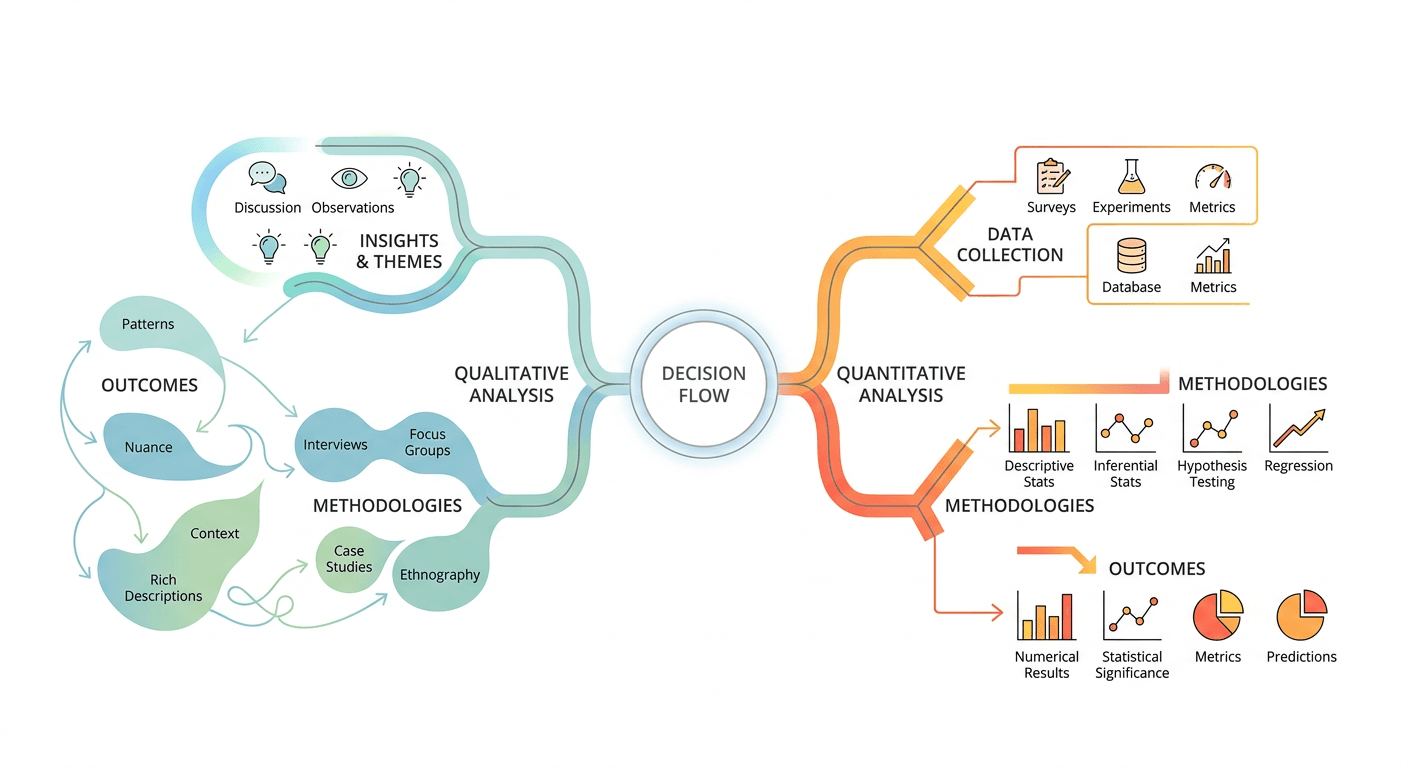
Stop overthinking this. Answer these four questions honestly and your methodology will choose itself.
Question 1: What is your research question actually asking?
If your research question contains words like “why,” “how,” “what is the experience of,” or “what does it mean to” — you need qualitative research. You’re exploring, not measuring.
If your research question contains words like “to what extent,” “what is the effect of,” “how much,” or “is there a relationship between” — you need quantitative research. You’re measuring, not exploring.
This single question eliminates about 70% of the confusion students have. If you get this right, everything else falls into place.
Question 2: Do you have access to data?
Qualitative: Can you realistically recruit 10–20 participants willing to be interviewed? Do you have access to case studies, documents, or observational settings relevant to your topic?
Quantitative: Can you distribute a survey to 100+ relevant respondents? Do you have access to an existing dataset from a credible source?
If the answer to either is no — that methodology isn’t just harder, it’s potentially impossible to execute properly. Don’t choose a methodology you can’t actually carry out. Supervisors spot this immediately.
Question 3: How much time do you realistically have?
Qualitative research takes longer at the back end — transcribing interviews, coding data, and interpreting themes is time-intensive work that can’t be rushed without damaging quality.
Quantitative research takes longer at the front end — designing a valid survey instrument and getting sufficient responses takes time, but the analysis stage moves faster once data is in.
If your deadline is uncomfortably close, read this before you decide anything else (https://assignprosolution.com/dissertation-deadline-close/) — because the methodology decision looks very different when time is a real constraint.
Question 4: Where does your confidence lie?
This isn’t about comfort zones — it’s about execution risk.
Are you comfortable sitting with ambiguity, interpreting language, and building arguments from themes? Qualitative might be your stronger ground.
Are you comfortable with data, numbers, and statistical logic — or willing to learn the tools quickly? Quantitative might be your stronger ground.
Choosing a methodology you genuinely cannot execute well is a bigger risk than choosing the one that’s slightly less fashionable in your field.
The 60-Second Decision
- Research question has “why/how” → Qualitative
- Research question has “to what extent/effect of” → Quantitative
- Can’t access enough participants for interviews → Quantitative
- Can’t distribute survey to 100+ people → Qualitative
- Deadline is very close + analysis heavy work ahead → Quantitative
- Strong in interpretation and theory → Qualitative
- Strong in data and statistics → Quantitative
Still landing in the middle? That’s what mixed methods is for — but that’s a separate conversation, and one worth having with an expert before you commit. For a deeper breakdown of how to structure whichever methodology you choose, this dissertation methodology guide (https://assignprosolution.com/dissertation-methodology-uk/) will walk you through it step by step.
Common Mistakes Students Make
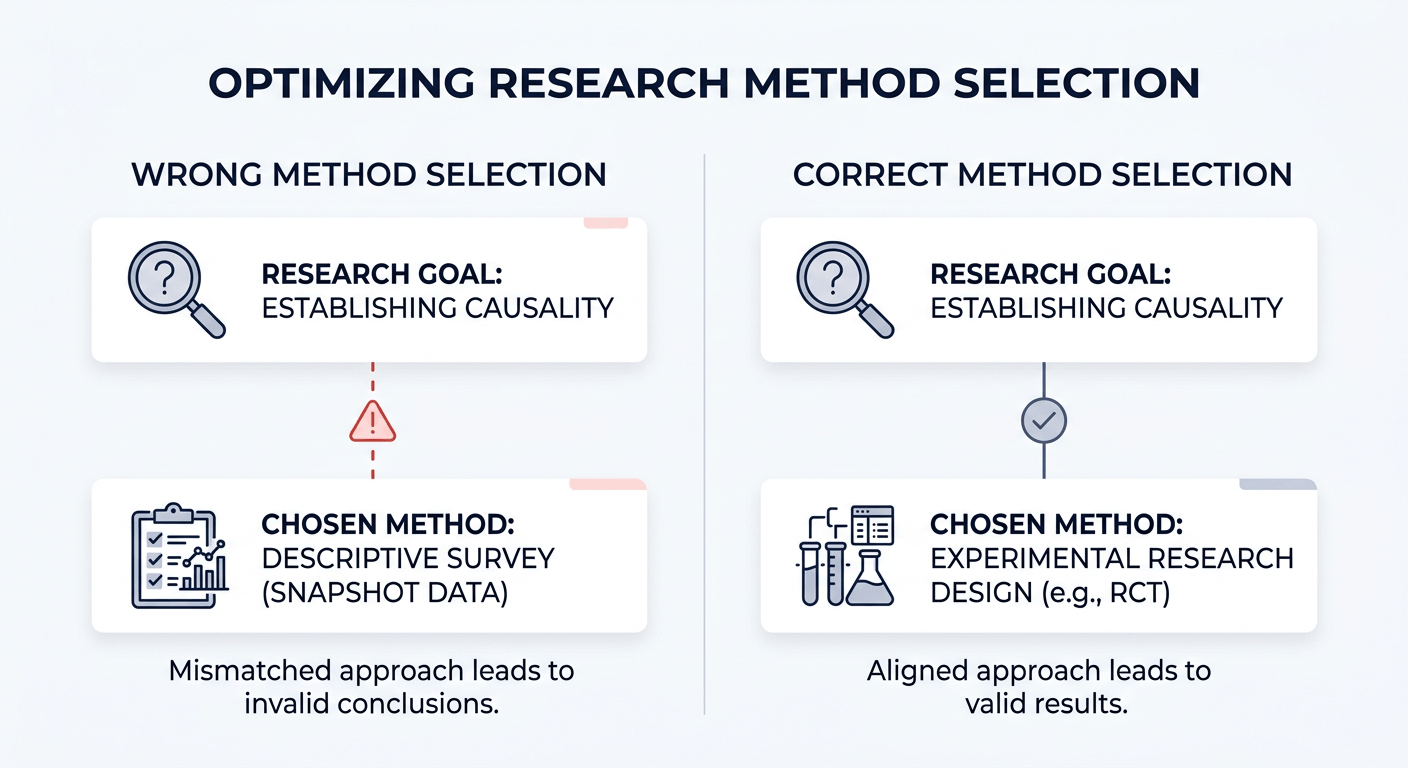
Most dissertation methodology errors aren’t random. They follow predictable patterns — the same mistakes, made by different students, every single year.
Here are the ones that actually get chapters rejected.
Qualitative Mistakes
Choosing a topic that’s too broad to explore meaningfully
A student studying “the impact of social media on mental health” qualitatively is setting themselves up for a vague, unfocused dissertation. The scope is too wide for 10–15 interviews to address meaningfully.
The fix — narrow it. “How do female university students in the UK perceive the relationship between Instagram use and body image” is specific, researchable, and defensible.
Treating thematic analysis like summarising
This is the most common qualitative mistake. Students read through their interview transcripts, pick out recurring words, call them “themes,” and present them as findings.
That’s not thematic analysis. That’s summarising.
Real thematic analysis requires you to move from raw data → codes → themes → theoretical interpretation. If your analysis chapter doesn’t show that journey, supervisors will ask you to redo it. If you’re unsure whether your analysis holds up, check our guide on common dissertation mistakes (https://assignprosolution.com/common-dissertation-mistakes/) before your supervisor does it for you.
Ignoring researcher positionality
In qualitative research, you are part of the research instrument. Your background, beliefs, and assumptions influence how you interpret data. Supervisors expect you to acknowledge this — it’s called reflexivity.
Students who skip this come across as methodologically naive. It’s a small section but it signals to your supervisor that you understand qualitative rigour.
Not justifying sample selection
Saying “I interviewed 12 people” is not enough. You need to explain who they were, why they were appropriate for your research question, how you recruited them, and why 12 was a sufficient number for the depth of analysis you conducted.
Every methodological decision needs a rationale — not just a description.
Quantitative Mistakes
Using a survey with no pilot test
A student designing a 20-question Likert scale survey and distributing it immediately — without testing it on 5–10 people first — is taking a serious risk.
Pilot testing reveals ambiguous questions, missing response options, and structural flaws before they contaminate your entire dataset. Skipping it is one of the most avoidable quantitative mistakes there is.
Choosing the wrong statistical test
This one gets students in real trouble. Using a Pearson correlation when your data is ordinal, or running a t-test when your sample violates normality assumptions — supervisors with any statistical background will catch it immediately.
If you’re not confident about which test fits your data type, get it checked before you run your analysis. A wrong test doesn’t just lose you marks — it invalidates your findings entirely.
Reporting results without interpreting them
Presenting a table of SPSS output and moving on is not analysis. You need to explain what the numbers mean in the context of your research question, relate them back to existing literature, and discuss whether your hypothesis was supported or refuted — and why.
Numbers without narrative don’t make a dissertation. They make a spreadsheet.
Overclaiming from a small sample
A sample of 45 undergraduate students from one university cannot be used to make claims about “all UK university students.” Supervisors will flag this as overgeneralisation — and rightly so.
Your conclusions need to stay within the boundaries of what your data can actually support. Anything beyond that needs to be framed as a limitation, not a finding.
Mini Case Studies: Real Student Scenarios
Sometimes the clearest way to understand a methodology decision is to see it play out in a real situation. Here are two student scenarios — one qualitative, one quantitative — showing what good execution looks like and where things nearly went wrong.
Student A — Qualitative Dissertation
Name: Sarah Course: MA Education University: University of Leeds Topic: How do first-generation university students in the UK experience academic belonging in their first year?
Why She Chose Qualitative
Sarah’s research question was exploratory by nature. She wasn’t trying to measure belonging — she was trying to understand what it felt like, what shaped it, and why some students felt it while others didn’t. No survey could capture that depth.
She conducted semi-structured interviews with 14 first-generation students across three UK universities, transcribed every session, and used thematic analysis to identify five core themes around belonging, identity, and institutional culture.
What Nearly Went Wrong
Sarah’s first draft of her analysis chapter was essentially a summary of what each participant said — organised by theme but with no theoretical grounding. Her supervisor flagged it immediately, asking her to connect her findings to Bourdieu’s theory of cultural capital.
Once she revised the analysis through that theoretical lens, the chapter transformed. The themes had depth, the interpretation had academic weight, and the findings were genuinely original.
The Outcome
Sarah passed with minor corrections. Her supervisor specifically praised the rigour of her thematic coding in the final feedback. The theoretical framework she almost skipped ended up being the strongest part of her dissertation.
The lesson — qualitative research lives or dies on the quality of your interpretation. Data collection is the easy part.
If your analysis chapter needs that kind of structured support before submission, our dissertation specialists can work through it with you.
Student B — Quantitative Dissertation
Name: James Course: BSc Business Management University: University of Birmingham Topic: To what extent does social media advertising influence the purchase intention of university students aged 18–25 in the UK?
Why He Chose Quantitative
James’s research question had “to what extent” written into it — a clear signal that measurement was needed, not exploration. He wanted to establish a statistically supported relationship between two variables: social media advertising exposure and purchase intention.
He distributed a structured Likert scale survey to 187 participants through his university network and two relevant student Facebook groups, ran a Pearson correlation and multiple regression analysis in SPSS, and produced findings that showed a statistically significant positive relationship between the two variables.
What Nearly Went Wrong
James’s first survey draft had three leading questions that assumed participants already found social media ads influential. His dissertation supervisor caught this during the proposal stage and asked him to redesign those questions before distributing.
He also initially planned to use a sample of 60 — which his supervisor flagged as statistically insufficient for the regression model he intended to run. He expanded to 187, which gave his findings the statistical power they needed.
The Outcome
James passed with no corrections required. His methodology chapter was cited in his feedback as “clearly structured and appropriately justified.” The statistical findings gave him strong, evidence-backed conclusions that held up under examination.
The lesson — quantitative research lives or dies on the quality of your design. If the foundation is solid, the rest follows logically.
Not sure if your survey design or sample size will hold up under supervisor review? Message us on WhatsApp before you distribute — it’s much easier to fix before the data is collected than after.
Expert Tips to Get Your Dissertation Approved Faster
Getting your dissertation approved isn’t just about picking the right methodology. It’s about how you build, justify, and present every decision you make from Chapter 1 to Chapter 5.
These are the tips that actually move the needle.
Tip 1: Lock Your Research Question Before You Touch Your Methodology
This sounds obvious. Most students skip it anyway.
If your research question is vague, broad, or still shifting — your methodology will be built on sand. Every methodological decision flows from the research question. Get that wrong and nothing else holds together.
Sit with your research question for a day before you commit to it. Ask yourself — can I actually answer this with the data I can realistically collect? If the answer is no, refine the question first. Everything else comes after.
Tip 2: Justify Every Methodological Decision — Not Just Describe It
The methodology chapter is not a list of what you did. It’s an argument for why you did it that way.
Every choice — qualitative or quantitative, interviews or surveys, thematic analysis or regression — needs a rationale grounded in methodology literature. Cite Saunders, Bryman, Creswell, or relevant methodologists to show your decisions are academically defensible, not just convenient.
Supervisors approve methodology chapters that read like informed, justified arguments. They send back chapters that read like procedural descriptions. For a detailed breakdown of how to structure this correctly, this dissertation methodology guide (https://assignprosolution.com/dissertation-methodology-uk/) is worth reading before you write a single word of Chapter 3.
Tip 3: Get Supervisor Feedback Early — Not Just at Submission
The biggest mistake students make is treating supervisor feedback as a final-stage safety net. It isn’t. It’s a tool you should be using throughout the process.
Share your methodology outline before you write the full chapter. Share your data collection instrument before you distribute it. Share your analysis framework before you code your data.
Early feedback prevents late-stage disasters. A supervisor who sees your methodology evolve is far more likely to approve it than one who sees it for the first time at submission. If you’re unsure how to act on supervisor feedback effectively, read this guide on handling supervisor feedback on your dissertation (https://assignprosolution.com/supervisor-feedback-on-dissertation/).
Tip 4: Don’t Start Writing Without a Clear Dissertation Structure
Students who start writing Chapter 1 without knowing what Chapter 3 and 5 will look like almost always run into structural problems mid-way through.
Before you write anything, map out your entire dissertation — research question, methodology, data collection method, analysis approach, and the type of conclusions you expect to draw. Every chapter should connect logically to the next.
If you’re not sure how to build that structure from scratch, this guide on how to start writing a dissertation (https://assignprosolution.com/start-writing-a-dissertation-guide/) will walk you through the full process.
Tip 5: Treat Your Limitations Section as a Strength — Not an Admission of Failure
Most students write their limitations section reluctantly — as if acknowledging weaknesses will cost them marks.
The opposite is true. A well-written limitations section shows your supervisor that you understand the boundaries of your research and have thought critically about its scope. That’s a sign of academic maturity.
Acknowledge your sample size constraints, potential researcher bias, data access limitations, or generalisability issues — and briefly explain how you mitigated them where possible. Supervisors reward this. Examiners respect it.
Tip 6: Never Submit a Methodology Chapter Without Peer Review
Before your methodology goes to your supervisor, it should go to at least one other person — a coursemate, a writing centre tutor, or a dissertation specialist — who can read it critically.
You’ve been staring at your own work for weeks. You will miss things. A fresh pair of eyes will catch the gaps, the unjustified decisions, and the sections that make sense in your head but not on paper.
If you don’t have anyone in your network who can do this properly, our team reviews methodology chapters and gives structured, actionable feedback — so you go into your supervisor meeting with confidence, not anxiety.
FAQs
Is qualitative or quantitative dissertation easier?
Neither is easier — they’re difficult in different ways. Qualitative dissertations are harder at the analysis stage because interpretation requires depth, theoretical grounding, and rigour. Quantitative dissertations are harder at the design stage because a flawed survey or wrong statistical test can invalidate your entire study. The one that’s easier for you is the one that aligns with your research question and your ability to execute it properly.
Can I mix qualitative and quantitative methods in my dissertation?
Yes — this is called mixed methods research. It combines the depth of qualitative data with the measurability of quantitative data. However, it’s significantly more complex to design, execute, and justify than either approach alone. Unless your research question genuinely requires both, mixed methods can increase your workload and your approval risk. Always discuss this with your supervisor before committing to it.
Which research method gets approved faster by supervisors?
The one that fits your research question gets approved faster — full stop. Supervisors don’t have a preference for qualitative or quantitative. They have a preference for alignment, clarity, and justification. A well-structured qualitative methodology will always be approved faster than a poorly designed quantitative one, and vice versa.
How do I know if my dissertation methodology will get rejected?
Common warning signs include: your research question and methodology don’t logically connect, your sample size can’t support the claims you’re making, your data collection method won’t actually give you the data you need, or your analysis approach doesn’t match your data type. If any of these apply to your current plan, read this guide on what to do when your dissertation methodology gets rejected (https://assignprosolution.com/dissertation-methodology-rejected/) before your supervisor sees it.
What is the best research method for a business dissertation?
Most business dissertations lean quantitative — particularly for topics involving consumer behaviour, financial performance, market trends, or organisational efficiency. However, qualitative research is entirely appropriate for business topics involving leadership, organisational culture, employee experience, or strategic decision-making. The discipline doesn’t dictate the methodology — the research question does.
How long does a qualitative dissertation take to complete?
A qualitative dissertation typically takes longer than a quantitative one at the analysis stage. Transcribing interviews, coding data, identifying themes, and interpreting findings through a theoretical lens is time-intensive work. Realistically, from data collection to a complete methodology and findings chapter, you should allow 6–10 weeks minimum — more if your topic is complex or your participant recruitment is slow. If your timeline is tighter than that, talk to our team and we’ll help you map out a realistic plan.
Conclusion
Choosing between a qualitative and quantitative dissertation isn’t a coin flip — and it shouldn’t feel like one.
By now you know the real differences between the two approaches, what supervisors are actually looking for when they review your methodology, and how to make the decision based on your research question rather than your comfort zone or your coursemates’ choices.
The students who get their dissertations approved faster aren’t necessarily the smartest ones in the room. They’re the ones who made an informed methodology decision early, justified every choice clearly, and got the right feedback before their supervisor did.
If you’ve read this entire guide and still feel uncertain — that’s not a sign you’re not capable. It’s a sign your dissertation needs a conversation, not just a blog post.
Our dissertation specialists work with students across the UK, Australia, and Canada every day — helping them choose the right methodology, structure their chapters correctly, and submit with confidence. Whether you’re at the very beginning or your deadline is dangerously close, we’re here to help you move forward.
Explore our dissertation help services and take the guesswork out of your methodology decision today.
Or if you’d rather talk it through first — no forms, no commitments — message us directly on WhatsApp and one of our specialists will get back to you within minutes.
Your dissertation doesn’t have to be this hard. Let’s make it easier — together.
Related reading you may find useful: