

Technical Fact-Check (Updated September 2026): This analysis provides an independent technical review of Turnitin’s AI writing detection capabilities, documented false positive rates, and UK higher education assessment standards based on official Turnitin technical specifications and academic integrity research.
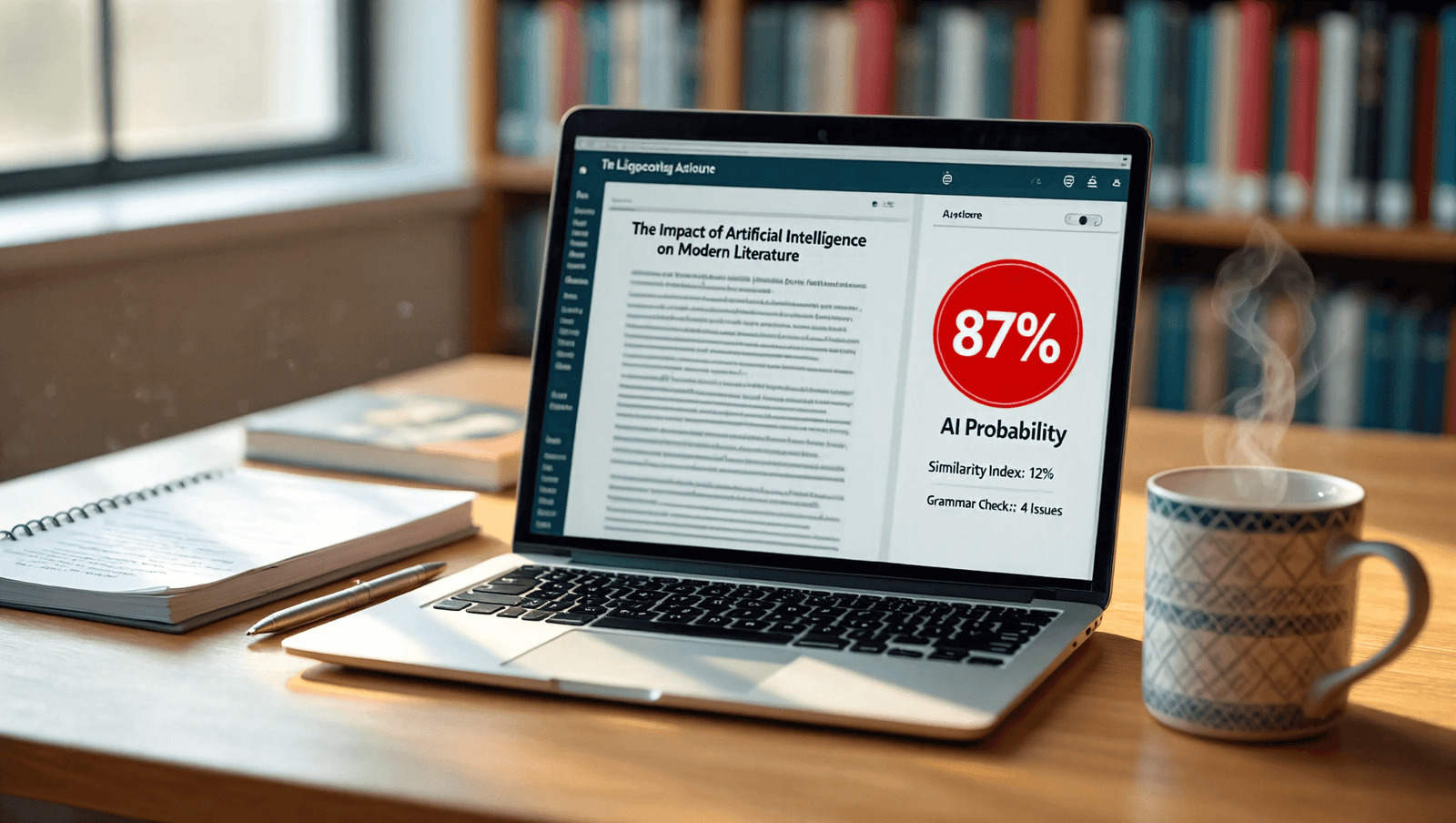
Does Turnitin detect AI writing? Yes — but not in the way most UK students expect. It doesn’t just catch copy-pasted ChatGPT responses. It analyses your writing patterns, sentence rhythm, and word predictability to generate an AI score. And that score is now sitting in front of your lecturer before you even know it’s there.
Since Turnitin launched its AI detection feature in 2023, UK universities have been switching it on quietly. Some students have been flagged for work they genuinely wrote themselves. Others submitted AI-heavy essays and heard nothing back. That inconsistency is exactly what makes this so stressful.
This guide gives you 7 real answers — covering how the detector actually works, its accuracy rate in 2025, what triggers a red flag, and what UK universities are doing with those scores right now.
If you’ve used AI in any form — even just for research or grammar — read this before your next submission.
According to Turnitin’s official AI detection page, the tool was specifically built to identify content generated by large language models including ChatGPT and GPT-4.
Already worried about how universities treat AI use beyond Turnitin? Read our detailed guide on AI in UK Academia: What Universities Allow vs What They Penalise.
Table of Contents
- What Is Turnitin’s AI Detection Tool and How Does It Work?
- How Accurate Is Turnitin AI Detection in 2025?
- Can Turnitin Detect ChatGPT and Other AI Tools?
- What Percentage Score Should UK Students Worry About?
- Can Universities Detect ChatGPT Essays Beyond Turnitin?
- Is Using AI for Essays Cheating? UK Rules Explained
- What Should UK Students Do If Their Work Gets Flagged?
1. What Is Turnitin’s AI Detection Tool and How Does It Actually Work?
Turnitin didn’t build its AI detector overnight. The company spent years training it on millions of human-written and AI-generated texts before launching it in April 2023. Since then, it has been updated multiple times. And UK universities have been quietly switching it on — often without telling students directly.
But most students still don’t know what it’s actually looking for.
How Does Turnitin Detect AI Writing — The Technology Behind It
Turnitin’s AI detector doesn’t search the internet for matching text. That’s the plagiarism checker’s job. This is something different entirely.
It analyses the probability patterns inside your writing. AI language models like ChatGPT generate text by predicting the most likely next word, every single time. That creates a very specific rhythm — sentences that feel smooth, consistent, and almost too clean.
Turnitin’s tool is trained to spot exactly that pattern. It looks at three things specifically:
- Sentence predictability — how expected each word choice is statistically
- Stylistic consistency — human writing has natural variation, AI writing doesn’t
- Perplexity and burstiness — how surprising and uneven the text feels overall
The output is a single percentage score showing what portion of your submitted text appears AI-generated.
Does Turnitin detect AI writing?
It analyses sentence predictability, word choice patterns, and stylistic consistency to identify text likely generated by tools like ChatGPT or GPT-4 — producing a percentage score visible to your lecturer.
Is Turnitin AI Detection Different From Its Plagiarism Checker?
Yes — and this confusion catches students off guard more than anything else.
The plagiarism checker compares your text against a database of existing sources — websites, academic journals, previously submitted papers. It is looking for matching text.
The AI detector doesn’t compare against anything external. It analyses the writing itself — the structure, the rhythm, the pattern. Two completely separate systems running simultaneously on the same submission.
This means your work can be:
- 0% plagiarism but 80% AI-generated
- Fully original in sources — and still flagged
They are not the same tool. They don’t measure the same thing. Treating them as one is a costly mistake.
Want to understand how UK universities are responding to AI submissions beyond Turnitin? Read our full breakdown of AI in UK Academia: What Universities Allow vs What They Penalise.
2. How Accurate Is Turnitin AI Detection in 2025?

This is the section most blogs skip. They tell you Turnitin detects AI — but nobody talks about how often it gets it wrong.
The honest answer? It’s not perfect. Not even close.
What Do the Numbers Actually Say About Turnitin AI Detector Accuracy?
Turnitin advertises its AI detection tool with a 98% confidence rate and an advertised false positive rate of less than 1% at the document level (for submissions containing at least 20% AI-generated text). That sounds reassuring — until you understand the technical distinctions between document-level and sentence-level detection.
According to Turnitin’s official technical guidance, while document-level false positives are kept under 1% by suppressing scores below 20%, the sentence-level false positive rate is approximately 4%. This means individual human-written sentences have an estimated 1-in-25 chance of being incorrectly highlighted as AI-generated. Furthermore, independent university studies have found error rates climb when text is lightly edited, highly technical, or written by non-native English speakers.
That figure applies to fully AI-written content. Meaning someone opened ChatGPT, typed a prompt, copied the output word for word, and submitted it unchanged.
Real student work doesn’t look like that.
Most students mix AI with their own writing. They use it for research, for restructuring paragraphs, for fixing grammar. That’s where Turnitin’s accuracy drops — and drops significantly.
Independent researchers have found error rates climbing when content is:
- Partially AI-written or heavily edited after generation
- Written by non-native English speakers
- Formal and structured in academic style
How accurate is Turnitin AI detection?
Turnitin advertises 98% accuracy on fully AI-generated text and a document-level false positive rate under 1% (on submissions with 20%+ AI). However, sentence-level false positives hover around 4%, and reliability drops substantially on mixed or edited content — meaning detection scores serve as an investigative indicator rather than definitive proof of authorship.
Turnitin AI Detection False Positives — Can It Flag Innocent Students?
Yes. This is documented, not speculation.
Turnitin itself admits its tool can produce false positives. Their own guidelines state that a high AI score alone should never be used as proof of academic misconduct.
Students who write in a structured, formal academic style have reported being flagged incorrectly. Non-native English speakers are at higher risk because their writing patterns can unintentionally mirror AI output.
If your work gets flagged, it doesn’t automatically mean you’re guilty. UK universities are required to investigate further before taking any action.
This is exactly why sample-based academic help is safer than AI-generated content — human-written work simply doesn’t carry this risk.
3. Can Turnitin Detect ChatGPT and Other AI Tools?
This is the question students search most. The answer is yes — but with important limits that most guides don’t explain properly.
Can Turnitin Detect Paraphrased AI Text?
Partially. If you take ChatGPT output and lightly rephrase it, Turnitin can still flag it. The sentence structure and predictability patterns often survive basic paraphrasing.
Heavy manual rewriting reduces the score — but doesn’t eliminate risk entirely. The more you rewrite, the less it looks like AI. But at that point, you’re essentially writing it yourself anyway.
Can Turnitin detect paraphrased AI text?
Yes, partially. Light paraphrasing of AI content often doesn’t fool Turnitin’s detector because the underlying sentence patterns remain recognisable even after rewording.
Does Turnitin Detect QuillBot Paraphrasing Too?
This is where it gets complicated. QuillBot rewrites text — but if the original source was AI-generated, the patterns can still survive through the paraphrasing layer.
Turnitin has specifically updated its detector to account for paraphrasing tools. So no — QuillBot is not a reliable workaround in 2025. Students banking on it are taking a serious risk.
Does Turnitin detect QuillBot?
Turnitin can detect QuillBot paraphrasing, especially when the original text was AI-generated. Updated detection models in 2025 specifically account for paraphrasing tool patterns.
Can Chat GPT Be Detected by Turnitin Every Single Time?
No — not every single time. Detection rates vary based on how much the text has been edited, the subject area, and the writing style. But the risk of being caught is real and growing with every update Turnitin rolls out.
The question students should actually be asking isn’t whether Turnitin will catch them. It’s whether the risk is worth taking at all.
Still unsure about where the line is between acceptable AI use and academic misconduct? Our breakdown of paraphrasing vs plagiarism under UK academic rules explains exactly where universities draw that line.
4. What Percentage Score Should UK Students Worry About?

There is no official safe threshold. Turnitin does not publish a cutoff score that automatically means misconduct. Different UK universities set their own internal guidelines — and most don’t share them publicly.
How Do UK Universities Use the AI Score in 2025?
Most UK universities treat the AI score as a trigger for review — not automatic guilt. Here’s roughly how it plays out in practice:
- 0–10% — Usually ignored or noted without action
- 10–20% — May prompt a closer look depending on the university
- 20–50% — Typically triggers formal review
- 50%+ — Almost always results in academic misconduct investigation
But here’s the reality — some universities are acting on scores as low as 10% if other suspicious patterns exist alongside them. A sudden shift in writing quality, generic arguments, or mismatched references can all add weight to a low AI score.
What AI percentage does Turnitin flag for UK universities?
There is no universal threshold. Most UK universities begin formal review at scores above 20%, but internal policies vary significantly — and some institutions act on scores as low as 10% when combined with other suspicious indicators.
Turnitin AI Detection UK Universities — What Policies Actually Say
UK universities are not consistent on this. Russell Group institutions tend to have detailed, published AI policies. Smaller universities are still catching up — some have no formal AI policy at all as of early 2025.
What most policies do agree on: the AI score is evidence, not proof. Students have the right to defend their work. But defending yourself takes time, causes stress, and can delay your results significantly.
The smarter move is knowing the rules before submission — not after a flag appears. Our full guide on what UK universities allow vs what they penalise on AI breaks down exactly what each type of institution expects.
5. Can Universities Detect ChatGPT Essays Beyond Turnitin?
Yes — and this is what catches most students off guard. Turnitin is not the only detection method in use at UK universities right now.
How Do Professors Know If You Used ChatGPT?
Experienced lecturers spot AI writing without any tool. They’ve marked hundreds of essays. They know what a student at your level writes like — and they know what doesn’t fit.
Common giveaways that lecturers flag manually:
- Generic arguments with no subject-specific examples
- Perfectly balanced structure throughout — no genuine critical position
- References that don’t quite support the actual argument being made
- Sudden improvement in writing quality compared to previous submissions
- No personal academic voice — just clean, neutral, forgettable prose
How do professors know if you used ChatGPT?
Lecturers identify AI-written essays through pattern recognition — generic arguments, suspiciously clean structure, mismatched references, and a sudden shift in writing quality compared to a student’s previous work.
Can Teachers Detect AI Generated Text Without Any Tool?
Many can — particularly those who have marked your previous submissions. If your writing style shifts dramatically between assignments, that alone is enough to raise questions.
Beyond Turnitin, tools like GPTZero and Copyleaks are being used at some UK institutions alongside their standard submission process. A growing number of universities are also requiring students to submit drafts, notes, or reflective logs alongside final work — making it harder to hide AI use even if the text itself passes detection.
The detection net is wider than most students realise. And it’s getting wider every semester.
Understanding why assignments get low grades — and what examiners are actually looking for — gives you a clearer picture of what genuine academic work looks like to the people marking it.
6. Is Using AI for Essays Cheating? UK Rules Explained
It depends entirely on your university’s policy — and those policies are not uniform across the UK. What’s acceptable at one institution can be a disciplinary offence at another.
Is AI Generated Text Plagiarism Under UK University Policy?
Most UK universities now classify submitting AI-generated text as a form of academic misconduct — separate from plagiarism but treated with equal seriousness. Some institutions categorise it as contract cheating. Others have created entirely new policy categories for it.
The core issue isn’t the tool itself. It’s misrepresentation — submitting work that isn’t genuinely yours and presenting it as original independent thinking.
Using AI to brainstorm, summarise reading, or check grammar sits in a grey area at most universities. Using it to write your actual submission does not.
Is AI generated text plagiarism in UK universities?
Most UK universities treat AI-generated text submission as academic misconduct rather than traditional plagiarism — but the consequences are equally serious, ranging from mark reduction to module failure.
Can You Get Expelled for Using ChatGPT in the UK?
In serious cases — yes. But expulsion is rare for first offences.
The typical progression looks like this:
- First offence, low AI score — formal warning, possible mark reduction
- First offence, high AI score — module failure or grade capped at pass mark
- Repeat offence — suspension or permanent academic record notation
- Serious or deliberate misuse — expulsion in extreme cases
The risk isn’t just about one assignment. A misconduct finding follows your academic record. It can affect postgraduate applications, professional registrations, and graduate job references.
The confusion around acceptable AI use is real — and most students don’t realise where the line is until they’ve already crossed it. Our guide on paraphrasing vs plagiarism under UK academic rules explains exactly where universities draw that line — and how to stay on the right side of it.
7. What Should UK Students Do If Their Work Gets Flagged?

Don’t panic — but don’t ignore it either. How you respond in the first 48 hours matters more than most students realise.
How to Avoid AI Detection on Turnitin — What Actually Works
The only genuinely reliable approach is writing your own work. That sounds obvious — but it’s the truth that no one wants to say out loud.
If you’ve been using AI as a research or planning aid, make sure your final submitted text is:
- Written in your own voice — not cleaned up AI output
- Built around specific examples tied to your course material
- Supported by sources you’ve actually read and understood
- Consistent with your previous writing style and academic level
These aren’t just tips to avoid detection. They’re what separates a genuine submission from one that gets flagged — and what separates a 2:1 from a first.
How to avoid AI detection on Turnitin?
The most reliable way to avoid Turnitin AI detection is to write in your own voice, use course-specific examples, and ensure your submission is consistent with your previous academic work — not edited AI output.
Why Human-Reviewed Academic Help Is Safer Than AI Tools
Sample-based academic support — where qualified human writers produce reference material — carries no AI detection risk. The writing patterns are genuinely human. The structure varies naturally. There is no predictability score to flag.
That’s not a workaround. It’s a fundamentally different approach to academic support.
When a student uses a human-written sample to understand structure, argument, and referencing — then writes their own submission based on that understanding — they are learning. That’s exactly how academic guidance is supposed to work.
AI tools skip that learning entirely. They hand you text you don’t understand, can’t defend, and didn’t write. When a lecturer asks you to discuss your argument in a viva or follow-up — you’re exposed.
That’s the real risk students keep underestimating.
Find out exactly why sample-based academic help is safer than AI-generated content — and how thousands of UK students are using it to improve their grades without the risk.
Final Verdict — Does Turnitin Detect AI Writing Reliably?
Yes — but with real limitations. It catches obvious AI use well. It struggles with mixed content. It produces false positives. And it is just one of several detection methods now running inside UK universities.
The safest position in 2025 is simple: understand your university’s specific policy, know what triggers a flag, and make sure whatever you submit genuinely reflects your own thinking.
If you want academic guidance that won’t put your grades or your record at risk, explore how sample-based academic help works — and why it remains the smarter choice over AI tools for UK students serious about their results.
Related reading you may find useful: