
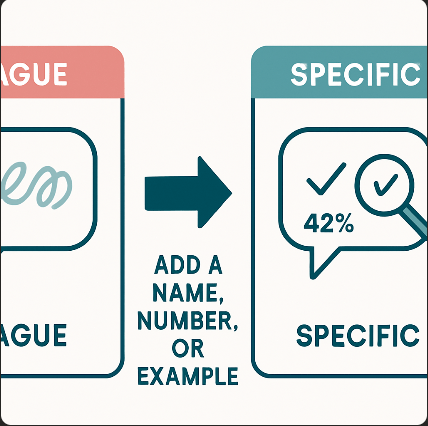
You get the essay back and there it is again, red ink circling half your paragraphs: “too vague, be more specific.” Maybe your professor wrote it as “not specific enough” or “needs more precision.” Same complaint, different wording, and it’s one of the most common lines students see on marked-up drafts. You reread your own paragraph and honestly can’t tell what’s missing. It sounds fine to you. That gap, between what you meant and what actually landed on the page, is the entire problem, and it’s fixable in an afternoon once you know what graders are actually flagging.
This guide walks through exactly why markers write “too vague, not specific enough” on undergraduate work, and five concrete fixes you can apply to any paragraph in under ten minutes each. No filler, no generic “add more detail” advice. Real before-and-after rewrites you can copy the pattern from. If you’ve been told your writing is too vague, not specific enough, more than once this term, you’re not alone, and the pattern behind that comment is more mechanical than it feels.
Search “too vague, not specific enough” in any student forum and you’ll find hundreds of threads asking the same question: what does this actually mean, and how do I fix it before the next deadline. Most of the advice out there stops at “add more detail,” which is exactly the kind of vague instruction this comment is criticizing in the first place. This guide breaks the comment down into five mechanical fixes instead.
What Does It Mean When a Professor Says Your Writing Is Too Vague, Not Specific Enough? (Quick answer)
“Too vague, not specific enough” means your sentences make claims or observations without naming the exact thing, source, number, or example that backs them up, forcing the reader to guess what you actually mean. It usually shows up as unnamed sources (“studies show”), unmeasured claims (“a significant increase”), or generic nouns standing in for real ones (“various factors,” “many researchers”). The fix is almost always the same: replace the placeholder word with the actual name, figure, date, or example you have in your notes. A paragraph goes from vague to specific the moment a reader could fact-check every sentence in it.
| Vague Version | Why It’s Vague | Specific Fix |
|---|---|---|
| “Many studies show climate change affects agriculture.” | No named study, no named crop, no mechanism | “A 2021 study by Zhao et al. found wheat yields in northern China fell 4.2% per degree of warming.” |
| “Social media has a big impact on teenagers.” | “Big impact” and “teenagers” are undefined | “Daily Instagram use above two hours correlates with a 13% higher self-reported anxiety score in girls aged 13 to 17 (Twenge, 2020).” |
| “The company improved its performance significantly.” | No metric, no timeframe, no baseline | “Revenue rose from $2.1M to $3.4M between Q1 and Q4 2023.” |
| “Various factors contributed to the failure.” | “Various factors” names nothing | “Poor ventilation, a delayed inspection, and an untrained night shift caused the failure.” |
Why Does a Vague Paragraph Feel Fine to You But Not to Your Marker?
You already know what you mean. Your marker doesn’t. That’s the whole mechanism behind this feedback, and it’s worth sitting with because it explains why proofreading your own work rarely catches vagueness. When you wrote “several researchers have noted this trend,” your brain filled in the actual names from memory while you typed. The sentence felt complete because your internal knowledge completed it for you. Your marker has none of that context. They read “several researchers” and their honest reaction is: which ones? How many is several? Noted it where?
This is why reading your essay aloud to a friend who hasn’t studied the topic works better than rereading it yourself. They’ll stop you at exactly the spots a grader stops. If a listener asks “wait, which factors?” or “how significant is significant?”, that sentence needs a name, number, or example inserted before submission.
There’s also a structural reason too vague, not specific enough shows up more in first drafts than final ones: most students write their first draft from memory and only add citations afterward, as an editing step rather than a drafting step. That order guarantees vague placeholder phrases in the first pass, because you genuinely haven’t looked up the exact figure yet when you write “studies show.” The fix isn’t to write more carefully the first time. It’s to treat the citation-and-numbers pass as its own dedicated revision step, separate from checking grammar or flow, so vague placeholders get caught systematically instead of by accident.
5 Proven Fixes for “Too Vague, Not Specific Enough” Feedback
1. Name Every Source, Never Say “Studies Show”
The single highest-frequency vagueness flag in undergraduate writing is the unnamed source. “Research indicates,” “experts agree,” “studies have found”: these phrases tell your marker nothing and cost you marks on almost every rubric that includes an evidence or research criterion. Go back through your draft and highlight every sentence that starts with a vague reference to research. For each one, open your reference list and insert the actual author and year. If you genuinely can’t remember which source supported that claim, that’s a signal the claim needs to be cut or you need to go find the citation before submission, not paper over it with “studies show.”
A quick scan trick: search your document for the words “research,” “studies,” “experts,” and “scientists.” Each hit is a candidate for a named citation. This alone typically resolves a third of the vagueness comments on a first-year essay. If you’re pulling those named sources into your own sentences, be careful with how closely you follow the original wording. Our guide on fixing patchwriting covers the difference between properly paraphrasing a named source and copying its sentence structure too closely.
2. Replace Every Vague Quantifier With a Real Number
Words like “significant,” “a lot,” “many,” “most,” and “a large percentage” are quantifiers doing no quantifying. If your source or data actually has a number, put it in the sentence. “A significant increase in dropout rates” becomes “a 9 percentage point increase in dropout rates between 2019 and 2022.” If you genuinely don’t have the exact figure, use a defensible range from your source rather than an adjective. This single substitution is often the fastest way to move a paragraph from “too vague, not specific enough” to “well-supported” in a marker’s eyes, because numbers are the most easily verified form of specificity there is.
3. Swap Generic Nouns for Named Examples
“Various factors,” “several countries,” “certain groups,” and “many industries” are generic nouns hiding real information you already have. If you know which factors, name two or three of them directly in the sentence instead of gesturing at their existence. Compare “various factors contributed to the 2008 financial crisis” against “subprime lending, excessive leverage at investment banks, and inadequate credit rating oversight contributed to the 2008 financial crisis.” The second version does the analytical work your assignment is actually grading you on. The first version just promises that work exists somewhere in your head.
4. Attach a Concrete Example to Every Abstract Claim
Abstract claims read as vague until a concrete, specific instance sits right next to them in the same paragraph. If you write “globalization has changed labor markets,” your next sentence needs to show one specific way, in one specific place, with one specific number or case. Add: “In Vietnam, textile manufacturing employment grew from 450,000 workers in 1995 to over 2.7 million by 2015 as foreign apparel brands relocated production there.” Now the abstract claim has a body. Markers grading on depth of analysis are specifically hunting for this pairing of claim plus concrete instance, and its absence is exactly what triggers “too vague” comments on essays that otherwise read smoothly.
5. Define Your Key Terms Before You Use Them Repeatedly
If your essay leans on a term like “sustainable,” “effective,” “successful,” or “traditional” more than twice without ever defining it, every use of that word reads as vague because the reader doesn’t know your working definition and has to guess whether it matches theirs. Add one sentence early in your essay that states exactly what you mean by the term in this context: “For this essay, ‘effective policy’ means measurable adoption above 60% within two years of implementation.” Every later use of the word now inherits that precision instead of floating free as an undefined judgment call.
A Full Before-and-After Paragraph Rewrite
Reading fixes in isolation only gets you so far. Here’s what all five fixes look like applied together to one real paragraph, the kind you’d hand in for a second-year sociology essay.
Before (flagged too vague, not specific enough): “Many studies show that social media use has a significant impact on young people’s mental health. Various factors are involved, including how much time they spend online and what kind of content they see. This is a growing problem that experts say needs more attention.”
Every sentence in that paragraph fails a different fix. “Many studies show” has no named source. “Significant impact” has no number. “Various factors” names nothing. “Experts say” is unnamed again. It reads smoothly and sounds confident, which is exactly why students are surprised when it comes back marked too vague, not specific enough. Confidence and specificity are not the same thing.
After: “Twenge (2020) found that teenage girls who spent more than three hours a day on social media were 60% more likely to report symptoms of depression than those spending under an hour. Two mechanisms drive this: passive scrolling through curated content increases social comparison, while displaced sleep time, averaging 37 fewer minutes per night among heavy users in the same study, independently worsens mood regulation. Given these findings, platform design changes such as removing public like counts, already trialed by Instagram in 2019, represent a more targeted intervention than blanket screen-time limits.”
Notice what changed. Every claim now has a name attached (Twenge, 2020; Instagram), every impact has a number (60%, 37 fewer minutes), and the paragraph ends by connecting the specific evidence back to an actual argument instead of gesturing at “a growing problem.” That closing move, tying the specific evidence back into your argument, is what separates a paragraph that merely lists facts from one that analyzes them.
How to Choose Which Fix to Apply First
Not every vague paragraph needs all five fixes. Use this quick framework to triage your draft before you start rewriting line by line.
| What You See in the Comment | Likely Cause | Fix to Apply |
|---|---|---|
| “Which studies?” or “cite this” | Unnamed sources | Fix 1: Name every source |
| “How significant?” or “quantify” | Vague quantifiers | Fix 2: Replace with real numbers |
| “Such as?” or “give an example” | Generic nouns, no named instances | Fix 3: Swap for named examples |
| “Explain how” or “show this in practice” | Abstract claim with no case attached | Fix 4: Attach a concrete example |
| “Define this term” or repeated undefined jargon | Undefined key terms | Fix 5: Define terms on first use |
If a single paragraph has more than one of these comments stacked on it, work through the fixes in the order above. Naming sources and swapping in real numbers usually resolves the surface-level vagueness fastest, which then makes it much easier to see where a concrete example still needs to be added.
What Vague Writing Actually Costs You on a Rubric
Most university rubrics don’t have a line item literally called “specificity,” so it’s worth knowing exactly where the too vague, not specific enough problem shows up on your grade. Look at almost any essay rubric and you’ll find criteria like “evidence and support,” “critical analysis,” or “use of sources.” Each one is, functionally, testing for the same thing this feedback is naming. A paragraph full of unnamed sources and unmeasured claims can’t score in the top band on any of those criteria, no matter how well-organized or grammatically clean it is, because the rubric is checking for named, verifiable support, not just the presence of a claim.
Here’s the part students miss: markers aren’t penalizing you for having the wrong opinion or the wrong argument. Two students can argue the exact same thesis and land three grade bands apart, purely because one names sources, numbers, and examples while the other leans on “many,” “several,” and “various.” The thesis was never the issue. The specificity was.
Nursing, business, and law assignments tend to get hit hardest by this comment because their rubrics explicitly reward measurable outcomes and named precedent. A nursing case study that says “the patient’s condition improved significantly” instead of “the patient’s oxygen saturation rose from 89% to 96% within four hours of intervention” is losing marks on a clinical reasoning criterion, not a writing-style criterion. The fix is identical to the one used above: replace the vague quantifier with the actual figure from your case notes.
It helps to actually sit down with the marking criteria before you revise, rather than guessing at what “specific enough” means for your particular course. Our guide on how to read a grading rubric before you submit walks through exactly how to translate criteria language like “depth of evidence” into concrete checks you can run on your own draft. The Purdue OWL guide to establishing arguments is also a solid external reference for how named evidence should function inside an academic paragraph.
Vagueness rarely travels alone. It’s common to see “too vague, not specific enough” show up on the same draft as comments about a weak thesis statement, since an unfocused thesis makes it hard to know which specific evidence even belongs in each paragraph. It also frequently appears alongside “too descriptive, not critical enough” feedback, because descriptive paragraphs tend to summarize rather than name and analyze specific evidence.
Where AssignPro Solution Fits Into This Process
Once you’ve applied these five fixes yourself, a second set of trained eyes catches what you’ll still miss, because you’re now too close to your own rewrite to spot the sentences that still read as vague to someone outside your head. AssignPro Solution offers one-on-one academic coaching sessions where a tutor reads your draft specifically for this kind of feedback: unnamed sources, unquantified claims, and abstract statements that still need a concrete example attached. The tutoring is structured around exactly the kind of rubric-level, sentence-by-sentence feedback that turns a “too vague, not specific enough” comment into a paragraph that reads as precise and well-supported. It’s coaching and structured feedback on work you’ve already written yourself, not a service that writes the paragraph for you.
The Bottom Line
“Too vague, not specific enough” is not a comment on your intelligence or your grasp of the topic. It’s a signal that information living in your head hasn’t made it onto the page yet. Every fix above does the same basic thing: it takes something you already know (the actual study, the actual number, the actual example) and moves it from your memory into the sentence, where your marker can see it too.
Run your next draft through the five fixes before you submit it, not after you get it back with comments. Search for “studies show,” search for “significant,” search for “various,” and replace each one with the real name, number, or example sitting in your notes. That single habit closes the gap between what you meant and what actually made it onto the page, and it’s the difference most markers are actually rewarding when they call a paragraph “specific” instead of “vague.”
Frequently Asked Questions
What’s the difference between “too vague” and “too general” as feedback?
They’re usually the same comment written two ways. Both mean your claim lacks a named source, number, or example. Treat “too general” comments with the same five fixes used for “too vague, not specific enough.”
How many named examples does one paragraph need?
One solid, specific example per major claim is usually enough. A paragraph making three separate claims needs three examples, not one example stretched across all three.
Can I be too specific in an academic essay?
Rarely, but it happens when specific details replace analysis instead of supporting it. Every number or example should still connect back to your argument in the next sentence, not sit there as decoration.
Does this apply to lab reports and case studies too?
Yes. Lab reports get “too vague” comments on methods sections that skip exact quantities or equipment models, and case studies get it on recommendations that lack a specific timeline or measurable target.
My source really doesn’t give an exact number. What do I write instead?
Use the closest defensible range the source actually provides, and name the source directly next to it, for example “Smith (2019) reports growth ‘in the range of 5 to 8 percent.'” Naming the source still resolves most of the vagueness even without one exact figure.
Will fixing vagueness alone raise my grade?
It typically moves a paper up within the same grade band, since most rubrics tie “specific and well-supported evidence” directly to marks. Combined with a clear thesis and logical structure, it can push a paper into the next grade band entirely.
Why do I keep getting “too vague, not specific enough” on every draft even after revising?
Usually because the revision added more words without adding a name, number, or example. Length and detail feel similar when you’re writing but read very differently to a marker. Check each new sentence against the five fixes above rather than just expanding the paragraph.
Is “too vague, not specific enough” worse feedback than “unclear argument”?
They point at different problems. “Unclear argument” usually means your thesis or structure needs work; too vague, not specific enough usually means your evidence within an otherwise clear paragraph needs names, numbers, or examples. Fix the argument first, then run this evidence check.
Related reading you may find useful: