
Gibbs Reflective Cycle Explained With a Nursing Example
Nursing · Reflective Practice
All six stages walked through, then one continuous nursing reflection so you can see the model applied from start to finish, and write your own with confidence.
Quick answer
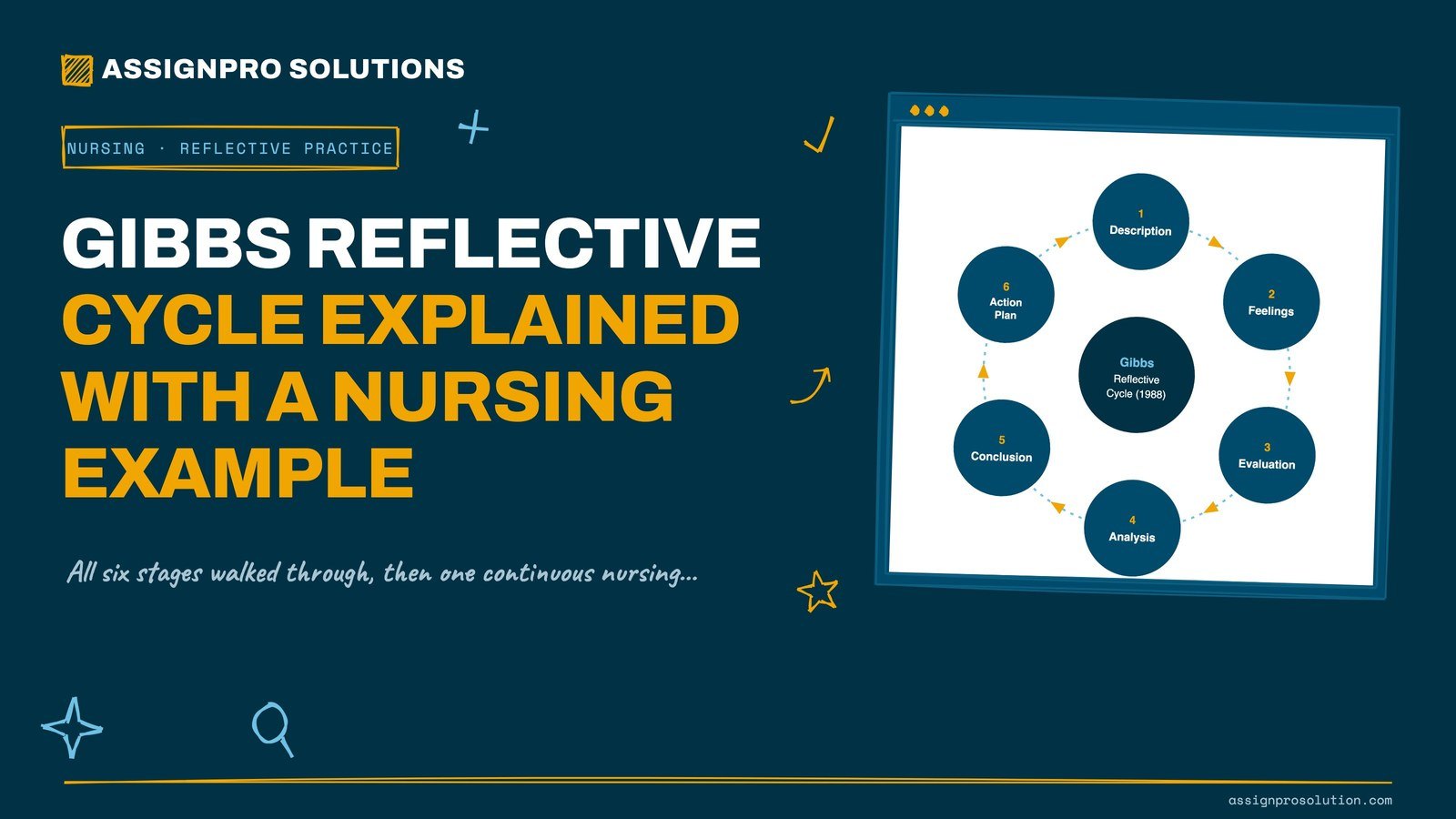
The Gibbs reflective cycle is a six-stage model for structured reflection: Description, Feelings, Evaluation, Analysis, Conclusion and Action Plan. Published by Graham Gibbs in 1988, it turns a single experience into a clear learning loop. In nursing, you take one real placement event and move through each stage in order, ending with what you would do differently next time.
The Gibbs reflective cycle is the model most UK nursing programmes ask you to use, and for good reason. It gives a beginner a clear scaffold, yet it still rewards the deeper, critical thinking that markers look for at degree level. If you have been set a reflective account and told to "use Gibbs", this guide walks you through the whole thing and then shows one worked nursing reflection so you can see the model applied end to end.
We should be clear about what the Gibbs reflective cycle is not. It is not a diary entry, and it is not a story about a shift. The Gibbs model of reflection is a disciplined way of interrogating your own practice so that experience actually becomes learning. Each of the six stages asks a different kind of question, and the value comes from answering all six honestly rather than lingering on the easy, descriptive ones.
Before we go further, a quick note on what we do. We are a tutoring and guidance service, so our job is to explain the Gibbs reflective learning cycle, model it, and give you feedback on your own draft. You write and submit your own reflection. What follows is a teaching example, not something to copy.
What is the Gibbs reflective cycle?
So, what is the Gibbs reflective cycle in practical terms? It is a framework created by Graham Gibbs in his 1988 book Learning by Doing. The Gibbs 1988 reflective cycle was designed to help people learn from repeated experience by moving through a fixed sequence of prompts. Because the final stage feeds back into the first, it is drawn as a loop rather than a straight line: the action plan you set this time becomes the practice you reflect on next time.
The six stages are ordered deliberately. You start with the facts, move into your emotional response, weigh up what went well and badly, then dig into why. Only after that do you draw conclusions and commit to change. Skipping straight to "what I learned" without the analysis in between is the single most common way students lose marks with this model.
The six stages, one at a time
1Description
Set the scene briefly and factually. Who was there, what happened, where and when? Stay objective and keep it short. This stage answers "what happened", not "how I felt" or "why". A common trap is to spend half your word count here, so aim for a tight paragraph that a reader with no context could follow.
2Feelings
Name your thoughts and emotions at the time, and just afterwards. Were you anxious, confident, out of your depth? Be honest. Feelings are legitimate clinical data in reflective practice because they shape the decisions you make. You are not judging them yet, only recognising them.
3Evaluation
Make a balanced judgement about the experience. What went well, and what did not? Try to give both sides even when the event felt entirely positive or entirely negative. This is where you begin to step back from the raw account and start weighing it.
4Analysis
This is the heart of the reflection and where the best marks live. Ask why things happened the way they did, and bring in the evidence base: clinical guidelines, the NMC Code, module theory and wider literature. Link your evaluation to what the research or policy says should happen. This is the stage weaker reflections rush or skip.
5Conclusion
Draw together what you have learned. Given the analysis, what could you have done differently, and what does this event tell you about your own practice and knowledge gaps? Conclusions should follow logically from the analysis rather than introducing brand new points.
6Action Plan
State concretely what you will do next time you face a similar situation. Good action plans are specific and measurable: a piece of reading, a skill to practise under supervision, a conversation with your mentor. This stage closes the loop and points at your next cycle of learning.
The Gibbs reflective cycle applied: one worked nursing example
Now let us see the model in motion. Below is one continuous Gibbs reflective cycle nursing example, running through all six stages on a single event. The names are anonymised, as they must be in any real reflection, and the detail is illustrative. Read it as a demonstration of structure and depth, then write your own account about your own placement experience.
1. Description
During a morning shift on a surgical ward, I was asked to record the vital signs of a post-operative patient, Mr A (pseudonym). I recorded his observations and calculated a National Early Warning Score of 6, driven by a raised respiratory rate and low blood pressure. I noted the score but continued with my round of other patients, intending to report it once I had finished. My mentor reviewed the chart ten minutes later and escalated it immediately.
2. Feelings
At the time I felt competent taking the observations and pleased that I had calculated the score correctly without help. When my mentor escalated the score straight away, I felt a wave of embarrassment and anxiety. I realised I had treated a task I could complete as if the job was finished, when the reason for taking observations is to act on them. Afterwards I felt unsettled but also determined to understand what I had missed.
3. Evaluation
Looking at it honestly, the accurate measurement and correct scoring went well; my clinical skill was sound. What went badly was my clinical prioritisation. I had the right information and did not act on it with the urgency it demanded. The positive is that no harm came to Mr A because my mentor caught the delay. The negative is that in a busier moment, that ten-minute gap could have mattered a great deal.
4. Analysis
Why did I hesitate? The NEWS2 system exists precisely so that a rising score triggers a defined escalation response, and national guidance treats an aggregate score of 5 or more as a threshold for urgent review. My error was not knowledge of the numbers but a failure to connect the number to an action. Reflecting on it, I think I was still framing observations as a task to be completed rather than a form of surveillance that carries a duty to respond. The NMC Code is explicit that we must act without delay if we believe there is a risk to patient safety. My behaviour also revealed a habit of finishing my own list before communicating, which works for routine tasks but fails in time-critical ones. The literature on failure to rescue suggests that deteriorating patients are often harmed not because signs are missed but because recognition is not followed by timely escalation, which is exactly the gap my own practice exposed.
5. Conclusion
I have learned that recognising deterioration and escalating it are two separate skills, and I was stronger at the first than the second. If I met the same situation again I would escalate the score to a registered nurse straight away, before completing the rest of my round. More broadly, I have learned to treat any abnormal early warning score as an interruption to my plan rather than something to file until later.
6. Action Plan
Next time I record observations, I will escalate any NEWS2 score of 5 or above to my supervising nurse immediately and document the time of escalation. To build the underlying knowledge, I will re-read my trust's escalation policy and the Royal College of Physicians NEWS2 guidance this week, and I will ask my mentor to observe me managing a full set of observations, including the escalation step, so I can practise the whole sequence under supervision rather than the measurement alone.
Want feedback on your own reflection?
Send us your draft and a subject-specialist tutor will show you where to deepen the analysis, tighten the description and strengthen your evidence base. We guide; you write and submit your own work. 100% AI-free, plagiarism-free, human-written support.
The mistake that costs the most marks
Being too descriptive, not critical enough. By far the most common problem we see is a reflection that reads like a story: lots of Description and Feelings, then a thin Analysis and a vague Action Plan. Markers reward the thinking in stages three to six, especially the Analysis. As a rough guide, Description should take up the least space, and Analysis the most.
Two quick tests. First, count how many sentences ask why something happened and link it to evidence; if the answer is one or two, your Analysis is too light. Second, check that your Conclusion and Action Plan could not have been written without reading the Analysis. If they could, the reflection is not yet doing its job. It is also worth getting familiar with how Gibbs compares to other reflective frameworks, so you can justify why it suits this piece of work over the alternatives.
How to structure your write-up
You do not have to give every stage its own heading, but for an assignment it usually helps the marker and helps you keep the balance right. Write in the first person, keep the patient and setting anonymous, and support your Analysis with cited sources in your programme's referencing style, whether that is Harvard, APA or Vancouver. Spread the work across the week rather than writing it in one sitting, as the timeline above suggests, so the Analysis has time to develop.
If reflective writing is new to you, our step-by-step guide on how to write a reflective assignment covers structure, tense and tone in more depth. Nursing students working to placement deadlines can also get subject-specific mentoring through our nursing assignment help, and if your reflection needs to sit within a wider literature discussion, see how to write a literature review. Gibbs is not the only option either; if your module points you towards a nursing-specific framework, it is worth weighing it against alternatives such as the Roper, Logan and Tierney model before you choose.
One-to-one tutoring, whenever you need it
Since 2015 we have mentored students through reflective accounts, essays and dissertations across Business, Law, Nursing, IT and more, with 24/7 support and fast, feedback-led after-sales help. Ready when you are.
Related reading
Frequently asked questions
What are the six stages of the Gibbs reflective cycle?
The six stages are Description, Feelings, Evaluation, Analysis, Conclusion and Action Plan. You work through them in order on a single experience, and because the Action Plan feeds into your next experience, the model is drawn as a repeating loop rather than a straight line.
Who created the Gibbs reflective cycle and when?
Graham Gibbs created it, publishing the model in his 1988 book Learning by Doing. This is why it is often written as the Gibbs 1988 reflective cycle. It was designed to help people learn from repeated experience through a structured sequence of prompts.
Why is the Gibbs model of reflection used so much in nursing?
It gives a clear, ordered scaffold that beginners can follow, while still rewarding the critical analysis that degree-level markers expect. It also maps neatly onto real clinical events, which makes it a natural fit for placement reflections and revalidation.
What is the most common mistake students make with Gibbs?
Being too descriptive and not critical enough. Many reflections spend too long on Description and Feelings and then rush the Analysis. Markers reward the thinking in the later stages, so the Analysis should usually be the longest and most evidence-based section.
Can AssignPro Solutions write my reflection for me?
No. We are a tutoring and guidance service, so we explain the model, mentor you and give feedback on your own draft. You write and submit your own reflection. Our support is 100% AI-free, plagiarism-free and human-written, which keeps your work genuinely yours.
Need help choosing?
Send the brief on WhatsApp or email. The team will help identify the right service and tutor.