
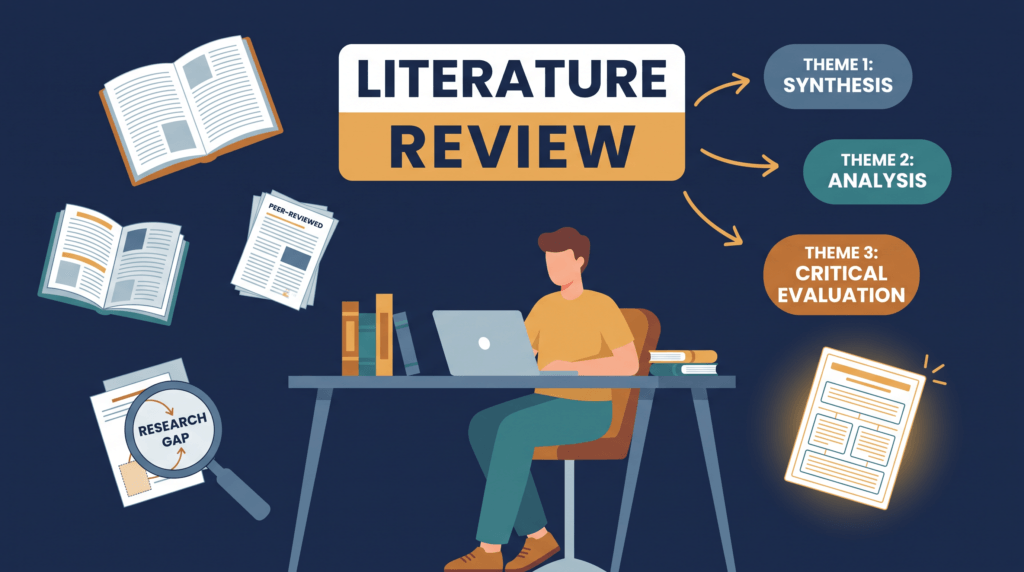
Every student hits this moment: you open the assignment brief, read the words literature review, and immediately feel less confident than you did thirty seconds ago. You know roughly what a literature review is supposed to be. You’ve read enough of them. But sitting down to write a literature review — knowing where to start, what to include, how to actually structure the thing — is a different problem entirely.
This guide walks you through how to write a literature review from scratch. It covers what a literature review actually is (and what it isn’t), how to find and evaluate sources, how to structure your argument, and what most students get wrong. Whether you’re writing a standalone piece for a module or drafting the review chapter inside your dissertation, the same core principles apply.
By the end, you’ll have a clear process to follow — not just a vague sense of what good looks like.
Quick note: If you’re already past the literature review and struggling with what comes next, our guide on how to write a dissertation methodology covers that transition in detail.
What Is a Literature Review?
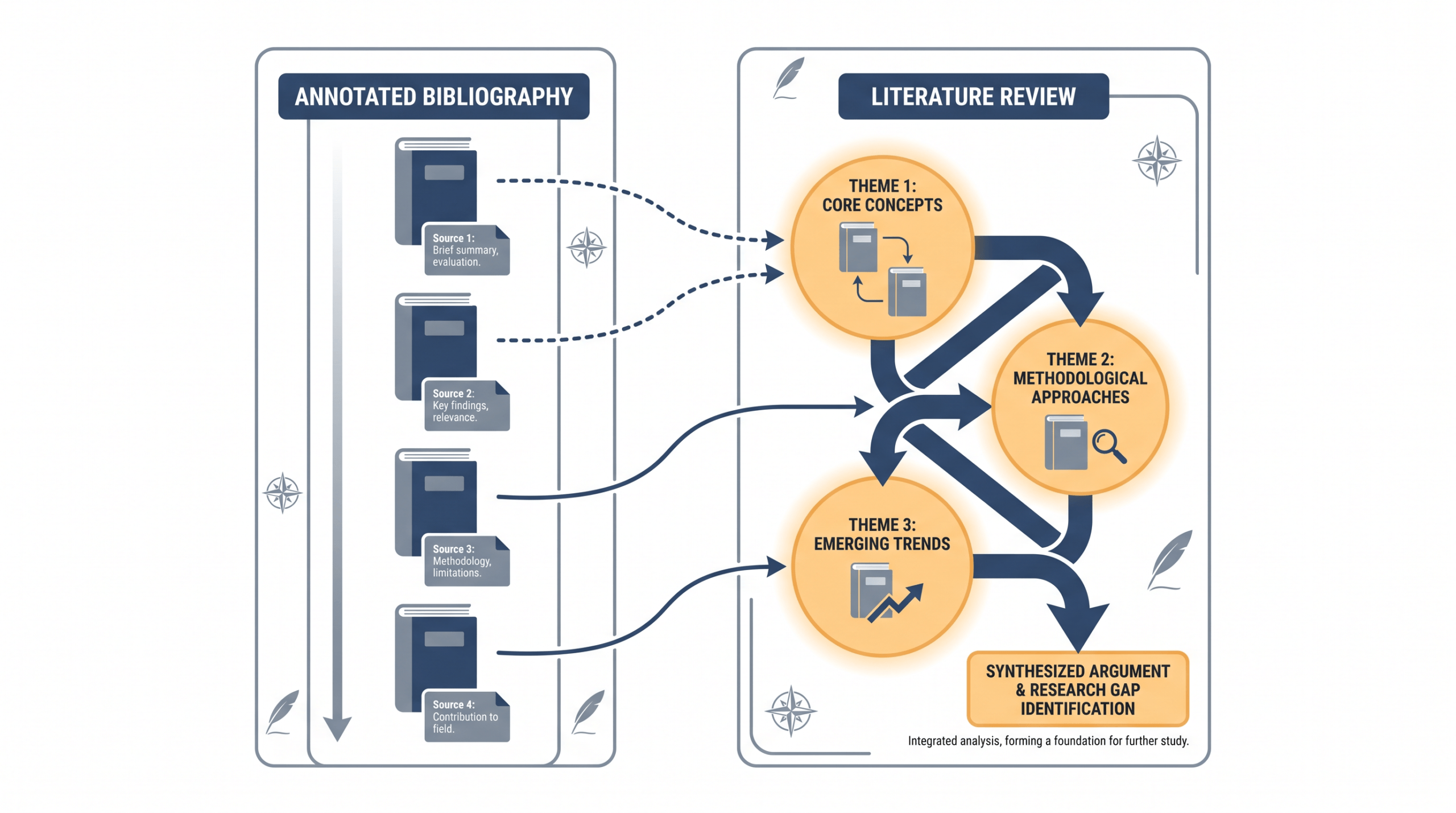
A literature review is not a summary of sources. That distinction matters more than most students realise, and getting it wrong is the single fastest way to lose marks on an otherwise solid piece of work.
Here is the simplest way to think about it: a summary tells you what each source says. A literature review tells you what the field says — and does so by pulling sources together around shared themes, tensions, and gaps rather than walking through them one by one. It is a critical, synthesised argument about the state of existing research on a topic.
Universities assign literature reviews because they want to see whether you can do three things: locate and evaluate credible scholarship, identify patterns across multiple sources, and think critically about where the research agrees, where it conflicts, and what it has not yet addressed. The review is not a hoop to jump through. It is evidence of your ability to engage with your discipline at an academic level.
Academically, a literature review can be defined as a systematic survey of published work on a defined topic, structured to reveal the current state of knowledge, identify theoretical frameworks, and locate gaps that justify further research.
You will encounter literature reviews in two main contexts during your degree. The first is as a standalone assignment — a self-contained piece asking you to review what exists on a particular topic. The second is as a chapter inside a longer dissertation or thesis, where the review exists to justify your own research question and methodology. The expectations differ between the two, and it is worth knowing which one you are writing before you plan a single heading.
Literature Review vs Annotated Bibliography — What’s the Difference?
Students consistently confuse these two, and it is easy to see why. Both involve engaging with a list of sources. But the output is completely different.
An annotated bibliography is exactly what it sounds like: a list of sources, each followed by a short note summarising what the source says and why it is relevant. Each entry stands alone. There is no argument being built across them.
A literature review synthesises those sources into a coherent discussion. You are not describing each source in turn — you are grouping them by theme, comparing what they find, and building an argument about what the field collectively knows and does not know.
| Annotated Bibliography | Literature Review | |
|---|---|---|
| Structure | List of individual entries | Continuous, themed argument |
| Focus | What each source says | What sources say together |
| Critical analysis | Brief, per-source | Extended, cross-source |
| Research gap | Not required | Central requirement |
If your assignment brief asks for an annotated bibliography, do not write a literature review. If it asks for a literature review, do not produce a glorified list of summaries. The distinction is that clear.
Literature Review as a Standalone Assignment vs Dissertation Chapter
The content of a literature review does not change dramatically depending on context — but the scope, length, and purpose do.
A standalone literature review is typically shorter, focused on a narrower topic, and assessed on its own merits. At undergraduate level, this usually sits between 1,000 and 3,000 words. At postgraduate level, expect 2,000 to 5,000 words. The conclusion identifies what the field has left unanswered, but you are not required to then go and answer it yourself.
A dissertation literature review chapter is a different beast. It is longer — usually 5,000 to 8,000 words, or roughly 20 to 30 percent of your total word count — and its entire job is to justify what comes next. Every gap you identify in the literature points toward your own research question. Every methodological weakness in existing studies sets up your own methodology. The review is not separate from your dissertation; it is load-bearing.
If you are working on the dissertation side of this, our guide on how to start writing a dissertation covers how the literature review fits into the broader structure and what examiners expect from each chapter.
Why Do Universities Assign Literature Reviews?
Most students treat the literature review as an administrative hurdle — something to get through before the real work starts. That framing costs marks, because examiners can tell when a student does not understand why they are doing what they are doing.
The honest answer is that universities assign literature reviews to test a specific cluster of skills that essays and exams cannot reach. Here is what is actually being assessed when you submit one.
Your ability to search and evaluate sources. Anyone can type a topic into Google Scholar and collect ten results. The literature review tests whether you can identify which sources are credible, current, and relevant — and whether you can cut the ones that are not. Examiners notice when a review is padded with weak sources or relies on textbooks instead of peer-reviewed research.
Your ability to synthesise rather than summarise. This is the skill that separates a strong literature review from a weak one. Summarising means describing what each source says. Synthesising means pulling sources together to show what the field collectively argues, where studies reinforce each other, and where they pull in different directions. If your review reads like a list of source descriptions, it has not reached synthesis.
Your critical thinking. A literature review is not just a report on what exists. It is an argument about what the existing research does and does not tell us. That means identifying methodological weaknesses in studies, noting where findings contradict each other, and — most importantly — locating the gap that your own research addresses. For a standalone review, identifying the gap is the conclusion. For a dissertation chapter, it is the justification for everything that follows.
Understanding what examiners are actually looking for changes how you approach the task. It also makes the process less frustrating, because the goal becomes clear: you are not collecting sources, you are building an argument about a field of knowledge.
For a deeper look at how that argument connects to the rest of your dissertation, the University of North Carolina Writing Center’s literature review guide is one of the clearest free resources available and worth reading before you plan your structure.
How to Write a Literature Review Step by Step
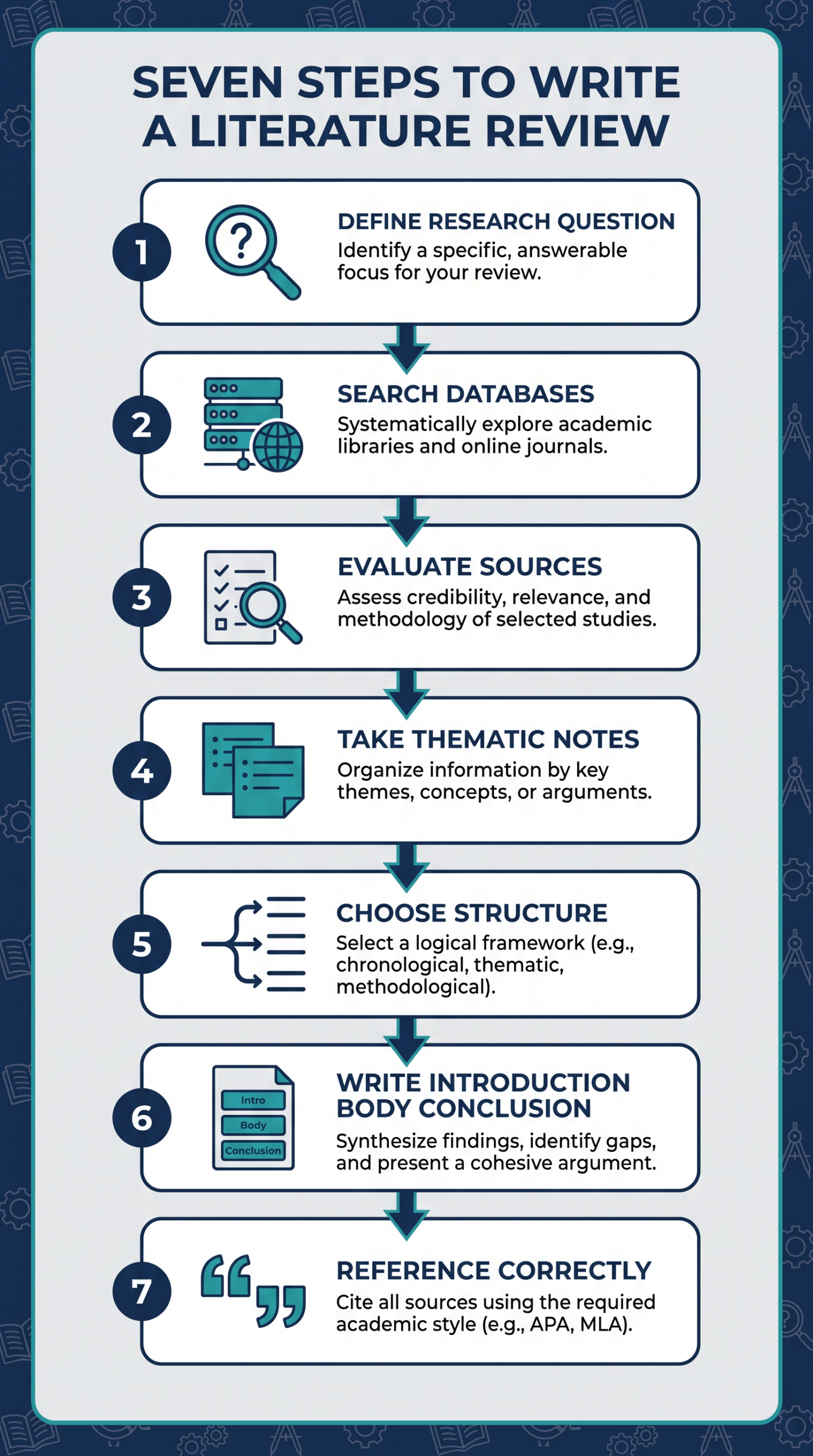
Step 1 — Define Your Research Question Before You Search Anything
The most common mistake students make is searching first and forming a question from whatever they find. That produces a review shaped by what exists rather than by what you are actually trying to understand. Reverse the order.
Your research question defines the scope of your review — what is in, what is out, and what counts as relevant. Without it, you have no basis for cutting sources and no logic to your structure.
A question that is too broad creates an unmanageable review. Consider the difference:
- Too broad: What are the effects of social media on young people?
- Correctly scoped: How does Instagram use among university students aged 18 to 24 relate to self-reported academic performance in UK higher education settings?
The second version tells you exactly which sources belong in the review and which do not. Keywords fall out of it naturally — Instagram, university students, academic performance, UK higher education — and those keywords drive your database searches in the next step.
If you are writing a dissertation literature review and are not yet clear on your research question, our guide on how to start writing a dissertation covers how to develop and narrow a research question before you begin reviewing the literature.
Step 2 — Search for Sources Systematically
Once the research question is defined, the search becomes a structured process rather than an open-ended browse. Use academic databases, not general search engines, as your primary sources.
Where to search:
- Google Scholar — broad coverage across disciplines, good starting point
- JSTOR — strong for humanities and social sciences
- PubMed — health, medicine, and life sciences
- IEEE Xplore — engineering and computer science
- ScienceDirect — sciences, technology, and medicine
- Your university library database — often provides full-text access to sources that appear paywalled elsewhere
How many sources you need:
- Undergraduate literature review: 15 to 25 sources
- Postgraduate or Masters level: 30 to 50 sources
- PhD chapter: 50 or more, depending on the field
Filters to apply from the start:
- Date range: limit to the last 5 to 10 years unless your topic requires foundational or historical work
- Peer-reviewed only: a peer-reviewed source has been evaluated by independent experts in the field before publication — this is the baseline standard for academic work
- Language: English language unless your topic specifically requires otherwise
Keep a simple tracking spreadsheet as you go: source, year, key argument, relevance to your research question, and any gap or limitation the study acknowledges. That spreadsheet becomes your planning document when you move to structuring the review.
Step 3 — Evaluate and Select Sources Using the CRAAP Test
Not every source that appears in your search results belongs in your review. The CRAAP test is a practical framework for deciding what stays and what gets cut.
- Currency — Is the source recent enough for your topic? A 2009 study on social media behaviour is almost certainly outdated.
- Relevance — Does it directly address your research question, or is it tangentially related? Tangential sources pad the review without strengthening it.
- Authority — Who wrote it and where was it published? A peer-reviewed journal article carries more weight than a report from an unknown organisation.
- Accuracy — Are the claims supported by data or evidence? Does the methodology hold up?
- Purpose — Why was this written? A study funded by an organisation with a vested interest in the outcome deserves more scrutiny than an independent academic study.
Cut ruthlessly. A focused review of 20 strong sources is more effective than a bloated review of 40 weak ones. If a source does not directly serve your argument, it does not belong in the review regardless of how interesting it is.
Step 4 — Read and Take Notes With a Theme in Mind, Not Source by Source
This is the step where most students derail themselves without realising it.
The instinct is to read Source A, write a summary of it, read Source B, write a summary of it, and so on down the list. The result is a collection of summaries — which is exactly what a literature review is not supposed to be.
Instead, read across your sources looking for patterns. What do most studies agree on? Where do findings contradict each other? Which populations or contexts have been studied repeatedly, and which have been ignored? What methodological approaches dominate the field, and what are their acknowledged limitations?
Organise your notes by theme, not by author. A simple structure might look like this:
- Theme 1: What studies agree on
- Theme 2: Where studies conflict
- Theme 3: Populations or contexts not yet studied
- Theme 4: Methodological patterns and their limitations
When you sit down to write, you are writing about themes — and the sources are the evidence you draw on within each theme. That shift in how you take notes changes everything about how the final piece reads.
Step 5 — Identify the Structure That Fits Your Review
There is no single correct way to structure a literature review, but there are three main approaches. Choosing the right one depends on your topic and discipline.
Thematic structure organises the review around recurring themes in the literature rather than around individual studies or time periods. This is the most common structure for standalone literature reviews and works well when multiple sources address the same core questions from different angles.
Chronological structure traces how thinking on a topic has developed over time, showing how early studies were built on, challenged, or overturned by later research. This works best for historical topics, policy areas, or fields where the evolution of ideas is itself significant.
Methodological structure groups studies by the research methods they used rather than by their findings. This is most common in science, health, and engineering dissertations where comparing quantitative, qualitative, and mixed-methods approaches is a meaningful part of the review.
Most undergraduate and postgraduate students writing in the social sciences, humanities, or business will default to a thematic structure. If you are unsure which applies to your discipline, check past dissertations in your university library or ask your supervisor before you commit to a structure.
Step 6 — Write the Literature Review — Introduction, Body, Conclusion
With your sources evaluated, your notes organised by theme, and your structure chosen, the writing itself becomes a matter of execution. Each part of the review has a specific job.
Introduction
State the topic, define the scope of the review — what has been included, what has been excluded, and why — and outline the structure the review follows. Do not begin summarising sources in the introduction. Its job is to orient the reader, not to preview your findings.
Body — Thematic Sections
Each thematic section opens with a topic sentence that states the theme clearly. Everything that follows synthesises sources around that theme. Do not dedicate one paragraph to each source — bring sources together within paragraphs, compare what they find, identify where they agree or conflict, and signal what each theme contributes to the overall picture.
Quote sparingly. Paraphrase and cite heavily. The goal is to show that you understand the literature, not that you can reproduce it.
Conclusion
Summarise what the literature has established, identify what it has left unanswered, and connect that gap to your own research question or the implications of the field. For a dissertation chapter, the gap you identify here is the direct justification for your methodology. For a standalone review, it is the takeaway — what the field knows, what it does not, and what that means.
For guidance on the referencing conventions your conclusion and body sections need to follow, our resource on common referencing mistakes students make is worth checking before you finalise the draft.
Step 7 — Reference Every Source Correctly and Consistently
One missed citation is a plagiarism risk. One inconsistent citation style across a review is an easy mark deduction. Reference as you write — not after — and use the correct style for your discipline from the first draft.
The most common referencing styles by subject area:
- Harvard — business, social sciences, humanities
- APA — psychology, education, social work
- Vancouver — medicine and health sciences
- OSCOLA — law
- Chicago — history and some arts disciplines
If you are unsure which style your department requires, check your assignment brief or module handbook. When in doubt, ask before you submit.
Reference generators such as Cite This For Me or MyBib are useful as a final check, but they make errors — particularly with edited volumes, online sources, and sources with missing fields. Treat them as a verification tool, not a primary one.
For a full breakdown of the most common errors students make with citations and how to fix them, see our guide on common referencing mistakes.
Literature Review Structure — Section Live
The step-by-step block was approved and closed. Axiom pulled the structure section off the brief, checked the annotated example requirement, and wrote it clean. “Students need a template they can print and follow, boss man. Abstract explanations don’t survive contact with a blank page.”
Literature Review Structure — What It Should Look Like
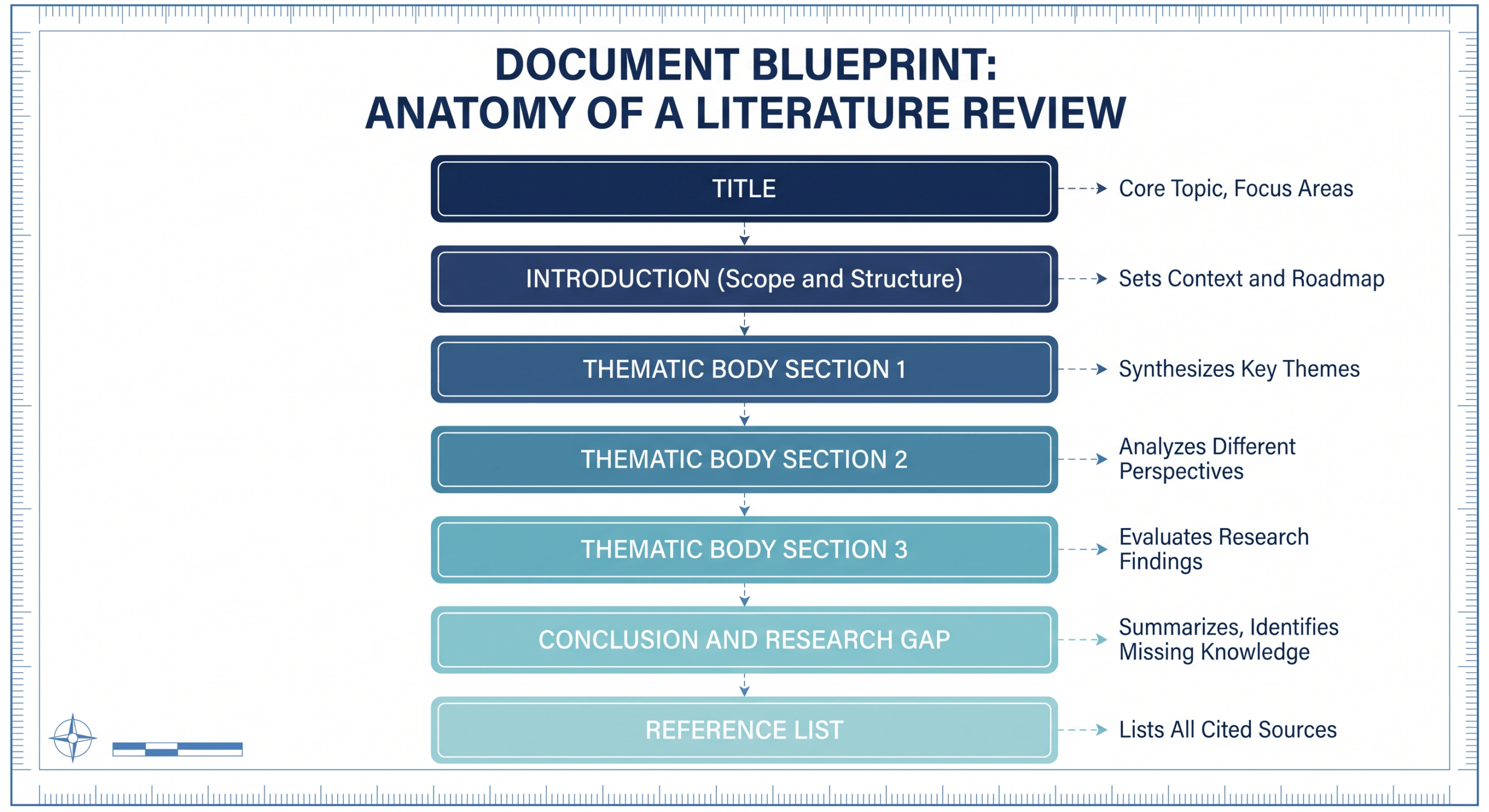
Knowing the steps is one thing. Seeing the structure laid out as a complete unit is another. Here is how a well-organised literature review sits together from top to bottom.
- Title (standalone reviews only — dissertation chapters use the chapter heading)
- Introduction — scope of the review, what was included and excluded, how the review is organised
- Thematic Body Section 1 — first major theme identified across the literature
- Thematic Body Section 2 — second theme, building on or contrasting with the first
- Thematic Body Section 3 — third theme, often where tensions or contradictions in the field are addressed
- Conclusion and Research Gap — summary of what the literature establishes, what it leaves unanswered, and what that means for your research or the field
- Reference List — every source cited in the body, formatted correctly and consistently in your required referencing style
The body sections are not fixed at three. Some reviews have two thematic sections; some have five. The number depends on how many distinct themes emerge from your sources and how much your word count allows you to develop each one properly. What matters is that each section has a clear focus and that the sections connect — the review should read as a single argument, not as a series of separate mini-essays.
A useful test: cover the headings and read the body sections back to back. If the logic still holds without the headings guiding you, the structure is working. If it reads as disconnected pieces, the transitions between themes need work.
Literature Review Example Paragraph (Annotated)
The most useful thing at this stage is seeing what a body paragraph actually looks like when it is working. The following example is built around the topic of student mental health and academic performance — a neutral subject used here purely to demonstrate the structure.
Example paragraph:
[Topic sentence — states the theme this paragraph addresses]
Research consistently identifies a negative relationship between poor mental health and academic performance among university students.
[Source A introduced and its finding stated]
A large-scale study of undergraduate students across five UK universities found that students reporting moderate to severe anxiety symptoms achieved significantly lower grade point averages than their peers, even after controlling for prior academic attainment.
[Source B brought in for comparison — agreement or contrast]
These findings align with research conducted in Australian higher education settings, where depression scores were found to predict both assignment submission rates and likelihood of voluntary withdrawal from modules.
[Source C introduced to complicate or extend the picture]
However, not all studies point in the same direction. Some research suggests that mild academic stress functions as a performance motivator for certain student populations, particularly those with strong self-regulation skills, complicating any straightforward claim that mental health difficulties uniformly depress outcomes.
[Gap identified — what the sources together leave unanswered]
What remains underexplored across this body of research is the role of institutional support structures. Most studies measure the relationship between mental health and performance without accounting for whether students accessed counselling services, academic extensions, or peer support programmes — a gap that limits the practical conclusions universities can draw from the existing evidence.
That paragraph does several things at once. It opens with a clear claim. It brings in sources to support, extend, and complicate that claim. It does not dedicate one sentence per source or summarise each study in isolation. And it closes by identifying what the sources together still leave open — which is the foundation of a strong research gap statement.
Use that structure as a template for each thematic section in your own review. The sources change. The logic does not.
Common Mistakes — Section Live
The structure section was approved and stacked. Axiom pulled the mistakes block off the brief, cross-referenced the “professor said” format note, and wrote it straight. “Six mistakes minimum, boss man. Each one gets what it looks like, why it costs marks, and the fix. No padding between them.”
Common Literature Review Mistakes That Cost Students Marks
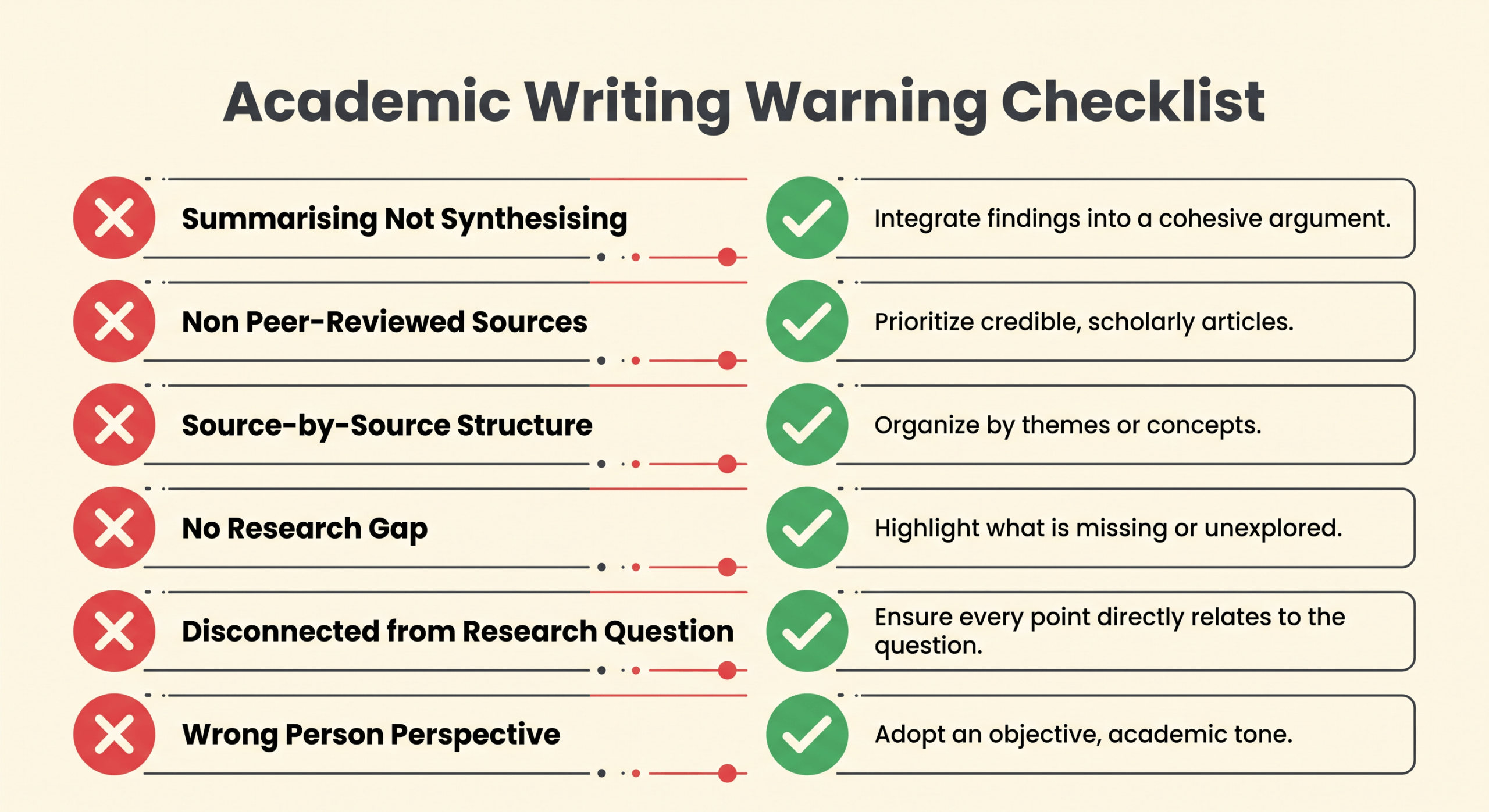
Most literature review feedback falls into the same six categories regardless of subject, level, or institution. These are the patterns examiners flag repeatedly — and the ones that are entirely avoidable once you know what to look for.
Mistake 1 — Summarising Sources Instead of Synthesising Them
This is the most common mistake and the one that costs the most marks. A review built from source summaries reads like an annotated bibliography with the list formatting removed. Each paragraph describes one study. The next paragraph describes another. Nothing connects them.
Synthesis means grouping sources by what they argue, not by who wrote them. When two studies reach the same conclusion through different methods, that convergence is worth noting. When a 2021 paper directly contradicts a widely cited 2016 study, that tension is the substance of your review. The sources are evidence for an argument about the field — not the argument itself.
The fix: Before writing each paragraph, ask what claim you are making about the literature. Write the claim first. Then bring in sources to support, extend, or complicate it.
Mistake 2 — Including Sources That Are Not Peer-Reviewed
Blog posts, news articles, organisational reports, and textbooks are not peer-reviewed sources. Using them as primary evidence in a literature review signals to examiners that you have not searched the academic literature properly — or that you could not find enough credible sources to meet the scope of your question.
Textbooks in particular are a trap. They are useful for understanding concepts, but they summarise and interpret primary research rather than contributing original findings. Citing a textbook where a peer-reviewed journal article exists is always the weaker choice.
The fix: Run every source through the CRAAP test from Step 3. If it has not been through a peer-review process, it does not belong in the body of the review. Non-academic sources can appear in the introduction for context, but sparingly.
Mistake 3 — Organising by Source Rather Than by Theme
A review organised by source is structurally indistinguishable from a list. The heading changes. The paragraph structure does not. Each section is still about one author or one study, and the reader has no way of understanding what the field collectively argues because the field has never been assembled into a coherent argument.
Thematic organisation requires more planning upfront, but it produces a fundamentally different piece of writing — one that demonstrates synthesis rather than just collection.
The fix: Before writing, group your sources into themes on paper or in a spreadsheet. Each theme becomes a section. Sources appear within sections as evidence, not as the organising principle.
Mistake 4 — Failing to Identify the Research Gap
The research gap is not optional. For a standalone review, it is the conclusion — the point the entire piece has been building toward. For a dissertation chapter, it is the justification for your own study. A review that identifies what exists but never identifies what is missing has not completed its argument.
Students avoid the gap statement because it feels presumptuous — like claiming that an entire field of researchers has missed something. But the gap does not need to be dramatic. It can be a population that has not been studied, a context that has not been tested, a methodological approach that has not been applied, or a time period that predates a significant development. Small, specific gaps are more credible than sweeping claims about what the field has ignored.
The fix: As you read, keep a running note of what each study does not address. The pattern across those notes is your gap.
Mistake 5 — Not Connecting the Review to the Research Question
A literature review written without a clearly defined research question tends to wander. Sources get included because they are interesting rather than because they are relevant. Themes emerge from what exists in the literature rather than from what the research question actually needs. The review covers a lot of ground and arrives nowhere in particular.
Every section of the review should be traceable back to the research question. If a theme cannot be connected to what you are investigating, it does not belong in the review regardless of how much you have written about it.
The fix: Write your research question at the top of every planning document and check each section against it before you write. If a section cannot answer “how does this relate to my research question,” cut it or reframe it until it can.
Mistake 6 — Writing in First Person When the Convention Is Third Person
Most academic literature reviews are written in the third person. “This review examines” rather than “I examined.” “The literature suggests” rather than “I found.” The convention varies by discipline — creative arts, reflective practice, and some education contexts allow or even require first person — but the default across the sciences, social sciences, business, and law is third person.
The reason is not arbitrary formality. First person in a literature review tends to foreground the writer rather than the evidence, which pulls focus away from the argument being made about the field.
The fix: Check your assignment brief and any departmental style guidelines before you write. If neither specifies, default to third person. If your supervisor has expressed a preference, follow it. When in doubt, our team at AssignPro Solution can review your draft and flag any style issues before submission.
Length, Survey Distinction, and FAQ — Three Sections Live
The mistakes block was approved and closed. Axiom stacked the next three sections — length, the survey distinction, and the FAQ block with schema markup notes — and wrote them straight through. “Three short sections, boss man. Each one answers a question students are actively searching. No padding, no overlap.”
How Long Should a Literature Review Be?
The honest answer is: it depends on what you are writing and who set the brief.
As a general guide across UK, Australian, Canadian, and UAE university contexts:
| Context | Typical Word Count |
|---|---|
| Standalone undergraduate review | 1,000 to 3,000 words |
| Standalone postgraduate review | 2,000 to 5,000 words |
| Dissertation literature review chapter | 20 to 30% of total dissertation word count |
| PhD thesis literature review chapter | 8,000 to 12,000 words |
For dissertation chapters, the 20 to 30 percent figure is a reliable rule of thumb — so a 10,000-word dissertation would carry a literature review chapter of roughly 2,000 to 3,000 words, while a 15,000-word Masters dissertation would expect somewhere between 3,000 and 4,500 words for that chapter.
That said, always check your assignment brief first. Many universities and departments specify an exact word count or range for the literature review. When a figure is given in the brief, that figure overrides any general guideline. If no figure is given and you are unsure, ask your supervisor before you start writing rather than after you have drafted 5,000 words in the wrong direction.
Literature Review vs Literature Survey — Is There a Difference?
In most university contexts, the terms are interchangeable. If your assignment brief says “literature survey,” you are being asked to produce what this guide calls a literature review — a critical synthesis of existing research on a defined topic, structured around themes and building toward a research gap.
The distinction becomes relevant in specific disciplines. In engineering and computer science in particular, a literature survey sometimes implies a broader scope than a standard literature review — covering a wider range of approaches, methods, and technologies rather than drilling into a narrower question. Some survey papers in these fields run to tens of thousands of words and are published as standalone academic contributions.
For the vast majority of undergraduate and postgraduate students, however, encountering the term “literature survey” on an assignment brief simply means a literature review under a different name. If your department uses the term and you are unsure whether the scope expectations differ, one conversation with your supervisor will settle it faster than any amount of online research.
Frequently Asked Questions About Literature Reviews
How many sources do I need for a literature review?
The number depends on your level of study and the scope of your research question. As a general guide: undergraduate reviews typically draw on 15 to 25 sources, postgraduate reviews on 30 to 50, and PhD chapters on 50 or more. More important than hitting a number is ensuring every source you include is credible, peer-reviewed, and directly relevant to your research question. A focused review of 20 strong sources will always outperform a padded review of 40 weak ones.
Can I use websites as sources in a literature review?
Generally, no — not as primary academic sources. Websites, blog posts, and news articles are not peer-reviewed and do not meet the evidential standard expected in a literature review. There are narrow exceptions: government statistical databases, official policy documents, and institutional reports can be cited where the source is authoritative and the data is not available in peer-reviewed form. When in doubt, ask your supervisor whether a specific source is acceptable before citing it.
Should a literature review be in first or third person?
Third person is the default convention across most disciplines — sciences, social sciences, business, law, and most humanities subjects. Some fields, including reflective practice, creative arts, and certain education contexts, allow or require first person. Check your assignment brief and departmental style guidelines before you write. If neither specifies, default to third person.
How do I find the research gap in my literature review?
As you read through your sources, keep a running note of what each study does not address — populations not studied, contexts not tested, methodological limitations acknowledged by the authors themselves, or time periods that predate a significant development in the field. The pattern across those notes is your gap. It does not need to be a sweeping claim about what the entire field has missed. A specific, well-evidenced gap — even a narrow one — is more convincing than a vague assertion that “more research is needed.”
What is the difference between a literature review and a research paper?
A literature review surveys and synthesises existing research — it does not generate new data or findings. A research paper reports original research conducted by the author, including methodology, data collection, analysis, and conclusions. In a dissertation or thesis, the literature review is one chapter within a larger research paper. As a standalone assignment, a literature review contributes to knowledge by mapping what exists and identifying where gaps remain — but it does so through analysis of existing work, not through new empirical investigation.
How AssignPro Solution Can Help With Your Literature Review
Writing a literature review is one of the more demanding tasks your degree will ask of you — and being stuck on it does not mean you are doing something wrong. It usually means you need a second set of eyes from someone who knows the material.
At AssignPro Solution, subject-specialist tutors work with students across UK, Australian, Canadian, and UAE universities on every stage of the literature review process — from narrowing a research question and identifying credible sources to structuring the review and strengthening the gap statement.
Support is available for standalone literature review assignments and for the literature review chapter inside a full dissertation. Turnaround options are flexible, all work is confidential, and consultation is free.
If you are working on a dissertation and need support beyond the literature review, our dissertation methodology guide covers the next chapter in the same level of detail.