
Dissertation Table of Contents: Format, Numbers and Examples
Dissertation guidance
The Contents Page, Done Properly
What goes in, what stays out, how the numbering works, and why the page should be generated rather than typed.
A dissertation table of contents lists every numbered chapter, section and sub-section in your work, with the page each one begins on, in the order they appear. It sits after the abstract and acknowledgements and before the lists of figures and tables. It does not list itself, and it does not list the title page.
The single most important rule is that it should be generated automatically by your word processor from your heading styles, never typed by hand. A hand typed contents page is wrong the moment you add a paragraph, and markers notice when page numbers do not match.
A dissertation table of contents is one of the few parts of a thesis with an objectively correct answer, which makes it an easy place to gain or lose a mark. Get the dissertation table of contents right once and it stops being something you think about. We review a lot of submissions, and a surprising number arrive with a contents page that disagrees with the document behind it. This guide sets out the format UK departments expect, gives you a sample dissertation table of contents you can pattern match against, and explains the numbering logic that makes the whole thing hold together.
As always, your handbook overrides anything here. Some departments require roman numerals for front matter, some do not number the front matter at all, and a few specify a maximum heading depth. Check first, then apply consistently.
What goes into the contents page
The contents page is a map of the document below it, which means the front matter above it is not included. That single principle resolves most of the questions students ask about the table of contents in dissertation formatting.
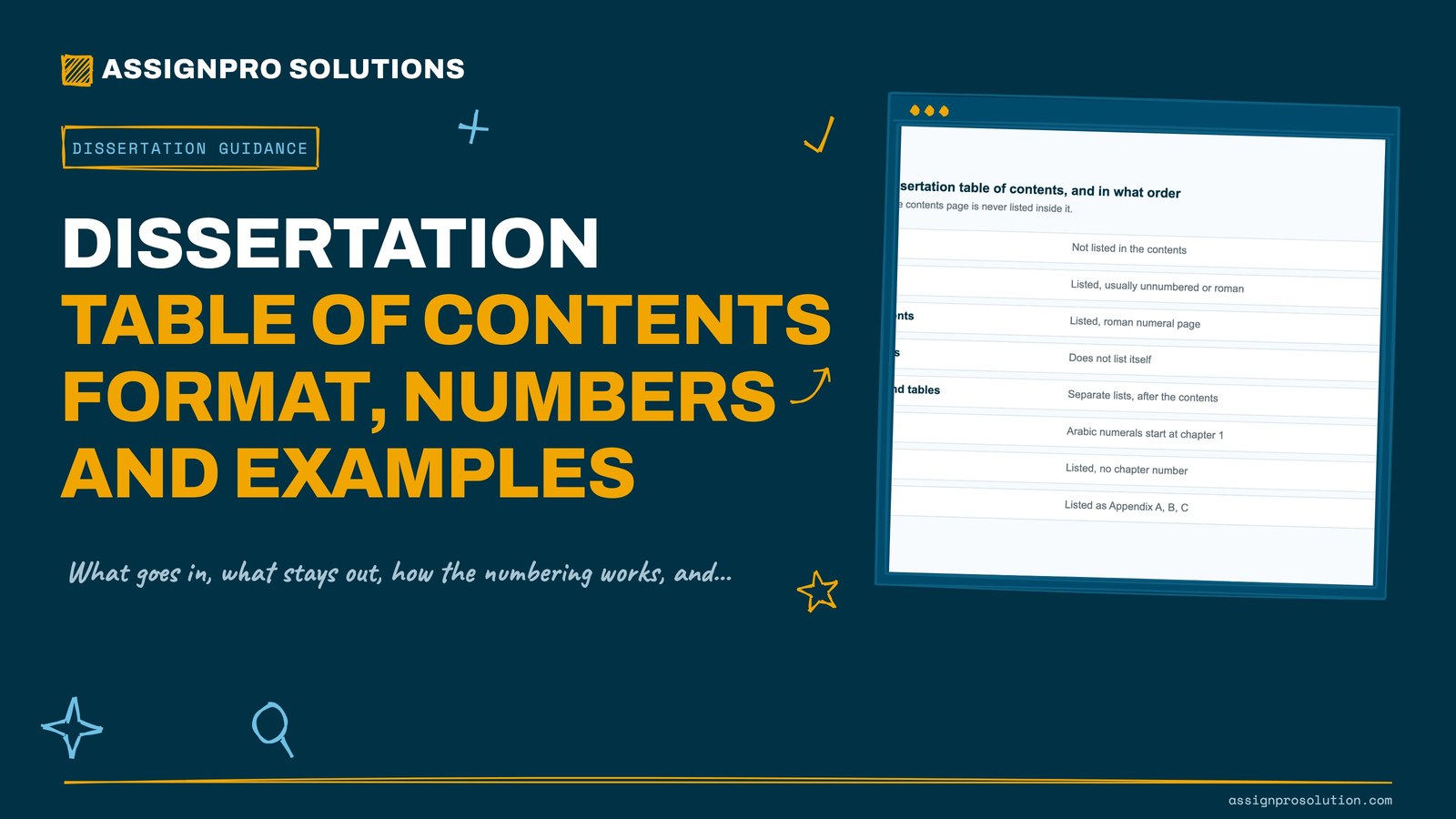
A dissertation contents page in order, showing which front matter is listed and which is not.
Two entries on that diagram catch people out. The contents page never lists itself, which sounds obvious but is a common artefact of hand typing. And the list of figures and list of tables come after the contents page, are separate lists, and are themselves listed in the contents.
Appendices are listed individually rather than as a single line. "Appendix A: Interview schedule" and "Appendix B: Participant information sheet" each get their own row with their own page number. A marker looking for your ethics documentation should be able to find it from the contents page without hunting.
How the numbering works
UK dissertations almost always use decimal numbering, where the chapter number leads and each level adds a dot and a digit. It is a hierarchy, and the hierarchy is the argument structure made visible.
Heading levels in a table of contents in a dissertation, from chapter down to minor heading.
Three levels is the practical ceiling. Once you reach 1.1.1.1 the reader has lost the thread, and a contents page with four levels usually indicates that the chapter needs restructuring rather than renumbering. If a sub-section is important enough to be found, it belongs at level three. If it is not, it can be an unnumbered heading that does not appear in the contents at all.
Page numbering usually runs in two sequences. Front matter takes lowercase roman numerals, so i, ii, iii, and the main body restarts at 1 with arabic numerals from the first page of chapter 1. This is why your word processor needs section breaks rather than page breaks between the front matter and the body, and it is the single most common cause of the numbering going wrong.
Sample dissertation table of contents
Abstract ........ iii
Acknowledgements ........ iv
List of Figures ........ vii
List of Tables ........ viii
1 Introduction ........ 1
1.1 Background to the study ........ 1
1.2 Problem statement ........ 4
1.3 Research aims and questions ........ 6
2 Literature Review ........ 9
2.1 Theoretical framework ........ 9
2.1.1 Defining the core construct ........ 11
2.2 Empirical evidence ........ 15
2.3 The gap this study addresses ........ 22
3 Methodology ........ 25
3.1 Research philosophy ........ 25
3.2 Sampling and participants ........ 29
3.3 Ethical considerations ........ 34
4 Findings ........ 38
5 Discussion and Conclusion ........ 52
References ........ 64
Appendix A: Interview schedule ........ 71
Appendix B: Participant information sheet ........ 73
That dissertation table of contents example is a five chapter social science shape, which is the most common in UK business, education and nursing programmes. A science thesis may split findings across several chapters. A law dissertation may not use chapters at all in the same way. The logic is identical: number the hierarchy, list it in order, give the page it starts on.
Generate it, do not type it
Every word processor builds this page from your heading styles. If you have applied Heading 1 to chapter titles, Heading 2 to sections and Heading 3 to sub-sections, the contents page is three clicks away and updates itself.
- Apply built in heading styles throughout. Do not fake headings by making body text bold and larger, because the generator cannot see that.
- Put the cursor on the blank page where the contents belongs.
- Insert the automatic table of contents, set to the number of levels your handbook allows.
- After any edit, right click the field and update the whole table, not just page numbers.
- Before submission, update once more and then check three entries against the actual pages.
The reason this matters beyond tidiness is accessibility and navigation. A generated contents page produces real internal links and a document outline, so a marker reading on screen can jump to your methodology directly. A typed page is a picture of a contents page and does none of that.
If your numbering has come apart and you cannot see why, send us the file through our contact page. A tutor will identify which styles and section breaks are fighting each other and show you the fix, so you can apply it yourself and know what to do next time.
The errors we see most often
- Page numbers that do not match the document. Almost always a hand typed page, or a generated one that was never updated after the final edits.
- Heading text in the contents that differs from the heading in the chapter. This happens when someone edits a chapter title and updates only page numbers rather than the whole table.
- Inconsistent capitalisation. Pick sentence case or title case and hold it across every level.
- The contents page listing the abstract but not the references. Both are listed. The references section is part of the document.
- Four or five heading levels. Usually a structural problem wearing a formatting costume.
The second of those is worth dwelling on, because it signals something to a marker. A mismatch between a chapter title and its entry in the contents suggests the document was assembled late and checked in a hurry. It is a small thing that colours how carefully the rest is read.
How the contents page reveals your structure
Here is the part that is genuinely useful rather than merely correct. Read your own contents page as if you were the examiner and had nothing else. Does it tell a coherent story? Do the section titles say what the sections argue, or are they generic labels such as "Analysis" and "Discussion"?
A contents page full of one word headings is usually a dissertation whose argument has not yet been decided. A contents page where the section titles are short claims is usually a dissertation that knows what it is saying. This is why we often ask students to send the contents page first when they want dissertation guidance. It shows the skeleton faster than reading forty pages does.
If you are still deciding that structure, our guidance on writing a literature review and on justifying your research methodology covers the two chapters that most often need reorganising.
Get your contents page and chapter structure checked before you submit
Send us your draft contents page or outline. A subject tutor checks the numbering, heading levels and front matter order against what UK markers expect, explains the reason behind each correction, and reviews your revision. We do not write or submit work for students, and all guidance is human written and AI free.
Frequently asked questions
What should a dissertation table of contents include?
Every numbered chapter, section and sub-section with its starting page, plus the abstract, acknowledgements, lists of figures and tables, references and each appendix listed individually. It does not include the title page and it does not list itself.
Does the table of contents come before or after the abstract?
After. The usual UK order is title page, abstract, acknowledgements, table of contents, then the list of figures and list of tables. The main body begins after those lists, with page numbering restarting at 1.
How many heading levels should a dissertation contents page show?
Three is the practical maximum, so chapter, section and sub-section, numbered 1, 1.1 and 1.1.1. A fourth level makes the page hard to read and usually signals that the chapter needs restructuring rather than more numbering.
Should the contents page be typed or generated?
Generated, always. Apply built in heading styles and let the word processor build the page, then update the whole table before submission. A typed page becomes wrong as soon as the document changes and produces no working internal links.
Are appendices listed in the table of contents?
Yes, and individually rather than as one line. Each appendix gets its own entry with its own page number, so "Appendix A: Interview schedule" and "Appendix B: Participant information sheet" appear as separate rows.
Need help choosing?
Send the brief on WhatsApp or email. The team will help identify the right service and tutor.