
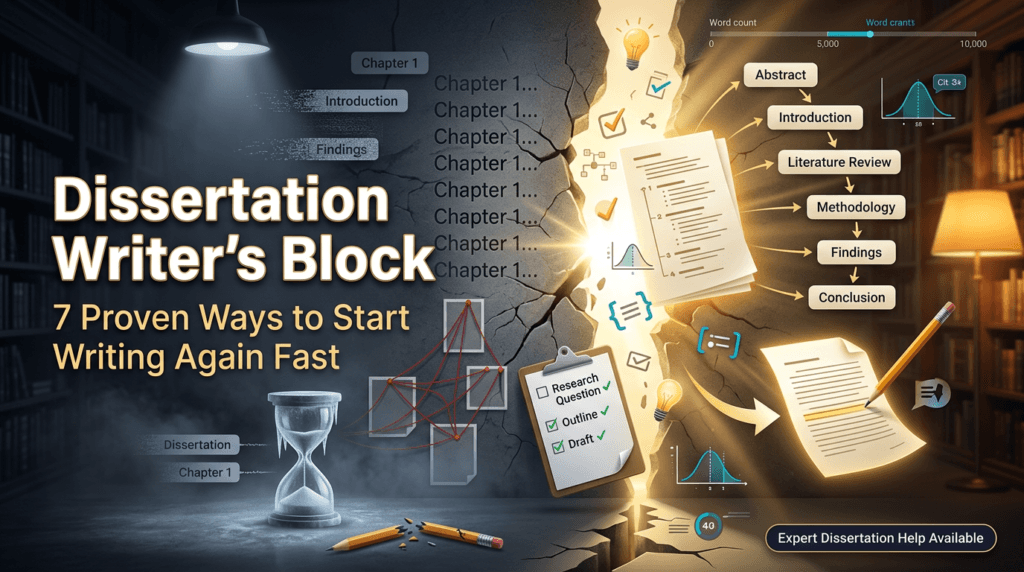
You open your laptop. You stare at the blank document. The cursor blinks. You type three words, delete them, and close the tab.
Sound familiar?
If you are a dissertation student sitting with that same empty page for days — or even weeks — you are not alone, and you are definitely not lazy. What you are experiencing is dissertation writer’s block. And it is far more common than your university will ever admit.
It does not matter whether you are an undergraduate writing your final-year project, a postgraduate working on your thesis, or a PhD candidate halfway through a chapter you cannot seem to finish. That paralysing, suffocating feeling of not being able to write — even when you know your topic — hits thousands of students every single year.
The worst part is not the blank page. It is the spiral that comes after it. You start to wonder if you are cut out for this. You convince yourself that everyone else is further ahead. You check your deadline, panic, then somehow end up watching three hours of YouTube. By the time you go to bed, the guilt sets in.
That cycle — stuck, anxious, distracted, guilty — is not a character flaw. It is a psychological response to pressure. And like most psychological problems, it has real, practical solutions.
This guide covers exactly that. Not vague advice like “just start writing” or “believe in yourself.” Actual methods that work — backed by how the brain handles stress, perfectionism, and creative block. Whether you are stuck at the introduction, halfway through your literature review, or completely frozen before you have written a single word, something in here will help you move again.
And if a deadline is already close, do not wait — chat with a dissertation expert on WhatsApp and talk through your options today.
What Is Dissertation Writer’s Block?
Dissertation writer’s block is not a lack of ideas. It is not laziness. It is not even a lack of time. It is what happens when your brain refuses to convert what you know into words on a page — and there is usually a very specific reason for it.
Think of it this way. You have done the reading. You have your notes. You roughly know what you want to say. But the moment you sit down to actually write, something shuts down. Your mind goes blank, or worse, it floods with so many thoughts at once that you cannot organise any of them. That is not a knowledge problem. That is a psychological block.
Researchers who study writing anxiety describe this as a conflict between what a student wants to produce and what they fear producing. The gap between your ideal dissertation and the imperfect draft sitting in front of you feels so large that your brain decides not to start at all. Perfectionism, fear of judgment, and academic pressure all feed into this — and for dissertation students, those pressures are significantly higher than in any other type of assignment.
There is also the scale of the task to consider. A dissertation is not an essay you can bash out the night before. It is months of work, dozens of decisions, and a document that will be formally assessed by people whose opinion genuinely matters to your degree. That weight alone is enough to freeze even the most capable students.
So if you have been asking yourself why you cannot write your dissertation despite knowing your subject — this is why. It is not about ability. It is about the mental and emotional load that comes with a task this size.
Why You Can’t Start Writing (Real Reasons)
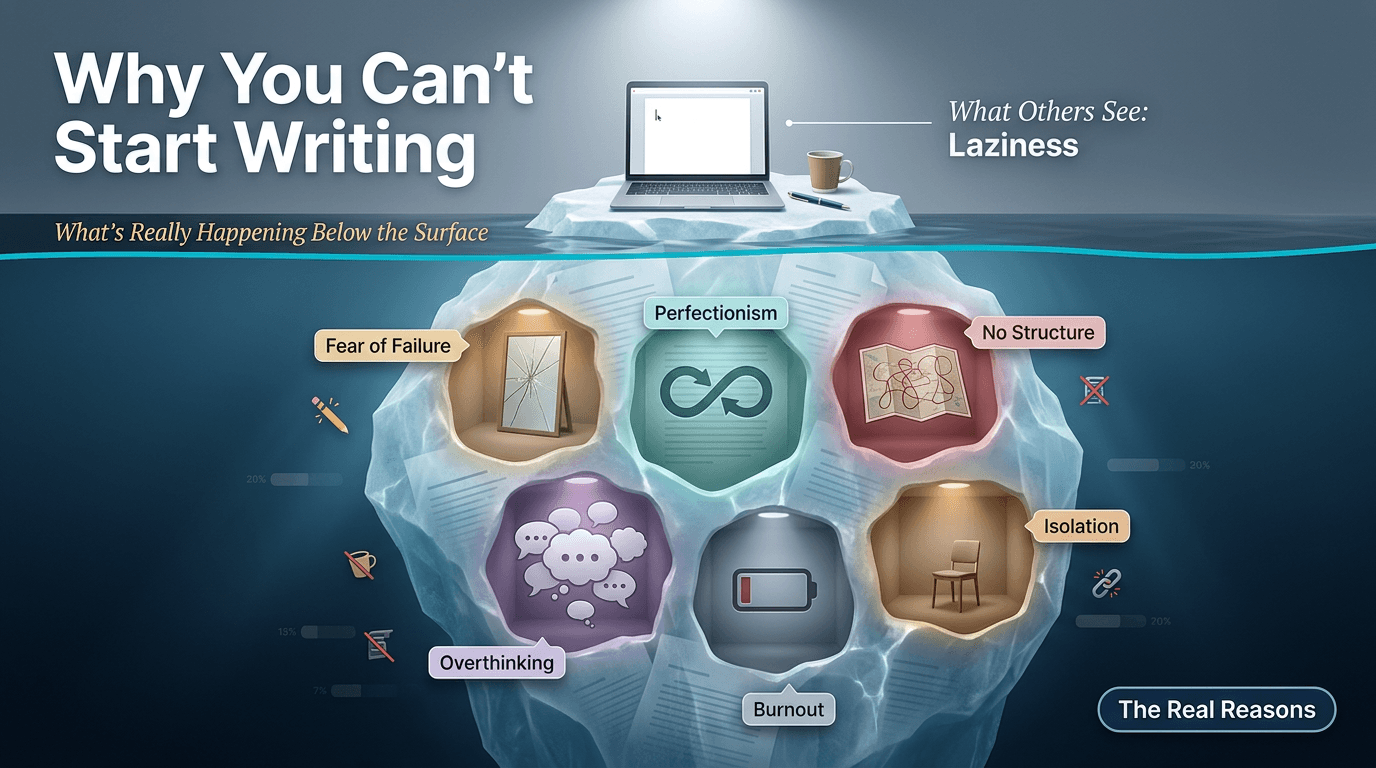
There is a difference between not wanting to write and not being able to write. Most students assume they are dealing with the first problem when they are actually dealing with the second. Here are the real reasons dissertation writer’s block takes hold — and why generic advice like “just sit down and do it” completely misses the point.
Fear of Failure
This is the big one. When the stakes are high — a degree classification, years of work, your supervisor’s expectations — writing feels like putting yourself up for judgment. Every sentence you type is evidence that can be used against you. So your brain, trying to protect you, simply refuses to produce sentences at all. It feels safer to not write than to write something that might be wrong.
Perfectionism
Perfectionism and procrastination are not opposites. They are partners. Students who care deeply about their work are often the ones most paralysed by it. You keep waiting for the right words, the perfect argument, the ideal structure — and because that version never arrives, neither does the writing. The bar you have set for yourself is so high that starting feels pointless.
No Clear Structure
A blank page with no plan is genuinely terrifying. If you sit down to write without knowing exactly what the next 500 words need to do, your brain has nowhere to go. Structure is not just an organisational tool — it is the scaffolding that makes writing psychologically possible.
Overthinking
Some students get so deep into their own head that writing becomes impossible. You second-guess your argument before you have made it. You question your sources before you have cited them. You rewrite your introduction fifteen times before reaching the literature review. Overthinking is not thoroughness — it is fear dressed up as diligence.
Burnout
Dissertation writing does not happen in isolation. Most students are managing part-time work, social pressure, financial stress, and the general exhaustion that comes with final year. By the time you sit down to write, there is genuinely nothing left in the tank. Burnout is not weakness — it is what happens when you have been running on empty for too long.
Isolation
Unlike coursework, a dissertation is largely a solo project. There is no classroom, no group discussion, no peer accountability. You are alone with your thoughts, your laptop, and a deadline that feels both far away and terrifyingly close. That isolation compounds every other issue on this list.
If you recognise yourself in more than one of these, that is completely normal. Most students dealing with dissertation writer’s block are not facing one problem — they are facing several at once.
7 Proven Ways to Overcome Dissertation Writer’s Block
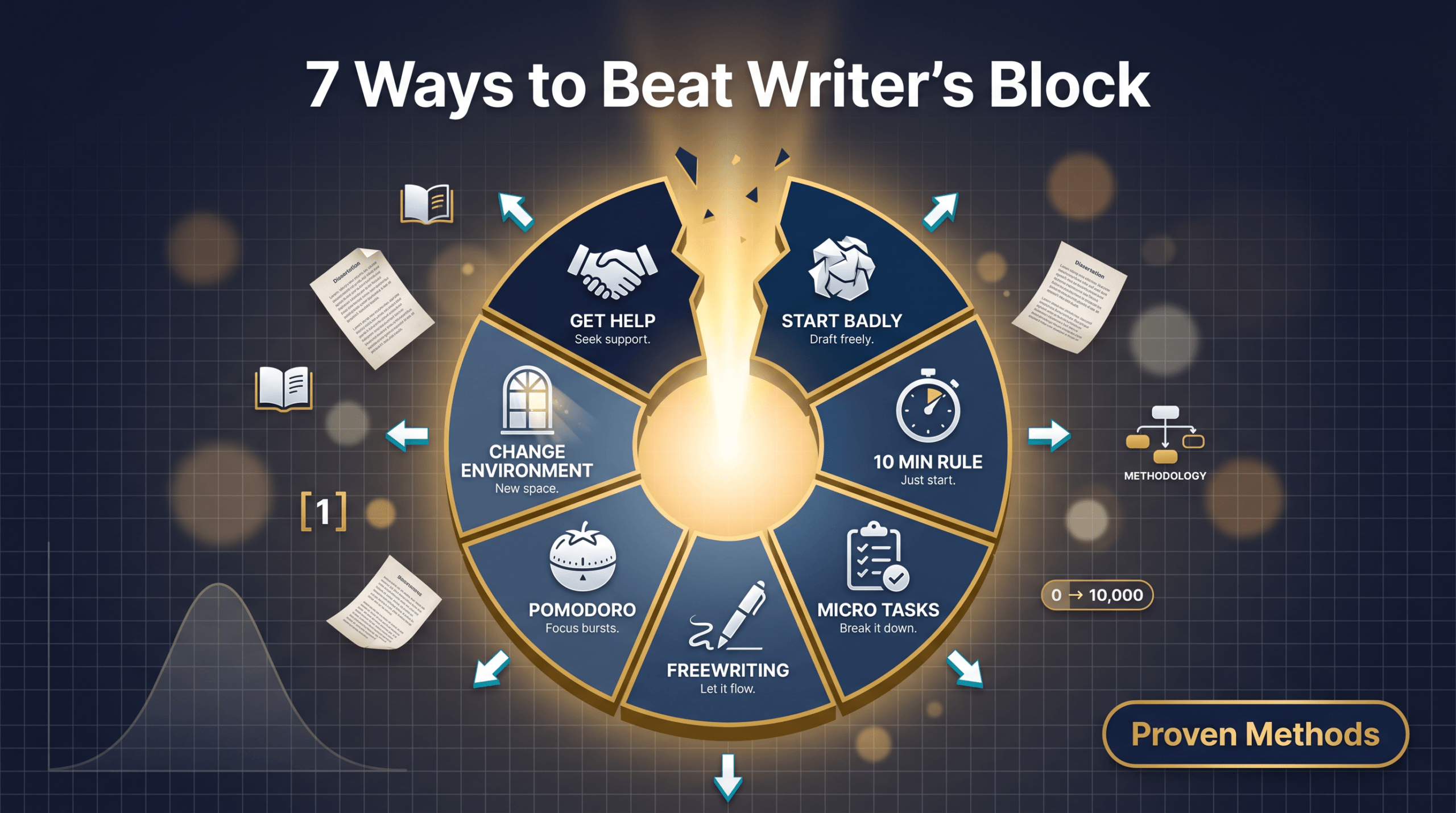
These are not motivational platitudes. Each method below has a specific mechanism — a reason it works — and a practical way to apply it today.
1. Start With Bad Writing
The single biggest trap dissertation students fall into is waiting until they feel ready to write well. That moment rarely comes. Instead, give yourself explicit permission to write badly.
Open a blank document and write the ugliest, most disorganised version of your argument you can manage. No references, no formal language, no structure. Just get the ideas out of your head and onto the page in whatever form they arrive.
This works because the hardest part of writing is not the writing itself — it is the transition from silence to words. Once something exists on the page, even something terrible, you have something to work with. Editing a bad draft is infinitely easier than staring at nothing.
2. The 10-Minute Rule
Tell yourself you will write for exactly ten minutes and then stop. Set a timer. Commit to nothing beyond those ten minutes.
This works because dissertation writer’s block is largely a resistance problem, not a capability problem. Your brain resists starting because it anticipates hours of painful effort. Ten minutes feels manageable. And in almost every case, once the ten minutes are up, you will keep going — because starting was the only hard part.
If you genuinely stop after ten minutes, that is still ten minutes more than you had before. Do it again tomorrow.
3. Break It Into Micro Tasks
“Write my literature review” is not a task. It is a project. And your brain treats it like one — which is why it feels impossible to start.
Break it down until the next action is so small it takes less than five minutes. Not “write the methodology” but “write one sentence describing my research approach.” Not “finish chapter three” but “find two sources for the gap I identified yesterday.”
Micro tasks remove the overwhelm. They give your brain a clear, achievable target — and every small completion releases enough dopamine to make the next step slightly easier.
4. Freewriting
Set a timer for fifteen minutes. Write continuously without stopping, without editing, without lifting your hands from the keyboard. It does not matter if the sentences make no sense. It does not matter if you go completely off-topic. The rule is simple: keep writing.
Freewriting bypasses the internal critic — the part of your brain that edits and judges every sentence before it reaches the page. After fifteen minutes, you will almost always find at least one usable idea buried in the chaos. That idea becomes your starting point.
This technique has been used in academic writing programmes at universities across the UK and Australia precisely because it works for students who are too much in their own heads to write normally.
5. The Pomodoro Technique
Work for 25 minutes. Rest for 5 minutes. Repeat four times, then take a longer break of 20 to 30 minutes.
This structured rhythm does two things. First, it makes the writing session feel finite — 25 minutes is short enough to commit to without dread. Second, the built-in breaks prevent the mental fatigue that turns a writing session into a staring contest with your screen.
For dissertation students specifically, Pomodoro works well because it creates a clear separation between writing time and everything else. During those 25 minutes, nothing else exists. No phone, no email, no checking whether your supervisor has replied.
6. Change Your Environment
Your brain associates locations with behaviours. If your desk at home has become the place where you sit and do not write, that association is working against you every time you sit down there.
Move. Go to a library, a coffee shop, a study room on campus, or even just a different room in your house. A new environment resets the psychological state you associate with writing — or more accurately, with not writing.
This is not a permanent solution, but it is a genuinely effective circuit-breaker when you have been stuck in the same place for days.
7. Get Expert Help
Sometimes the block is not psychological — it is structural. You are stuck because you genuinely do not know how to move your argument forward, because your methodology has a gap you cannot resolve, or because you have received feedback you do not know how to act on.
In those cases, working through it alone is not discipline. It is just delay.
Our dissertation experts work with students across the UK, Australia, Canada, and beyond — providing one-to-one dissertation tutoring support to help them untangle exactly these kinds of structural problems. Whether you need someone to review what you have written, help you plan what comes next, or support you through an urgent deadline, we are here.
Talk to a dissertation expert on WhatsApp — no commitment, just a conversation about where you are stuck and what your options are.
You can also explore our dissertation deadline support if your submission date is closer than you would like.
What Causes Dissertation Writer’s Block (Deep)
The seven methods above will help you start writing again. But if you want to stop dissertation writer’s block from coming back every few weeks, you need to understand what is actually driving it beneath the surface.
Academic Pressure
Universities set the bar high — and they should. But the pressure that comes with that bar is rarely discussed openly. Your dissertation is worth a significant portion of your final grade. In many programmes, it is the single largest piece of work you will ever submit. That kind of weight does not sit quietly in the background. It shows up as paralysis every time you open your document.
The pressure is compounded by comparison. You see other students who appear to be further along, more confident, more organised. What you do not see is that most of them are dealing with exactly the same thing behind closed doors.
Isolation
A dissertation is one of the few academic tasks you are expected to complete almost entirely alone. There are no weekly seminars where someone checks your progress. No group project to pull you forward. Just you, your supervisor meeting once a month if you are lucky, and a deadline that sits quietly at the end of the calendar.
That isolation is genuinely hard. Human beings do not think or work well in complete solitude over long periods. The absence of collaboration, feedback, and simple human contact around your work makes every problem feel larger than it is.
Lack of Clarity
A significant number of students are not blocked because they cannot write — they are blocked because they are not sure what they are trying to say. The argument is fuzzy. The research question keeps shifting. The theoretical framework does not quite fit the data.
When the intellectual foundation is unclear, writing feels dishonest. You cannot commit words to the page because you are not sure you believe them yet. This is one of the most common and least talked-about causes of thesis writing paralysis — and it requires thinking work, not just writing work, to resolve.
If this sounds like your situation, our dissertation methodology support page covers exactly how to get your structure and argument back on solid ground.
Fear of Feedback
For many students, the block is not really about writing at all. It is about what comes after writing — showing it to someone. Your supervisor, your second marker, your examiners. The moment you submit a chapter, you open yourself up to critique. And if that critique has been harsh in the past, your brain will do everything it can to delay the moment it happens again.
This is especially common after a supervisor has returned work with significant comments. If you have been through that experience and found it difficult, take a look at how other students have handled supervisor feedback on their dissertation — it might reframe how you approach the next submission.
How to Start Writing Again (Step-by-Step System)
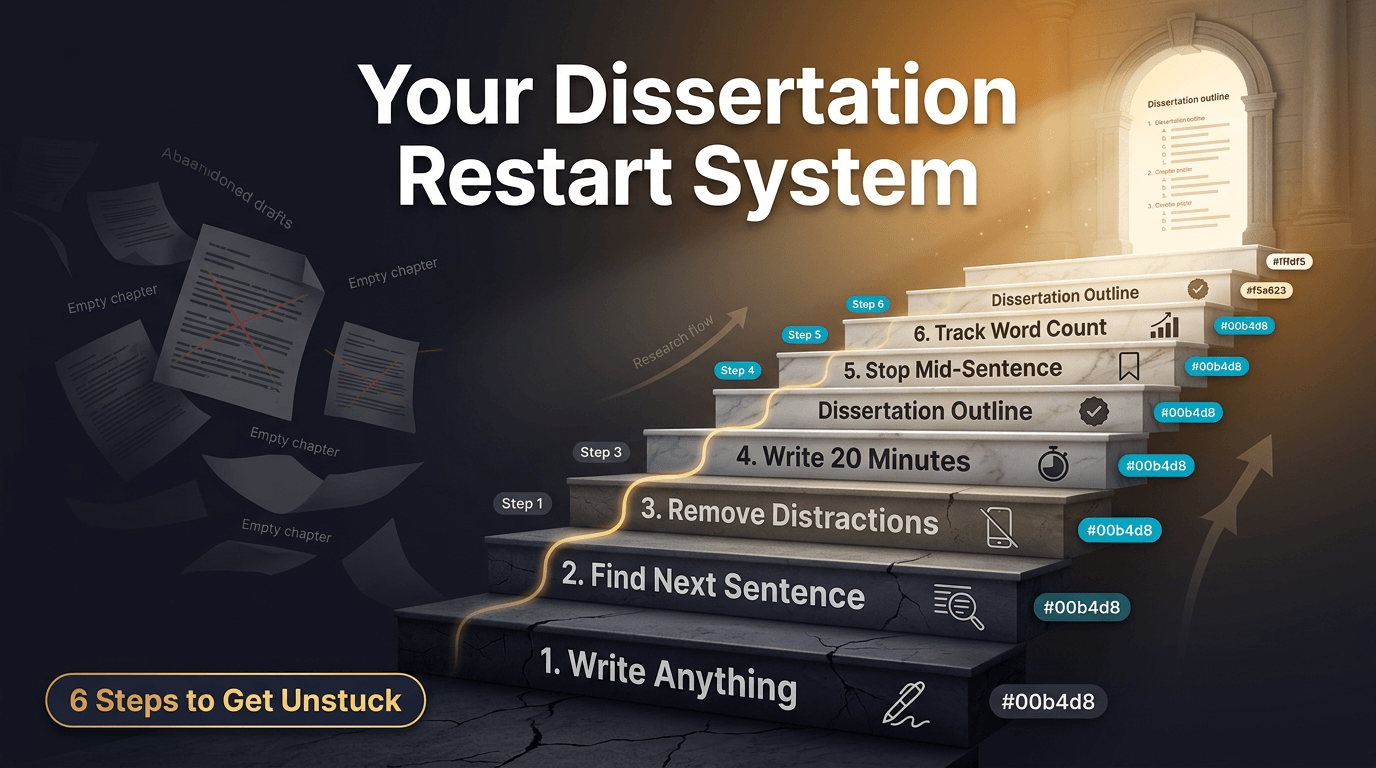
Knowing why you are blocked is useful. Having a system to get unblocked is what actually moves the needle. This is a simple restart sequence you can use any time dissertation writer’s block hits — whether you have been stuck for an hour or for three weeks.
Step 1: Do Not Start With the Dissertation
Open a blank document that has nothing to do with your dissertation. Write three to five sentences about anything — what you did this morning, what you are worried about, what you had for lunch. It does not matter what.
This is not a warm-up exercise for its own sake. Writing anything at all activates the part of your brain responsible for producing language. Once it is running, switching to your dissertation is significantly easier than cold-starting directly into academic writing.
Step 2: Identify the Smallest Possible Next Step
Do not ask yourself “what do I need to write today.” Ask yourself “what is the one sentence I need to write next.” Literally one sentence. Find it, write it, and stop thinking about anything beyond it.
If you cannot identify that sentence, the problem is probably clarity — you do not yet know what you are trying to argue. In that case, skip the writing entirely and spend twenty minutes on a bullet-point outline of just the next section. Writing cannot happen without thinking, and sometimes thinking needs to happen first.
Step 3: Remove Every Distraction Before You Start
Phone in another room. Notifications off. Browser tabs closed except the one document you are working on. If you use music, keep it instrumental — lyrics compete with the language centres in your brain.
This sounds obvious, but most students underestimate how much partial attention costs them. Every notification your brain registers — even one you do not act on — interrupts the cognitive state required for sustained writing. Protecting that state is not optional. It is the whole job.
Step 4: Write for Twenty Minutes Without Stopping
Not until it is good. Not until the paragraph is finished. Just twenty minutes, continuous, whatever comes out. Use the freewriting approach from the methods section if you need to — keep your hands moving even if the words are not what you want.
After twenty minutes, stop. Read what you have written. In almost every case, there will be at least one sentence or idea worth keeping. That is your anchor for the next session.
Step 5: End Each Session Before You Are Finished
This is a technique used by many professional writers and it works for dissertation students too. Stop writing mid-sentence or mid-paragraph — somewhere you know exactly what comes next. When you return to the document, you are not facing a blank page. You are finishing a thought you already started. The psychological barrier of starting disappears almost entirely.
Step 6: Track What You Write, Not How Long You Sit There
Time spent at your desk is not the same as writing. A student who writes 200 words in twenty focused minutes has made more progress than one who sits at their laptop for three hours while scrolling between tabs.
Keep a simple daily word count. Even 150 words a day, maintained consistently, will produce a full chapter in a month. The number matters less than the habit.
If you have tried this system and you are still stuck — or if your deadline is close enough that a slow restart is not an option — speak to one of our dissertation experts on WhatsApp. Sometimes the fastest way through a block is having someone sit with you in it.
What If You Are Stuck for Days or Weeks
First, the honest part: being stuck for days or weeks does not mean you are failing. It means you are human, and the task in front of you is genuinely hard. Dissertation writer’s block at this level is not a sign that you chose the wrong topic, picked the wrong programme, or lack the ability to finish. It is a sign that something — pressure, clarity, exhaustion, fear — has built up to a point where normal coping is not enough.
That said, there is a difference between being stuck and being in trouble. Knowing which one you are dealing with matters.
When It Is Still Manageable
If you have weeks left on your deadline and you are producing something — even small amounts, even rough drafts — you are not in crisis. You are in a difficult patch. The methods in this guide will work for you. Pick one, apply it consistently for three days, and track whether your output increases. If it does, keep going. If it does not, switch methods.
The mistake most students make at this stage is treating the block as permanent. It is not. It is a temporary state with a specific cause — and specific causes have specific solutions.
When You Need to Take It Seriously
If you have not written anything meaningful in two weeks or more, if your deadline is within four to six weeks, or if you are starting to avoid thinking about your dissertation entirely — that is a signal worth paying attention to.
At that point, continuing to push through alone is not resilience. It is stubbornness that costs you marks. The students who recover from serious blocks fastest are almost always the ones who asked for help earlier than felt comfortable.
Talk to your supervisor. Talk to your university’s student support service. And if you need practical writing support quickly, this is exactly what our team exists for. We have worked with students who came to us with two weeks left and a blank document — and we helped them submit work they were genuinely proud of.
If that is where you are right now, do not spend another day hoping it resolves on its own. Message us on WhatsApp and tell us where you are. We will tell you honestly what is possible and what your options are.
You can also read how other students have handled being close to the wire on our dissertation deadline support page — it might help you figure out your next move.
The Emotional Side Nobody Talks About
Being stuck for weeks affects more than your word count. It affects your sleep, your confidence, your relationships, and your sense of self. Students in this position often describe feeling like a fraud — as if everyone else has it together and they are the only one falling apart.
You are not the only one. And the feeling passes — but usually only once you start moving again, even slightly. Momentum is its own medicine. The first 100 words after a two-week block will feel disproportionately good, because they prove to you that you can still do this.
You can.
Common Mistakes Students Make
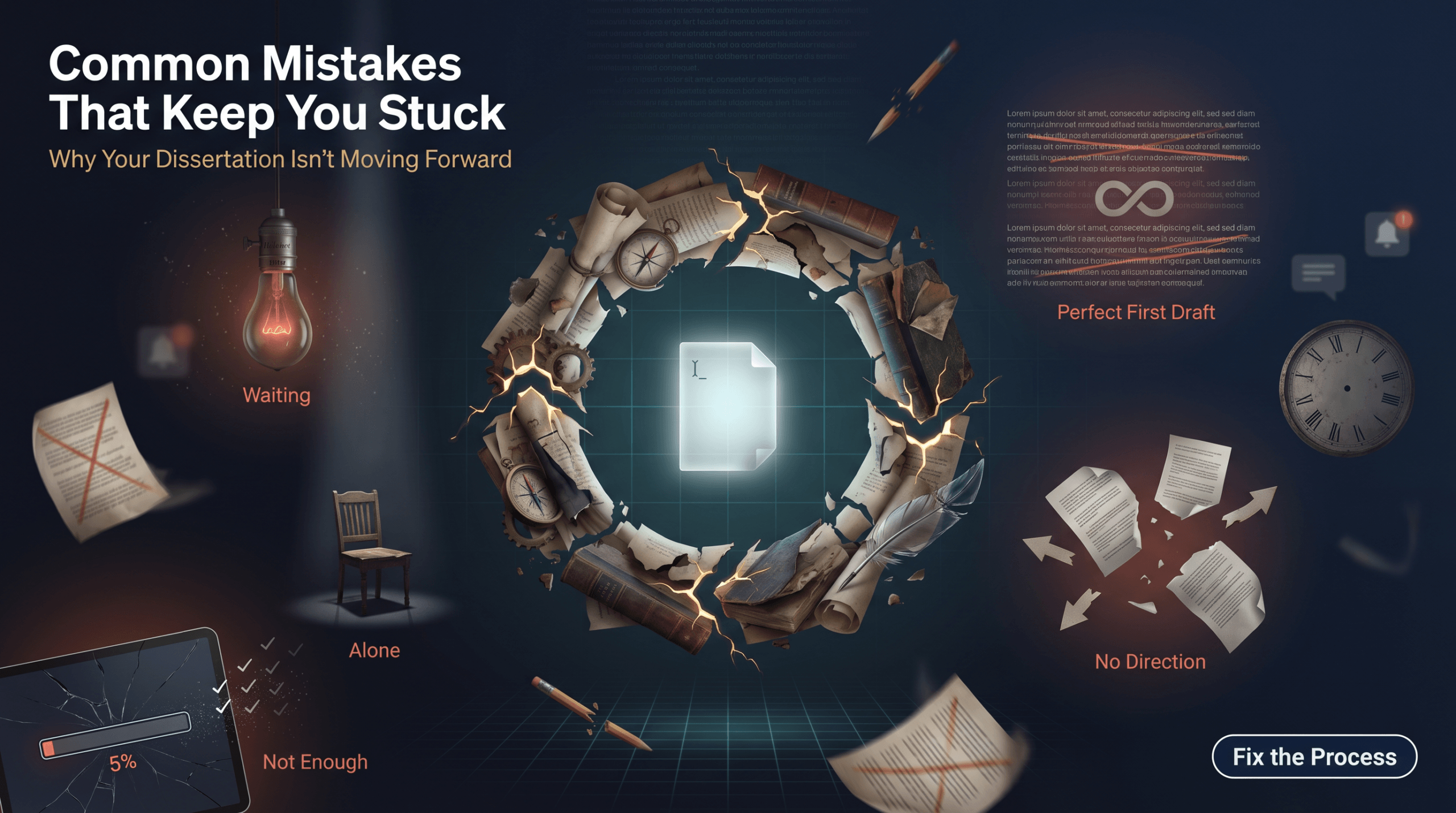
Most students dealing with dissertation writer’s block do not make it worse through laziness. They make it worse through well-intentioned habits that quietly work against them. These are the most common ones.
Waiting for Motivation to Arrive
Motivation is not a prerequisite for writing. It is a byproduct of it. Waiting until you feel inspired, focused, or confident before you sit down to write is a strategy that will keep you stuck indefinitely — because that feeling rarely arrives on its own.
The students who finish their dissertations are not the ones who felt motivated. They are the ones who wrote anyway, on the days it felt pointless, on the days the words were bad, on the days they would have rather done anything else. Action produces motivation. Not the other way around.
Trying to Write Perfectly From the Start
A first draft is not supposed to be good. It is supposed to exist. The moment you treat your first attempt as a performance rather than a process, you have already made the task harder than it needs to be.
Every sentence you write trying to be perfect is a sentence that took three times longer than it should have and will probably be rewritten anyway. Write fast, write badly, and fix it later. That is how dissertations actually get finished — not in one polished pass, but in layers.
If you are unsure what a solid structure even looks like before you start drafting, our dissertation writing guide walks you through the process from the very beginning.
Working Without a Structure
Sitting down to write without a clear outline is the academic equivalent of setting off on a long drive with no map and no destination. You might move, but you will not get anywhere useful.
Before every writing session, you should know exactly what the section you are working on needs to accomplish — what argument it makes, what evidence it uses, and how it connects to what comes before and after. Without that clarity, every paragraph becomes a decision you have to make under pressure, and that pressure feeds directly into the block.
Working Completely Alone
Isolation is one of the root causes of dissertation writer’s block — so choosing to work through it in complete isolation is one of the least effective responses to it. Yet most students do exactly this, either out of pride, out of not wanting to bother anyone, or because they do not know where to turn.
Talk to someone. Your supervisor, a peer, a study group, a writing centre at your university, or a professional service. Externalising the problem — saying it out loud to another person — has a measurable effect on how solvable it feels. Problems that feel enormous inside your head almost always shrink when you describe them to someone else.
Ignoring the Small Wins
Students who are blocked tend to measure progress in chapters and sections — which means they spend most of their time feeling like they have made no progress at all. A paragraph is progress. A solid argument is progress. Finding one source that finally makes your theoretical framework click is progress.
If you only celebrate finishing, you will spend months feeling like you are failing. Track the small wins. They are what the finished dissertation is actually made of.
Got it. Teen external links hain jo abhi end mein clustered hain — inhe spread karta hoon section ke andar naturally.
Daily Writing Habits That Actually Work
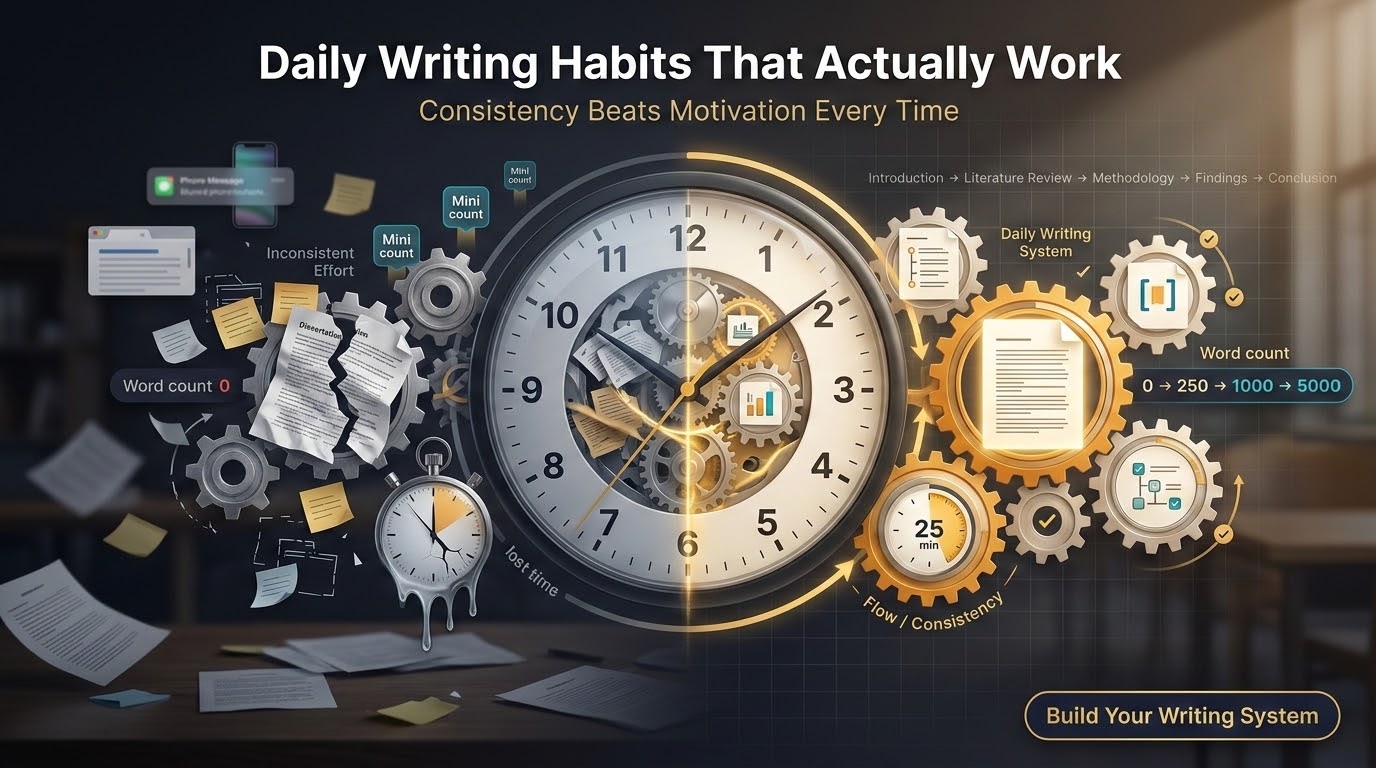
The methods in this guide will help you break through dissertation writer’s block when it hits. But the goal is to build a rhythm that stops it from becoming a recurring problem in the first place. These habits are small, sustainable, and genuinely effective — not because they are revolutionary, but because consistency beats intensity every single time.
Write at the Same Time Every Day
Your brain responds to routine. When you write at the same time each day — even for just twenty to thirty minutes — your brain begins to anticipate that state and prepare for it. The resistance you feel at the start of a session gradually decreases because starting is no longer a decision. It is just what happens at that time.
Pick a time that realistically fits your life. Early morning works well for many students because the decision-making part of the brain is fresh and distractions are fewer. But the best writing time is the one you will actually use consistently — not the one that sounds most productive in theory. Many universities actively support students in building this kind of routine — the academic writing support team at Coventry University offers structured guidance that can help you stay on track.
Protect Your Writing Session Like an Appointment
Most students treat their writing time as flexible — something they will get to once everything else is done. Everything else is never done. Writing that has no fixed slot in your day will always be displaced by something more urgent, more social, or more comfortable.
Put it in your calendar. Tell the people around you that you are unavailable during that time. Treat it with the same seriousness you would give a seminar or a supervisor meeting. Because it matters at least as much.
Keep a Running Outline
Before you finish each writing session, spend five minutes updating your outline for the next one. Note exactly where you stopped, what the next section needs to cover, and any sources you want to use. When you return the following day, you are not starting from scratch — you are continuing from a clear set of instructions you left for yourself.
This single habit removes more friction from daily writing than almost anything else. The blank page problem disappears when the page is not actually blank.
Separate Writing From Editing
Do not edit while you write. These are two different cognitive modes, and switching between them mid-session is one of the most effective ways to slow your output to almost nothing.
During writing time, write. During editing time, edit. If you spot a mistake while drafting, highlight it and keep going. You can fix it in the next pass. The goal of a writing session is words on the page, not perfect words on the page.
Read Before You Write
Spending ten to fifteen minutes reading something relevant to your dissertation — a paper, a chapter, a set of notes — before you start writing activates the part of your brain that processes academic language and argument. You will find that the transition into writing feels noticeably smoother when your mind is already in that mode. If you are unsure where to find reliable academic resources, the student learning support at the University of Greenwich is a good starting point.
This is especially useful on days when motivation is low. You are not asking yourself to create from nothing — you are asking yourself to respond to something you have just read. That is a much smaller psychological ask.
Know When to Rest
Productivity is not the same as constant output. Students who write every single day without rest do not outperform students who write consistently with deliberate breaks. Fatigue accumulates, and writing produced at the end of an exhausted week is often so poor it needs to be rewritten anyway.
Build rest into your schedule deliberately. A day off from writing is not a failure of discipline — it is part of the system. Come back the next day with a cleaner mind and you will almost always find the session goes better than the ones that preceded it. If exhaustion and stress are making it genuinely difficult to function, the student wellbeing services at the University of Hertfordshire provide dedicated support for exactly this kind of situation.
Frequently Asked Questions
How do I overcome dissertation writer’s block?
There is no single answer that works for everyone, but the most effective starting point is almost always the same — lower the bar for what counts as writing. Stop trying to produce good work and start trying to produce any work. Write one bad sentence. Then another. The block lives at the starting line, not in the middle of the race. Once you are moving, staying in motion is significantly easier than it looks from a standstill.
Why can’t I write my dissertation even though I know my topic?
Because knowing your topic and being able to write about it are two different things. Writing is not just thinking — it is thinking under pressure, in a specific format, for a specific audience, with real consequences attached. That pressure is what creates the block, not ignorance. Most students who cannot write their dissertation know more than enough to write it. What they are missing is a way to get that knowledge out without the fear getting in the way first.
How do I start writing my dissertation when I feel completely stuck?
Do not start with your dissertation. Start with anything else — a few sentences about your day, a rough bullet point list of what you want to say, a voice note to yourself. Get language moving in your brain before you ask it to produce academic writing. Then open your document and write one sentence — not a paragraph, not a section. One sentence. That is the only target.
How many hours a day should I write my dissertation?
Fewer than you think. Two to three focused hours of genuine writing will outperform six hours of sitting at a desk while distracted. Quality of attention matters far more than quantity of time. Most students who claim they spent all day writing spent most of it in a low-grade state of avoidance — open document, phone nearby, half a mind on something else. Two clean hours beats that every time.
What causes dissertation writer’s block in PhD students specifically?
PhD-level dissertation writer’s block tends to be driven by a specific combination of factors — the original contribution requirement, the length of the project, the depth of supervisor scrutiny, and the identity stakes involved. When your work is expected to add something new to a field, every sentence carries the weight of that expectation. That is a genuinely harder psychological environment than undergraduate or even postgraduate writing, and it deserves to be treated as such rather than dismissed as procrastination.
How do I get over dissertation writer’s block fast when my deadline is close?
Stop trying to solve the whole dissertation and solve only today. What is the one section, the one paragraph, the one argument you need to nail down in the next two hours? Work on that and nothing else. If the deadline is genuinely close and the gap between where you are and where you need to be is large, that is also the point at which getting professional support stops being a luxury and starts being a practical decision. Reach out on WhatsApp and we can help you work out exactly what is still possible in the time you have left.
Still Stuck? Here Is What You Can Do Right Now

Reading about dissertation writer’s block is one thing. Actually getting unstuck is another — and sometimes the gap between the two is wider than any guide can bridge on its own.
If you have read this far and you are still not sure where to start, or if your deadline is close enough that a slow, methodical restart is not a realistic option, this section is for you.
You Do Not Have to Figure This Out Alone
The biggest mistake students make is treating their dissertation as a problem they have to solve in isolation. You would not sit alone with a broken laptop hoping it fixes itself. This is no different. The dissertation is the most high-stakes piece of work your degree demands — and getting support with it is not cheating. It is strategy.
Our team works with students across the UK, Australia, Canada, Ireland, and beyond — students who came to us at every stage of the process, from completely blank documents to nearly finished dissertations that needed one final push.
Here is what we can help you with:
- Stuck on a specific chapter or argument — we can help you plan and structure it
- Received feedback you do not know how to act on — we can help you interpret and respond to it
- Deadline is in days or weeks and you are significantly behind — we can help you work out what is realistically possible
- You have written something but you are not confident it is good enough — we can review it and tell you honestly where it stands
If any of those sound like your situation, the fastest thing you can do right now is message us on WhatsApp. No long forms, no waiting. Just tell us where you are and we will take it from there.
For Students With Urgent Deadlines
If your submission date is within the next few weeks and you are significantly behind, visit our dissertation deadline support page to understand exactly what kind of help is available and how quickly we can move.
Not Sure If You Need Help Yet?
That is fine too. Start with our complete dissertation writing guide — it covers the full process from research question to final submission, and it might be enough to get you moving again on your own.
And if you have been struggling with your methodology specifically — one of the most common places dissertation writer’s block takes hold — our dissertation methodology support page goes into detail on how to fix structural problems before they derail your whole chapter.
Whatever your situation, do not sit with it longer than you have to. The longer a block stays, the heavier it gets. The best time to deal with it was last week. The second best time is right now.
Talk to us on WhatsApp — and let us help you finish this.
Conclusion
Dissertation writer’s block is not a sign that you are failing. It is not evidence that you chose the wrong topic, that you are not cut out for academic writing, or that everyone else is handling this better than you are. It is a normal, well-documented psychological response to an abnormally high-pressure task — and it has solutions.
You have read through those solutions in this guide. The bad writing method, the ten-minute rule, the micro tasks, the freewriting, the Pomodoro technique, the environment shift, the step-by-step restart system — none of these are complicated. What they require is not talent or motivation. They require you to start, imperfectly, just once.
Because that is the only thing that actually breaks the block. Not reading more about it. Not planning to start tomorrow. Not waiting until the conditions feel right. Starting — badly, reluctantly, with one sentence that might not even make it to the final draft — is what moves you from stuck to writing. And once you are writing, everything changes.
The students who finish their dissertations are not the ones who had it easier. They are not the ones who never struggled or never sat staring at a blank page wondering if they could do this. They are the ones who kept showing up anyway — on the hard days, on the days the words would not come, on the days it felt pointless.
You are closer than you think. The fact that you are still looking for a way through — still reading, still trying — means you have not given up. That matters more than you probably realise right now.
If you need support getting over the line, we are here. Message us on WhatsApp and tell us where you are stuck. We will help you figure out the rest.
Now close this tab and go write one sentence. Just one. That is all it takes to start.