
Roper Logan Tierney Model: Nursing Care Plan Walkthrough
Nursing Tutoring · Care Planning Guides
Short answer: The roper logan tierney model of nursing assesses a person across twelve activities of living, placing each activity on a dependence to independence continuum shaped by five influencing factors and the individual's lifespan. In a care plan you assess every activity, identify the actual and potential problems, set patient-centred goals, plan and deliver interventions, then evaluate whether independence improved. The mark is won by applying the model to one real person, not by describing the theory.
The roper logan nursing model is the assessment framework most UK nursing programmes reach for first, and for good reason: it turns a whole person into twelve manageable, comparable activities of living. Yet it is also the model where students lose the most marks, because a care plan that lists the twelve activities and defines each one reads like a glossary, not a piece of clinical reasoning. This guide walks the framework through one continuous scenario so you can see assessment, planning, implementation and evaluation link up as a single argument. Get that flow right and it stops feeling like a checklist and starts doing what your marker actually rewards.
We are a tutoring service, so everything below is here to help you understand and structure your own care plan. You write and submit your work; we guide the thinking. Along the way we will map the twelve activities to a patient with both physical and psychological needs, touch on where the dependence continuum meets a mental health continuum, and set out the principles of care and the social model of health that examiners expect you to weave in.
The twelve activities of living at a glance
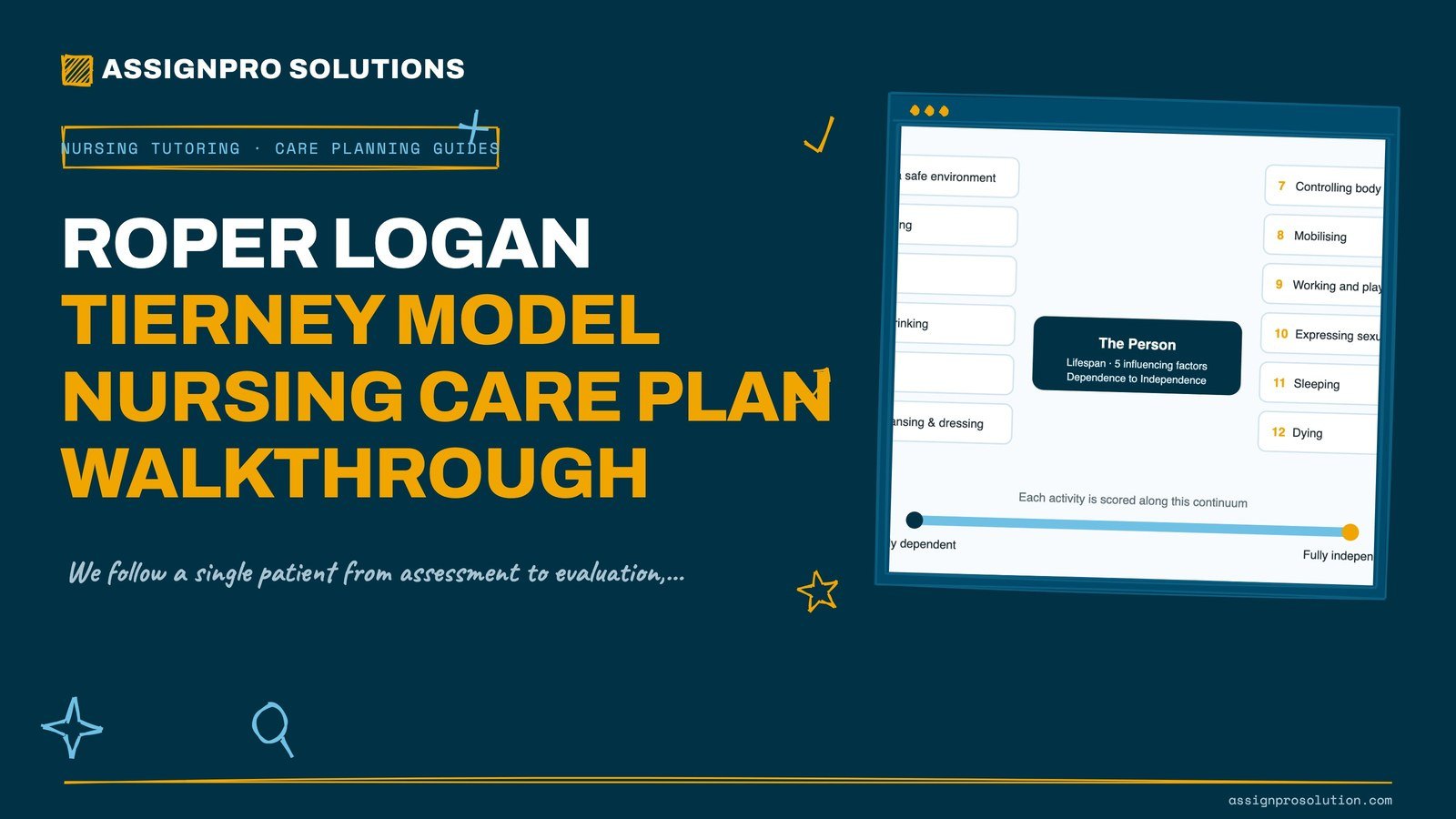
Roper, Logan and Tierney built their model around twelve activities of living (ALs). Each activity is assessed along a dependence to independence continuum, and each is shaped by five influencing factors: biological, psychological, sociocultural, environmental and politicoeconomic. The diagram below shows the twelve activities grouped around the person so you can see them as one integrated assessment rather than twelve separate tasks.
One patient, one continuous care plan
Meet our worked scenario. Mr David Okafor, 68, is admitted with an acute exacerbation of chronic obstructive pulmonary disease (COPD). He was recently bereaved, lives alone in a first-floor flat, and appears withdrawn with low mood on admission. We will hold this one person in view across the whole assess to evaluate cycle, because that continuity is exactly what a strong care plan demonstrates.
Stage 1: Assessment across the activities
Assessment means placing each of the twelve activities on the continuum for this patient today, and noting the influencing factors behind it. You do not write a paragraph on all twelve at equal length. You assess all twelve, then prioritise the activities that carry actual or potential problems.
| Activity of living | Assessment for Mr Okafor | Position on continuum |
|---|---|---|
| Breathing | Breathless at rest, SpO2 88% on air, using accessory muscles | Highly dependent |
| Communicating | Withdrawn, short answers, low mood since bereavement | Partially dependent |
| Mobilising | Breathlessness limits walking; fatigue after a few steps | Partially dependent |
| Eating and drinking | Reduced appetite, meals skipped at home | Partially dependent |
| Sleeping | Wakes breathless; ruminating at night | Partially dependent |
| Working and playing | Socially isolated, stopped attending his club | Dependent on support |
Notice that Communicating and Working and playing are where the psychological picture surfaces. Here the dependence to independence continuum runs alongside a mental health continuum: Mr Okafor is not acutely unwell psychiatrically, but his mood sits toward the distressed end and directly reduces his engagement with breathing exercises and mobilising. Naming that link, rather than treating physical and mental needs as separate lists, is a strong-mark move. The social model of health earns its place here too: his isolation, housing and bereavement are shaping his health as much as his lungs are, and the assessment should say so.
Stage 2: Planning and patient-centred goals
For each prioritised problem, set a SMART goal written in the patient's terms and grounded in the principles of care: dignity, autonomy, safety and individualised support. Goals move the patient along the continuum toward independence, however small the step.
Worked example: from problem to goal
Problem (Breathing): Mr Okafor is dependent for oxygenation, SpO2 88% on air, breathless at rest.
Goal: Mr Okafor will maintain SpO2 at or above 92% on prescribed oxygen within 24 hours, and will demonstrate one controlled breathing technique independently before discharge.
Why it scores: it is measurable, time-bound, tied to a named activity of living, and it moves him along the continuum rather than simply describing the problem.
Stage 3: Implementation
Implementation is the nursing action for each goal, with a rationale and the evidence behind it. Keep linking back to the activity and the influencing factor you identified.
- Breathing: administer prescribed oxygen and monitor SpO2; teach pursed-lip and controlled breathing; position upright to ease work of breathing.
- Communicating and mood: use unhurried, open questions; screen mood appropriately and refer to the multidisciplinary team; involve him in every decision to protect autonomy.
- Working and playing: discuss a supported discharge, community respiratory support and social prescribing to address the isolation the social model flagged.
Stage 4: Evaluation
Evaluation closes the loop: did the patient move along the continuum toward the goal, and what happens next? This is where weaker assignments simply stop. Strong ones re-assess against each goal, state whether it was met, partly met or unmet, and feed that judgement back into a revised plan. The cycle is iterative, not a single pass.
Stuck turning your scenario into a care plan?
Bring us your patient scenario and we will help you structure the assessment, goals and evaluation in your own words. 100% AI-free, plagiarism-free, human-written guidance from subject-specialist nursing tutors, with fast after-sales support on marker feedback.
How to write it up for your assignment
Once the thinking is done, the write-up follows a predictable shape. A tidy structure lets the marker follow your clinical reasoning without hunting for it, and our guide on how to structure a university assignment properly covers the general principles behind the shape below.
- Introduction: name the model, the patient scenario and the confidentiality point (a pseudonym per the NMC Code). Two or three sentences, no more.
- Brief rationale for the model: one short paragraph on why this framework suits this patient. Resist the urge to define all twelve activities here.
- Assessment: the twelve activities covered, prioritised problems drawn out, influencing factors named.
- Planning, implementation, evaluation: problem, goal, action with rationale, evaluation, for each priority, in that order.
- Critical reflection: a short paragraph on the model's strengths and limits for this case, referencing the social model of health and the principles of care.
If you want to compare how this care-planning structure sits next to reflective writing, our guide to writing a reflective assignment shows the other half of most nursing modules. For the mechanics of building a case around one patient, our guide on how to write a case study pairs neatly with this walkthrough.
Where students lose marks
The single biggest error: describing the model instead of applying it, the same trap our guide on being too descriptive and not critical enough covers in general. A care plan that defines each activity of living, quotes the theorists and never returns to the patient reads as a summary. The marks live in the application: this patient, this continuum position, this goal, this evaluation.
- All twelve activities at equal weight. Assess all twelve, but write in depth only on the activities with actual or potential problems. Depth beats coverage.
- Goals that are not measurable. "Improve breathing" cannot be evaluated. Tie every goal to a number, a technique or a timeframe.
- No evaluation. Stopping at implementation loses the final and often heaviest section. Always re-assess against the goal.
- Ignoring the influencing factors. The five factors and the lifespan dimension are what make the model holistic. Leaving them out flattens the whole assessment.
- Physical and psychological needs kept apart. Show where the dependence continuum meets the mental health continuum, as we did with mood and engagement.
- Weak referencing. UK nursing usually expects Harvard or Vancouver, and our rundown of common referencing mistakes students make covers the errors that cost marks most often. Keep it consistent and current.
Want feedback before you submit?
Send us your draft care plan and our nursing tutors will review it against these mark criteria and explain, in writing, exactly where to strengthen your application, structure and referencing. You keep authorship; we help you improve it.
For broader support across your programme, see our nursing assignment help and our wider academic tutoring services, where subject-specialist tutors guide you through care planning, reflection and referencing in your own voice.
Related reading
Frequently asked questions
What is the Roper Logan Tierney model of nursing in simple terms?
It is a UK nursing assessment framework that looks at a person across twelve activities of living, such as breathing, communicating and mobilising. Each activity is judged on a dependence to independence continuum and shaped by five influencing factors and the person's stage of life, so care is planned around the whole individual rather than a single diagnosis.
What are the twelve activities of living?
They are maintaining a safe environment, communicating, breathing, eating and drinking, eliminating, personal cleansing and dressing, controlling body temperature, mobilising, working and playing, expressing sexuality, sleeping, and dying. You assess all twelve, then write in depth on the activities where the patient has actual or potential problems.
How do I apply the model rather than just describe it?
Keep one patient in view from start to finish. For each prioritised activity, state the problem, set a measurable goal that moves the patient along the continuum, give the nursing action with a rationale, then evaluate whether the goal was met. Application means every point is about your specific patient, not the theory in general.
Where do students most often lose marks with this model?
The most common loss is describing the model instead of applying it, followed by writing all twelve activities at equal length, setting goals that cannot be measured, and omitting evaluation. Linking physical and psychological needs, and naming the influencing factors, are the additions that lift a grade.
Can AssignPro write my nursing care plan for me?
No. We are a tutoring and feedback service, so we explain the framework, review your draft and show you where to strengthen your reasoning, structure and referencing. You research, write and submit your own care plan. Our guidance is 100% AI-free, plagiarism-free and human-written, with fast support on any marker feedback.
Need help choosing?
Send the brief on WhatsApp or email. The team will help identify the right service and tutor.