
Kolb, Schon, Johns and Driscoll: Reflective Models Compared
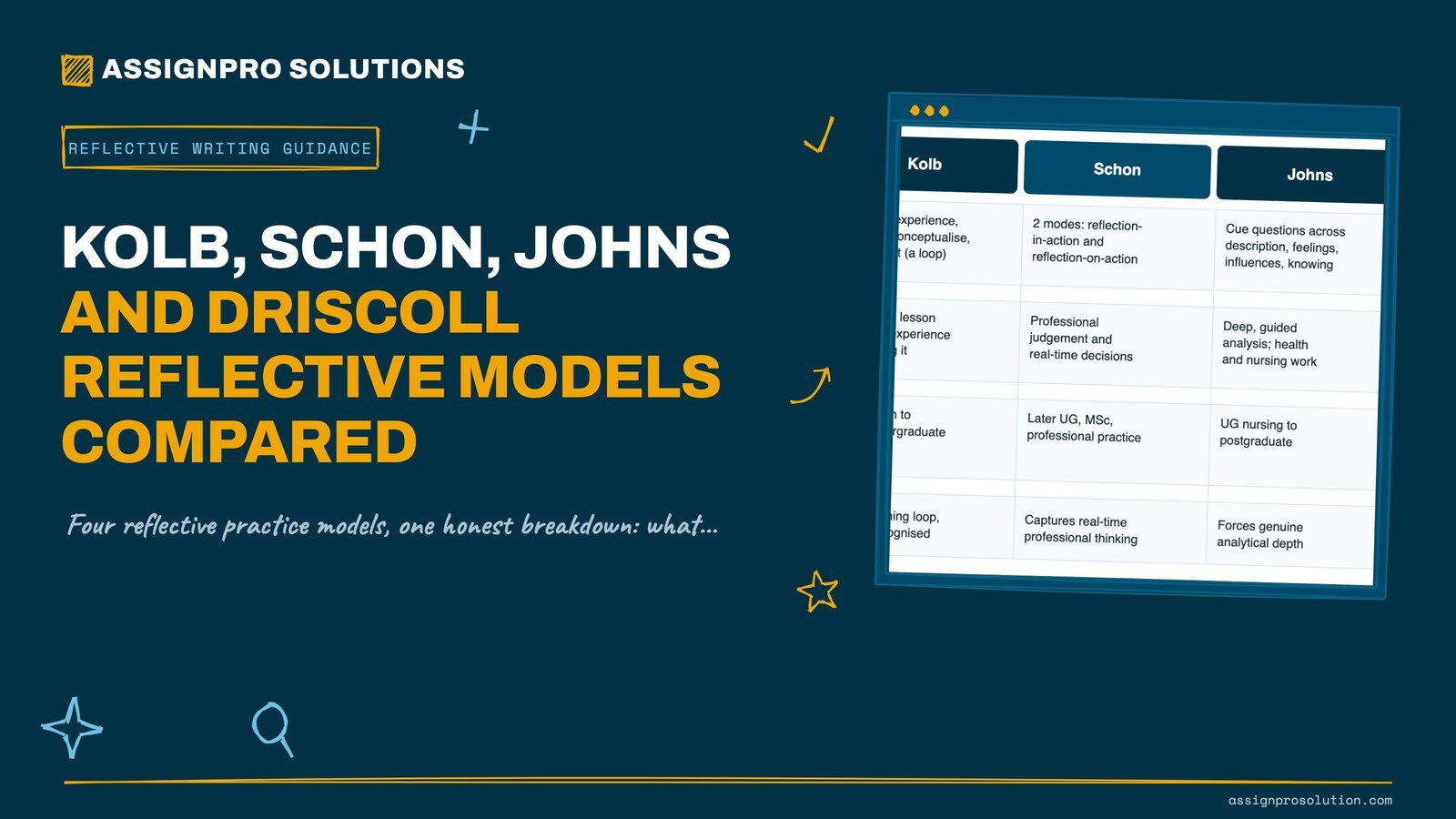
Reflective writing guidance
Four reflective practice models, one honest breakdown: what each is for, which one your marker expects, and how to choose.
If your module handbook asks for reflection, you have almost certainly met the Kolb reflective cycle first. It is the model most tutors reach for when they introduce reflective practice, and for good reason. But the Kolb reflective cycle is only one of four models you are likely to be pointed towards, and choosing the wrong one for your academic level is a fast route to a "too descriptive" comment in the margin.
This guide compares the four models markers used in UK briefs: the Kolb reflective cycle, the Schon reflective model, the Johns model of structured reflection, and the Driscoll 2007 model of reflection. We are a tutoring team, so our job is not to write your reflection for you. It is to help you understand each model, see the difference between them, and pick the one that earns marks at your stage. To make the difference visible, we finish by reflecting on the same short placement incident through all four models side by side.
A quick note before we start. The Kolb reflective cycle is sometimes written as Kolb's reflective cycle or the Kolb reflective model, and some handbooks label it experiential learning. They mean the same four-stage loop. Keep that in mind when your reading list and your assignment brief use slightly different names for it.
Short answer: use the Kolb reflective cycle or the Driscoll 2007 model of reflection for early, foundation-level reflection where you are learning the habit. Move to the Schon reflective model when you need to discuss professional judgement and thinking on your feet. Use the Johns model of structured reflection for deep, guided analysis at degree and postgraduate level, especially in nursing. All four turn experience into learning; they differ mainly in how much structure and depth they force you into.
What each of the four models is for
Reflective practice models exist to stop reflection collapsing into a diary entry. Each one gives you a scaffold of questions or stages that push you from "what happened" towards "what I now understand and will change". They are not interchangeable, though, and knowing the intent behind each is how you choose well.
The Kolb reflective cycle (experiential learning)
The Kolb reflective model frames learning as a four-stage loop: concrete experience, reflective observation, abstract conceptualisation, and active experimentation. You have an experience, you look back on it, you draw out a general principle, and you test that principle next time. Kolb's reflective cycle is strong when the point of the assignment is to show that a specific experience changed how you understand a topic. It is clean, it is well known, and markers recognise it instantly.
The Schon reflective model
The Schon reflective model splits reflection into two moments: reflection-in-action, the thinking you do while the event is unfolding, and reflection-on-action, the thinking you do afterwards. Schon was interested in how skilled professionals make good decisions in messy, real-time situations that no textbook fully covers. Reach for reflective practice models like Schon when the assignment asks about professional judgement, decision-making under pressure, or the gap between theory and real practice.
The Johns model of structured reflection
The Johns model reflection approach is the most guided of the four. It gives you a set of cue questions that move you through describing the experience, examining your own feelings and the factors that influenced you, and drawing on different "ways of knowing". It deliberately forces depth, which is why nursing and other health programmes lean on it. If your feedback keeps saying you are not analytical enough, the Johns model reflection cues are built to fix exactly that.
The Driscoll 2007 model of reflection
The Driscoll 2007 model of reflection is the simplest: three questions, What? So what? Now what? Driscoll adapted these into a clear cycle that beginners can hold in their head. It is ideal for a first reflective assignment, a reflective log entry, or any situation where you want a low-friction structure that still moves you towards an action point. Do not mistake simple for weak; a well-answered Driscoll reflection can be sharper than a padded Kolb one.
Comparison matrix: the four models at a glance
Comparison matrix: Kolb, Schon, Johns and Driscoll reflective models across stages, best use, academic level and key strength.
Which model does a marker expect at your level?
Markers rarely mark the model itself; they mark the depth of thinking it produces. That said, there is a clear progression across UK programmes, and matching the model to the expectation matters.
At foundation and first-year level, tutors want you to build the habit of reflection without drowning. The Driscoll 2007 model of reflection and the Kolb reflective cycle both suit this stage. If your brief simply says "reflect on your experience", the Kolb reflective model gives you a defensible, recognisable structure.
By later undergraduate years, and certainly at MSc level, markers expect you to engage with professional judgement and to name the theory behind your practice. This is where the Schon reflective model earns its place, because reflective practice models like Schon give you the language of reflection-in-action to discuss decisions you made in the moment. On health and nursing programmes, the Johns model reflection cues are often the expected default because they push you into the analytical depth that higher marks require.
How to choose between the reflective practice models
Use these three questions to narrow it down quickly.
1. What is the assignment really testing?
If it tests whether one experience taught you something, the Kolb reflective cycle fits. If it tests your professional decision-making, choose the Schon reflective model. If it tests analytical depth and self-examination, choose Johns. If it tests whether you can reflect at all, cleanly, Driscoll is enough.
2. How much word count do you have?
The Johns model reflection cues generate a lot of material and suit longer pieces. The Driscoll 2007 model of reflection is efficient and works well within tight word limits. Kolb's reflective cycle sits comfortably in between.
3. Does your handbook name a model?
Always check first. Many nursing modules specify Gibbs or Johns; many business modules specify Kolb. If a model is named, use it, even if you personally prefer another. Marks follow the brief, not your preference.
The same incident through all four models
Here is the incident we will reflect on with each model, so you can see the difference the structure makes. It is deliberately short.
The incident: During a busy placement handover, I began to record a patient observation against the wrong name on the chart. A senior colleague noticed before I finished and corrected me. No harm reached the patient, but I felt shaken.
The four models at the same scale: a loop (Kolb), two modes (Schon), layered cues (Johns) and a three-step line (Driscoll).
Kolb reflective cycle
Concrete experience: I mis-recorded an observation against the wrong patient. Reflective observation: looking back, I was rushing and had not confirmed the patient's identity against the chart. Abstract conceptualisation: safe documentation depends on a fixed identity-check step, not on memory or pace. Active experimentation: at my next handover I will state and confirm the patient's name and number before writing anything, every time.
Schon reflective model
Reflection-in-action: in the moment I sensed the handover was chaotic but did not slow down; my colleague's correction was the cue I had missed. Reflection-on-action: afterwards I recognised that experienced staff build a private checking routine that runs even under pressure. The learning is about developing that automatic check, not simply "being more careful".
Johns model reflection
Description: the near-miss during handover. Feelings: I felt embarrassed and briefly lost confidence. Influencing factors: time pressure, an unfamiliar ward layout, and my reluctance to slow a senior colleague down. Ways of knowing: ethically I owed the patient a correct record; personally I need to accept that pausing is professional, not slow. This depth is what the Johns model reflection cues are designed to surface.
Driscoll 2007 model of reflection
What? I nearly recorded an observation against the wrong patient and was corrected. So what? it showed that speed without an identity check is a real safety risk, and that I accept correction well. Now what? I will adopt a two-point identity check before any documentation. Notice how the Driscoll 2007 model of reflection reaches a clear action in three moves.
Read side by side, the difference is obvious. Kolb's reflective cycle drives towards a tested change. Schon foregrounds professional judgement. Johns produces the most depth. Driscoll is fastest to a usable action point. None is "best"; the right choice depends on what your marker is looking for and how much space you have.
Common mistakes across all four models
Whichever model you pick, the same errors cost marks. The biggest is staying descriptive: retelling the event and stopping there. Every model above has a stage that demands analysis or a decision, and that is the stage markers weight most. If your feedback keeps flagging this, our writing guides explain how to move from narration that reads as too descriptive and not critical enough into genuine reflection.
The second mistake is switching models halfway through. Choose one, name it early, and follow its stages in order. The third is ignoring the "now what". A reflection without an honest, specific action point feels unfinished to a marker, no matter how well you described the event.
Where to go next
If you are ready to structure a full piece, our guidance on how to write a reflective assignment walks through planning, model choice and drafting. Nursing students working with Johns or Gibbs will find our nursing assignment help useful, and our guides cover a worked Gibbs reflective cycle nursing example for a fifth model many health briefs prefer. For ongoing, subject-specialist support across any module, see our academic tutoring services.
Related reading
Frequently asked questions
Is the Kolb reflective cycle better than Gibbs?
Neither is better in general. The Kolb reflective cycle has four stages and centres on turning one experience into a tested principle, while Gibbs adds explicit stages for feelings and evaluation. Choose Kolb when your brief is about learning from experience and choose Gibbs when you want more structured emotional evaluation. Always follow any model your handbook names.
When should I use the Schon reflective model instead of Kolb?
Use the Schon reflective model when the assignment focuses on professional judgement or decisions made under pressure. Schon separates reflection-in-action, the thinking you do during an event, from reflection-on-action afterwards, which suits later undergraduate and MSc work. The Kolb reflective model suits earlier work where you are simply learning a lesson from an experience.
Why is the Johns model of reflection popular in nursing?
The Johns model reflection approach uses detailed cue questions that push you through feelings, influencing factors and different ways of knowing. That structure forces the analytical depth health programmes expect, which is why nursing modules often prefer it. It produces a lot of material, so it works best when you have the word count to develop each cue.
Is the Driscoll 2007 model of reflection too simple for a degree?
No. The Driscoll 2007 model of reflection uses three questions, What? So what? Now what?, but a well-answered Driscoll reflection can be sharper than a padded piece built on a longer model. It suits foundation and first-year work and any reflective log with a tight word limit, provided your "so what" shows real analysis.
Can you write my reflective assignment for me?
No, and we never would. We are a tutoring, coaching and feedback service. We explain the models, review your draft and show you how to add depth, but you complete and submit your own work. Our guidance is human-written, 100% AI-free and plagiarism-free, so what you learn and submit is genuinely yours.
Need help choosing?
Send the brief on WhatsApp or email. The team will help identify the right service and tutor.