

Of all the chapters in a dissertation, the methodology is the one UK students most consistently underestimate — and most frequently get wrong.
It is not the longest chapter. It is not the most research-intensive. But it is the chapter examiners scrutinise most carefully — because a flawed methodology does not only damage one section. It casts doubt over your entire study. Your findings become questionable. Your conclusions lose weight. And months of research begin to feel less credible than they should.
The reason most students struggle with dissertation methodology UK universities expect is not a lack of effort. It is a lack of clarity — about what the chapter needs to demonstrate, how each decision connects to the next, and why justification matters more than description alone.
Supervisor rejection at the methodology stage is more common than most programmes openly acknowledge. Students describe what they did without explaining why. They choose research designs that sound appropriate without aligning them to their research questions. And they discover the problem only when feedback arrives — often when time is already short.
This guide changes that. Whether you are writing a Masters, MBA, or undergraduate dissertation, this practical breakdown covers every component of the methodology chapter — with clear structure, real examples, and guidance built around what UK universities actually expect.
If you have not already read our guides on common dissertation mistakes and MBA dissertation help, those are worth reviewing alongside this one.
What Is a Dissertation Methodology Chapter?
The methodology chapter is the section of your dissertation where you explain how you conducted your research — and more importantly, why you made those specific choices. It is not a log of actions taken. It is a justified, academically grounded argument for why your research approach is the most appropriate one for the questions you are investigating.
Definition of Methodology in Dissertation
In simple terms, methodology refers to the overall framework that governs your research process. It covers your philosophical stance, your approach to reasoning, your research design, how you collected data, how you analysed it, and how you handled ethical responsibilities throughout. Every element must connect logically to the one before it.
Purpose of the Methodology Section
The purpose of this chapter is twofold — to demonstrate that your research was conducted rigorously, and to give your examiner enough detail to evaluate and, in principle, replicate your study. A methodology chapter that only describes what you did without justifying why leaves examiners with unanswered questions. Those unanswered questions become lost marks.
Why Methodology Is Important in UK Universities
UK universities place significant weight on the methodology chapter because it directly determines the credibility of your findings. A well-justified methodology signals academic maturity. A weak one — regardless of how strong your analysis is — raises doubts about the validity of everything built on top of it.
Methodology vs Methods — Common Confusion
These two terms are frequently used interchangeably, but they are not the same. Methodology is the broader framework — the reasoning behind your approach. Methods are the specific tools and techniques used within that framework, such as surveys, interviews, or statistical analysis. Confusing the two is a common mistake that weakens the academic rigour of the chapter
Why Mastering Methodology Matters for UK Students
Methodology is not just another chapter to complete and move past. For UK university examiners, it is one of the clearest indicators of whether a student genuinely understands their own research — or simply went through the motions of producing one.
Methodology Weightage in UK Marking Criteria
Across most UK universities, the methodology chapter carries between 20 and 25 percent of the total dissertation mark. That alone makes it one of the highest-weighted individual sections in the entire submission. More significantly, a weak methodology has a multiplier effect — it actively reduces confidence in your findings and analysis chapters too, even when those chapters are well written.
Supervisor Expectations in UK Universities
UK supervisors expect you to demonstrate independent academic thinking in your methodology — not a textbook recitation of research definitions. They want to see that you understood your options, evaluated them against your specific research questions, and made deliberate, justified choices. Vague or generic methodology chapters are among the most common reasons supervisors request revisions before approving a dissertation for submission.
How Weak Methodology Leads to Low Grades
The damage caused by a weak methodology chapter rarely stays contained within that chapter alone. If your research design is unjustified, your data collection method becomes questionable. If your sampling strategy is weak, your findings lack credibility. Examiners follow this chain — and they will flag every point where the logic breaks down.
Common Feedback Students Receive
The most frequently repeated supervisor feedback on methodology chapters across UK universities includes the following — no clear justification for the chosen research philosophy, insufficient explanation of why qualitative or quantitative design was selected, missing or inadequate ethics section, no acknowledgement of research limitations, and sample size decisions presented without academic reasoning. If any of these sound familiar, the sections ahead address each one directly.
For a broader picture of where dissertation students typically go wrong, our guide on common dissertation mistakes covers the full pattern in detail.
Standard Dissertation Methodology Structure (UK Format)
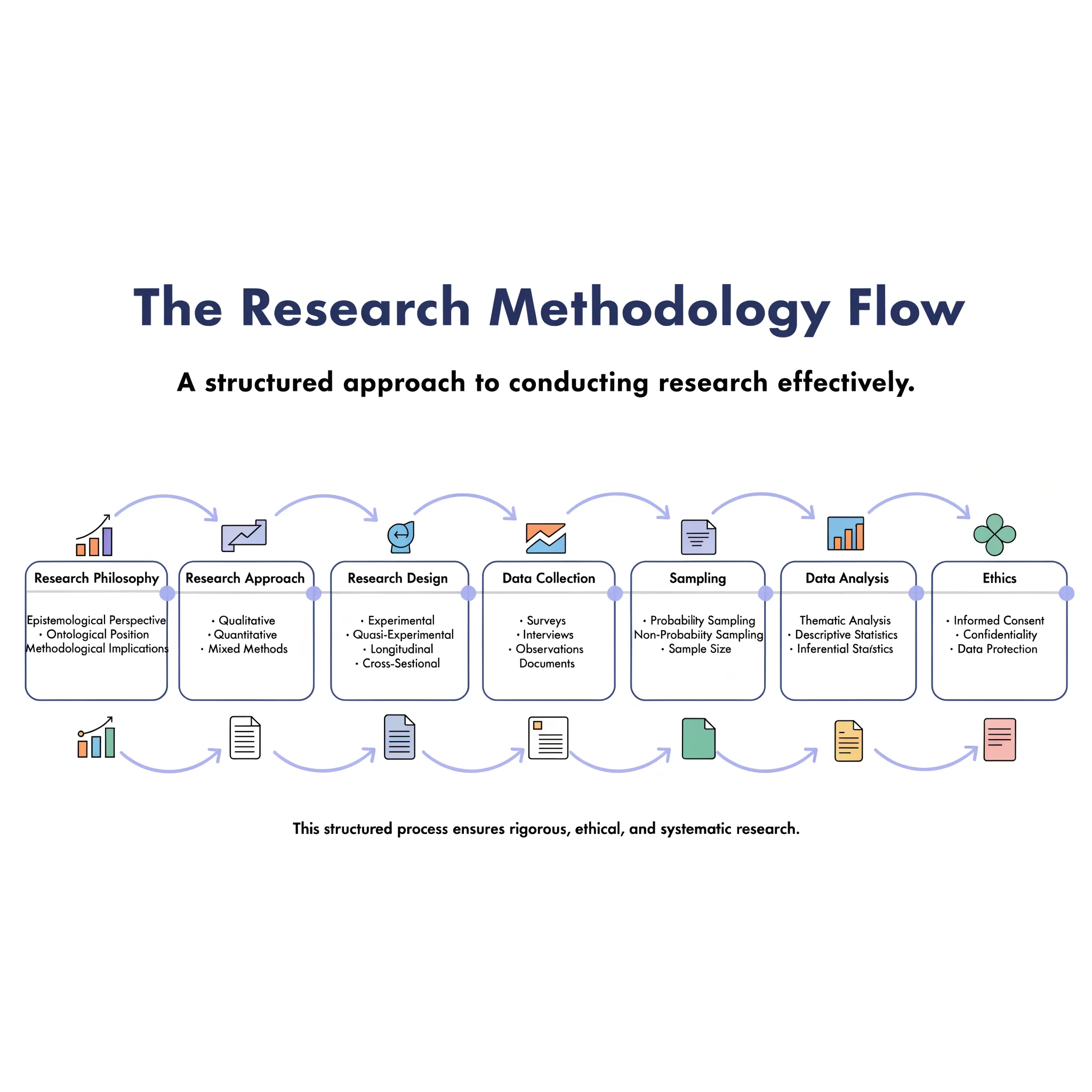
Before diving into individual components, it helps to see the full picture. A well-structured dissertation methodology chapter in UK format follows a consistent logical sequence — each section building on the one before it. Jumping straight into data collection methods without first establishing your research philosophy is one of the most common structural errors UK students make.
Here is the standard structure your methodology chapter should follow.
Research Philosophy
Your research philosophy establishes the foundational assumptions that underpin your entire study — specifically, how you believe knowledge is created and what counts as valid evidence. This is where your chapter begins because every decision that follows flows from this position.
Research Approach
Your research approach determines the direction of your reasoning — whether you are testing an existing theory against new data, or building a new theory from patterns you observe in your data. This must align directly with your research philosophy.
Research Design
Research design is the overall strategy you use to answer your research questions. It determines whether your study is qualitative, quantitative, or mixed methods — and each choice carries specific implications for how you collect and analyse data.
Data Collection Methods
This section explains the specific techniques you used to gather your data — surveys, interviews, secondary sources, case studies, or a combination. Each method must be justified in relation to your research design and questions.
Sampling Strategy
Here you explain who or what your data was collected from, how you selected that sample, and why that selection method is appropriate for your study. Sample size must also be justified — not simply stated.
Data Analysis Techniques
This section details how you processed and interpreted the data you collected. The analysis method must be consistent with your research design — thematic analysis for qualitative data, statistical methods for quantitative data.
Ethical Considerations
UK universities require explicit engagement with research ethics. This section addresses informed consent, confidentiality, data protection under GDPR, and any university ethics approval obtained before data collection began.
Research Limitations
Every study has limitations — constraints imposed by time, access, sample size, or methodology itself. Acknowledging these honestly demonstrates academic maturity and does not weaken your dissertation. Ignoring them does.
Choosing the Right Research Philosophy
Research philosophy is the section most UK students either rush through or copy from textbooks without genuinely engaging with it. That is a mistake — because your philosophy is the foundation everything else rests on. An examiner who sees a mismatch between your stated philosophy and your actual research design will flag it immediately.
Positivism Explained
Positivism holds that knowledge is objective, measurable, and best understood through empirical observation and statistical analysis. Positivist researchers believe reality exists independently of the observer — and that research should produce generalisable, replicable findings.
In dissertation terms, positivism typically leads to quantitative research designs. If your study involves surveys, numerical data, or statistical analysis, positivism is likely your philosophical home.
Best suited for: Business performance studies, consumer behaviour surveys, financial analysis dissertations.
Interpretivism Explained
Interpretivism takes the opposite view — that reality is subjective and socially constructed. It holds that human experiences, meanings, and perspectives cannot be reduced to numbers, and that understanding them requires qualitative, in-depth investigation.
Interpretivist researchers do not aim for generalisation. They aim for depth of understanding within a specific context.
Best suited for: HRM dissertations, leadership studies, organisational culture research, any study involving interviews or focus groups.
Pragmatism Explained
Pragmatism sits between the two. It argues that the research question itself should determine the methodology — not a fixed philosophical commitment. Pragmatist researchers are willing to use both qualitative and quantitative methods if doing so produces the most useful, complete answer to their research question.
Best suited for: Mixed methods dissertations where neither pure numbers nor pure narrative fully captures the research problem.
Which Philosophy Should You Choose?
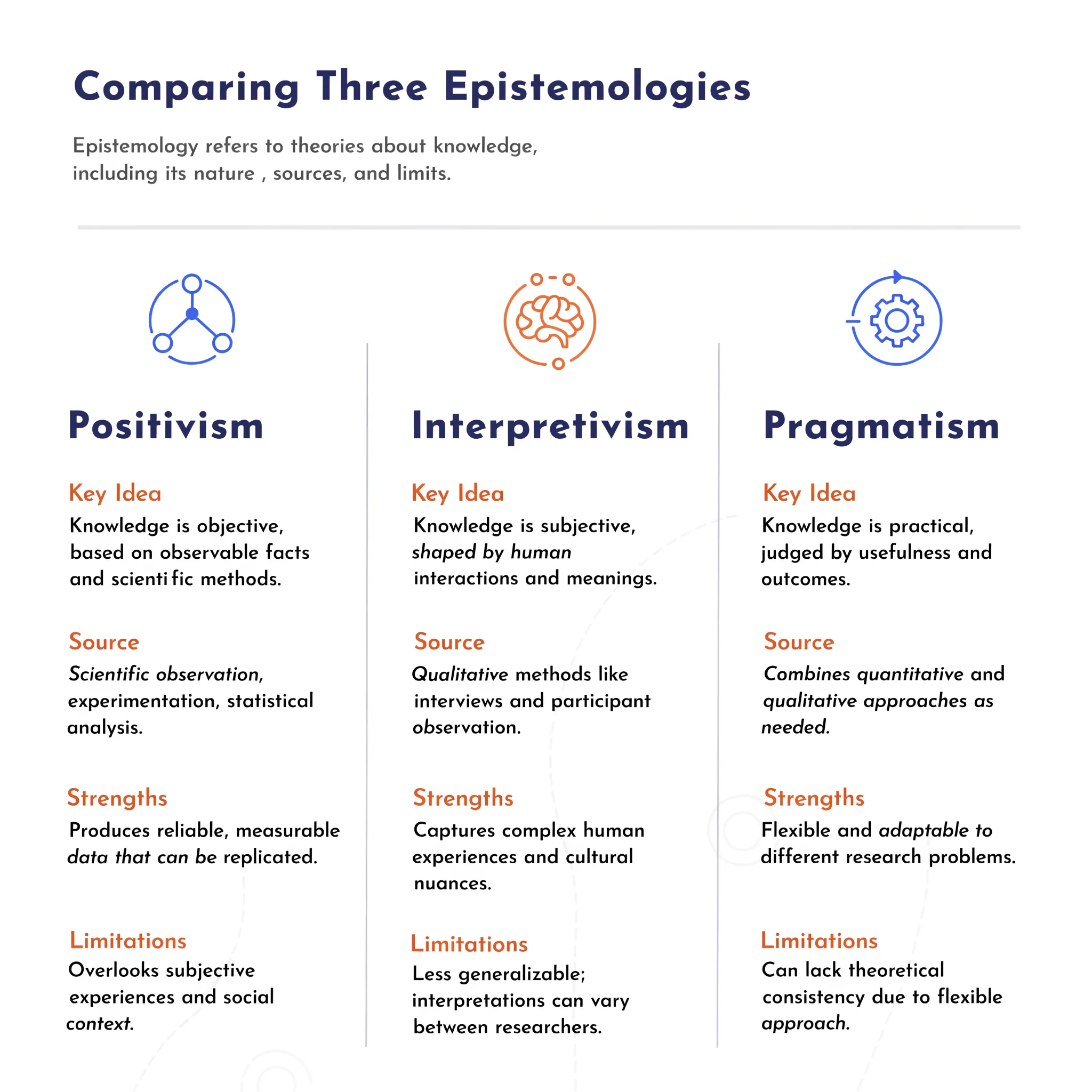
The honest answer — whichever one genuinely fits your research questions. The mistake most students make is choosing a philosophy first and then reverse-engineering their study to fit it. Work the other way around. Look at your research questions and ask — am I trying to measure something objectively, or understand something subjectively? That answer will point you to the right philosophy.
Example for Business Dissertation
An MBA student investigating the impact of remote work policies on employee productivity across UK firms would likely adopt a positivist stance — using quantitative survey data to measure productivity metrics across a defined sample.
Example for Nursing Dissertation
A nursing student exploring how frontline NHS staff emotionally process workplace trauma would adopt an interpretivist stance — using qualitative interviews to capture lived experience rather than statistical patterns.
Selecting Your Research Approach
If research philosophy answers the question of how you see the world, research approach answers the question of how you move through it. Your approach determines the logical direction of your study — whether you begin with theory and test it, or begin with data and build from it.
Deductive Approach
A deductive approach starts with an existing theory or hypothesis and works downward — testing it against newly collected data to see whether the evidence supports or challenges it.
This is the more structured of the two approaches. You know what you are looking for before data collection begins. The outcome either confirms, partially supports, or refutes your starting hypothesis.
Example: A student hypothesises that increased digital marketing spend leads to higher customer acquisition rates in UK SMEs. They collect sales and marketing data from 50 companies and run statistical analysis to test that hypothesis. That is deductive reasoning in action.
Best suited for: Quantitative studies, positivist philosophy, business performance research.
Inductive Approach
An inductive approach works in the opposite direction — beginning with raw data or observations and working upward to identify patterns, themes, and eventually broader conclusions or theories.
There is no fixed hypothesis at the start. The research remains open to wherever the data leads. This requires comfort with ambiguity and a willingness to let findings shape your conclusions rather than confirming predetermined ones.
Example: A student conducts in-depth interviews with ten UK MBA graduates about their dissertation experience and analyses the transcripts to identify recurring themes around supervisor relationships and academic confidence. No hypothesis existed at the outset — the theory emerges from the data.
Best suited for: Qualitative studies, interpretivist philosophy, exploratory research.
Abductive Approach
Abductive reasoning is less commonly discussed in undergraduate and Masters dissertations but is increasingly recognised in UK academic circles — particularly for mixed methods studies. It involves moving back and forth between data and theory, refining your understanding as new evidence emerges.
Rather than strictly testing a theory or purely building one, abductive reasoning seeks the most plausible explanation for what the data reveals — making it particularly useful when your research uncovers something unexpected midway through the study.
Best suited for: Pragmatist philosophy, mixed methods design, complex organisational or social research.
When to Use Each in UK Dissertation
The cleanest way to decide is to return to your research questions. If your questions contain words like how much, to what extent, or does X affect Y — deductive. If they contain words like why, how do people experience, or what factors influence — inductive. If your study genuinely requires both dimensions to answer the question fully — consider abductive or a mixed methods design with a pragmatist stance.
Example Scenario
A Masters student researching employee retention in UK retail has two research questions — one asking how retention rates vary across store formats (quantitative, deductive) and one asking why frontline staff choose to leave (qualitative, inductive). This student would adopt an abductive approach within a mixed methods design, and their methodology chapter needs to clearly justify that combination.
Research Design Options
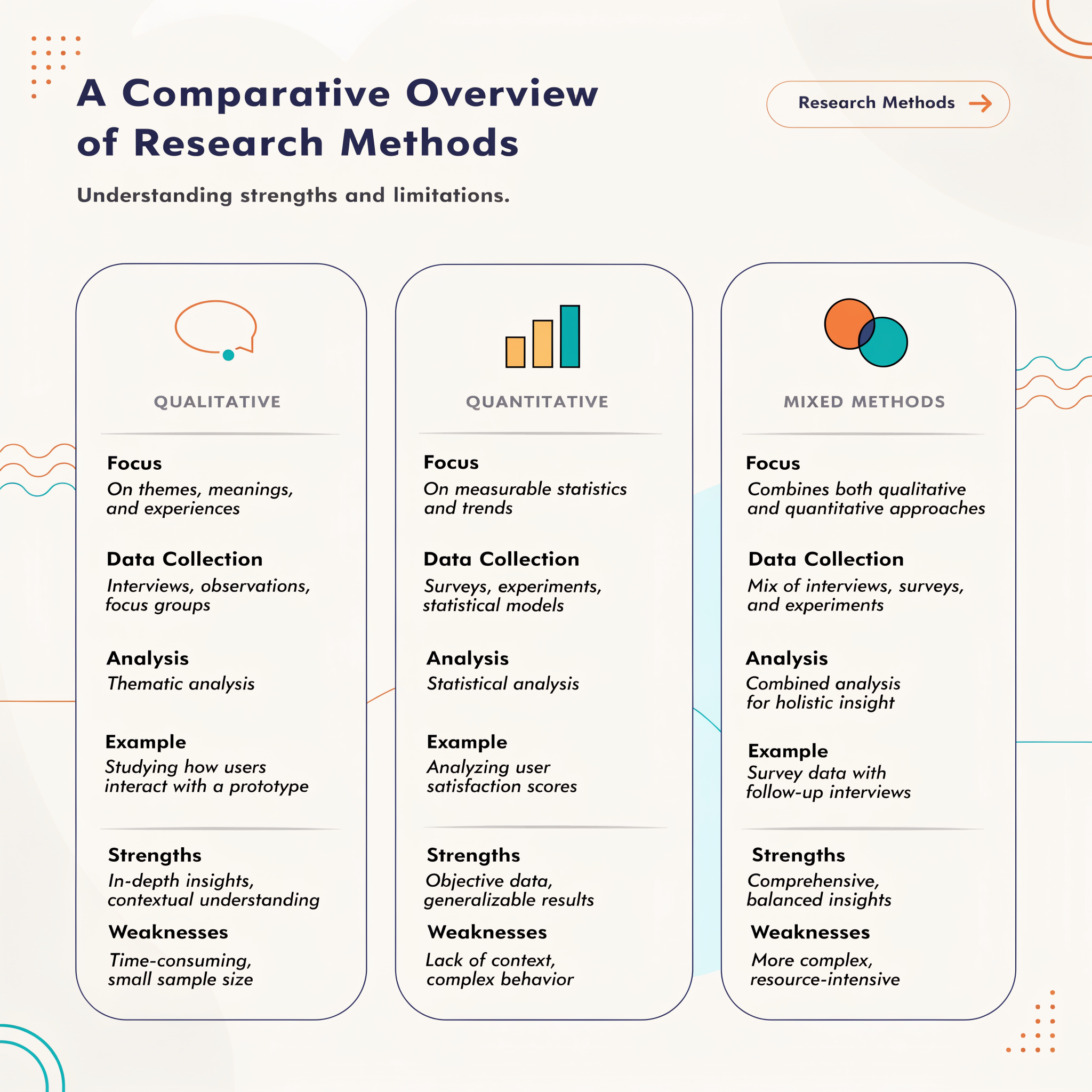
Research design is the strategic blueprint of your study. If philosophy is your worldview and approach is your direction, design is the actual structure you build your research within. Getting this decision right — and justifying it clearly — is one of the most important things your methodology chapter needs to achieve.
Qualitative Research Design
Qualitative research focuses on understanding experiences, meanings, perceptions, and social phenomena in depth. It produces non-numerical data — words, narratives, themes — and prioritises richness of insight over breadth of coverage.
Qualitative designs are exploratory by nature. They are best used when your research questions cannot be answered through numbers alone, when the human dimension of a topic matters, or when you are investigating something that has not been extensively studied before.
Common data collection methods: Semi-structured interviews, focus groups, observation, document analysis.
Common analysis methods: Thematic analysis, content analysis, discourse analysis.
Best suited for: HRM dissertations, leadership research, healthcare studies, organisational culture investigations.
Quantitative Research Design
Quantitative research focuses on measuring variables, identifying patterns, and testing hypotheses through numerical data and statistical analysis. It prioritises objectivity, replicability, and the ability to generalise findings across a broader population.
Quantitative designs are structured from the outset. Your variables are defined before data collection begins, your instruments are standardised, and your analysis follows established statistical procedures.
Common data collection methods: Online surveys, structured questionnaires, secondary datasets, financial reports.
Common analysis methods: Descriptive statistics, regression analysis, correlation analysis, SPSS-based testing.
Best suited for: Finance dissertations, marketing research, economics studies, any research requiring measurable outcomes across a defined sample.
Mixed Methods Design
Mixed methods research combines qualitative and quantitative approaches within a single study. It is not simply a matter of doing both — it requires a clear rationale for why the integration of both approaches produces a more complete answer to your research questions than either could alone.
The two most common mixed methods structures are sequential — where one phase informs the next — and concurrent, where both approaches run simultaneously and findings are triangulated at the analysis stage.
Mixed methods dissertations are more complex to design and execute, but when justified correctly they demonstrate a sophisticated level of methodological thinking that UK examiners respond well to.
Best suited for: Studies where quantitative data identifies patterns but qualitative data is needed to explain them — or vice versa.
How to Choose the Best Research Design
The decision should always flow from your research questions — not from personal preference, ease of execution, or what your peers are doing. Ask yourself what kind of evidence your research questions actually require. If the answer is measurement and comparison, go quantitative. If the answer is understanding and interpretation, go qualitative. If the answer is genuinely both, go mixed methods — but make sure your methodology chapter earns that choice with a clear justification.
One common mistake UK students make is choosing mixed methods simply to appear thorough, without a genuine methodological reason for the combination. Examiners see this regularly, and it weakens rather than strengthens the chapter.
MBA Dissertation Example
An MBA student examining the relationship between leadership style and financial performance across UK retail chains would adopt a quantitative design — collecting performance data and leadership style survey scores across a defined sample and running correlation analysis to identify patterns.
Masters Dissertation Example
A Masters student in HRM exploring how line managers in UK healthcare organisations experience the implementation of new performance review systems would adopt a qualitative design — conducting semi-structured interviews and applying thematic analysis to understand lived experience rather than measure outcomes.
Data Collection Methods for UK Dissertations
Choosing the right data collection method is where your research design becomes practical. This section of your methodology chapter needs to do more than name the method you used — it needs to explain why that method is the most appropriate way to gather evidence for your specific research questions.
Primary Data Collection
Primary data is original data collected directly by you for the purposes of your study. It does not exist before your research begins — you create it through direct engagement with participants or sources.
Surveys
Surveys are the most widely used primary data collection method in UK dissertations, particularly for quantitative studies. They allow you to gather standardised responses from a defined sample quickly and efficiently — making them well suited for studies that require measurable, comparable data across a relatively large group.
Online survey tools such as Google Forms, SurveyMonkey, and Microsoft Forms are commonly used by UK students. The key is ensuring your survey instrument is designed carefully — with clear, unambiguous questions that directly address your research objectives.
Strength: Efficient, scalable, produces quantifiable data. Limitation: Limited depth — surveys capture what people report, not necessarily what they experience or mean.
Interviews
Semi-structured interviews are the most common qualitative data collection method in UK dissertations. They allow for in-depth exploration of participant perspectives, experiences, and reasoning — producing rich, detailed data that surveys simply cannot capture.
Semi-structured interviews follow a prepared set of questions but allow the conversation to develop naturally, giving participants space to elaborate and giving you flexibility to probe deeper where relevant.
Strength: Depth of insight, flexibility, captures nuance and context. Limitation: Time-intensive, smaller sample sizes, findings are not generalisable in the statistical sense.
Focus Groups
Focus groups involve structured discussion with a small group of participants — typically five to eight people — and are used when the interaction between participants itself generates valuable data. They are less common in individual student dissertations due to logistical complexity, but are well suited to studies exploring shared experiences, group attitudes, or collective decision-making.
Strength: Captures group dynamics and collective perspectives. Limitation: Dominant voices can skew discussion, harder to organise and manage than individual interviews.
Secondary Data Collection
Secondary data refers to data that already exists — collected by other researchers, institutions, or organisations for purposes that may differ from your own. Using secondary data does not make your dissertation less rigorous. When used appropriately and critically, it is a legitimate and academically respected approach.
Journals
Peer-reviewed academic journals accessed through databases such as JSTOR, Emerald Insight, and Google Scholar are the most credible secondary sources available to UK dissertation students. They provide theoretically grounded, methodologically reviewed evidence that strengthens the academic foundation of your study.
Reports
Industry reports, government publications, and institutional data — such as ONS statistics, CIPD workforce surveys, or Bank of England economic data — are valuable secondary sources for business, finance, and social science dissertations. They provide real-world context and empirical evidence that supports or challenges your research findings.
Online Databases
Databases such as Statista, Bloomberg, and Euromonitor provide structured datasets that are particularly useful for quantitative dissertations requiring large-scale numerical data. Always verify the source, publication date, and methodology behind any dataset before using it in your study.
Choosing the Right Data Collection Method
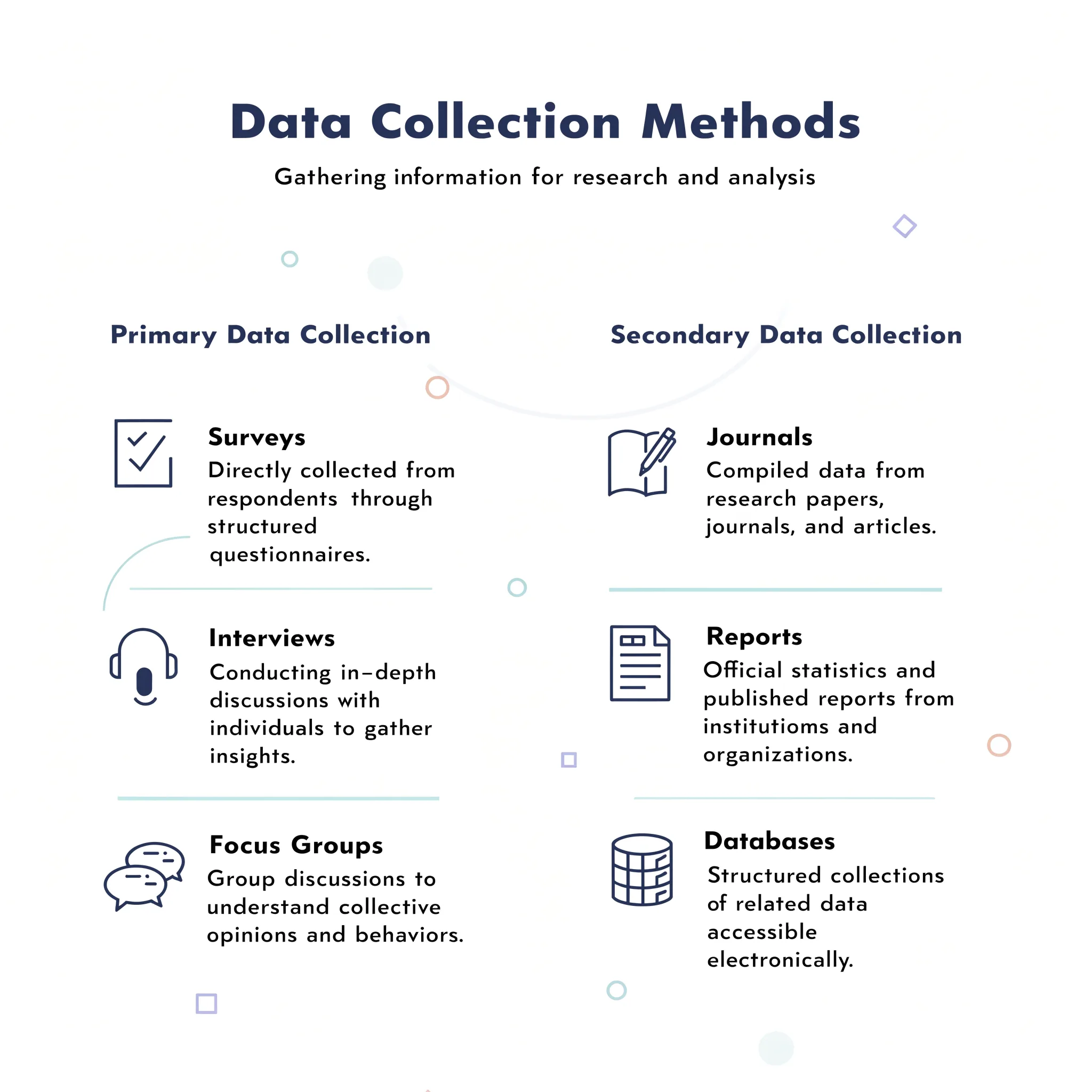
The method you choose must be driven by three things — your research questions, your research design, and your practical access to data sources. A qualitative design with an interpretivist philosophy demands interview or focus group data. A quantitative design with a positivist philosophy demands survey or secondary dataset data. Mixed methods requires both, with a clear rationale for how they complement each other.
One question worth asking before finalising your method — if I collect data this way, will I actually be able to answer my research questions with what I get back? If the answer is uncertain, reconsider the method before you commit.
Sampling Techniques Explained
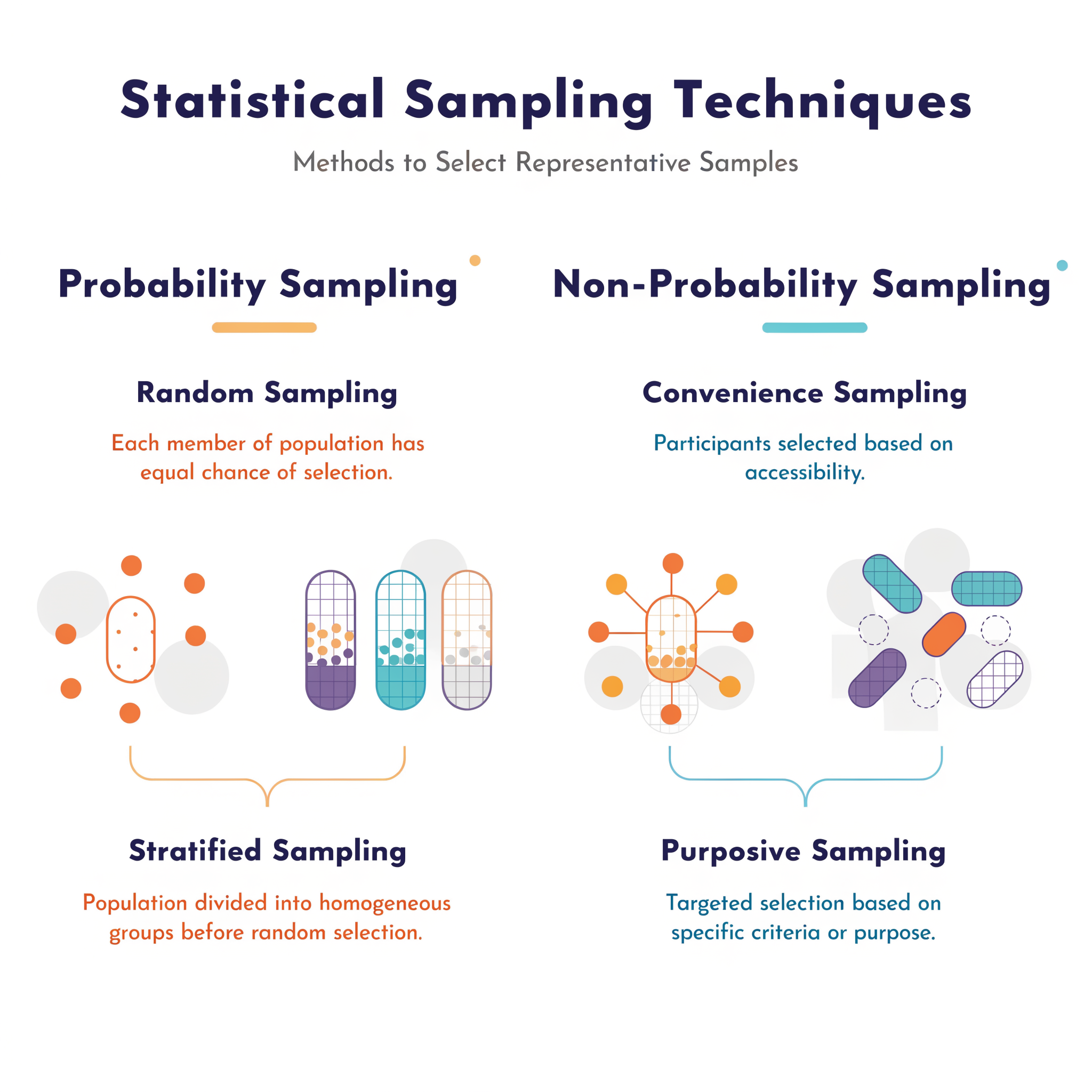
Once you have decided how you will collect your data, the next question is who or what you will collect it from. Sampling is the process of selecting the specific people, organisations, or data points that will form the basis of your study — and UK examiners expect you to justify every decision you make here with academic reasoning, not convenience.
Probability Sampling
Probability sampling means every member of your target population has a known, equal chance of being selected. It is associated with quantitative research designs and is used when your study aims to produce findings that can be generalised across a broader population.
Simple Random Sampling
Every individual in the target population is assigned a number and participants are selected entirely at random — through a random number generator or equivalent method. It is the purest form of probability sampling and eliminates selection bias when executed correctly.
Best suited for: Large, clearly defined populations where a full list of members is accessible.
Stratified Sampling
The population is divided into distinct subgroups — or strata — based on a relevant characteristic such as age, gender, industry sector, or job role. Participants are then randomly selected from within each stratum in proportion to their representation in the overall population.
Best suited for: Studies where specific subgroups within the population are relevant to the research questions and need to be proportionally represented in the sample.
Non-Probability Sampling
Non-probability sampling means participants are selected through non-random methods — judgment, availability, or purposeful criteria rather than statistical chance. It is most commonly associated with qualitative research designs where depth of insight matters more than statistical representativeness.
Convenience Sampling
Participants are selected based on their accessibility and willingness to take part. It is the quickest and most practical sampling method — but also the weakest in terms of academic rigour, because it introduces selection bias and limits the credibility of your findings beyond the immediate sample.
If you use convenience sampling, your methodology chapter must acknowledge this limitation honestly rather than presenting it as a neutral choice.
Best suited for: Exploratory studies, pilot research, situations where access to the target population is genuinely restricted.
Purposive Sampling
Participants are selected deliberately based on specific characteristics that make them relevant to your research questions. Unlike convenience sampling, purposive sampling is a strategic choice — you are not selecting whoever is available, you are selecting whoever is most likely to provide meaningful, relevant data.
Best suited for: Qualitative studies where participant expertise, experience, or role is directly relevant to the research — such as interviewing senior HR managers about organisational policy, or selecting case study organisations based on defined industry criteria.
Sample Size Justification for UK Universities
Sample size is one of the most frequently underdeveloped areas in student methodology chapters — and one of the most consistently flagged by UK examiners. Stating that you interviewed ten participants or surveyed one hundred respondents without explaining why those numbers are appropriate is not sufficient.
For quantitative studies, sample size should be justified with reference to statistical power — the larger the sample, the more reliably your findings reflect the broader population. A minimum of 100 responses is generally considered necessary for meaningful statistical analysis in a Masters or MBA dissertation, though the appropriate number depends on your population size and the complexity of your analysis.
For qualitative studies, sample size is governed by the principle of theoretical saturation — the point at which additional participants stop producing new themes or insights. In practice, most UK qualitative dissertations at Masters level use between eight and fifteen participants, with the justification centred on the depth of data generated rather than the quantity of respondents.
Whatever your sample size, your methodology chapter must explain how you arrived at that number and why it is appropriate for the aims of your study. An unjustified sample size is a weakness examiners will note — and it is entirely avoidable.
Data Analysis Methods
Collecting data is only half the work. What you do with it — how you process, interpret, and draw meaning from it — is where your research either holds together or falls apart. Your data analysis section must demonstrate that you chose an appropriate analytical method, applied it systematically, and understood why it was the right fit for your research design and data type.
Qualitative Data Analysis
Qualitative analysis deals with non-numerical data — words, narratives, and themes drawn from interviews, focus groups, or documents. The goal is not to count or measure but to interpret and understand meaning within context.
Thematic Analysis
Thematic analysis is the most widely used qualitative analysis method in UK dissertations — and for good reason. It is flexible, accessible, and well suited to a wide range of research questions involving human experience, perception, or behaviour.
The process involves systematically reading through your data, identifying recurring patterns or ideas, coding those patterns, and organising them into broader themes that directly address your research questions. Braun and Clarke’s six-phase framework is the most commonly referenced approach in UK academic work and is widely accepted across disciplines.
Best suited for: Interview-based studies, focus group data, any qualitative research exploring attitudes, experiences, or organisational phenomena.
Content Analysis
Content analysis involves systematically categorising and quantifying the presence of specific words, themes, or concepts within a body of text — whether that is interview transcripts, policy documents, social media posts, or published reports. It bridges qualitative and quantitative approaches, making it particularly useful in mixed methods dissertations.
Best suited for: Document analysis, media studies, policy research, studies involving large volumes of textual data.
Quantitative Data Analysis
Quantitative analysis deals with numerical data and uses statistical methods to identify patterns, test relationships, and draw conclusions that can be generalised — within defined limits — beyond the immediate sample.
Descriptive Statistics
Descriptive statistics summarise your dataset in terms of central tendency and spread — mean, median, mode, standard deviation, frequency distributions. They do not test hypotheses or establish causal relationships, but they provide the essential foundation for any further statistical analysis and give your reader a clear picture of what your data looks like before deeper interpretation begins.
Best suited for: Any quantitative study as a first analytical step before inferential testing.
Regression Analysis
Regression analysis examines the relationship between one or more independent variables and a dependent variable — allowing you to identify whether changes in one factor are statistically associated with changes in another. It is one of the most powerful and commonly used statistical tools in business, finance, economics, and social science dissertations at Masters and MBA level.
Best suited for: Studies testing causal or predictive relationships between measurable variables — such as the impact of marketing spend on sales performance, or the relationship between employee satisfaction scores and staff turnover rates.
Using SPSS in UK Dissertations
SPSS — Statistical Package for the Social Sciences — is the most widely used statistical software among UK dissertation students at undergraduate, Masters, and MBA level. Most UK universities provide student access to SPSS through their institutional software licences, and many dissertation supervisors expect quantitative students to demonstrate familiarity with it.
SPSS allows you to run descriptive statistics, correlation analysis, regression models, t-tests, and ANOVA with relative efficiency — and it produces output tables that can be directly referenced and discussed within your findings chapter. If you are conducting a quantitative dissertation and have not yet explored SPSS, prioritise it early in your data analysis phase rather than attempting to learn it under submission pressure.
Choosing the Right Analysis Method
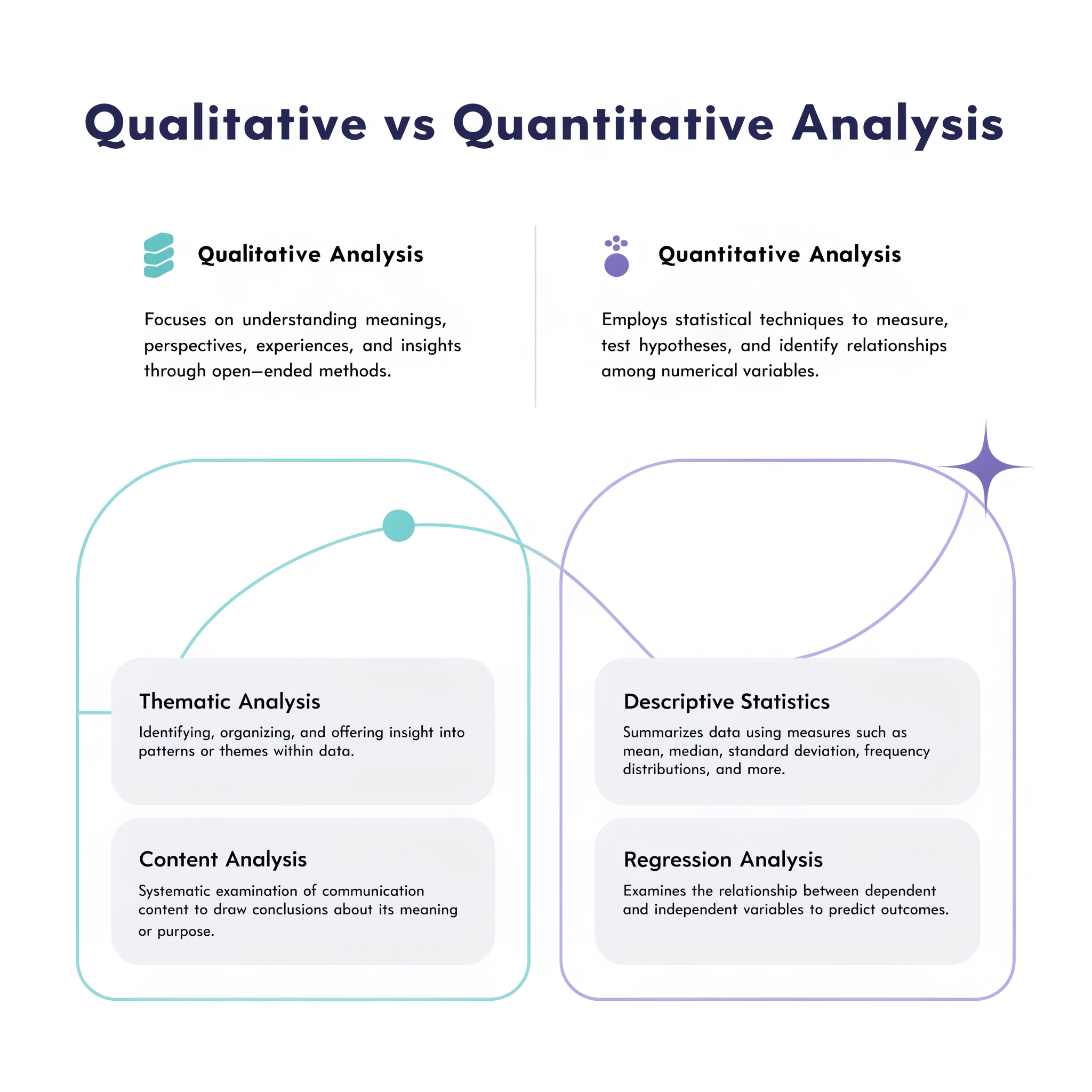
The decision is simpler than it first appears — your analysis method must match your data type, and your data type must match your research design. Qualitative data requires qualitative analysis. Quantitative data requires statistical analysis. Mixed methods data requires both, applied to their respective datasets and integrated at the interpretation stage.
The most common mismatch UK examiners flag is students who collect qualitative interview data and then attempt to quantify it superficially — counting how many participants said a particular thing rather than analysing what they meant by it. This approach neither satisfies qualitative rigour nor produces statistically meaningful results. Choose your method deliberately and apply it consistently throughout.
If your dissertation involves methodology that feels genuinely complex or you are unsure whether your analytical approach is appropriately justified, our MBA dissertation help service includes dedicated methodology support for exactly these situations.
Got it — from this section onwards, secondary keywords aur focus keyword dissertation methodology UK aur variants naturally zyada weave karenge. Last section pe aur heavy. Chalo.
Ethical Considerations in UK Dissertations
Ethical considerations are not a formality to be addressed in two paragraphs at the end of your dissertation methodology chapter. For UK universities, ethics is a substantive component of your research design — one that carries real weight in how examiners assess the rigour and integrity of your entire study.
If your dissertation methodology UK examiners review involves any form of primary data collection — interviews, surveys, focus groups, or observation — you are required to demonstrate that your research was conducted responsibly and in full accordance with both your university’s ethical guidelines and, where applicable, UK data protection law.
Informed Consent
Every participant in your research must have given informed consent before data collection begins. Informed consent means the participant understands what the research involves, how their data will be used, who will have access to it, and that their participation is entirely voluntary. It also means they have the right to withdraw at any point without consequence.
In practice, this is typically handled through a consent form — signed before interviews or surveys are administered. Your dissertation methodology chapter should confirm that consent was obtained, describe the format it took, and briefly explain what information participants were given beforehand.
Failing to address informed consent in your research methodology dissertation UK submission is one of the most consistently flagged ethical omissions — and it is entirely avoidable.
Confidentiality
Confidentiality means protecting the identities and personal information of your research participants. In qualitative studies involving interviews, this typically means anonymising participant names, job titles, and organisational affiliations within your findings chapter — replacing them with generic identifiers such as Participant A or Interviewee 3.
Your masters dissertation methodology UK chapter should explicitly state how confidentiality was maintained throughout the research process — from data collection through to the final written submission. This reassures both your examiner and your participants that sensitive information was handled responsibly.
Data Protection (GDPR)
UK dissertation students collecting personal data from participants are operating within the framework of the General Data Protection Regulation. Your dissertation methodology chapter UK examiners review must demonstrate awareness of GDPR obligations — specifically around data minimisation, storage security, and retention periods.
In practical terms this means storing participant data securely — password-protected files, encrypted storage — and confirming in your methodology that data will be deleted or anonymised once the dissertation has been examined and the retention period has passed. Many UK universities specify exactly how long student research data must be retained before disposal.
Ethics Approval from University
Most UK universities require students conducting primary research to obtain formal ethics approval before data collection begins — not after. The process typically involves submitting an ethics application form that outlines your research design, participant recruitment approach, consent procedures, and data handling plan.
Your MBA dissertation methodology UK chapter should reference this approval explicitly — including when it was granted and by which institutional body. If your study was exempt from formal ethics review — for example, because it relied entirely on secondary data — your methodology chapter should state this clearly and explain why exemption applied.
Ethics approval is not bureaucratic box-ticking. It is evidence that your research was planned responsibly, that participant welfare was considered from the outset, and that your study meets the standards UK universities hold their research to. Treat it accordingly.
Common Methodology Mistakes UK Students Make

Understanding dissertation methodology UK universities expect is one thing — but knowing exactly where students go wrong is what actually protects your grade. The mistakes below are not rare edge cases. They are the same errors UK examiners flag repeatedly, across every subject area and every level of study.
No Justification for Research Design
This is the single most damaging mistake in any dissertation methodology chapter UK examiners review. Students select a qualitative or quantitative research design and simply state it — without explaining why that design is the most appropriate choice for their specific research questions.
Describing your research design is not the same as justifying it. Your methodology chapter must demonstrate that you considered your options, understood the implications of each, and made a deliberate, reasoned decision. A research methodology dissertation UK submission that cannot justify its own design raises immediate doubts about everything built on top of it.
Wrong Sampling Method
Choosing a sampling method that does not align with your research design is a structural weakness that examiners catch quickly. Using convenience sampling in a quantitative study without acknowledging its statistical limitations, or applying probability sampling logic to a qualitative study where theoretical saturation is the relevant benchmark — both signal a fundamental misunderstanding of how sampling decisions connect to broader methodological choices in dissertation methodology UK work.
Missing Ethics Section
An ethics section that consists of a single sentence — or worse, no ethics section at all — is one of the most consistently penalised omissions in masters dissertation methodology UK submissions. As covered in the previous section, UK universities treat ethical considerations as a substantive component of research design. A missing or superficial ethics section does not just lose marks in the methodology chapter — it signals to examiners that the research process itself may not have been conducted responsibly.
Weak Data Analysis Explanation
Many students describe their analysis method in vague, generic terms — stating that thematic analysis or regression analysis was used without explaining how it was applied, why it was chosen over alternative methods, or how it directly addresses their research questions. In MBA dissertation methodology UK submissions particularly, where analytical rigour carries significant weight, a weak data analysis explanation is one of the fastest ways to lose marks that your actual findings may well have deserved.
Misalignment with Research Objectives
Perhaps the most fundamental mistake of all — a methodology chapter that does not connect back to the research questions and objectives stated in the introduction. Every methodological decision in your dissertation methodology chapter UK examiners assess should be traceable to a specific research objective. Philosophy, approach, design, data collection, sampling, and analysis must form a coherent, internally consistent chain. When any link in that chain breaks, the entire methodology loses credibility.
If you recognise any of these patterns in your own methodology — or if you are approaching your dissertation methodology UK submission for the first time and want to get the structure right before your supervisor sees it — our team provides targeted support at exactly this stage. Visit our MBA dissertation help page to find out how we can help.
Struggling to justify your methodology choices?
Many UK students lose marks because their research design, sampling, or data analysis is not clearly aligned with their research questions. Getting expert guidance at this stage can help you avoid multiple revisions.
- Custom methodology based on your topic
- UK university formatting standards
- Plagiarism-free academic writing
- Revision support included
Get expert help with your dissertation methodology
Advanced Tips to Master Your Methodology
Avoiding common mistakes gets you to a passing dissertation methodology UK submission. These tips get you to a strong one — the kind that earns supervisor approval faster, holds up under examiner scrutiny, and demonstrates the level of independent academic thinking UK universities genuinely reward.
Align with Research Questions
Every single methodological decision in your dissertation methodology chapter UK examiners review — philosophy, approach, design, data collection, sampling, analysis — must trace back directly to your research questions. This is not a stylistic preference. It is the structural logic that holds your entire methodology together.
A practical way to check this alignment before submission — take each research question individually and map it against every methodological choice you have made. If any decision cannot be justified with direct reference to at least one research question, it either needs a stronger justification or it does not belong in your research methodology dissertation UK chapter at all.
Justify Every Methodological Choice
The word that separates a good dissertation methodology UK submission from a mediocre one is because. Not “I used thematic analysis” — but “I used thematic analysis because it is the most appropriate method for identifying patterns across semi-structured interview data in an interpretivist study of this nature.” Not “I adopted a positivist philosophy” — but “I adopted a positivist philosophy because my research questions require objective, measurable evidence that can be analysed statistically across a defined sample.”
Every claim needs a because. Every because needs academic grounding. This is what justification means in methodology chapter dissertation UK terms — and it is what separates description from academic argument.
Use Academic References
Your dissertation methodology UK chapter is not exempt from the referencing standards that apply to the rest of your dissertation. Methodological decisions should be supported by references to established academic sources — Saunders, Lewis and Thornhill’s Research Methods for Business Students is the most widely cited methodology text across UK business and management programmes and is accepted as a credible reference by supervisors at virtually every UK institution.
Beyond Saunders, Bryman and Bell, Creswell, and Braun and Clarke are frequently referenced in UK dissertation methodology chapters depending on your research design and analysis method. Citing these sources does not simply satisfy a referencing requirement — it signals to your examiner that your methodological decisions are grounded in established academic thinking rather than personal preference.
Maintain Logical Flow
A dissertation methodology chapter UK examiners can follow without confusion is a methodology chapter that earns marks. The sequence matters — philosophy leads to approach, approach leads to design, design determines data collection, data collection shapes sampling, sampling informs analysis, and ethics runs throughout. Breaking this sequence — jumping to data collection before establishing your research design, or introducing your philosophy after describing your methods — creates a chapter that feels disorganised regardless of how sound the individual decisions are.
Write your methodology in the sequence it will be read. Then review it as if you are encountering it for the first time — does each section logically follow from the one before it? If any transition feels abrupt or unexplained, it needs a bridging sentence that makes the connection explicit.
Follow UK University Formatting
Masters dissertation methodology UK submissions are assessed not only on content but on presentation. Check your university’s dissertation handbook for specific requirements around chapter length, heading styles, referencing format, and whether methodology should be presented as a standalone chapter or integrated within a broader research design section — requirements vary between institutions and even between programmes within the same university.
Pay particular attention to word count allocation. In a 15,000 word Masters dissertation, the methodology chapter typically accounts for 2,000 to 2,500 words. In an MBA dissertation methodology UK submission at similar length, the same benchmark applies. Significantly under-writing the chapter signals insufficient engagement. Significantly over-writing it at the expense of analysis and findings chapters reflects poor structural planning.
Dissertation Methodology Example (UK)
Theory only gets you so far. Seeing how a methodology chapter actually comes together in practice is what makes the structure click — and helps you identify exactly where your own chapter needs strengthening before submission.
Sample Methodology Structure
Below is a representative structure for a Masters or MBA dissertation methodology UK chapter, written at the appropriate level of academic detail. This is not a template to copy — it is a reference point to understand how each component connects to the next in a coherent, examiner-ready chapter.
Research Philosophy: This study adopts an interpretivist philosophy, recognising that the experiences of HR managers within UK retail organisations are subjective, context-dependent, and cannot be meaningfully reduced to numerical measurement.
Research Approach: An inductive approach is employed, allowing themes and patterns to emerge organically from participant responses rather than testing a predetermined hypothesis against collected data.
Research Design: A qualitative research design is selected as the most appropriate framework for exploring lived managerial experience in depth — consistent with the interpretivist philosophy and inductive approach adopted.
Data Collection: Primary data was collected through ten semi-structured interviews with HR managers across five UK retail organisations, conducted via video call and recorded with participant consent for transcription purposes.
Sampling Strategy: Purposive sampling was used to ensure all participants held direct responsibility for performance management within their organisations — a criterion directly relevant to the research questions. Sample size was determined by theoretical saturation, achieved at interview nine and confirmed at interview ten.
Data Analysis: Thematic analysis following Braun and Clarke’s six-phase framework was applied to interview transcripts, producing five primary themes directly addressing the research objectives.
Ethical Considerations: Informed consent was obtained from all participants prior to data collection. Participant identities have been anonymised throughout. Data is stored in accordance with GDPR requirements and will be deleted following examination.
Example Paragraph
The following is an example of how justification reads in a strong dissertation methodology UK chapter — as opposed to simple description:
A qualitative research design was selected for this study because the central research questions require an in-depth exploration of managerial perception and lived experience — dimensions that quantitative measurement cannot adequately capture. This decision is consistent with the interpretivist philosophical stance adopted and aligns with Saunders, Lewis and Thornhill’s (2019) assertion that qualitative designs are most appropriate when the research aim is to understand meaning rather than measure outcomes.
Notice the structure — decision stated, reason given, academic source cited. That is the standard your dissertation methodology chapter UK examiners expect throughout. For further guidance on what constitutes rigorous qualitative research design, the Economic and Social Research Council’s framework for research ethics provides a reliable reference point widely recognised across UK academic institutions.
Word Count Guidelines
Word count allocation for the methodology chapter varies by dissertation level — but the principle is consistent across all of them. Every word should be doing work. Description without justification is padding, and examiners recognise it immediately.
Undergraduate
At undergraduate level, the methodology chapter typically accounts for 1,000 to 1,500 words within a 8,000 to 12,000 word dissertation. The expectation is a clear, structured explanation of your research design decisions — with justification but without the depth of critical engagement expected at postgraduate level.
Masters
In a Masters dissertation of 12,000 to 15,000 words, the methodology chapter should sit between 1,800 and 2,500 words. At this level, examiners expect full justification of every methodological decision, engagement with academic methodology literature, and explicit acknowledgement of research limitations.
MBA
MBA dissertation methodology UK word count expectations broadly mirror Masters level — 2,000 to 2,500 words within a 15,000 to 20,000 word dissertation. The emphasis at MBA level is on the coherence between your business research questions and your methodological framework — examiners expect you to demonstrate that your design choices are not only academically justified but practically appropriate for the real-world business context you are investigating.
Want a customised methodology for your own dissertation?
Every research topic requires a different structure, philosophy, and data collection method. Our experts help UK students create methodology chapters aligned with university guidelines and supervisor expectations.
- Complete methodology writing
- Research design selection
- Data analysis guidance
- Editing and improvement support
Share your topic and get a tailored methodology structure
When Students Usually Need Expert Help
Every student who sits down to write their dissertation methodology UK chapter starts with the same intention — to handle it independently, to figure it out, to get it done. And many do. But there are specific situations where that intention collides with reality in ways that are genuinely difficult to navigate alone — and recognising those situations early is what separates students who recover in time from those who do not.
Tight Deadlines
Dissertation methodology UK work takes longer than most students anticipate. When submission is weeks away and your methodology chapter is still incomplete — or worse, has already been returned by your supervisor with significant revision requests — the margin for independent recovery shrinks quickly.
The methodology chapter is not the section to rush. A hurried research methodology dissertation UK submission that skips justification, omits ethics, or misaligns research design with research questions does not just lose marks in one chapter. As covered throughout this guide, the damage spreads across your findings and analysis too. If your timeline is already under pressure, getting targeted support at this stage is a strategic decision, not a sign of weakness.
Supervisor Revisions
Receiving supervisor feedback requesting substantial changes to your dissertation methodology chapter UK submission is more common than most students expect — particularly at Masters and MBA level where the bar for methodological rigour is genuinely high.
The challenge with supervisor revision requests is that they often expose a structural problem rather than a surface one. Being told your research design is unjustified, your sampling strategy is weak, or your philosophy does not align with your approach are not problems solved by adding a few sentences. They require a fundamental rethink of how your methodology chapter is constructed — which is exactly the kind of rethink that benefits from expert guidance rather than repeated solo attempts.
Confusing Methodology Concepts
Research philosophy, ontology, epistemology, abductive reasoning, theoretical saturation — the conceptual vocabulary of dissertation methodology UK work is genuinely dense, and encountering it for the first time under dissertation pressure is a specific kind of academic stress that many students underestimate before they experience it.
If you find yourself reading the same methodology textbook pages repeatedly without clarity, or writing sentences you do not fully understand in the hope that they sound academically credible, that is a signal worth acting on. The Purdue Online Writing Lab offers accessible guidance on research methodology fundamentals that many UK students find useful as a starting point alongside their core academic reading.
Confusion at the conceptual level produces vague, poorly justified methodology chapters — and vague methodology chapters are exactly what masters dissertation methodology UK examiners flag most consistently. Getting clarity on the concepts before writing is significantly more efficient than rewriting after submission.
First-Time Dissertation Writers
For undergraduate students and taught Masters students writing their first extended independent research project, the methodology chapter presents a challenge that goes beyond content knowledge. It requires a level of academic self-awareness — the ability to reflect on and justify your own research decisions — that most students have not been explicitly taught before reaching the dissertation stage.
First-time dissertation writers often produce methodology chapters that read like descriptions of a process rather than justified academic arguments. They know what they did. They struggle to articulate why — in the precise, referenced, examiner-ready terms that MBA dissertation methodology UK and Masters dissertation methodology UK submissions require.
If this is your first dissertation and your methodology chapter feels more like a narrative than an academic argument, that instinct is worth trusting. It usually means the chapter needs restructuring — and the sooner that happens, the better.
How We Help UK Students With Methodology
Getting your dissertation methodology UK chapter right is not simply a matter of following a formula. It requires clarity on concepts, coherence across decisions, and the confidence to justify every choice in academically credible terms — under real deadline pressure, often for the first time. That is exactly where our support makes a measurable difference.
Custom Methodology Writing
Every dissertation methodology chapter UK we work on is built from scratch around your specific research questions, your subject area, and your university’s requirements. We do not apply generic templates or recycle previous work. Your methodology is constructed to reflect your study — your philosophy, your design choices, your data — written with the justification and academic rigour that UK examiners expect at Masters and MBA level.
Whether you need a complete methodology chapter written to brief or a partial draft developed from your own outline, the output is always tailored, original, and aligned with the broader structure of your dissertation.
UK University Guidelines
Dissertation methodology UK requirements vary between institutions, programmes, and even supervisors. What satisfies a methodology examiner at one university may fall short at another. Our team works within the specific guidelines of your institution — referencing style, chapter structure, word count allocation, ethics approval requirements, and the level of methodological detail your programme demands.
For MBA dissertation methodology UK submissions in particular, where the expectation is that methodological decisions connect explicitly to real-world business research contexts, we ensure that connection is made clearly and consistently throughout the chapter.
Plagiarism-Free Work
Every methodology chapter we produce is original, written specifically for your dissertation, and checked for plagiarism before delivery. You receive your chapter with a full originality report — giving you complete confidence before it goes to your supervisor or examiner.
Academic integrity is non-negotiable in dissertation methodology UK work. Every source cited in your chapter is real, accurately referenced, and applied in context — not fabricated, misrepresented, or lifted from another study.
Revisions Support
Supervisor feedback does not end when a first draft is delivered — and neither does our support. If your supervisor requests changes to your research methodology dissertation UK chapter, we work through those revisions with you. Whether the feedback concerns your philosophical positioning, your sampling justification, your ethics section, or the overall coherence of your methodological framework, our team addresses each point directly and thoroughly.
Getting your methodology chapter approved by your supervisor is the goal — and we remain engaged until that approval is secured. If you are at the stage where you need expert support with your dissertation methodology UK submission, our MBA dissertation help page is the right place to start. Share your requirements, your university guidelines, and your deadline — and we will take it from there.
FAQs
How long should the methodology chapter be?
The appropriate word count for a dissertation methodology UK chapter depends on your level of study. At undergraduate level, 1,000 to 1,500 words is the standard benchmark. At Masters level, examiners expect between 1,800 and 2,500 words. For an MBA dissertation methodology UK submission, 2,000 to 2,500 words is the accepted range within a full dissertation of 15,000 to 20,000 words. Always confirm the specific requirement with your university’s dissertation handbook — institutional guidelines take precedence over general benchmarks.
Can I use qualitative method for my dissertation?
Yes — and for many research questions, qualitative methodology is not just acceptable but the most appropriate choice. A qualitative research design is well suited to any dissertation methodology UK submission where the research questions require depth of understanding, exploration of lived experience, or investigation of meaning and perception. The critical requirement is justification — your methodology chapter must clearly explain why qualitative design serves your research questions better than a quantitative or mixed methods alternative.
Do UK universities require ethics approval?
Most UK universities require formal ethics approval before primary data collection begins for any research involving human participants. The process involves submitting an ethics application that outlines your research design, participant recruitment approach, consent procedures, and data handling plan. Your dissertation methodology chapter UK submission should reference this approval explicitly. If your study relies entirely on secondary data and involves no direct participant engagement, ethics exemption may apply — but your methodology chapter must state this clearly and explain why.
Is methodology the same for all subjects?
The core components of a dissertation methodology UK chapter — philosophy, approach, design, data collection, sampling, analysis, and ethics — apply across all subject areas. What differs is the specific choices made within each component. An MBA dissertation methodology UK chapter will typically favour quantitative or mixed methods designs grounded in business research contexts. A nursing or social science dissertation will more commonly adopt interpretivist, qualitative approaches. The structure remains consistent — the content reflects the discipline. For a detailed breakdown of how methodology applies specifically to business and management research, the British Academy of Management’s research guidelines provide a credible subject-specific reference point widely recognised across UK institutions.
Final Thoughts
Writing a strong dissertation methodology UK chapter is not about memorising definitions or following a checklist mechanically. It is about understanding the logic that connects every decision you make — from your research philosophy through to your data analysis method — and being able to articulate that logic in clear, justified, academically grounded terms.
Throughout this guide, every component of dissertation methodology UK format has been broken down in the sequence your examiner will read it. Research philosophy establishes your foundational assumptions. Research approach determines your reasoning direction. Research design builds the strategic framework. Data collection methods gather your evidence. Sampling strategy defines who that evidence comes from and why. Data analysis techniques transform raw data into meaningful findings. Ethical considerations demonstrate that your research methodology dissertation UK process was conducted responsibly. And research limitations show your examiner that you understand the boundaries of your own study.
That sequence is not arbitrary. It is the internal logic of a dissertation methodology chapter UK examiners recognise immediately — and reward when it holds together consistently from beginning to end.
The students who struggle most with masters dissertation methodology UK submissions are not the ones who lack intelligence or subject knowledge. They are the ones who treat the methodology chapter as a box to tick rather than an argument to construct. They describe instead of justify. They state instead of explain. And they discover the problem only after supervisor feedback arrives — when time is already short and the pressure to rewrite is real.
If you are approaching your MBA dissertation methodology UK submission with that pressure already building, the most important decision you can make right now is to act early. Methodology problems left unaddressed do not resolve themselves — they compound across every chapter that follows.
Whether you need your complete dissertation methodology UK chapter written to your brief, an existing draft reviewed and strengthened, or targeted support with a specific component your supervisor has flagged — our team works with UK students at every stage of this process. Every chapter we produce is original, justified to the standard your institution requires, and delivered with the revision support needed to secure supervisor approval.
 Do not let your methodology chapter be the reason your dissertation falls short of the grade your research deserves. Explore our MBA dissertation help service today — share your requirements, your university guidelines, and your deadline, and we will handle the rest.
For a broader understanding of the mistakes that most commonly derail UK dissertation submissions beyond the methodology chapter alone, our guide on common dissertation mistakes covers the full picture in detail.
Related reading you may find useful: