

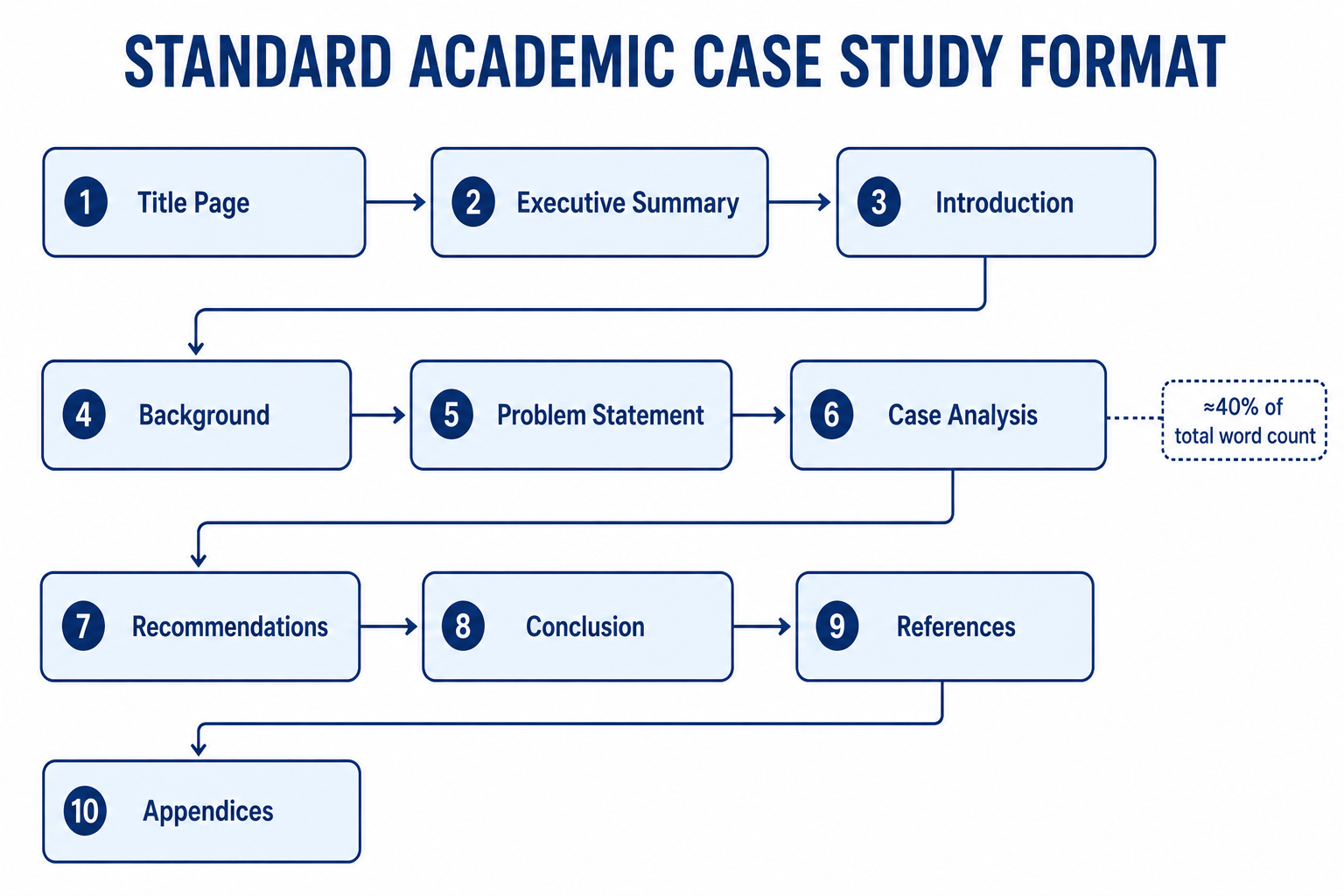
A case study format is the standard structure used to organise a case study assignment. It typically includes a title page, executive summary, introduction, background, problem statement, analysis, recommendations, conclusion, and references. Following this structure improves clarity, academic quality, and logical flow — and it is what most UK, Australian, and Canadian universities expect.
Quick Summary
Reading Time 12 minutes Difficulty Intermediate Typical Word Count 1,000 to 3,000 words Suitable For Business, Nursing, Law, Psychology, Healthcare, Education Main Sections Introduction, Background, Problem, Analysis, Recommendations, Conclusion Estimated Completion 6 to 12 hours depending on complexity
What Is a Case Study?
A case study is an in-depth examination of a specific individual, event, organisation, group, or real-life situation. Unlike essays or research papers, a case study focuses on practical analysis rather than broad theoretical discussion. The goal is to understand what happened, why it happened, and what can be learned from it.
A strong case study must:
- Analyse a real or realistic scenario
- Identify the core problem
- Apply theories, models, or frameworks
- Evaluate decisions or actions
- Present logical solutions
- Support claims with evidence
For a step-by-step guide to the actual writing process, the how to write a case study guide covers each stage from blank page to finished draft.
Why Case Study Format Matters
Many students assume a case study is just a long explanation. It is not. The structure determines the quality.
Without the right format, the analysis loses direction, arguments become hard to follow, and conclusions feel disconnected from the evidence. Universities expect a structured, polished, research-supported document — and following the right format is what makes that possible.
A well-formatted case study:
- Makes the argument easy to follow
- Strengthens analytical depth
- Demonstrates academic rigour
- Helps markers award credit where it is due
- Improves the overall grade
Types of Case Studies Students Encounter
Before choosing a format, it helps to know which type of case study you are writing. Each serves a different academic purpose.
| Type | Focus | Common Subjects |
|---|---|---|
| Descriptive | Facts and conditions as they are | Sociology, anthropology, education |
| Explanatory | Cause-and-effect relationships | Psychology, medicine, business |
| Exploratory | Identifying patterns before full research | Social sciences, management |
| Intrinsic | A case that is unique in itself | Humanities, literature, law |
| Instrumental | The case as a lens for something broader | Public policy, healthcare, education |
| Comparative | Two or more cases analysed side by side | Management, international relations, economics |
Knowing the type helps you choose the right tone, framework, and depth of analysis.
Before You Begin: Essential Preparations
Most problems in a finished case study trace back to the preparation stage. Students who skip it tend to misidentify the problem, choose the wrong framework, or run out of relevant evidence halfway through.
Understand the assignment requirements. Know the word count, required referencing style, and any framework specified by your module.
Read the case thoroughly. Go through the scenario at least twice. Highlight key events, decisions, stakeholders, and problems before writing a word.
Identify the central problem. Every case study revolves around one main issue. The entire analysis depends on how precisely you define it.
Conduct background research. Study the industry, sector, or theoretical context behind the case. Frameworks applied without context produce generic analysis.
Choose suitable frameworks. Common options include SWOT, PESTLE, Porter’s Five Forces, Root Cause Analysis, and subject-specific models like the Clinical Reasoning Cycle for nursing or IRAC for law.
Outline before you write. A rough outline keeps the structure on track and prevents sections from bleeding into each other.
The Standard Case Study Format
The following structure is accepted across universities and professional institutions in the UK, Australia, Canada, and internationally. Every section has a specific job — understanding what each one does is as important as knowing what order they go in.
1. Title Page
The title page is the first thing a marker sees. Keep it clean and complete.
Include:
- Full title of the case study
- Your name and student ID
- Course or module name
- Institution and department
- Instructor or tutor name
- Submission date
- Word count (if required)
Some universities provide a standard cover sheet. Use it if they do.
2. Executive Summary
The executive summary sits at the top of the document but gets written last. In 150 to 200 words, it gives the marker a complete picture of the case study before they read it.
Cover:
- The scenario or context
- The main problem
- Key findings from the analysis
- The proposed solution or recommendation
Think of it as a standalone document. A marker reading only this section should understand what the case study argues.
3. Introduction
The introduction frames the case and tells the reader what the analysis will do.
A strong introduction:
- Introduces the organisation, individual, or situation being examined
- States the central problem or research question
- Explains why this case is academically significant
- Briefly outlines the structure of the case study
Keep it to around 150 to 200 words. The introduction is not the place for analysis.
4. Background
The background section provides enough context for the reader to understand the case before the analysis begins. It is not a summary of everything — it is the relevant history.
Include:
- Organisational or situational context
- Key individuals or stakeholders involved
- Industry, sector, or disciplinary background
- Events leading up to the central problem
- External factors that shaped the situation
A useful test: if a reader unfamiliar with the case can understand the problem after reading this section, it is working.
5. Problem Statement
This is the section students most often get wrong. The problem statement must be precise. Vague problem statements lead to vague analysis.
An effective problem statement:
- Identifies the core issue, not just the symptoms
- Is supported by evidence from the case
- Is specific enough that a solution can be proposed
- Does not attempt to solve the problem yet
Example:
Weak: “The company had financial difficulties.”
Strong: “Between 2019 and 2021, declining customer retention in the 18 to 34 demographic reduced recurring revenue by 23%, driven by poor product-market fit in the mid-range segment.”
The stronger version gives the analysis somewhere to go.
Most case studies present multiple issues at once. Your job is to find the one driving the others. Separate symptoms from causes before writing the problem statement.
6. Case Study Objectives
After defining the problem, state what the analysis will do with it. Objectives explain what you intend to explore, examine, or prove.
Strong objectives might include:
- Examining the root cause of the problem
- Understanding the impact on key stakeholders
- Evaluating decisions made in the scenario
- Applying frameworks to support the analysis
- Recommending evidence-based solutions
Clear objectives keep the analysis focused and give the marker a benchmark against which to read your conclusions.
7. Case Analysis
The analysis section is where most of the marks live. This is where you examine the problem, apply frameworks, and build your argument.
Strong analysis:
- Breaks the problem into identifiable components
- Examines internal and external contributing factors
- Applies at least one relevant theoretical framework
- Draws conclusions from evidence, not assumptions
- Explains why things happened, not just what happened
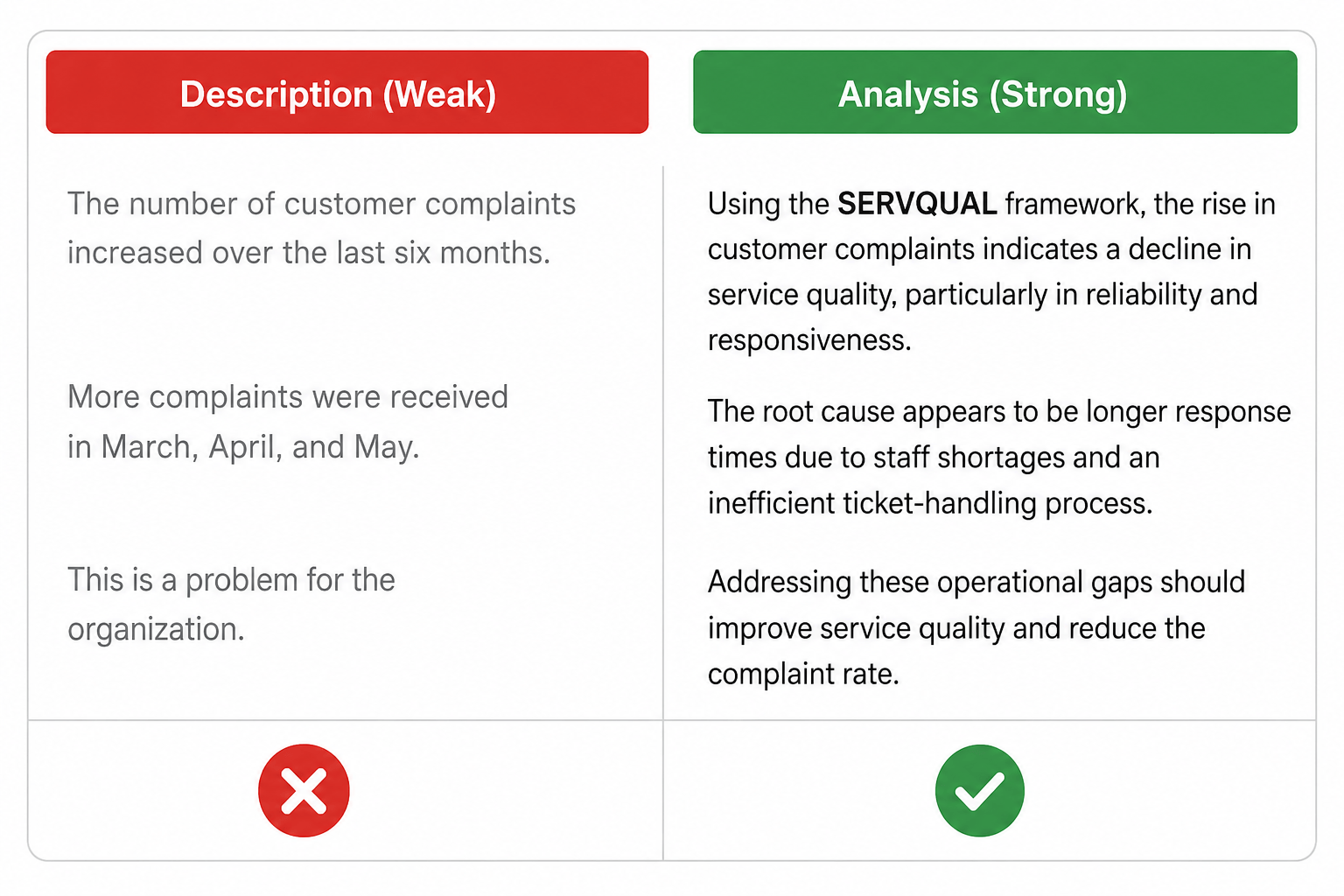
Avoid narrating events. Every paragraph should follow this pattern: state the fact from the case, apply the framework, name the cause, say what it rules in or out.
Weak (description): The company’s complaint rate rose 40% over six months. Most complaints came from the fulfilment team. This is a problem for the company’s reputation.
Strong (analysis): Applying the Service Gap Model (Parasuraman et al.), the 40% rise in complaints indicates a widening gap between customer expectations and perceived service delivery, concentrated specifically at the fulfilment stage. This localisation suggests an operational failure rather than a broader service-culture issue, which rules out company-wide training as the primary intervention.
8. Using Frameworks in Case Study Analysis
Frameworks structure your thinking and ensure the analysis is organised and professionally grounded. Different disciplines use different models.
| Framework | Best Used For |
|---|---|
| SWOT Analysis | Internal strengths and weaknesses, external opportunities and threats |
| PESTLE Analysis | Macro-environmental factors affecting the case |
| Porter’s Five Forces | Competitive landscape and industry pressure |
| Root Cause Analysis | Diagnosing the source of a problem |
| Clinical Reasoning Cycle | Nursing and healthcare cases |
| IRAC | Legal case studies (Issue, Rule, Application, Conclusion) |
| Gibbs’ Reflective Cycle | Reflective nursing or education case studies |
| Maslow / Herzberg | Motivation, HR, and organisational behaviour cases |
Use the framework that fits the case. Do not force a model onto a case where it does not apply — markers notice.
9. Applying Theory to the Case
Universities expect students to connect real-world events with academic concepts. Theory should be a tool for deeper understanding, not decoration.
When applying theory:
- Name the theory and cite the source
- Explain what the theory predicts or identifies in general terms
- Apply it directly to the specific facts of the case
- Show what conclusion that application produces
Theories commonly applied include organisational behaviour models, leadership frameworks, psychological and behavioural theories, healthcare and clinical frameworks, and marketing or economic models.
For guidance on referencing theoretical sources correctly, the APA Style Guide and the Purdue OWL Harvard referencing guide are reliable starting points.
10. Stakeholder Analysis
Stakeholders shape outcomes and are directly affected by the problem and any proposed solution. Ignoring them is one of the more common reasons case studies lose marks at the analysis stage.
Stakeholders may include employees, customers, managers, investors, medical professionals, students, community members, or government bodies — depending on the case.
Your analysis should address:
- Who is affected by the problem
- How each stakeholder is impacted
- Their interests, motivations, and conflicts with other stakeholders
- How proposed solutions will affect them
A stakeholder map or table can make this section cleaner and easier to follow.
11. Decision Evaluation
A key component of case study analysis is assessing the quality of decisions made within the scenario.
Consider:
- Were decisions based on evidence?
- Were alternatives properly considered?
- What assumptions drove the decisions?
- What biases may have influenced them?
- What were the actual outcomes?
Objective evaluation of decisions — rather than simply describing them — is what moves a case study from a 2:2 into first-class territory.
12. Solutions and Alternatives
Before presenting your final recommendation, some case studies require a section that considers multiple possible solutions. This demonstrates that the recommendation was chosen over alternatives, not arrived at by default.
For each alternative:
- State what it involves
- Explain its potential advantages
- Identify its limitations or risks
- Explain why it was not selected as the primary recommendation
This section is optional unless your brief or mark scheme specifically requires it. Check your module handbook.
13. Recommendations
Recommendations must follow directly from the analysis. If the analysis identifies poor communication as the core problem, the recommendation should address communication — not something unrelated.
Each recommendation should be:
- Specific and actionable
- Justified using evidence from the analysis
- Realistic given the constraints of the case
- Prioritised where multiple recommendations are made
Weak: “Improve staff training.”
Strong: “Introduce a structured six-week onboarding programme for new fulfilment staff, benchmarked against the service standards identified in the 2022 customer satisfaction survey.”
Two to four well-developed recommendations mark better than a longer list of shallow ones.
Structuring an Actionable Implementation Plan
A frequent separator between 2:1 and First-Class case study submissions is the inclusion of a concrete, feasible implementation plan. University markers look for evidence that your recommendations can actually be executed within realistic organizational constraints rather than remaining abstract ideals.
Structure your implementation plan across four essential dimensions:
- Phased Timeline: Categorize actions into immediate/short-term (0–3 months: stabilization and quick wins), medium-term (3–12 months: core process re-engineering or system rollout), and long-term (1–3 years: cultural consolidation and strategic review).
- Resource & Budget Allocation: Explicitly assign responsibility to key internal stakeholders (e.g., Change Management Lead, CFO, Operations Director) and specify financial and human capital requirements.
- Milestones & Measurable KPIs: Define quantifiable success criteria (e.g., employee retention rate, customer satisfaction index, debt-to-equity ratio) to monitor progress at each phase.
- Risk Mitigation & Contingency Planning: Identify potential operational bottlenecks, staff resistance, or market disruptions, accompanied by proactive fallback measures.
14. Conclusion
The conclusion synthesises — it does not introduce new material.
A strong conclusion:
- Restates the central problem briefly
- Summarises the key findings from the analysis
- Confirms how the recommendation addresses the problem
- Reflects on the broader implications or lessons from the case
Keep it to around 150 to 200 words. A conclusion that runs too long usually signals that the analysis section was not doing enough work.
What makes a conclusion strong:
- Concise and analytical, not descriptive
- Reflective and theory-driven
- Directly connected to the objectives set at the start
- Leaves the reader with a clear understanding of what the case teaches
15. References
Follow the referencing style specified by your university. In the UK and Australia, this is most commonly Harvard or APA. Every source cited in the body of the case study must appear in the reference list, and vice versa.
Common sources in case studies include academic journals, textbooks, industry reports, government publications, and news articles. Use the AssignPro Solution Reference Generator to format citations correctly as you write.
16. Appendices
Appendices are optional. Use them for supporting material that would interrupt the flow of the main case study — data tables, charts, full financial statements, interview transcripts, or detailed framework outputs.
Label each appendix clearly (Appendix A, Appendix B) and reference them in the body text where relevant. Do not put material in appendices that should be in the main analysis.
Word Count Distribution by Section
One of the most common questions students ask is how long each section should be. The table below gives a general guide for a 2,000-word case study. Adjust proportionally for different word counts.
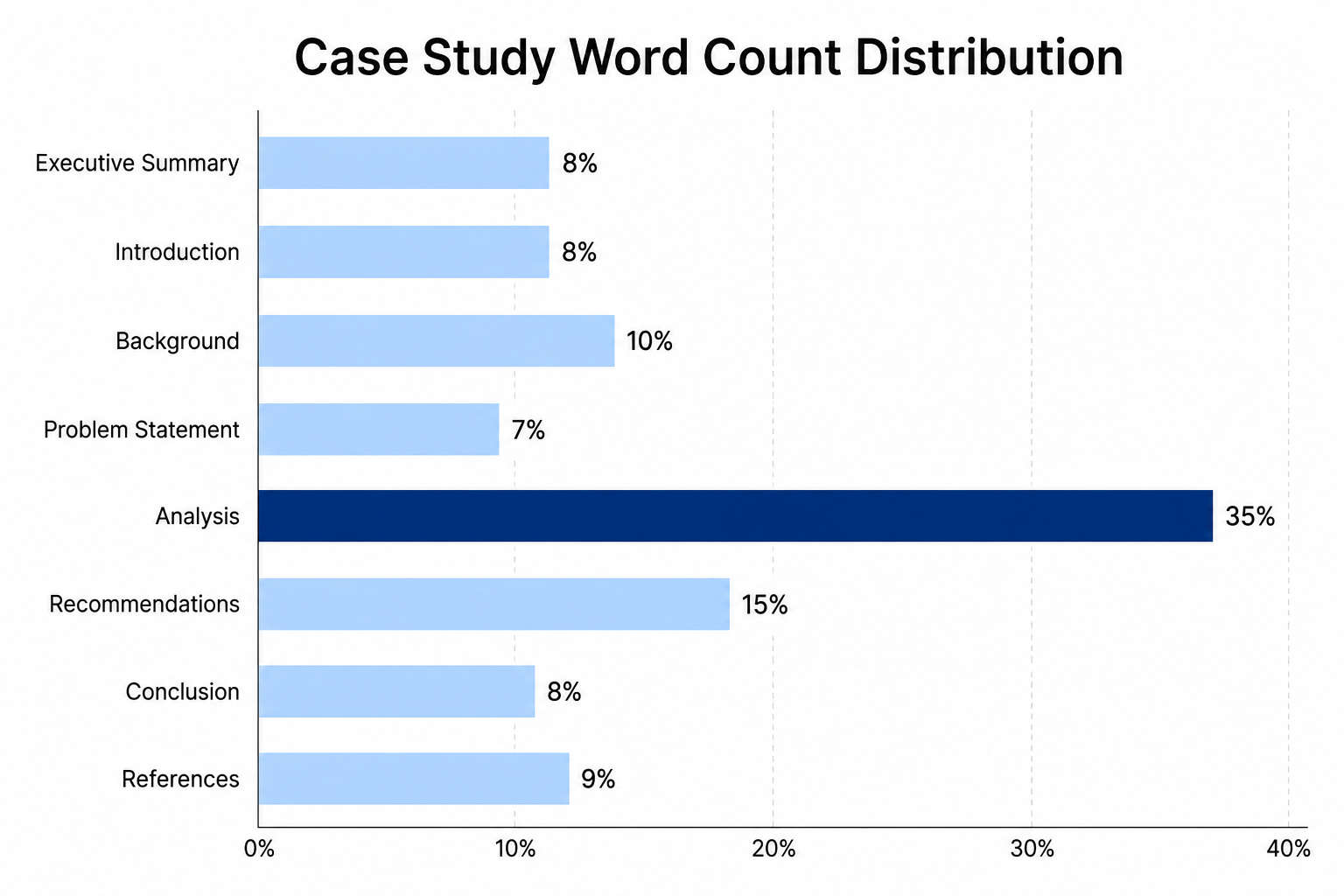
| Section | Recommended % | Approx. Words (2,000 total) |
|---|---|---|
| Executive Summary | 8% | 160 |
| Introduction | 8% | 160 |
| Background | 10% | 200 |
| Problem Statement | 7% | 140 |
| Analysis | 35% | 700 |
| Recommendations | 15% | 300 |
| Conclusion | 8% | 160 |
| References | 9% | 180 |
Analysis almost always deserves the most space. If your word count distribution puts background ahead of analysis, the marks are already capped.
Subject-Specific Format Differences
The core case study structure stays consistent across disciplines, but the framing, frameworks, and emphasis shift by subject.
| Subject | Key Framework(s) | Emphasis |
|---|---|---|
| Business | SWOT, PESTLE, Porter’s Five Forces | Strategic decisions, financial impact |
| Nursing | Clinical Reasoning Cycle, NMC Code | Patient outcomes, ethical considerations |
| Law | IRAC, statutory analysis, case law | Legal precedent, rights and duties |
| Psychology | Biopsychosocial model, DSM-5 criteria | Individual behaviour, diagnostic criteria |
| Engineering | 5 Whys, failure mode analysis | Technical fault, safety implications |
| Education | Bloom’s Taxonomy, Vygotsky’s ZPD | Curriculum impact, learner outcomes |
A nursing case study will spend more time on patient context and clinical reasoning. A law case study will prioritise statutory interpretation. The structure is the same — the content priorities differ.
For subject-specific support, the AssignPro Solution assignment help service connects you with specialists across business, nursing, law, psychology, and education.
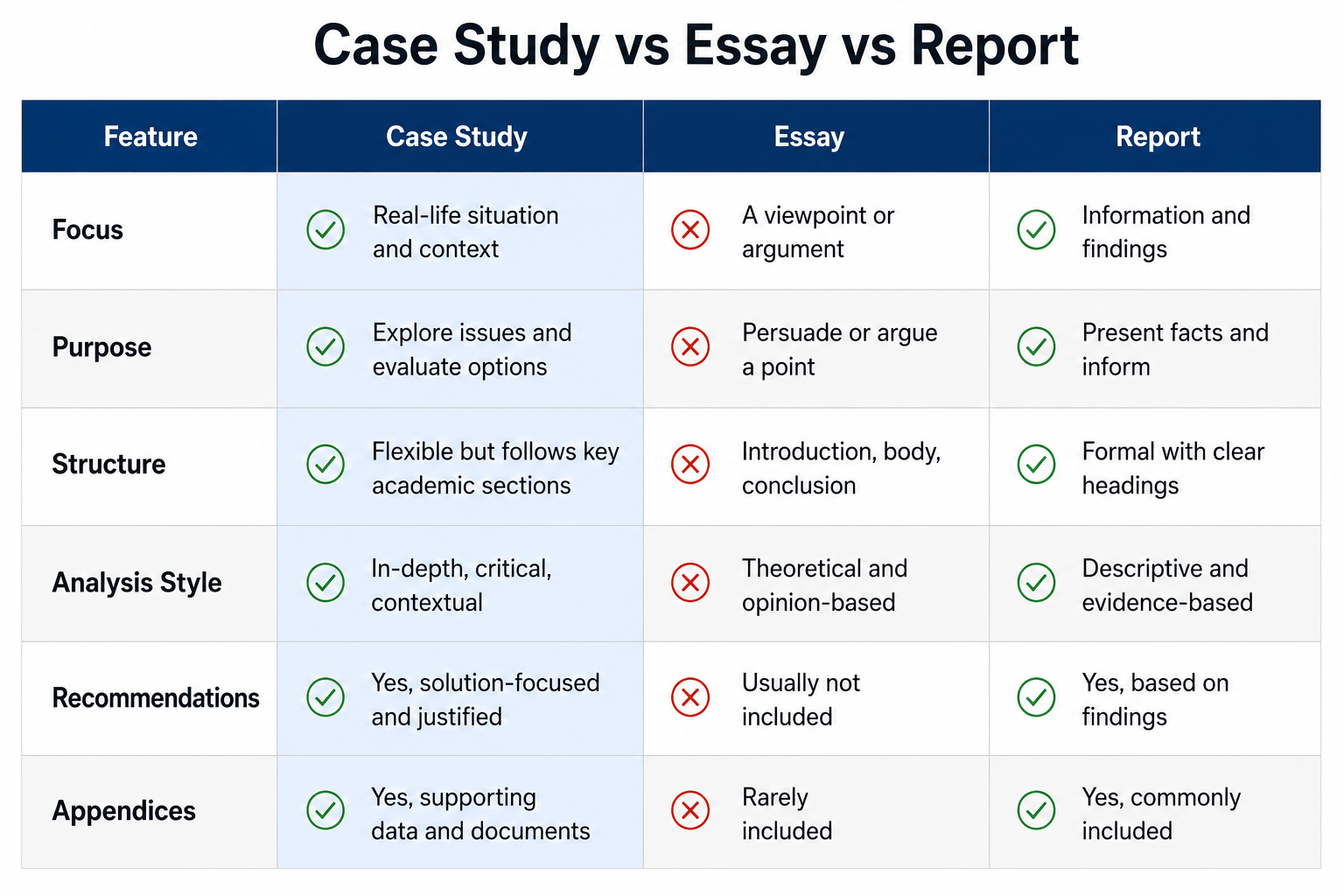
Case Study vs Essay vs Report
| Feature | Case Study | Essay | Report |
|---|---|---|---|
| Focus | Specific real scenario | Broad argument or question | Findings and recommendations |
| Structure | Fixed sections with headings | Flowing paragraphs | Formal sections with headings |
| Analysis style | Applied to a specific case | Theoretical and general | Data-driven and objective |
| Recommendations | Expected | Rarely included | Always included |
| Referencing | Required | Required | Required |
| Appendices | Common | Rare | Common |
The key difference: a case study is always tied to a specific scenario. You are not arguing a general point — you are explaining what happened in this case, why it happened, and what should be done about it.
Marking Rubric: What Separates Each Grade Band
First Class / High Distinction (70%+ / 85%+) Problem is precisely defined. Analysis applies theory with genuine depth and evaluates its limitations. Recommendations are specific, evidence-based, and prioritised. Writing is clear, structured, and virtually error-free.
Upper Second / Distinction (60–69% / 75–84%) Problem is clearly identified. Theory is applied correctly with reasonable depth. Recommendations follow from the analysis. Minor gaps in evidence or structure.
Lower Second / Credit (50–59% / 65–74%) Problem identified but may be imprecise. Theory applied but at a surface level. Recommendations present but not well justified. Adequate evidence, some structural issues.
Third Class / Pass (40–49% / 50–64%) Analysis is largely descriptive. Recommendations are generic. Structure followed loosely. Referencing incomplete or inconsistent.
Fail (below 40% / below 50%) Core problem missing or incorrectly identified. No clear framework applied. Recommendations absent or illogical. Significant structural and referencing failures.
The single biggest jump between bands is almost always the shift from describing the case to analysing it with a named framework.
Common Mistakes to Avoid
Poorly defined problem. If the main problem is unclear, every section that follows is built on an unstable base.
Overly descriptive content. A case study analyses — it does not narrate events. Description tells the marker what happened; analysis tells them why it matters.
No use of theory. Frameworks must be applied to the specific facts of the case, not just mentioned by name.
Weak recommendations. Solutions must be logical, specific, and tied directly to the analysis. “Improve communication” is not a recommendation.
Ignoring word count distribution. Spending half the word count on background leaves no room for analysis, where most marks sit.
Missing citations. Every claim that is not self-evident needs a source. Uncited analysis is easy for markers to discount.
Ignoring stakeholders. Cases do not happen in isolation. Stakeholder analysis is expected at most universities.
New evidence in the conclusion. The conclusion synthesises — it does not introduce arguments that did not appear in the analysis.
Advanced Techniques for a Stronger Case Study
Cross-reference between sections. Linking your analysis back to the problem statement and forward to recommendations shows the marker that the argument is coherent end to end.
Compare with similar cases. A brief reference to a parallel scenario from the literature can strengthen your analysis and demonstrate wider reading.
Integrate real data where permitted. Statistics, financial figures, and sector benchmarks make the analysis more specific and harder to dismiss.
Identify contradictions in the evidence. Conflicting data or competing explanations, acknowledged and resolved, demonstrate stronger analytical skill than a case study that only presents one side.
Connect the case to broader themes. Showing how the specific scenario reflects a wider industry pattern or theoretical debate adds academic weight.
Conducting Root Cause Analysis (The 5 Whys Method)
Superficial case studies mistake visible symptoms for underlying problems. Applying the 5 Whys Method allows you to drill down through layers of operational friction to uncover the foundational institutional breakdown:
- Symptom (Why 1): High customer churn rate in Q3.
Because: Order fulfillment delays increased by 40%. - Why 2: Why were orders delayed?
Because: The automated inventory management system frequently desynchronized with warehouse stock levels. - Why 3: Why did the system desynchronize?
Because: Warehouse personnel bypassed automated barcode scanning due to excessive software latency. - Why 4: Why was there software latency?
Because: Legacy database infrastructure was never upgraded when the firm expanded its SKU catalog by 300%. - Root Cause (Why 5): Misaligned capital investment priorities: executive leadership prioritized marketing spend over scalable digital infrastructure during aggressive corporate expansion.
By anchoring your problem statement and recommendations to Why 5 rather than Why 1, your analysis immediately shifts from descriptive retelling to high-level managerial reasoning.
Contrasting Competing Theoretical Models
Relying on a single framework (e.g., SWOT alone) often produces predictable, one-dimensional analysis. Academic excellence requires demonstrating how competing theoretical perspectives illuminate different dimensions of the same dilemma:
- External Positioning vs. Internal Capabilities: Evaluating market entry using Porter’s Five Forces (highlighting industry barriers and competitor rivalry) contrasted against the Resource-Based View (RBV / VRIO framework) (evaluating whether the firm’s internal human capital, proprietary technology, and corporate culture possess rare, inimitable advantages).
- Deliberate vs. Emergent Strategy: Contrasting planned rational management models against Mintzberg’s emergent strategy framework to explain why formal strategic plans diverged from actual frontline execution.
Critical Evaluation Interrogation Checklist
Before submitting, audit your analytical sections against these critical evaluation interrogatives:
- Underlying Assumptions: What unstated assumptions did organizational leaders make about consumer behavior or competitor inertia, and did case evidence validate them?
- Trade-Off Analysis: Every strategic choice involves a sacrifice. Does your analysis explicitly evaluate what opportunities were foregone (opportunity cost) when the firm chose its course of action?
- Unintended Second-Order Consequences: Did solving an immediate problem (e.g., rapid cost-cutting) inadvertently trigger a catastrophic secondary failure (e.g., talent attrition, regulatory non-compliance, reputational erosion)?
- Qualitative vs. Quantitative Triangulation: Are financial metrics and performance data corroborated by organizational climate surveys, employee interviews, and external market audits?
Case Study Format Checklist
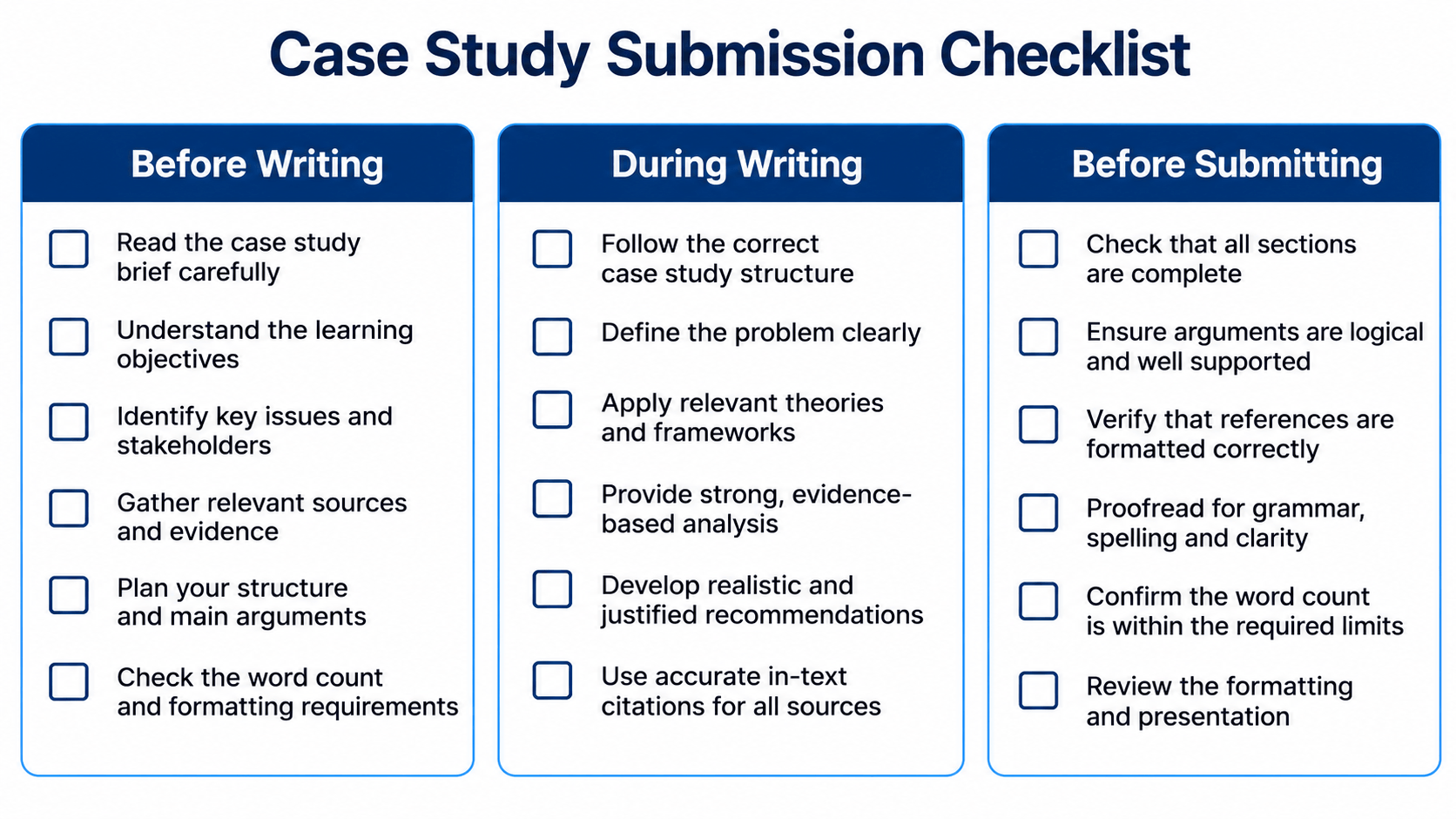
Before Writing
- Assignment brief understood and re-read
- Case studied thoroughly — at least twice
- Central problem identified and written as one sentence
- Evidence gathered and frameworks selected
- Outline drafted
During Writing
- All sections present in correct order
- Analysis section uses at least one named framework
- Each analysis paragraph follows: fact, framework, cause, conclusion
- Recommendations linked directly to specific analysis points
- Conclusion synthesises without introducing new material
Before Submitting
- Word count within the required range
- References complete and formatted consistently
- Spelling and grammar checked in a separate pass
- Headings and formatting consistent throughout
- Plagiarism check completed
Why Universities Emphasise Case Study Writing
Case studies are set because they test something exams and essays cannot: whether a student can take a theory from a lecture and apply it to a messy, real situation. Markers are checking for judgement, not recall.
A well-written case study develops:
- Critical thinking under realistic conditions
- The ability to apply knowledge practically
- Research and evidence-evaluation skills
- Structured academic writing
- Decision-making and problem-solving capability
These skills carry directly into careers in business, healthcare, law, education, public policy, and most other professional fields.
Common Questions About Case Study Format
What is the standard case study format? The standard format includes a title page, executive summary, introduction, background, problem statement, analysis, recommendations, conclusion, and references. Most UK and Australian universities follow this structure with minor variations depending on the subject.
Do all universities use the same case study format? The core structure is widely consistent. Some departments rename or reorder sections — a nursing school may use “Clinical Assessment” where a business school uses “Analysis.” Always check your module handbook before starting.
How long should each section be? Analysis typically takes 30 to 40% of the total word count. Introduction, background, and conclusion each take around 8 to 10%. See the word count distribution table above for a full breakdown.
Should I write the executive summary first? No. Write it last. The executive summary reflects what is actually in the case study — you cannot write it accurately until the rest is complete.
Can I use headings in a case study? Yes. Headings are standard in case study format and improve readability. Use the section names in this guide unless your university specifies otherwise.
Can I use bullet points? Sparingly. Use bullet points for lists of stakeholders, checklist items, or options. Your analysis paragraphs should stay in prose so the reasoning is visible and followable.
Should recommendations come before the conclusion? Yes. Recommendations follow the analysis. The conclusion then reflects on the recommendations and broader implications.
How should I reference a case study? Follow your university’s required referencing style — Harvard or APA in most cases. Cite all sources in-text and include a full reference list at the end. The AssignPro Reference Generator handles both formats.
Can I include appendices? Yes, and you should if you have supporting data or detailed framework outputs. Label them clearly and reference them in the body text.
What is the difference between a case study and a report? A report is typically broader and data-driven. A case study is tied to a specific scenario and focuses on diagnosis and theory-based recommendation rather than general findings.
What is the difference between a problem statement and a problem symptom? A symptom is what you observe — declining sales, low morale. The problem is the underlying cause — poor leadership, misaligned pricing. Case studies require you to identify the cause, not just describe the symptom.
Can I use first person in a case study? Most UK universities expect third-person academic writing. Check your module guidelines — some disciplines allow first person in reflective sections.
How many recommendations should I include? Two to four well-developed, evidence-based recommendations mark higher than a longer list of shallow ones. Quality over quantity.
What frameworks work best for a business case study? SWOT and PESTLE suit environmental analysis.
To see how these sections come together in practice, review our downloadable international business case study sample with complete financial and strategic evaluation.
Porter’s Five Forces suits competitive analysis. For leadership or HR cases, Bass and Avolio’s Full Range Leadership Model or Herzberg’s Two-Factor Theory are widely used.
When should I get help with a case study? If you are struggling to identify the core problem, your analysis keeps sliding into description, or you are working against a tight deadline, the AssignPro Solution case study help service can review a draft or work through the analysis stage directly.
Conclusion
Following the right case study format is not about ticking boxes — it is about giving your analysis the structure it needs to be understood and credited properly. Every section has a job. The title page sets expectations. The background provides context. The problem statement focuses the analysis. The analysis section — which should always take the largest share of the word count — is where marks are won or lost. Recommendations follow from it. The conclusion synthesises without adding.
Students who struggle with case studies almost always have the knowledge. What they are missing is the structure to present it. Use the format in this guide, check the word count distribution before you start writing, and verify that every recommendation can be traced directly back to a specific point in your analysis.
For additional support with understanding structure, formatting specific to your subject, or working through a complex scenario, AssignPro Solution provides academic guidance across all major subjects and university systems.
Reviewed by the AssignPro Solution Editorial Team — Academic Content Specialists. Last updated: 2026.
Related reading: