

If you’ve been handed a case study brief and don’t know where to start, the problem usually isn’t a lack of knowledge. It’s structure. Most students describe the situation at length, then bolt a few generic recommendations onto the end without ever properly analysing why the problem exists in the first place.
This guide walks through how to write a case study from a blank page to a finished draft: the seven steps to follow, the structure examiners expect, a worked example you can model your own answer on, and a free template you can copy straight into your document. If you only read one section, make it the worked example. It shows the actual difference between describing a situation and analysing one, and that gap is where most marks are won or lost.
Quick Summary
| Reading time | ~9 minutes |
| Difficulty | Intermediate |
| Typical word count | 1,500 to 3,000 words (always check your module brief) |
| Suitable for | Business, Nursing, Law, Psychology, Education, Engineering, Social Sciences |
| Main sections | Background, Problem Statement, Analysis, Recommendations, Conclusion |
| Time to complete | 3 to 5 hours, including research |
| Skills built | Applying theory to a real scenario, structured argument, evidence-based recommendations |
Table of Contents
- What Is a Case Study?
- Why Case Studies Matter in UK Universities
- How to Write a Case Study: 7 Steps
- Case Study Structure and Format
- Worked Example
- Mini Examples by Subject
- Free Case Study Template
- Common Mistakes to Avoid
- How UK Case Studies Are Typically Graded
- Submission Checklist
- How to Improve Your Case Study Writing
- When to Get Help
- FAQs
What Is a Case Study?
A case study is a detailed analysis of a real or hypothetical situation that requires you to identify a problem, evaluate evidence, apply a relevant theoretical framework, and recommend a practical solution. UK universities use them to assess critical thinking and the application of theory, not the ability to summarise a scenario.
A case study is an in-depth examination of a real or hypothetical situation: an organisation, a patient, a legal dispute, a community, where you evaluate what’s happening, identify the central problem, and propose a solution grounded in theory. It’s not a summary. The mark scheme is built around your analysis, not your ability to retell the scenario back to the examiner.
A case study is often confused with an essay, a research paper, or a report. The differences matter for how you plan your word count and where your marks come from.
Case Study vs Essay
| Case Study | Essay | |
|---|---|---|
| Focus | One specific, bounded situation | A general topic or question |
| Purpose | Diagnose a problem and recommend a solution | Present and defend a position |
| Structure | Background, then problem, then analysis, then recommendations | Introduction, then argument, then counterargument, then conclusion |
| Evidence | Facts specific to the case, run through a framework | Wider academic sources and theory |
| Output | A decision or action plan | A reasoned conclusion |
Case Study vs Research Paper
| Case Study | Research Paper | |
|---|---|---|
| Scope | A single situation, examined in depth | A broader question, tested against data or literature |
| Method | Applies an existing framework to one scenario | Often generates or tests new data or methodology |
| Length | Usually shorter and tightly bounded | Often longer, with a full methodology section |
| Goal | A practical recommendation | A contribution to knowledge or theory |
Case Study vs Report
| Case Study | Report | |
|---|---|---|
| Basis | Requires theoretical analysis | Often descriptive, with less emphasis on theory |
| Structure | Fixed academic shape: background, problem, analysis, recommendations | Varies by brief, often findings, methodology, conclusions |
| Voice | Analytical and argument-led | Informational and neutral |
| Use of theory | Central to the mark scheme | Optional, sometimes absent entirely |
If your case study reads like it could apply to any similar organisation, it’s too generic. The analysis isn’t tied tightly enough to the specific facts you were given.
A strong case study consistently includes four things:
- Background and context. Just enough detail to understand the situation, no more.
- A clearly stated problem. One core issue, not a list of everything that could be better.
- Analysis using a relevant framework. Theory applied to this situation, not theory explained in the abstract.
- Evidence-based recommendations. Solutions that follow logically from the analysis above them.
Keep that shape in mind as you read the rest of this guide. Everything below builds toward it.
Case Study Types You’ll Meet at University
For healthcare and clinical disciplines, see a completed patient scenario in our clinical nursing case study sample and analysis.
How you write a case study shifts slightly by subject, though the underlying process stays the same:
- Business case studies are usually built around a strategic or operational decision. Analysis leans on frameworks like SWOT analysis, PESTLE, or Porter’s Five Forces.
- Healthcare and nursing case studies centre on a patient scenario. Analysis draws on clinical reasoning and care frameworks such as Gibbs’ Reflective Cycle, and evidence needs to trace back to observed symptoms or documented history.
- Legal case studies apply case law and statute to a set of facts, often using IRAC (Issue, Rule, Application, Conclusion).
- Social science case studies are typically qualitative, examining a group, community, or individual within its real-world context, drawing on sociological or psychological theory.
Whichever type you’re assigned, the same four-part shape holds. Only the framework you plug into the analysis section changes.
Why Case Studies Matter in UK Universities
Case studies test whether you can apply theory to a specific, messy situation rather than just recall it in an exam. Markers look for three things: identification of the real underlying problem, correct application of a framework, and recommendations that follow logically from your analysis.
UK modules lean on case studies because they test something exams and essays can’t: whether you can take a theory from a lecture and actually use it on a messy, real situation. Markers are checking for judgement, not recall.
Examiners are specifically looking for:
- Critical thinking. Can you identify the real problem, not just the most visible symptom?
- Applied theory. Do you use a framework to explain why something is happening, rather than just naming it?
- Structured argument. Does each recommendation trace back to a piece of your analysis, or does it appear out of nowhere in the conclusion?
If you’re regularly losing marks on structure, our assignment structure guide breaks down how UK markers weight each section. Worth reading alongside this one.
How to Write a Case Study: 7 Steps
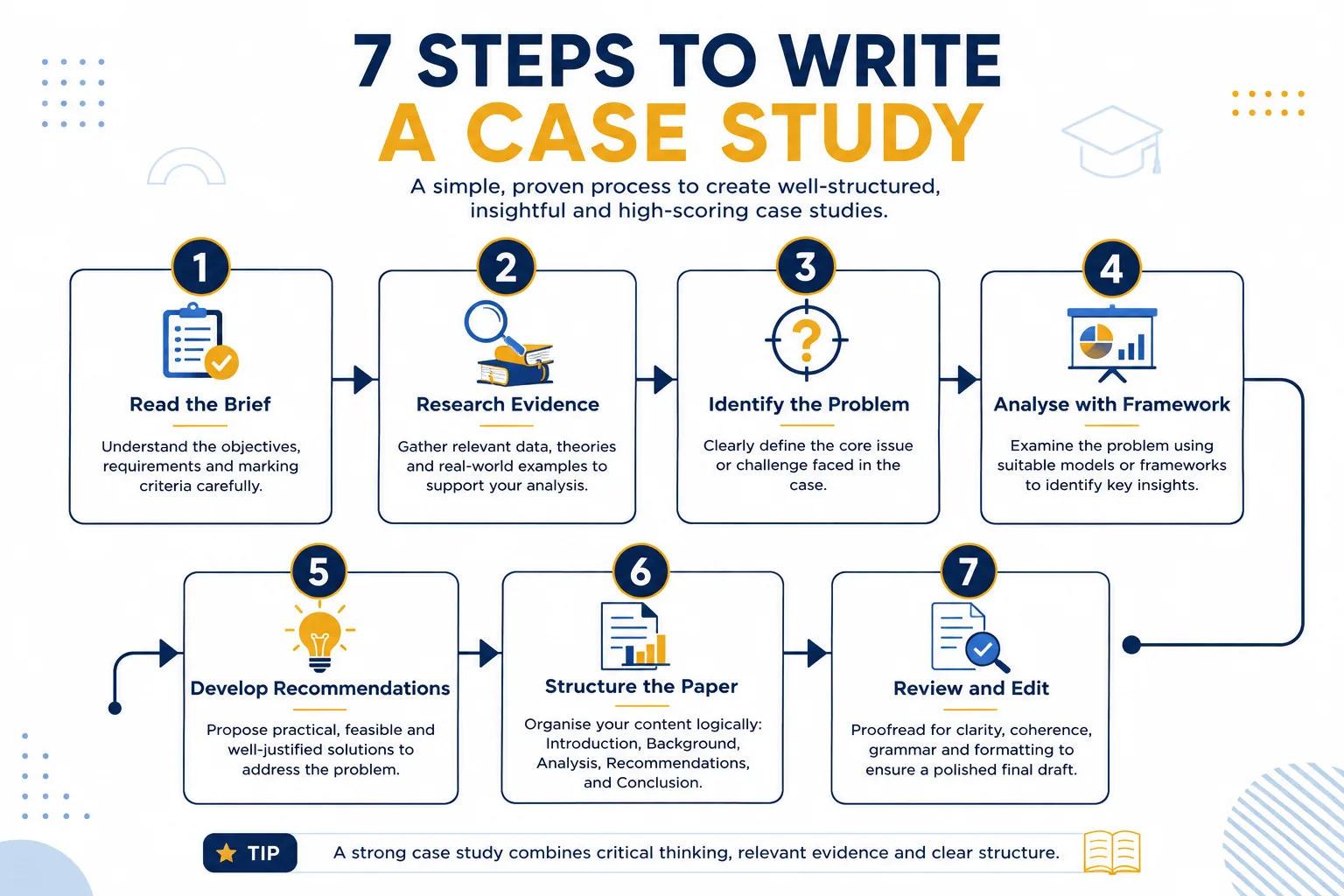
Writing a case study involves seven steps: reading the brief and defining the objective, researching relevant theory, identifying the core problem, analysing it with a chosen framework, developing evidence-based recommendations, structuring the write-up, and reviewing for flow and accuracy.
Step 1: Read the Brief and Define the Objective
Read the case at least twice before writing a sentence. Most lost marks trace back to this step, because students start analysing the wrong problem after skimming the brief. Note down:
- What the assignment is actually asking you to produce (a recommendation? a diagnosis? both?)
- The key facts and any numbers, dates, or constraints given
- Word count and any framework the module requires
Step 2: Research and Gather Evidence
Identify two or three theories or frameworks that genuinely fit the situation, not whichever one you remember best from the lecture slides. Pull in academic sources that support your interpretation of the case, and keep a running list of citations as you go rather than trying to reconstruct your reading afterward. Our research methodology guide covers how to evaluate whether a source is strong enough to build an argument on.
Step 3: Identify the Core Problem
Most cases present several issues at once. Your job is to find the one actually driving the others. Ask yourself:
- If this one issue were fixed, would several of the smaller problems resolve too?
- Is this a cause, or a symptom of something else in the case?
Write your problem statement in a single sentence. If you can’t, it isn’t focused enough yet.
Deconstructing Complex Problems: The Issue Tree (MECE) Method
To prevent your case analysis from devolving into a scattered list of disjointed observations, professional case analysts and university markers recommend structuring problems with an Issue Tree. Applying the MECE principle (Mutually Exclusive, Collectively Exhaustive) ensures that every sub-issue is distinct, with no overlap, and that all critical drivers of the problem are accounted for:
- Level 1 (Core Diagnostic Problem): A concise, evidence-based statement of the central strategic challenge facing the subject (e.g., “Accelerating operating margin erosion across European retail operations”).
- Level 2 (Key Contributing Categories): Divide the problem into 2–4 mutually exclusive operational or strategic pillars (e.g., Revenue Drivers vs. Cost Structure Inefficiencies).
- Level 3 (Root Causes & Evidence Branches): Drill beneath surface symptoms to identify specific operational breakdowns, anchoring every branch directly to case data, financial ratios, or stakeholder testimony.
Constructing an issue tree prior to drafting provides a structural blueprint for your case study body paragraphs, ensuring that every claim directly supports the overarching diagnostic argument.
Step 4: Analyse Using a Relevant Framework
This is where most of your marks live, and where most students under-invest. Analysis means explaining why the problem exists using your chosen framework, not summarising what the framework says in general. The worked example below shows exactly what that looks like on the page. If you want a deeper grounding in how to build an argument rather than just describe one, our critical analysis guide is worth a read before you start drafting.
Step 5: Develop Practical Recommendations
Each recommendation should trace directly back to a specific point in your analysis. One that isn’t grounded in your own analysis reads as generic, and markers notice. Keep them specific: “improve communication” isn’t a recommendation. “Introduce a weekly cross-department stand-up to close the reporting gap identified in Section 3” is.
Step 6: Structure the Write-Up
Use the structure in the next section. Don’t mix sections. Background belongs in background, not scattered through your analysis.
Step 7: Review and Edit
Read it once for logical flow (does each section build on the last?) and once for line-level accuracy: grammar, citations, consistent terminology. Do these as two separate passes. Trying to catch both at once is how errors slip through.
Case Study Structure and Format
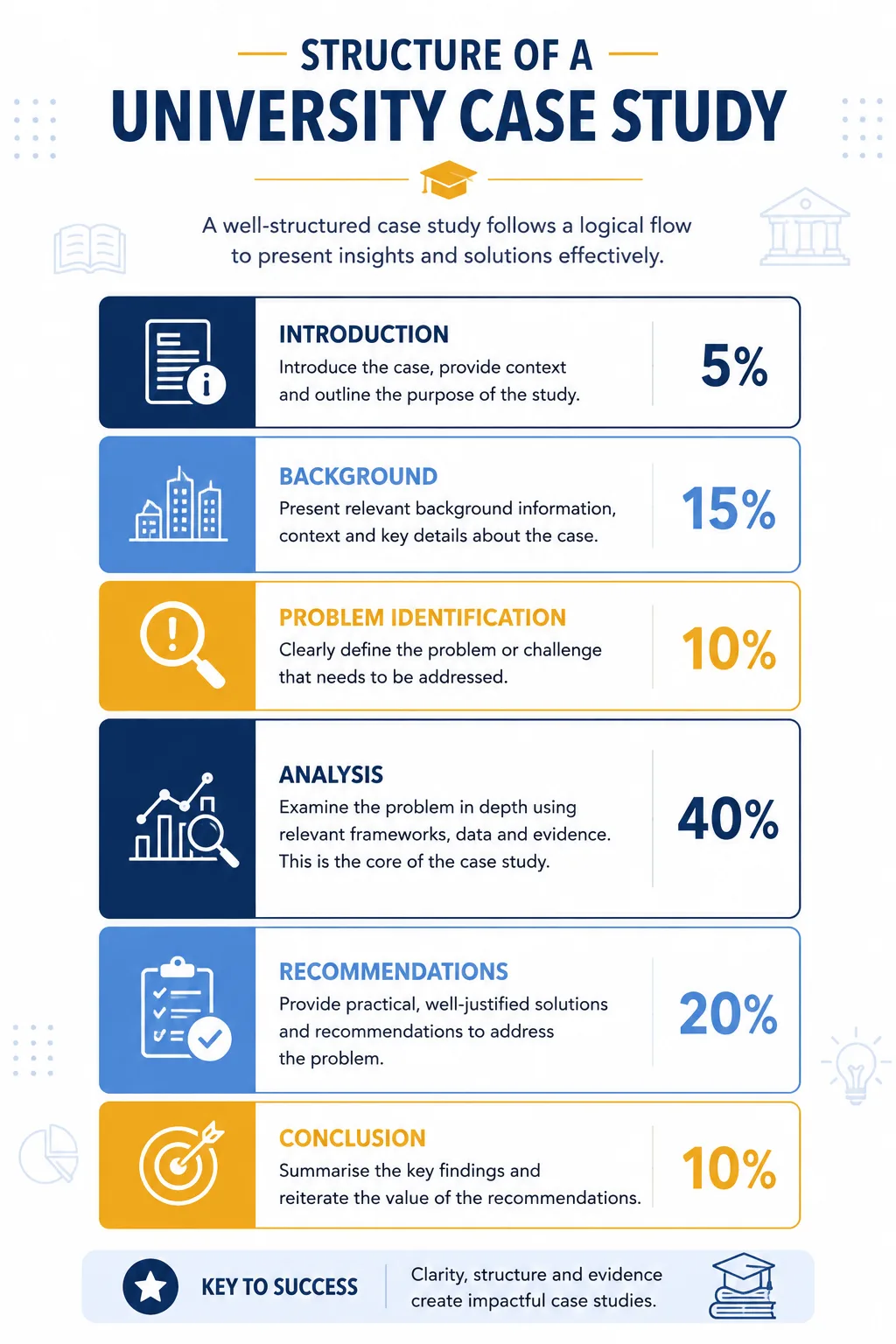
A standard UK case study structure runs: introduction (~5%), background (~15%), problem identification (~10%), analysis (~40%), recommendations (~20%), and conclusion (~10%). Analysis should always take up the largest share of the word count.
| Section | Purpose | Typical share of word count |
|---|---|---|
| Introduction | Frame the case and state what the analysis will cover | ~5% |
| Background | Only the facts needed to understand the problem | ~15% |
| Problem identification | One clear, specific problem statement | ~10% |
| Analysis | Theory applied to the specific facts of the case | ~40% |
| Recommendations | Solutions that follow directly from the analysis | ~20% |
| Conclusion | Summarise, don’t introduce new points | ~10% |
Always confirm this split against your actual module brief. Some assessments weight analysis even more heavily, and a few require a separate “alternatives considered” section. Check your rubric before you allocate word count, not after.
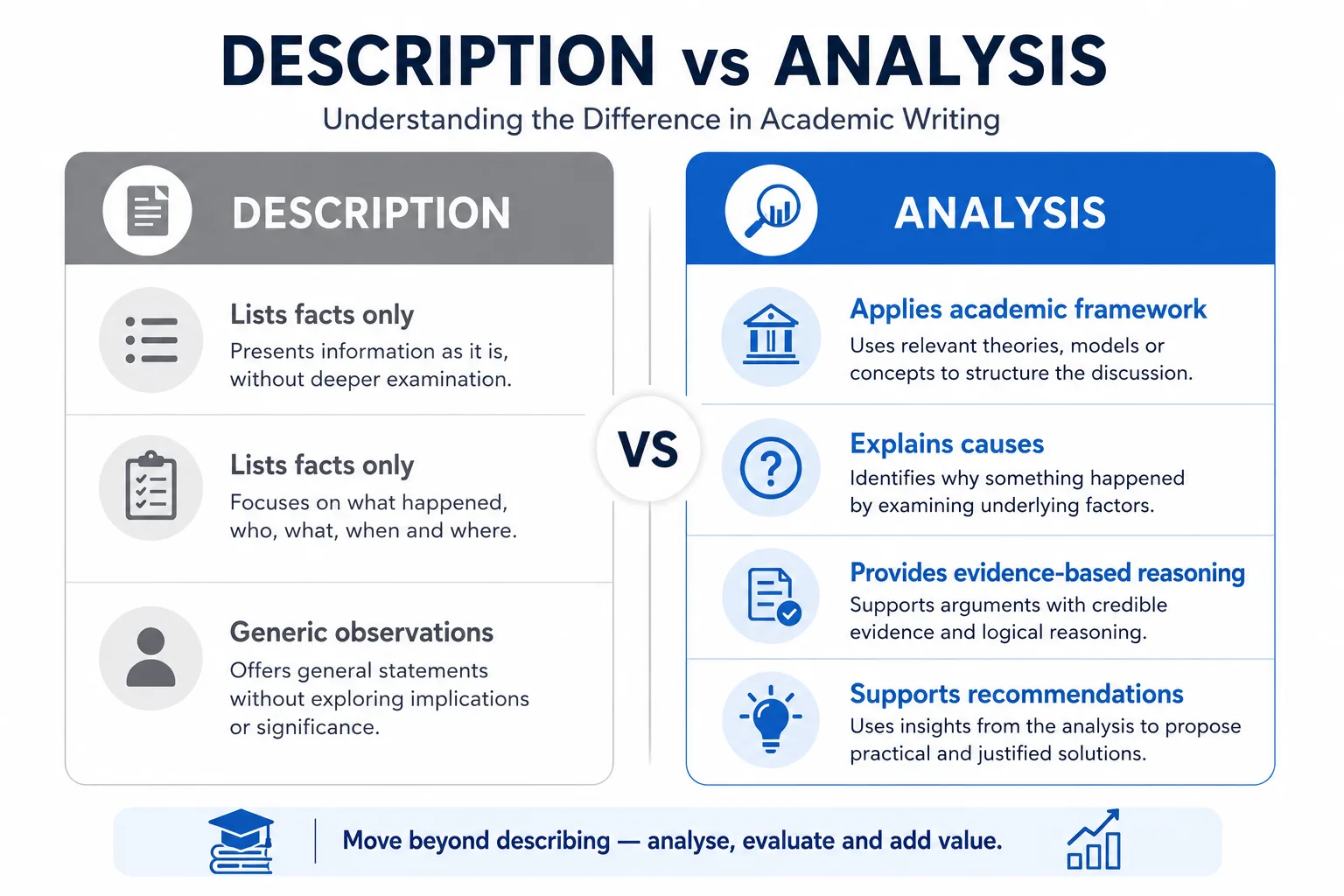
Worked Example: Turning Description Into Analysis
Here’s the difference between a weak and a strong paragraph on the same case fact, so you can see what “analysis” actually means in practice.
Case fact: A mid-sized retail company’s customer complaints have risen 40% over six months, concentrated in the online order fulfilment team.
Description (weak, and what most students write):
The company has seen complaints go up by 40% in the last six months. Most of these are about the fulfilment team. This is a problem because customers are unhappy, which could hurt the company’s reputation.
This just restates the fact and adds a generic consequence. There’s no theory and no cause, nothing a marker can give credit for beyond “read the case.”
Analysis (strong, applying a framework to explain why):
Applying the Service Gap Model (Parasuraman et al.), the 40% rise in complaints points to a widening gap between customer expectations and perceived service delivery, concentrated specifically at the fulfilment stage rather than across the whole customer journey. This localisation suggests the issue is operational, likely a capacity or process failure within fulfilment, rather than a broader service-culture problem. That narrows the diagnosis considerably and rules out company-wide training as the primary fix.
The difference is a named framework, a specific cause traced from the evidence, and a conclusion that sets up a targeted recommendation later in the case study rather than a vague one.
Use the same pattern for every paragraph in your analysis section: state the fact, apply the framework, name the cause, say what it rules in or out.
Weak vs. Strong Phrasing: Transforming Description into Academic Critique
The table below contrasts standard descriptive student prose against the analytical rigor expected in high-scoring university coursework:
| Weak (Purely Descriptive / Grade Band: Pass) | Strong (Analytical & Theoretical / Grade Band: First Class) |
|---|---|
| “The company experienced high staff turnover in 2024, leading to low customer satisfaction.” | “Voluntary employee turnover reached 38% following the rapid restructuring, indicating severe breakdown in psychological safety and relational leadership (Schein, 2010), which directly degraded service quality metrics by 22%.” |
| “Leadership should communicate better with frontline teams and give them more incentives.” | “Implementing structured bi-directional communication channels and non-monetary recognition mechanisms addresses the intrinsic motivational deficits identified through Herzberg’s two-factor model, mitigating frontline attrition within 90 days.” |
Common Lecturer Feedback: Marker Comments & Exact Structural Fixes
When case study assignments are marked, university assessors frequently leave characteristic margin comments. Here is how to diagnose and resolve them before final submission:
| Marker Feedback Comment | What the Lecturer Actually Means | Actionable Structural Fix |
|---|---|---|
| “Too descriptive; tell me why, not just what happened.” | You summarized case facts without explaining the underlying operational or financial drivers. | Apply an academic framework to explain the causative mechanism behind every observed case event. |
| “Theory introduced in literature review but abandoned in case analysis.” | You wrote about models in the abstract, but analyzed the company using generic common sense. | Directly map case facts into the specific quadrants, axes, or variables of your chosen frameworks. |
| “Recommendations are idealistic / disconnected from organizational constraints.” | Your proposed solutions require unlimited capital, time, or executive alignment that the case contradicts. | Ground every recommendation in a structured implementation plan with realistic timelines, resource requirements, and risk contingencies. |
Mini Examples by Subject
The pattern above (fact, then framework, then cause, then conclusion) holds across subjects. Here’s what it looks like applied to six common ones.
Business
- Problem: A regional retail chain’s online reviews show declining satisfaction despite a 30% increase in marketing spend over two quarters.
- Framework: SWOT analysis
- Analysis: A SWOT breakdown separates the issue into internal weakness (inconsistent stock availability at three of five branches) versus external threat (a competitor’s price-matching campaign launched the same quarter). Complaint data ties most negative reviews to stock-outs, not price, which points to an operational rather than a competitive problem.
- Recommendation: Redirect the next quarter’s budget from marketing toward inventory forecasting before increasing ad spend further.
(For a longer worked example at MBA level, our MBA dissertation help page covers case-based methodology in more depth.)
Nursing
- Problem: A post-operative patient shows new confusion and reduced mobility 48 hours after discharge planning began.
- Framework: Gibbs’ Reflective Cycle
- Analysis: Working through description, feelings, evaluation, and analysis stages links the confusion to a documented but unflagged interaction between two prescribed medications, missed at the shift handover. The reflective structure isolates a communication gap rather than a clinical error.
- Recommendation: Introduce a mandatory medication-interaction check at handover, not just at prescribing.
Law
- Problem: A supplier delivers goods eleven days late, and the buyer refuses payment, citing breach of contract.
- Framework: IRAC (Issue, Rule, Application, Conclusion)
- Analysis: The issue is whether the delivery clause constitutes a condition or a warranty. Applying relevant contract law to the clause’s wording and the parties’ prior dealings, the analysis shows the clause reads as a warranty, not a condition, meaning late delivery gives grounds for damages but not contract termination.
- Recommendation: Advise the buyer to pursue a damages claim rather than treating the contract as void.
Psychology
- Problem: A 14-year-old client shows social withdrawal and declining school attendance following a family relocation six months prior.
- Framework: Biopsychosocial model
- Analysis: Separating biological, psychological, and social factors shows no clinical markers of depression on screening, but a clear social factor: loss of an established peer group with no replacement structure in the new school. This narrows the case toward adjustment difficulty rather than a mood disorder.
- Recommendation: A structured peer-integration plan through the school, reviewed at six weeks, before considering clinical referral.
Education
- Problem: A Year 9 class shows a 25% drop in homework completion in one subject only, with attendance unaffected.
- Framework: Formative assessment framework
- Analysis: Reviewing recent formative assessment data shows the drop began the week the class moved to a harder unit without a corresponding scaffolding change. Because attendance and behaviour are unaffected, the pattern points to task difficulty rather than disengagement or a wellbeing issue.
- Recommendation: Reintroduce scaffolded homework tasks for this unit before reassessing completion rates.
Engineering
- Problem: A production line component fails at roughly triple the expected rate, with no single root cause identified in maintenance logs.
- Framework: 5 Whys root cause analysis
- Analysis: Working back through each “why” traces the failure past the component itself to a torque specification that was updated in the manual but never re-applied on the factory floor after a supplier change.
- Recommendation: Update the floor procedure to match the current torque spec and add a supplier-change checklist item to catch this in future.
Free Case Study Template
Copy this outline directly into a blank document and write into each bracket. It mirrors the structure and word-count split above.
CASE STUDY TITLE

1. Introduction (~5%)
   - One sentence: what is this case about?
   - One sentence: what will this analysis cover?

2. Background (~15%)
   - Key facts only, no analysis yet
   - Include only details that matter to the problem you'll identify

3. Problem Statement (~10%)
   - "The core issue facing [organisation/subject] is [X], caused primarily by [Y]."

4. Analysis (~40%)
   - Framework 1 applied to fact(s) -> cause -> what it rules in/out
   - Framework 2 applied to fact(s) -> cause -> what it rules in/out
   - (Repeat for each major cause identified)

5. Recommendations (~20%)
   - Recommendation 1 -> ties back to Analysis point [ref]
   - Recommendation 2 -> ties back to Analysis point [ref]
   - Note any trade-offs or risks for each

6. Conclusion (~10%)
   - Restate the core problem and your central recommendation
   - No new information here
Common Mistakes to Avoid
The most common case study mistakes are misreading the brief, over-describing background instead of analysing, mixing sections together, using evidence without explaining its relevance, and writing vague, generic recommendations that don’t trace back to the analysis.
- Misreading the question. Writing generally about the topic instead of the specific problem in the case. Re-read the brief before you start Step 3.
- Over-describing. Spending 50% of your word count on background that should take 15%.
- Poor structure. Mixing analysis and recommendations together instead of keeping them in separate, clearly labelled sections.
- Weak use of evidence. Citing a source without explaining what it proves about this specific case.
- Vague recommendations. “Improve training” or “communicate better” instead of a specific, actionable step tied to your analysis.
- Ignoring the marking rubric. If your module weights analysis at 40% and you spend 40% of your word count on background instead, you’re capped on marks before a lecturer even reads your argument.
- Ending the conclusion with new evidence. Anything you haven’t already argued in the analysis section doesn’t belong in the conclusion, however relevant it feels in the moment.
Most of these mistakes share one root cause: writing the case study in the order it will be read, rather than the order it needs to be built. That’s why analysis (Step 4) has to happen before you structure the write-up (Step 6). Decide what you’re arguing before you decide how to present it.
If structure keeps tripping you up, running a draft through our structure checker tool will flag missing or out-of-order sections before you submit.
How UK Case Studies Are Typically Graded
UK universities mostly grade on the degree classification scale, though some postgraduate and international programmes use High Distinction, Distinction, Credit, and Pass bands instead. Both map onto roughly the same skills.
| UK Classification | Typical Range | What Separates This Band |
|---|---|---|
| First Class (sometimes “High Distinction”) | 70%+ | Original, well-evidenced analysis; recommendations that clearly follow from the framework applied; near-flawless structure and referencing |
| 2:1 (“Distinction”) | 60 to 69% | Solid application of theory to the specific case; recommendations mostly well-grounded; minor structural or evidence gaps |
| 2:2 (“Credit”) | 50 to 59% | Correct framework identified but applied generically; some recommendations not clearly tied to analysis; adequate but thin evidence |
| Third Class (“Pass”) | 40 to 49% | Heavy on description, light on analysis; recommendations present but vague or generic; structure followed loosely |
| Fail | Below 40% | Core problem misidentified or missing; no clear framework applied; recommendations don’t follow from any analysis in the case study |
The single biggest jump between bands is almost always the shift from describing the case to analysing it with a named framework, which is exactly the distinction covered in the worked example above.
Submission Checklist
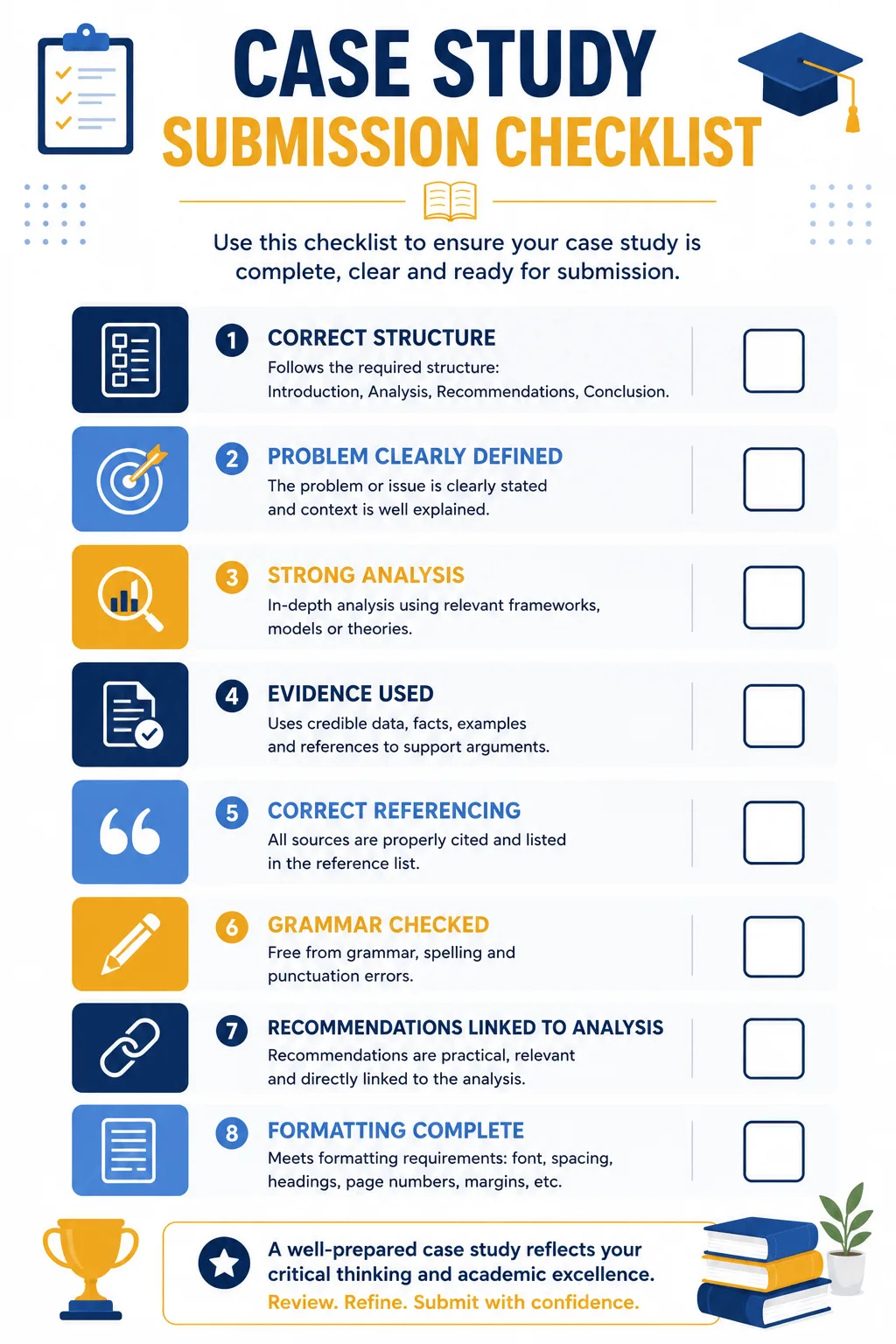
- [ ] Structure. Introduction, background, problem, analysis, recommendations, conclusion, in that order.
- [ ] Analysis. Every section applies a named framework to specific facts, not general theory.
- [ ] Referencing. Consistent style throughout, matching what your module requires. Our Harvard referencing guide and APA referencing guide cover the two most common formats.
- [ ] Grammar. Proofread in a separate pass from the structural read-through.
- [ ] Evidence. Every claim in your analysis is tied to a fact from the case or a cited source.
- [ ] Recommendations. Each one references the specific analysis point it comes from.
- [ ] Formatting. Word count matches the brief’s split, headings are consistent, tables and figures are labelled.
How to Improve Your Case Study Writing
The fastest way to improve a case study draft is to write the analysis section before the introduction, cite sources as you go rather than at the end, and check that every recommendation references a specific point made earlier in the analysis.
Write the analysis section first, before the introduction. It’s easier to introduce a case once you already know what you’re going to argue.
Cite as you go, not at the end. Reconstructing citations from memory is where errors creep in; our reference generator can format them correctly as you add them.
Read one strong recommendation out loud. If it doesn’t clearly reference a specific piece of your own analysis, rewrite it.
Get feedback on structure, not just content. A lot of case study marks are lost on organisation, not knowledge.
Compare your draft against the worked example above. Check whether each analysis paragraph follows the same pattern (fact, framework, cause, conclusion), or whether it’s slipped back into description halfway through.
Time-box your first draft. Students often spend too long polishing the introduction and run out of time for analysis, which is where most of the marks sit. Draft analysis and recommendations first, and polish the introduction last.
When to Get Help
Most students can work through the steps above independently once they’ve seen the pattern. It’s worth getting a second opinion if:
- You’re not confident you’ve identified the actual core problem, not just a symptom of it
- Your draft feels like a summary rather than an analysis, even after a rewrite
- You’re consistently marked down on structure despite following a template
- You’re juggling a tight deadline against multiple assignments at once
If any of that sounds familiar, our case study and assignment support can review a draft or work through the analysis stage with you directly.
FAQs
What is a case study in academic writing? A detailed analysis of a real or hypothetical situation where you identify a core problem, apply relevant theories, and present structured, evidence-based solutions. It’s about analysis and application, not description.
How do you write a case study step by step? Understand the case and the objective, research relevant theory, identify the core problem, analyse it using appropriate frameworks, develop practical solutions, structure the write-up properly, then review and edit.
What is the correct format for a case study? Introduction, background and context, problem identification, analysis, recommendations, and a conclusion, in that order.
What are the most common mistakes in case study writing? Misreading the question, over-describing instead of analysing, weak structure, using evidence without explaining its relevance, an unclear problem statement, and vague recommendations.
Why are case studies important in UK universities? They test whether students can apply theory to real situations rather than just recall it, building critical thinking, problem-solving, and structured writing skills that get assessed across business, healthcare, law, and social science modules.
How long should a university case study be? Check your module brief first. As a general pattern, background should be your shortest section, and analysis plus recommendations should take up the largest share of your word count.
When should I get help with a case study? If you’re struggling to identify the core problem, your structure feels disorganised, you’re consistently losing marks despite the effort, or you’re up against a tight deadline.
Can I use first person in a case study? Check your module guidance first. Business and nursing case studies often allow limited first person, especially in reflective sections. Law and most social science case studies expect third person throughout.
How many references should a case study include? There’s no fixed number. What matters is that every claim in your analysis is supported. A shorter case study with five well-used sources beats a longer one with fifteen superficial citations.
What tense should I write in? Past tense for describing what happened in the case, present tense for stating what a theory or framework says, and often future or conditional tense for recommendations (“this would reduce…”).
Can ChatGPT or another AI tool help with a case study? It can help you understand a framework or check structure, but the analysis itself needs to reflect your own reading of the specific case. Markers are trained to spot generic, unanchored analysis, which is exactly what AI tools produce without detailed prompting on the actual case facts.
Can I include tables in a case study? Yes, and for comparative analysis they’re often clearer than a paragraph. Use them for SWOT grids, financial data, or comparing options in the recommendations section.
Can I use bullet points? Sparingly, for lists of facts or options. Your analysis paragraphs, where the actual argument happens, should stay in prose so the reasoning is visible.
How do lecturers mark a case study? Most UK rubrics weight analysis and recommendations most heavily, often 50 to 60% of the total mark combined, with background and structure worth less. See the grading section above for what separates each band.
Can poor structure alone cause me to fail? Rarely on its own, but poor structure usually drags analysis down with it, since markers struggle to follow an argument that isn’t in the right place. Structure problems are more often what caps a good case study at a 2:2 than what fails it outright.
How many recommendations should I include? Two to four well-developed recommendations, each tied to a specific analysis point, mark better than a long list of shallow ones.
How long should each section be? Use the word-count table above as a starting point, then check your specific module brief, since some assessments weight analysis even more heavily than the standard split.
Do I need an executive summary? Only if your brief asks for one. Business school case studies sometimes require a short summary at the start; most other subjects don’t.
Should I include a title page? Follow your university’s standard cover sheet requirements. This varies by department, not by case study convention.
How do I choose the right framework? Pick the one that actually explains the specific facts in your case, not the one you’re most comfortable writing about. If two frameworks seem to fit, the one that produces a more specific, falsifiable conclusion is usually the stronger choice.
Can I disagree with the “obvious” recommendation? Yes, and a well-argued unconventional recommendation often scores higher than a safe, generic one, provided it’s backed by your analysis rather than just asserted.
What’s the difference between findings and recommendations? Findings are what your analysis shows: the cause. Recommendations are what should be done about it: the action. Keep them in separate sections. Don’t let recommendations sneak into your analysis before you’ve finished arguing the cause.
Can I use a case study I’ve written before as a basis for a new one? Only if your institution’s academic integrity policy allows resubmission or reuse of your own prior work, and even then, check with your tutor first. Most UK universities treat this as self-plagiarism if undeclared.
What is an issue tree, and how does it prevent superficial case study analysis?
An issue tree is a systematic analytical tool that breaks a complex case dilemma down into mutually exclusive, collectively exhaustive (MECE) branches. By isolating 2–4 primary issues and mapping their underlying root causes with direct case evidence, it prevents students from getting distracted by superficial symptoms or writing unstructured, disjointed narrative descriptions.
What is the difference between a case symptom and an actionable root cause?
A symptom is a visible manifestation of distress (e.g., falling quarterly revenue, declining student engagement, rising patient complaints). A root cause is the underlying systemic or structural breakdown that created the symptom (e.g., misaligned incentive structures, outdated technology stacks, defective triage protocols). High-scoring case studies focus their analysis and recommendations on resolving root causes rather than patching symptoms.
What is the IRAC framework, and when should I apply it in case study assignments?
IRAC stands for Issue, Rule, Application, and Conclusion. While originating in legal problem questions, IRAC is widely utilized across business ethics, healthcare compliance, and management case studies involving regulatory governance, contractual disputes, or professional ethical standards. It ensures a methodical, rigorous evaluation of specific rules applied to case facts.
Conclusion
A strong case study isn’t the one with the most background detail or the longest reference list. It’s the one where every recommendation can be traced back to a specific piece of analysis. Work through the seven steps in order, keep your analysis section doing the heavy lifting at roughly 40% of your word count, and use the worked example above as your benchmark: if a paragraph could apply to any similar organisation, it’s still description, not analysis yet.
Run your next case study through the free template above before you start writing. If you get stuck at the analysis stage specifically, that’s the point worth getting a second pair of eyes on.
Related reading: Free Reference Generator · Expert Assignment Support